
The biggest misunderstanding about shilajit and testosterone is that people think it works like a testosterone booster that directly signals the body to pump out more hormone. That is not how shilajit operates. The active compounds in shilajit, primarily fulvic acid and dibenzo-alpha-pyrones, are antioxidants and mitochondrial support agents. They do not tell the testes to produce more testosterone. They protect the cells that make testosterone from getting damaged in the first place.
Think of it this way. A factory that produces cars will keep making cars at a steady rate as long as its machinery is intact and the power supply is stable. If rust starts eating the machinery or the power flickers, production drops. Shilajit is like an anti-rust treatment and a voltage stabilizer. It helps the existing machinery run the way it should. It does not build a bigger factory.

In India, the confusion is compounded by the way shilajit is marketed. The substance has deep roots in Ayurveda, where it is classified as a rasayana, a rejuvenative that promotes vitality and longevity. That traditional reputation is real, but it has been twisted into a narrative that shilajit is an all-purpose male enhancement supplement. The gym-going crowd then adds another layer, treating it like a legal alternative to testosterone replacement therapy. Neither end of that spectrum is accurate. The Ayurvedic texts never claimed shilajit was a quick fix for gym performance, and modern science has not found it to be a potent androgen.
What the Clinical Research Actually Shows About Shilajit and Testosterone
The strongest clinical evidence for shilajit’s effect on testosterone comes from a single well-designed study, not a large body of research.
A 2016 randomized, double-blind, placebo-controlled study published in the journal Andrologia tested purified shilajit on 96 healthy men aged 45 to 55. Half the group took 500 mg of shilajit daily for 90 days, and the other half took a placebo. By the end of the trial, the shilajit group showed a statistically significant increase in total testosterone, free testosterone, and dehydroepiandrosterone (DHEA), a precursor hormone. The placebo group showed no meaningful change. View study on PubMed
The numbers are worth paying attention to. Total testosterone rose by approximately 20 percent from baseline in the shilajit group. That is meaningful if you are low, but it is not the kind of spike that transforms your physique in 12 weeks. A young man with normal testosterone of 600 ng/dL would not suddenly jump to 1000 ng/dL. The men in the study were middle-aged, and their baseline testosterone was likely on the lower side of the normal range or dipping below it. That is exactly the population where mitochondrial support and oxidative stress reduction can make a real difference.
This is the only large placebo-controlled human trial on shilajit and testosterone. Smaller pilot studies exist, and traditional use spans centuries, but if you are looking for the kind of evidence that makes doctors prescribe something, the body of research is still thin. One study does not make a consensus. It makes a starting point.
Shilajit does not work the same way for everyone, and expecting it to turn a normal testosterone level into a high one will only lead to disappointment.
The mechanism matters. Shilajit’s fulvic acid acts as an antioxidant that can cross the blood-testis barrier. Inside the testes, the Leydig cells responsible for testosterone production are vulnerable to oxidative damage. As men age, or under conditions of chronic stress, poor diet, and environmental toxin exposure, those cells accumulate damage and become less efficient. Fulvic acid appears to reduce that oxidative burden and restore mitochondrial function within the cells, allowing them to operate closer to their original capacity. The effect is restorative, not stimulative.
If your Leydig cells are already healthy because you are young, eat reasonably well, and do not carry excess body fat, shilajit will have very little to restore. You might see a small bump in energy from the overall mitochondrial support, but your testosterone is unlikely to move in any clinically meaningful way. This is why the supplement works better for older men and worse for young men, and why the marketing that targets twenty-year-olds is so misleading.
One myth Indian gym-goers hold is that shilajit works like an herbal anabolic steroid and can replace whey protein or creatine for muscle building.
Shilajit does not provide amino acids for muscle repair, and it does not directly increase muscle protein synthesis. Its relationship to muscle is indirect. If low testosterone was genuinely limiting your ability to build muscle, and shilajit brings your testosterone back to a normal range, you may see improved recovery and strength over time. But if your testosterone was normal to begin with, adding shilajit will not change your rate of muscle gain. It is not a substitute for adequate protein intake, caloric surplus, or progressive overload in the gym. Treating it as one is how you waste money and stall progress.
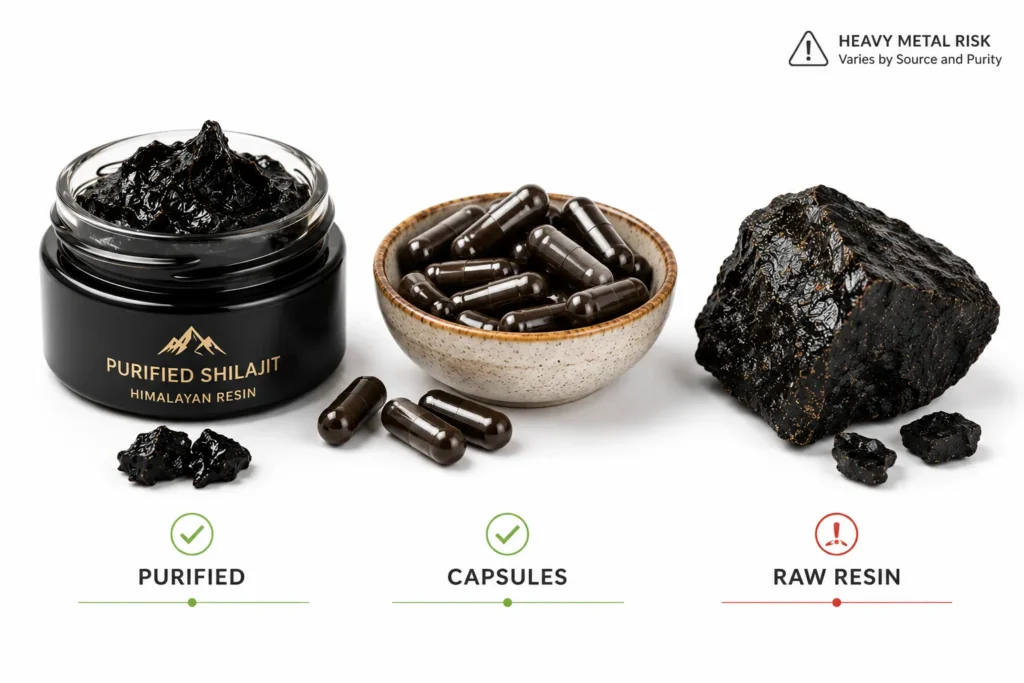
Shilajit Quality and Testosterone Effect Comparison
| Shilajit Form | Testosterone Effect Evidence | Heavy Metal Risk | Standardized Fulvic Acid | Best For | Verdict |
|---|---|---|---|---|---|
| Purified resin (lab-tested) | Supported by 2016 study | Low | Usually 20-40% | Men 40+ with low T | Most reliable option |
| Standardized capsules | Likely same as resin if standardized | Very low | Typically 20-50% | Convenience and dosing accuracy | Good alternative to resin |
| Unpurified raw resin | Unknown, potentially negative | High | Unmeasured | None | Dangerous, avoid |
| Shilajit blended with herbs | No direct testosterone data | Variable | Often unspecified | General vitality | Unclear, not for T |
| Cheap online resin (no lab report) | No guarantee | Very high | Unknown | None | High risk, avoid |
How Shilajit Actually Affects Your Body’s Testosterone Production
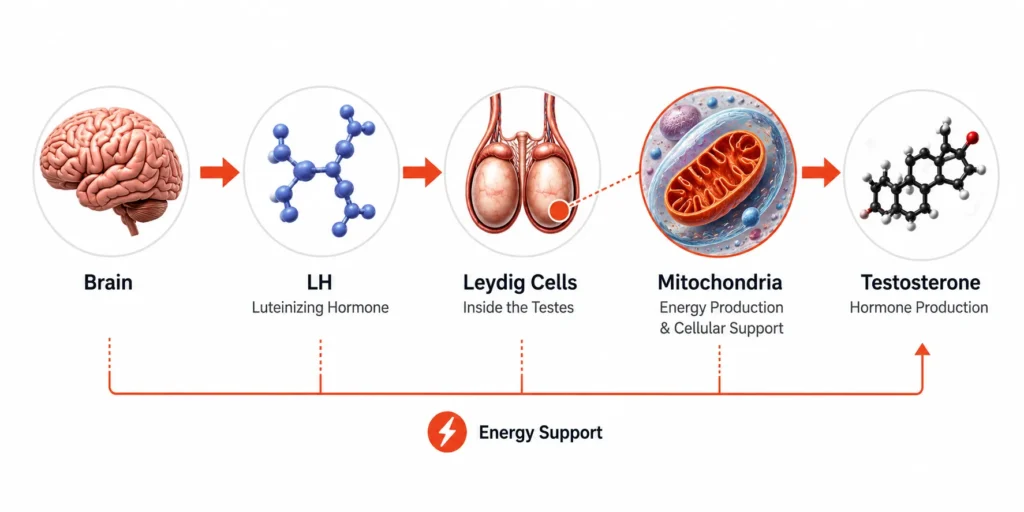
The core pathway for testosterone production starts in the brain. The hypothalamus releases gonadotropin-releasing hormone, which signals the pituitary gland to release luteinizing hormone, or LH, which then travels through the bloodstream to the testes and tells the Leydig cells to produce testosterone. Most pharmaceutical testosterone boosters try to manipulate this axis by increasing LH output. Shilajit takes a completely different route.
Fulvic acid and the dibenzo-alpha-pyrones in shilajit are small enough molecules to cross the blood-testis barrier, a physical barrier that protects the delicate environment where sperm and testosterone are produced. Once inside, they act as electron donors in the mitochondrial electron transport chain, which is the process that generates cellular energy. Leydig cells are rich in mitochondria because testosterone synthesis is an energy-intensive process. By improving mitochondrial efficiency and reducing the oxidative byproducts that damage those mitochondria over time, shilajit helps the Leydig cells produce testosterone at the rate they are already being told to produce it by LH. The signal does not get louder. The machinery just works better.
This is also why shilajit’s effects are gradual. You do not take it and feel a surge of testosterone within hours. Mitochondrial repair and oxidative stress reduction take weeks to meaningfully shift the cellular environment. The 2016 study ran for 90 days, and the largest changes were observed toward the latter half of the trial.
Dose timing matters less than consistency. Taking 500 mg of purified shilajit once per day, ideally with a meal to reduce the small chance of digestive upset, is the protocol used in the research. Morning or early afternoon is better than late evening, as the mild mitochondrial stimulation can make some people feel alert enough to interfere with sleep.
What the Research Actually Says, Without Exaggeration
The 2016 Pandit study is the anchor of the evidence, and it deserves to be quoted accurately.
“Treatment with purified Shilajit for 90 consecutive days resulted in a significant increase in total testosterone, free testosterone, and DHEA-S levels compared to placebo in healthy volunteers aged 45-55 years.” — Pandit et al., Andrologia, 2016
That is a real finding. It is also a narrow one. The study tested one dose, one duration, and one demographic. Extrapolating those results to a 22-year-old with normal testosterone is not supported by the data. Extrapolating to unpurified shilajit sold for 200 rupees a jar is not just unsupported, it is dangerous. Heavy metals in unpurified shilajit, particularly lead and arsenic, are themselves endocrine disruptors that can lower testosterone over time. Taking a cheap product to boost testosterone can easily backfire and suppress it instead.
The honest reality is that the average person who tries shilajit for testosterone will notice far less than the marketing suggests. Some will feel a subtle improvement in energy, recovery, and libido. Some will feel nothing. A small number may experience side effects like acne or mood swings if their testosterone shifts upward more than their body can handle smoothly. The controlled conditions of a study rarely match the chaos of real life.
The Things Worth Knowing Before You Start
Shilajit is not harmless just because it is natural. Men with prostate conditions or a family history of prostate cancer should be cautious about anything that raises testosterone, even mildly, because testosterone and its metabolite DHT can stimulate prostate tissue. This is not to say shilajit causes prostate cancer. It is to say the precaution is warranted.
Digestive side effects are the most common complaint. Nausea, loose stools, and stomach cramps affect perhaps one in ten users when starting, though this often resolves within a week. Starting with a lower dose, around 250 mg, and taking it with food reduces the risk.
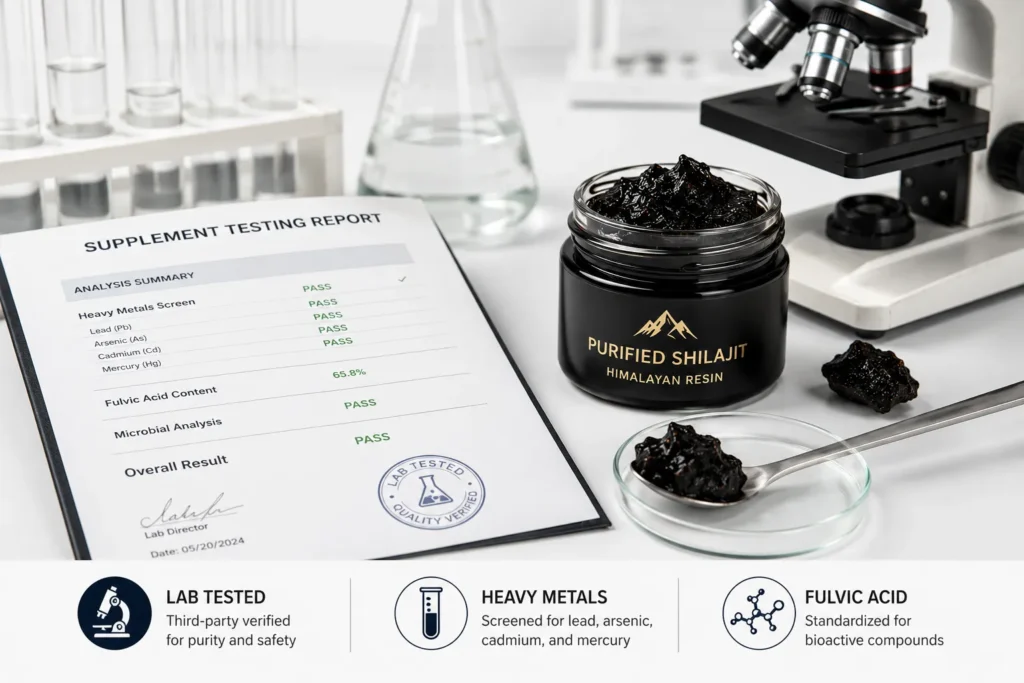
The India-specific warning is the one that matters most. The vast majority of shilajit sold online and in local shops is untested for heavy metals. If you cannot produce a third-party lab report that shows lead, arsenic, mercury, and cadmium below detectable or safe limits, do not put that shilajit in your body. Heavy metal poisoning is slow, cumulative, and often misdiagnosed as chronic fatigue or hormonal dysfunction. The irony of poisoning your testosterone production while trying to boost it is not lost on people who understand the mechanism.
Who Should Actually Try Shilajit for Testosterone
If you are a man over 40 with symptoms of low testosterone and bloodwork confirms it.
You are the best candidate for purified shilajit. Take 500 mg daily of a standardized, lab-tested product for at least 90 days. This is not a quick fix, but if your low testosterone is linked to oxidative stress and mitochondrial decline, shilajit can be a genuine part of the solution. It works best alongside improved sleep, strength training, and adequate zinc and vitamin D intake.
If you are under 30 and your testosterone is already normal.
Shilajit will almost certainly not raise your testosterone further. Spend your money on better food, better sleep, and a gym membership you actually use. The issue is rarely your testes. It is usually your lifestyle. If you have symptoms of low testosterone despite normal blood levels, the Low Testosterone in Young Men: 7 Signs Most Young Men Ignore article will help you identify what is actually going on.
If you are on a tight budget and want to support healthy testosterone.
Do not buy shilajit. High-quality purified shilajit is expensive, and cheap shilajit is dangerous. Instead, prioritize the minerals that directly support testosterone production. Zinc, magnesium, and vitamin D are well-studied and far more affordable. The Magnesium vs Zinc guide covers which mineral is the better starting point for your symptoms. These are not exotic solutions, but they work because deficiency is common and correction is straightforward.
If you are a vegetarian in India and worried about testosterone.
Shilajit is technically vegetarian, as it is a mineral pitch, not an animal product. It can be a useful addition if your diet is low in zinc-rich foods like meat and seafood, but it is not a direct replacement for dietary zinc. Focus on pumpkin seeds, chickpeas, and fortified cereals for zinc first. Shilajit can complement that approach, but it should not be your primary strategy.
If you are a complete beginner to supplements and want to try shilajit.
Start small. Buy the smallest quantity from a brand that publishes its lab testing reports publicly. Take 250 mg daily with food for the first two weeks, then increase to 500 mg if tolerated. Do not add five other supplements at the same time. If you change nothing else about your sleep, diet, or training, shilajit will not save you. It is a supporting tool, not a replacement for the basics.
The Bottom Line
Shilajit can boost testosterone, but only if your testosterone is low and the shilajit is real. The clinical evidence is promising but limited to a specific population of middle-aged men using purified extract. Applying that evidence to young men, untested products, or the expectation of dramatic muscle growth is a misuse of the data.
The most important decision you will make about shilajit has nothing to do with the dose. It has to do with the source. A purified, lab-tested product from a reputable company can support your health. A cheap, unverified resin from an unknown seller can quietly harm it. If you cannot afford the tested version, skip it entirely. There are safer, cheaper ways to support healthy testosterone, and none of them come with the risk of heavy metal poisoning.
People Also Ask
How long does shilajit take to increase testosterone?
Most studies showing an effect run for 90 days. Some men report feeling subtle changes in energy and libido within two to four weeks, but the underlying mitochondrial repair and reduction in oxidative stress are gradual processes. Bloodwork changes become measurable after six to twelve weeks of consistent daily use at the correct dose.
Can shilajit increase testosterone in young men?
There is no clinical evidence that shilajit raises testosterone in young men with normal levels. The only controlled study was conducted on men aged 45 to 55, a population more likely to have declining testosterone. Young men with normal testosterone are unlikely to see any meaningful change because shilajit restores function rather than overstimulating it.
Is shilajit better than ashwagandha for testosterone?
Ashwagandha has more human studies on testosterone and stress reduction, particularly in men with stress-related low testosterone. Shilajit works through a different mechanism, protecting the cells that produce testosterone from oxidative damage. The two are not directly comparable, and some men may benefit from taking both if their low testosterone has multiple contributing causes.
Can unpurified shilajit lower testosterone instead of boosting it?
Yes. Unpurified shilajit can contain heavy metals like lead and cadmium, which are known endocrine disruptors that damage the testes and suppress testosterone production. Taking cheap, untested shilajit to boost testosterone can backfire and make the problem worse over time.
What is the best time to take shilajit for testosterone?
Morning or early afternoon is ideal, ideally with a meal to reduce the chance of stomach upset. Avoid taking shilajit late at night, as the mild mitochondrial stimulation can make some people feel alert and delay sleep onset. Consistency matters more than the exact hour.
Does shilajit increase testosterone permanently?
No. Shilajit is not a permanent fix. If you stop taking it, the oxidative stress that was damaging your Leydig cells will gradually accumulate again if the underlying causes like poor diet, stress, or aging are still present. Maintaining the benefit requires ongoing use and addressing the root causes of low testosterone simultaneously.
How do I know if my shilajit is pure enough to help testosterone?
You need a third-party certificate of analysis that tests for heavy metals and confirms the fulvic acid content, typically 20 percent or higher. If the seller cannot provide this report, assume the product is not safe or effective. Price is also a signal. Properly purified shilajit is expensive because the purification process is not cheap.
Sources and References
- Pandit, S., Biswas, S., Jana, U., De, R.K., Mukhopadhyay, S.C., & Biswas, T.K. (2016). Clinical evaluation of purified Shilajit on testosterone levels in healthy volunteers. Andrologia, 48(5), 570-575. View on PubMed