
The creatine loading phase is not necessary for most people, and the research has said so for nearly thirty years. Taking 20 grams of creatine daily for five to seven days reaches muscle saturation faster than a standard 3 to 5 gram daily dose, but the endpoint — fully saturated muscle creatine stores — is identical. Loading just gets you there in one week instead of four.
The foundational study that established this was published in the Journal of Applied Physiology in 1996 by Hultman et al.. It found that both protocols — 20 grams daily for six days and 3 grams daily for 28 days — produced the same approximately 20% increase in total muscle creatine concentration. The destination is identical. The loading phase just uses a faster, more uncomfortable route to get there.
For most gym-goers in India, who are not competing in an event three weeks from now and are not under urgent athletic pressure, the loading phase adds cost, adds gastrointestinal discomfort, adds water-weight fluctuation, and adds nothing to the final result. It is one of the most successfully marketed myths in the supplement industry.
What the Loading Phase Is and What It Actually Does
The loading phase — also called the saturation phase — uses 20 to 25 grams of creatine daily, typically split into four doses of 5 grams each, for five to seven days. After loading, maintenance continues at 3 to 5 grams daily. The reasoning is that high doses rapidly fill muscle creatine stores, producing faster initial performance benefits.
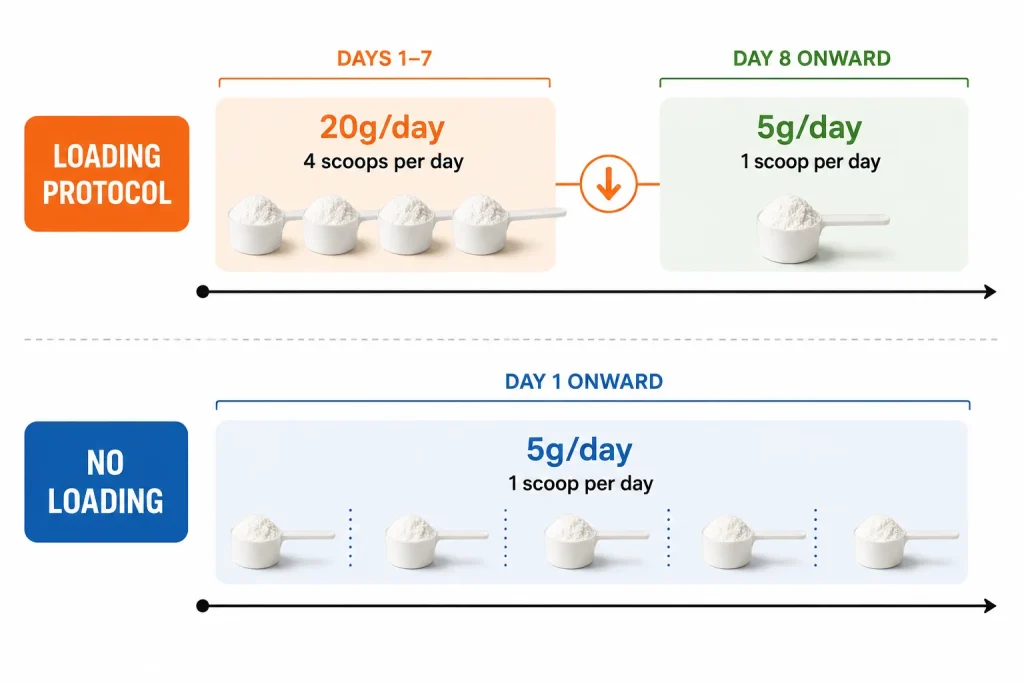
The Indian gym supplement culture has largely imported this protocol from American bodybuilding media, where brands have obvious commercial incentives to encourage high initial consumption. A loading week at 20g daily uses 140 grams of creatine. At standard maintenance of 5g daily, that same 140 grams lasts 28 days. Loading therefore increases your first-month creatine spend by roughly 4 times compared to simply starting at 5g daily.
What Does the Creatine Loading Phase Actually Achieve?
- Both loading and non-loading protocols produce the same approximately 20% increase in muscle total creatine concentration, established by the Hultman et al. 1996 study in the Journal of Applied Physiology. Loading reaches this endpoint in 5 to 7 days; 3g daily reaches it in 28 days.
- Muscle creatine saturation is the goal, not the speed of saturation, for anyone who is not preparing for a competition in the next two to three weeks.
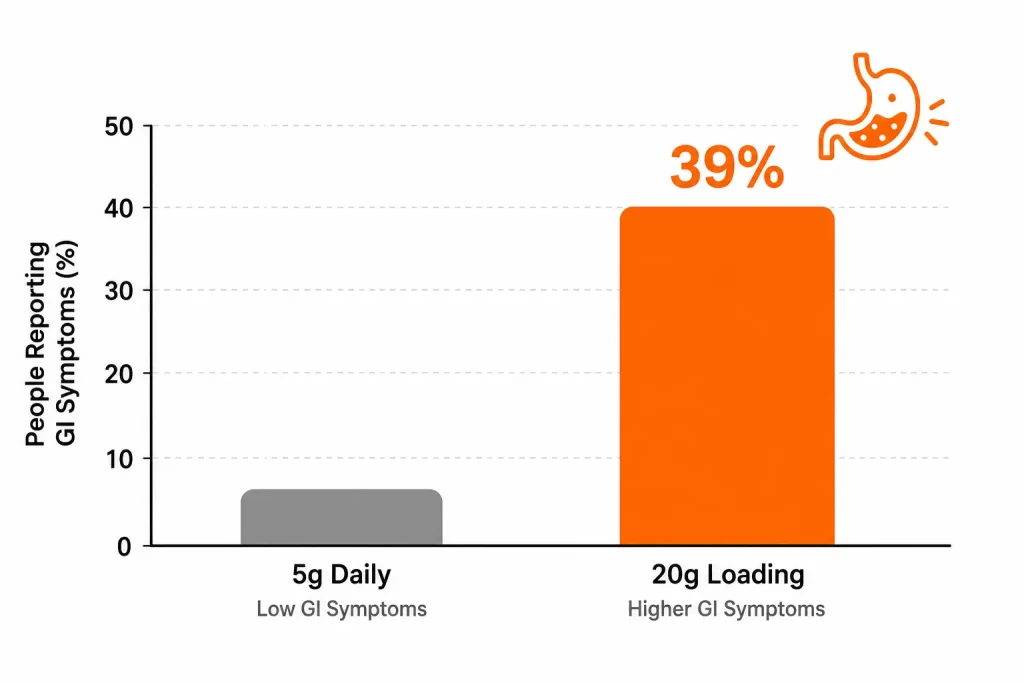
- Diarrhea occurs in approximately 39% of people during acute creatine loading, with the incidence rising to 55.6% when 10g is taken in a single dose versus 28.6% with split dosing.
- 3 to 5 grams daily without any loading phase is the current ISSN-recommended standard dosing strategy for long-term creatine supplementation in healthy adults.
- For Indian gym-goers specifically, the loading phase is rarely justified: a standard 5g daily protocol started at the same time as training produces the same long-term performance gains at lower cost and significantly lower digestive risk.
Why the Loading Myth Has Survived So Long
The loading phase originated in early creatine research and was adopted by the supplement industry before the simpler alternative was fully tested. The 1992 Barcelona Olympics saw widespread creatine use by elite athletes, and when creatine entered the commercial market in the mid-1990s, the loading protocol was already embedded in gym culture before the Hultman study clarified that 3g daily achieved the same endpoint.
What kept the myth alive is a combination of supplement industry incentives and the seductive logic of “more is faster is better.” Loading produces rapid initial weight gain — mostly water drawn into muscle cells by creatine — which feels like fast progress and gets credited to the loading phase. In reality, the weight gain is temporary fluid redistribution that occurs with any creatine protocol once stores saturate, though it occurs earlier with loading.
The Indian gym context adds another layer. Many Indian supplement vendors sell creatine in 250g packs marketed as “30-day supply” at 5g daily. Recommending a loading week immediately creates a second purchase within the first month. This is not a conspiracy — it is normal commercial behaviour — but it is worth recognising when evaluating advice that comes from a supplement retailer or affiliated fitness influencer.
The ISSN (International Society of Sports Nutrition) position stand on creatine states clearly that 3 to 5 grams daily without a loading phase can saturate intramuscular creatine stores and produce the same long-term outcomes as loading protocols.
Does the Creatine Loading Phase Actually Work Faster?
Yes, loading does produce faster initial muscle creatine saturation — but only if faster saturation matters for your specific situation. For someone competing in a strength or power event in the next two weeks, loading makes sense. For someone starting creatine as part of a regular training programme with no imminent competition, the three to four week difference in saturation time has no meaningful impact on outcomes.
The Saturation Comparison by the Numbers
The Hultman 1996 study measured muscle total creatine content in 31 male subjects across different dosing conditions. The key findings were:
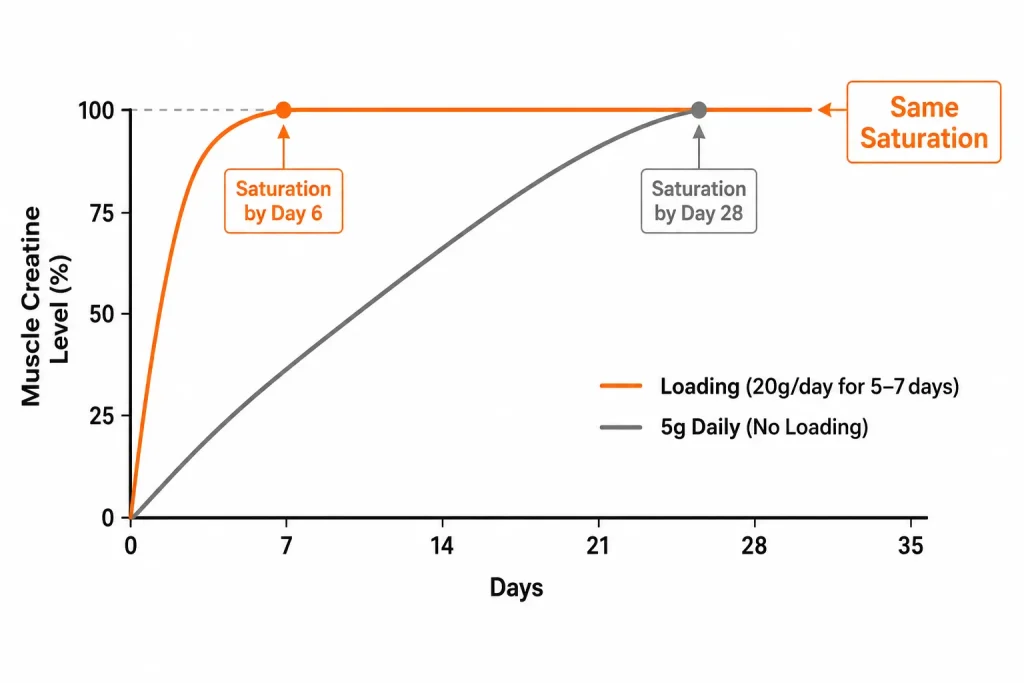
Loading protocol (20g daily for 6 days): approximately 20% increase in muscle total creatine concentration. Achieved in 6 days.
Low-dose protocol (3g daily for 28 days): same approximately 20% increase in muscle total creatine concentration. Achieved in 28 days.
Both groups reached equivalent saturation. The loading group got there 22 days earlier. If you start creatine on January 1 with 3g daily, you reach full saturation by approximately January 29. If you load, you reach full saturation by approximately January 7. By February 1, you have had identical creatine stores for the previous three weeks versus the previous 25 days. The difference in training outcomes at that point is unmeasurable.
The one-sentence verdict: Loading reaches saturation faster but does not produce greater saturation — the endpoint is the same, the timeline is different.
What the Creatine Loading Phase Actually Causes in the Body
Phosphocreatine (PCr) — the stored form of creatine in muscle, where roughly 66% of total intramuscular creatine exists as PCr — is the compound that matters for athletic performance. PCr replenishes adenosine triphosphate (ATP), the cell’s primary energy currency, during high-intensity exercise lasting approximately 1 to 10 seconds. When PCr stores are full, the muscle can sustain high-intensity effort slightly longer before switching to slower anaerobic glycolysis.
Loading fills PCr stores rapidly. During loading, creatine uptake into muscle is facilitated by insulin-dependent transporters, which is why taking creatine with a carbohydrate-containing meal has long been recommended. The rapid filling during loading also pulls intracellular water into muscle cells, producing the characteristic weight gain of 0.5 to 2kg in the first loading week. This water is inside muscle cells, not subcutaneous, and contributes to the muscle fullness that many users report.
The same mechanism operates during standard dosing. It simply takes three to four weeks for muscle creatine to reach the same saturation level.
The one-sentence verdict: Loading fills the same PCr stores through the same mechanism — it is a matter of speed, not magnitude.
Does Not Loading Mean Weaker Initial Results?
Training results in the first three to four weeks are not meaningfully worse without loading, for one practical reason: training adaptations in beginners and intermediates occur primarily through neuromuscular improvements in the first four to eight weeks, not primarily through energy system enhancement. The incremental benefit of creatine in the first few weeks of training is smaller than most gym-goers assume, because multiple other adaptation mechanisms are driving progress simultaneously.
Research consistently shows that creatine’s primary benefit — improved performance in high-intensity repeated-effort exercise — is measurable after full saturation regardless of how saturation was achieved. A 2024 systematic review and dose-response meta-analysis published in the Journal of the International Society of Sports Nutrition confirmed that 3 to 5g daily supplementation without a loading phase produces significant improvements in muscle mass, strength, and performance compared to placebo in healthy adults.
The one-sentence verdict: Not loading delays full saturation by approximately three weeks, but training results over a 12-week period are effectively identical to a loading protocol.
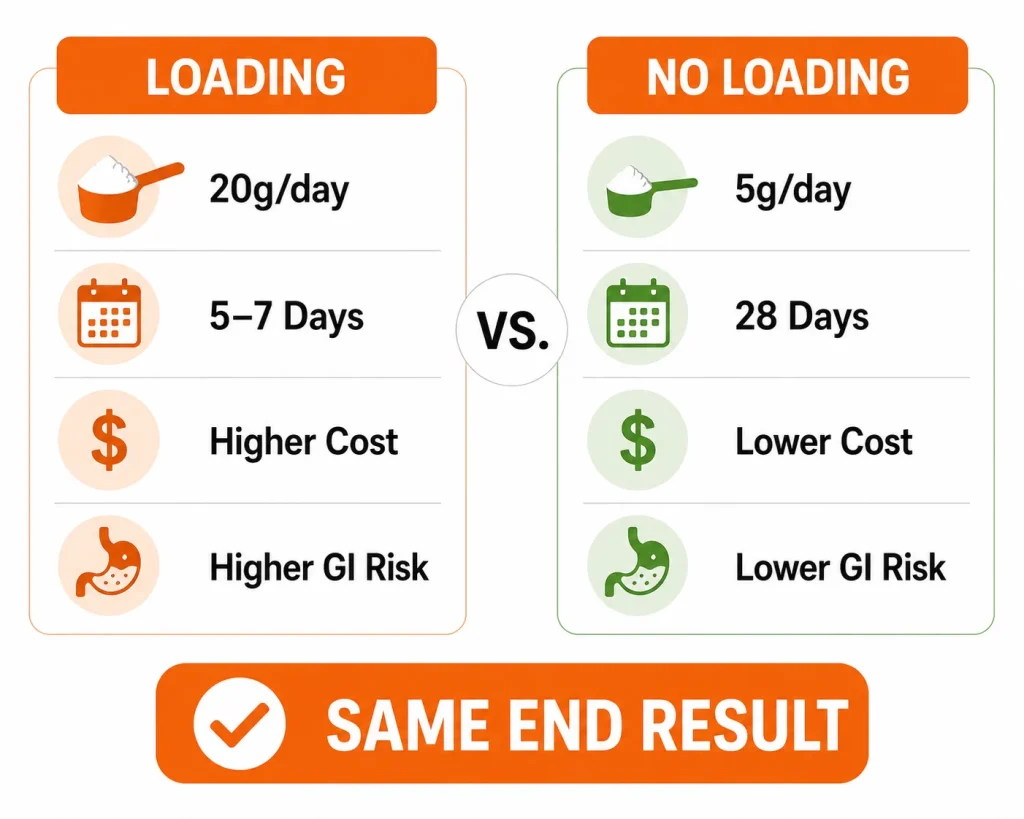
Creatine Loading vs No Loading: The Actual Numbers
| Protocol | Daily Dose | Duration to Full Saturation | GI Side Effect Risk | First Month Cost (200g pack at Rs 1000) | Best For |
|---|---|---|---|---|---|
| Loading (20g/day) + Maintenance (5g/day) | 20g for 5 to 7 days, then 5g | 5 to 7 days | High — diarrhea in approx 39% | Approx Rs 2000 to 2200 (uses nearly two packs) | Pre-competition in next 2 weeks |
| Standard dosing (5g/day, no loading) | 5g daily | 28 days | Low — minimal GI risk at 5g | Approx Rs 500 (uses one quarter of pack) | Long-term training without event deadline |
| Low-dose (3g/day, no loading) | 3g daily | 28 days | Minimal | Approx Rs 300 | Budget-conscious, sensitive digestive system |
| Gradual ramp (3g for 2 weeks, then 5g) | Increasing | 28 to 35 days | Minimal | Approx Rs 400 | Creatine beginners, sensitive stomach |
How Your Body Actually Uses and Stores Creatine
The body stores creatine primarily in skeletal muscle, with approximately 95% of total body creatine in muscle tissue, and the kidneys and liver each holding small additional amounts. Total muscle creatine capacity is approximately 150 to 160 mmol per kilogram of dry muscle weight, and most people without supplementation are at approximately 60% to 80% of this capacity.
When you supplement creatine, the sodium-dependent creatine transporter (CrT1) — a protein embedded in the muscle cell membrane — actively transports creatine from the bloodstream into the muscle against a concentration gradient. This transport is upregulated by exercise and by insulin. Both eating carbohydrates and exercising the muscle you want to load increase the efficiency of creatine uptake.
This is why timing creatine intake with a meal — particularly a meal containing carbohydrates — consistently shows slightly better uptake than fasted supplementation. The carbohydrate triggers an insulin response that enhances CrT1 activity. For practical purposes, take creatine with your largest meal of the day or within an hour of training.
Once inside the muscle, free creatine is phosphorylated to phosphocreatine by the enzyme creatine kinase (CK), using ATP as the phosphate source. When high-intensity exercise depletes ATP, PCr rapidly donates its phosphate group back to ADP (adenosine diphosphate) to regenerate ATP. This PCr buffer system operates faster than any other energy pathway and is responsible for creatine’s documented effects on strength, power, and sprint performance.
Timing recommendation: Take 3 to 5 grams of creatine monohydrate daily, with a meal that contains carbohydrates, at a consistent time. The specific timing — pre-workout, post-workout, or with a separate meal — has minimal effect on saturation over weeks. Consistency matters more than precision.
What the Research Actually Says About Loading
The landmark paper is Hultman et al. 1996, published in the Journal of Applied Physiology. This study established the foundational evidence that 3g daily for 28 days achieves the same approximately 20% increase in muscle total creatine as 20g daily for 6 days. Every credible review and meta-analysis since then has cited this finding as the basis for non-loading protocols.
The ISSN position stand on creatine supplementation, published in the Journal of the International Society of Sports Nutrition in 2021, reviewed the complete research base and specifically stated: “It is currently recommended that individuals consume approximately 3 to 5 grams per day of creatine for a minimum of 4 weeks in order to experience similar skeletal muscle saturation levels” to a loading protocol.
On gastrointestinal effects, one study found diarrhea occurring in approximately 39% of users during acute loading, with the rate rising to 55.6% when a 10-gram single dose was taken, compared to 28.6% with the recommended split-dose approach. A 2024 to 2025 randomised clinical study (currently available as a preprint on medRxiv) found that undesired GI symptoms were reported by 79.2% of all participants in both loading and non-loading groups, with bloating, water retention, and stomach discomfort more common and more severe in the loading group.
“A rapid way to creatine load human skeletal muscle is to ingest 20g of creatine for 6 days, which can be maintained by ingestion of 2g per day thereafter, and the ingestion of 3g creatine per day is in the long term likely to be as effective at raising tissue levels as this higher dose.” — Hultman et al., Journal of Applied Physiology, 1996.
The honest reality check: most people who go through a loading phase report feeling bloated and heavy during the loading week, lose some of that initial water weight in the following weeks, and end up at the same place as someone who just started at 5g daily. The loading phase produces real initial discomfort for a marginal speed benefit that matters in almost no recreational training scenario.
What to Know Before Choosing a Creatine Protocol
A few honest considerations that most loading-phase articles skip.
The GI risk is real and protocol-dependent. Diarrhea during loading affects a substantial proportion of users, and the risk is directly related to single-dose size. Even if you decide to load, splitting 20g into four 5g doses across the day is strongly preferable to two 10g doses. Better still, simply starting at 5g daily avoids this entirely.
Creatine-induced water weight gain happens regardless of loading. The initial weight gain of 0.5 to 2kg during creatine saturation is not fat. It is intracellular water. It is not visible as puffiness in the way subcutaneous water is. Loading causes this weight gain in week one. Standard dosing causes it gradually over weeks three to four. Either way, it resolves and normalises as your body adapts. Do not mistake it for fat gain.
Non-responders exist and loading does not help them. Approximately 25 to 30% of people are creatine non-responders — their muscle creatine does not significantly increase with supplementation, likely because their baseline creatine levels are already relatively high (common in people who eat substantial amounts of red meat). For non-responders, loading simply means spending more creatine on a process that will not produce the hoped-for outcome either way.
Quality matters more than protocol. Creatine monohydrate with Creapure certification (produced in Germany) has the most safety data and purity verification. Multiple Indian brands sell creatine at aggressively low prices; independent lab tests have occasionally found underdosed or adulterated products. For context on creatine safety data specific to India, the is creatine safe for Indians guide covers the specific concerns relevant to Indian consumers.
How to Choose Your Creatine Protocol Based on Your Situation
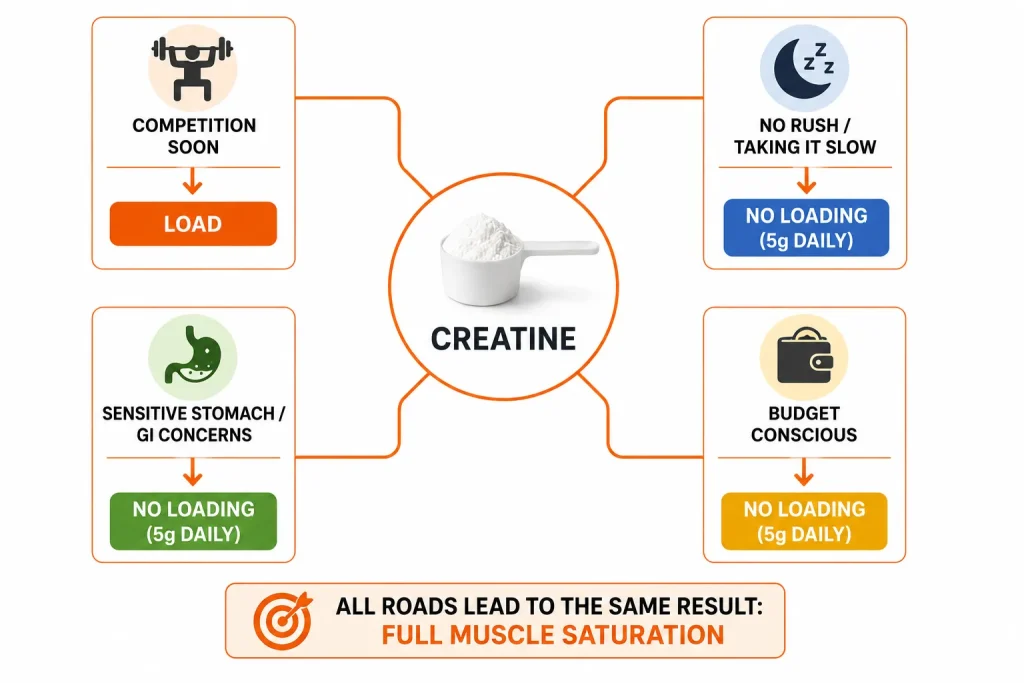
If You Have No Upcoming Competition and Are Training Long-Term
Start at 5 grams daily. Take it with your largest meal. Do not load. You will reach the same saturation in 28 days and avoid any GI risk. The endpoint is identical. For a broader overview of what creatine myths still circulate in Indian gym culture, the creatine myths busted article covers the full picture.
If You Are Competing or Peaking in the Next Two Weeks
Loading is the one situation where its speed advantage is genuinely relevant. Use 20g daily split into four 5g doses with meals for 5 to 7 days, then shift to 3 to 5g daily maintenance. Take it with carbohydrate-containing meals to maximise uptake.
If You Have a Sensitive Stomach or History of GI Issues
Start at 3g daily with food and stay there for 28 days. 3g daily achieves the same saturation as 5g daily — slightly more slowly, but the endpoint is the same. Never take more than 5g in a single dose. The GI risk from large single doses is real and not worth tolerating when smaller doses work.
If You Are a Beginner to Creatine
Start at 3 to 5g daily. Take it consistently with food. Expect subtle effects — not dramatic transformation — over the first 4 to 8 weeks. The weight gain in weeks three to four is water, not muscle. Do not interpret bloating as a problem requiring loading adjustment. It is normal and temporary.
If You Are on a Tight Budget
3g daily is the most economical protocol and produces the same endpoint as 5g daily or a loading protocol. A 250g pack at the standard Indian supplement price of Rs 800 to 1200 lasts 83 days at 3g daily versus 50 days at 5g daily. No loading means first-month costs are one-quarter of what loading requires.
The Bottom Line
The creatine loading phase is not necessary for most people. Both loading and standard daily dosing reach the same endpoint — approximately 20% greater muscle creatine concentration — with the only difference being timeline. Loading takes 5 to 7 days. Standard dosing takes 28 days.
For anyone training consistently without an imminent competition, this three-week difference is irrelevant to outcomes. The loading phase adds cost, adds gastrointestinal risk, and delivers nothing that 3 to 5 grams daily would not deliver by the end of the first month.
Take creatine monohydrate at 3 to 5 grams daily with food. Be consistent. Give it four weeks. That is the protocol the research actually supports, and it is the one most Indian gym-goers should use.
People Also Ask
Is the creatine loading phase necessary?
No, the creatine loading phase is not necessary for most people. The foundational Hultman et al. 1996 study in the Journal of Applied Physiology found that 3 grams daily for 28 days produces the same approximately 20% increase in muscle total creatine concentration as 20 grams daily for 6 days. The loading phase reaches full saturation faster, but the endpoint is identical. For anyone without an imminent athletic competition, standard daily dosing of 3 to 5 grams achieves the same long-term result.
What happens if you skip the loading phase with creatine?
If you skip the creatine loading phase and start at 3 to 5 grams daily, you reach full muscle creatine saturation in approximately 28 days instead of 5 to 7 days. Your long-term training results — strength gains, muscle mass, and high-intensity performance — are the same as someone who loaded. You avoid the gastrointestinal side effects associated with 20-gram daily loading doses, including bloating and diarrhea which occur in roughly 39% of people during acute loading.
How much creatine per day without loading?
Without a loading phase, 3 to 5 grams of creatine monohydrate daily is the standard and well-researched dose. The ISSN recommends 3 to 5 grams daily for a minimum of 4 weeks to achieve muscle creatine saturation equivalent to a loading protocol. For most Indian gym-goers at common body weights, 5 grams daily is the practical target. Take it consistently with food containing carbohydrates to optimise uptake through insulin-dependent muscle transporters.
Does creatine loading cause bloating?
Yes, creatine loading commonly causes bloating. Approximately 39% of users experience diarrhea during acute loading, with the rate rising to 55.6% when 10 grams is taken in a single dose. Bloating, stomach discomfort, and water retention are reported more frequently and more severely in loading protocols compared to standard daily dosing. The gastrointestinal risk is directly related to dose size per serving — splitting 20 grams daily into four 5-gram doses significantly reduces but does not eliminate the risk.
Does the creatine loading phase build more muscle than no loading?
No, the creatine loading phase does not build more muscle than a standard daily dose protocol. Both approaches saturate muscle creatine stores to the same level, which is what drives the improvements in high-intensity performance, recovery, and lean mass gain. A 2024 systematic review and meta-analysis confirmed that 3 to 5 grams daily without loading produces significant improvements in muscle mass and strength over time. Loading builds muscle no faster once both protocols have reached full saturation.
How long does creatine take to work without loading?
Without a loading phase, creatine at 3 to 5 grams daily takes approximately 28 days to fully saturate muscle stores. Measurable performance benefits typically begin to appear after 3 to 4 weeks of consistent daily supplementation once saturation approaches. Subtle effects — slightly better recovery between sets, marginally more reps at a given weight — may be noticeable from week two onward. Most people notice meaningful differences in training capacity and body weight in weeks three to four.
Is creatine loading worth it for Indian gym-goers?
For most Indian gym-goers training without an upcoming competition, creatine loading is not worth it. It uses four to five times more creatine in the first month, raising cost significantly. It carries meaningful gastrointestinal risk. And it produces the same long-term result as starting at 5 grams daily. The only scenario where loading is justified is when you need to be at full creatine saturation within two weeks, such as before a powerlifting meet or sports event. For everyone else, starting at 5 grams daily is the rational, research-supported approach.
Sources and References
- Muscle Creatine Loading in Men. Hultman E, Soderlund K, Timmons JA, Cederblad G, Greenhaff PL. Journal of Applied Physiology, 1996 — Foundational source for the finding that 3g daily for 28 days and 20g daily for 6 days produce the same approximately 20% increase in muscle total creatine concentration.
- Common Questions and Misconceptions About Creatine Supplementation: What Does the Scientific Evidence Really Show? Journal of the International Society of Sports Nutrition, 2021 — Source for the ISSN recommendation of 3 to 5g daily for a minimum of 4 weeks to achieve equivalent saturation to loading, and for the overall safety and efficacy consensus on creatine supplementation.
- Gastrointestinal and Fluid Retention Symptoms Associated With Creatine Monohydrate With and Without Loading Dose Over 28 Days of Supplementation. Wagner JC et al. medRxiv preprint, 2025 — Source for GI symptom incidence data: 79.2% overall GI symptom rate, higher severity and frequency in loading group versus standard dosing group. Note: currently a preprint, not yet peer-reviewed.