
Eating milk and fish together is not harmful – no credible scientific evidence supports the claim that this combination causes skin disease, poisoning, or any serious health problem in healthy adults. This is one of the most widespread food myths in Indian households, and it has been circulating for so long that most people treat it as medical fact when it is actually a belief inherited from a pre-scientific dietary framework.
The two most specific fears attached to this combination are worth naming directly. First, that eating milk and fish together causes vitiligo or leucoderma, a condition where white patches appear on the skin due to loss of melanin-producing cells. Second, that the combination causes severe indigestion because the two proteins are incompatible for digestion. Both claims have been investigated, and neither holds up.
What makes this myth so persistent is that it carries the authority of Ayurveda, it has been repeated by grandparents across generations, and vitiligo is genuinely common enough in India that people can always find a story of someone who developed white patches after eating fish and milk. Correlation becomes causation quickly when the belief is already established.
The science says otherwise. And the science is not ambiguous on this one.
The Belief, Where It Comes From, and Why It Stuck
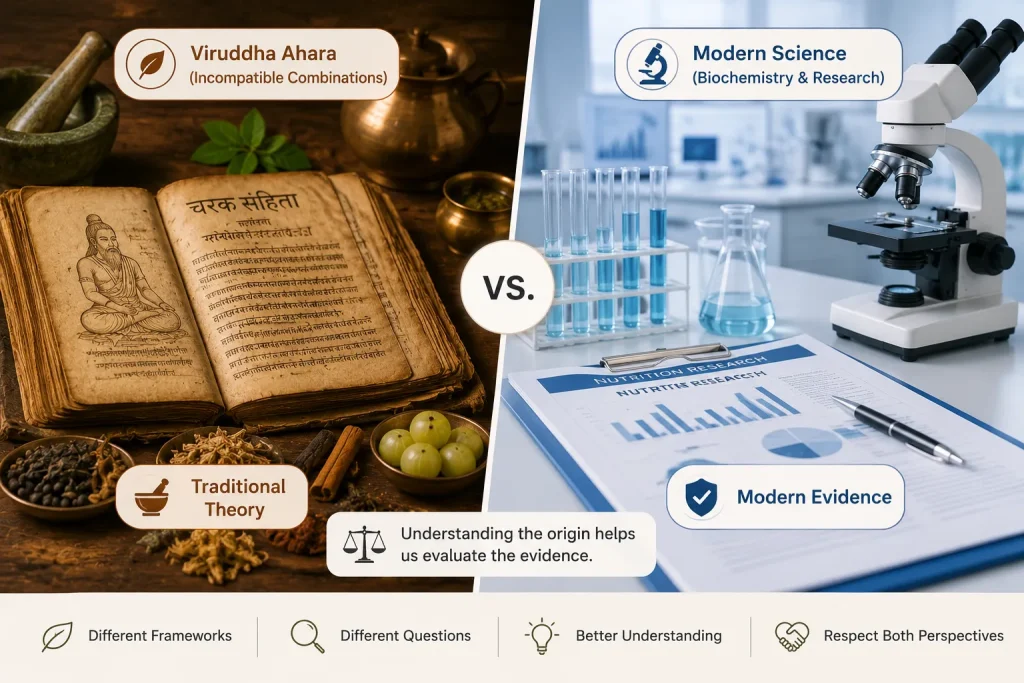
The milk-and-fish warning is rooted in Ayurveda’s concept of viruddha ahara, which translates roughly to incompatible food combinations. In this framework, foods are assigned qualities such as heating or cooling, heavy or light, and the combination of opposing qualities is thought to disturb digestion and accumulate toxins called ama in the body. Fish is classified as heating and milk as cooling in Ayurvedic taxonomy, making them viruddha – mutually incompatible.
This is not a fringe Ayurvedic idea. It appears in classical Ayurvedic texts including Charaka Samhita and Ashtanga Hridayam, which gives it real institutional weight within traditional Indian medicine. The problem is that the Ayurvedic classification of foods as heating or cooling is a theoretical framework for understanding internal balance, not a description of measurable physiological processes. The framework predates modern biochemistry by roughly two thousand years.
The leucoderma association specifically appears to have spread through a combination of textual authority and coincidence. Vitiligo affects approximately 0.5 to 2% of the global population and is an autoimmune condition. India has a relatively high prevalence, estimated at 0.25 to 4% depending on the region and study, per dermatology literature. With a condition this common, the odds of someone eating fish and milk and developing vitiligo shortly afterward are non-trivial simply by chance. That coincidence, repeated across enough families over enough generations, became causal belief.
The critical fact that dismantles the origin story: Indian coastal communities, particularly in West Bengal, Goa, Odisha, Kerala, and Bangladesh, have traditionally eaten fish-based curries cooked in or served with yoghurt, curd, or coconut milk for centuries. These populations do not have higher rates of vitiligo than non-coastal Indians. That single observation should be enough to settle the question.
Is Milk and Fish Together Harmful? The Biological Answer
Eating milk and fish together is not harmful because the human digestive system has no mechanism by which combining these two protein sources causes toxic reactions, skin disease, or enzyme interference. This is the established position of modern nutritional science and dermatology.
Does Combining Two Proteins Interfere With Digestion?
Combining fish and milk does not interfere with digestion because the human stomach digests all proteins using the same primary mechanism regardless of their source. Protein digestion begins in the stomach, where hydrochloric acid (HCl) denatures the protein structure and activates pepsin, a protease enzyme. Pepsin breaks proteins into smaller peptide chains by cleaving peptide bonds. This process works identically whether the protein is casein from milk, whey from milk, or myosin and actin from fish muscle.
The argument that fish and milk need “different enzymes” and therefore cannot be digested simultaneously is a specific myth from the food-combining movement, which emerged in the 1800s and has no basis in biochemistry. The stomach does not apply different enzymatic systems to different protein types. Pepsin digests all of them. The small intestine then continues the process with pancreatic proteases including trypsin, chymotrypsin, and elastase, along with brush border enzymes, which work on the resulting peptides regardless of whether they originated from fish or dairy.
The body also routinely digests mixed protein meals without difficulty. Every time someone eats a meal containing paneer and dal, or curd with chicken, or eggs with cheese, they are digesting multiple protein sources simultaneously. There is no physiological distinction that makes fish-and-milk combination uniquely problematic.
The one-sentence verdict: The human digestive system has no problem processing fish and dairy proteins simultaneously because it uses the same pepsin-based mechanism for all dietary protein.
Does Milk and Fish Together Cause Vitiligo or Leucoderma?
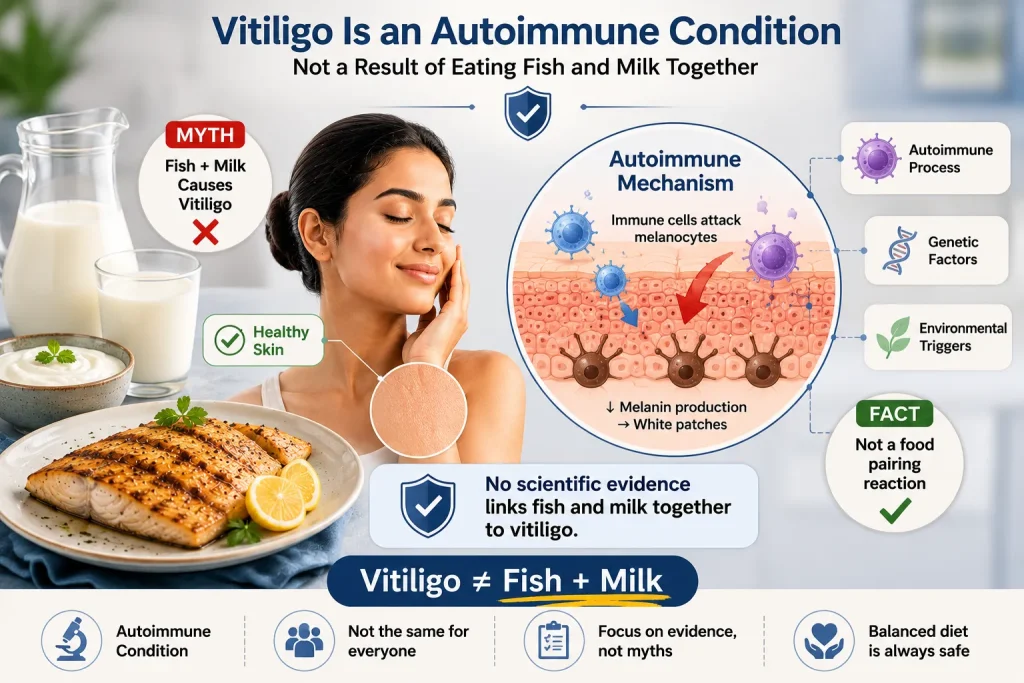
Eating milk and fish together does not cause vitiligo or leucoderma — this is the direct position stated in a review published in the Indian Journal of Dermatology, Venereology and Leprology (IJDVL), one of India’s most authoritative dermatology journals. The review specifically examined the milk-and-fish claim in the context of dietary advice given to vitiligo patients and stated: no scientific data exists to support or refute these beliefs, and no causative association between the food combination and vitiligo has been established.
Vitiligo is an autoimmune condition. Melanocytes, the skin cells responsible for producing melanin, the pigment that gives skin its colour, are destroyed by the body’s own immune cells. The autoimmune trigger for this destruction involves genetic predisposition, immune dysregulation, oxidative stress, and environmental factors. No dietary combination has been identified as a trigger for vitiligo in peer-reviewed dermatology literature. A 2024 Mendelian randomisation study in Frontiers in Immunology confirmed that vitiligo pathogenesis is driven by circulating immune cell activity, not dietary intake.
Dr. Kapil Umesh of AIIMS New Delhi, speaking to fact-checkers at The Week in February 2025, confirmed that consuming fish and milk or any food depends on the body’s ability to digest them, and not the combination itself, and that no evidence supports the vitiligo claim.
The one-sentence verdict: Vitiligo is an autoimmune condition with genetic and immunological causes; no peer-reviewed research has identified milk-and-fish combination as a trigger, a risk factor, or a dietary contributor.
Could the Combination Cause Digestive Discomfort in Some People?
Mild digestive discomfort after eating fish and milk together is possible in some individuals, but this is not caused by the combination itself — it is caused by individual sensitivities to dairy, fish, or both. Lactose intolerance is particularly relevant here. Approximately 60 to 70% of South Asian adults have some degree of lactose malabsorption, meaning the body does not produce sufficient lactase enzyme to break down the lactose in milk. In these individuals, consuming milk alongside any food, including fish, can cause bloating, gas, and loose stools. The fish is not the problem in this scenario. The dairy is.
Similarly, some individuals have fish allergies or sensitivities that produce digestive symptoms. These are food-specific immune responses unrelated to the combination.
The claim that the combination specifically creates toxic byproducts or a distinct physiological reaction beyond individual food sensitivities has no biochemical support.
The one-sentence verdict: Some people feel digestive discomfort after eating milk and fish together, but this is driven by individual lactose intolerance or food sensitivity, not by the combination itself.
Does This Combination Appear Safely in Other Cuisines?

Milk and fish are combined routinely in well-regarded global food traditions, and these populations show no elevated rates of the harms attributed to the combination in Indian dietary belief. New England clam chowder and Scottish cullen skink are milk-and-fish dishes eaten across generations in North America and the United Kingdom. Scandinavian cuisines routinely combine salmon with cream-based sauces. The French make fish gratins with bechamel sauce, which is milk-based. Mediterranean diets, which are consistently ranked among the healthiest dietary patterns in the world, combine fish with yoghurt, cheese, and dairy routinely.
If the combination were physiologically harmful, these populations would show the predicted outcomes. They do not.
The one-sentence verdict: Milk-and-fish combinations in global cuisines eaten by large populations over centuries produce none of the harm predicted by Ayurvedic food-incompatibility theory.
Milk, Fish, and the Nutritional Picture: What the Data Shows
| Nutrient / Claim | Milk (250ml) | Fish (100g rohu) | Combined Meal | Verdict |
|---|---|---|---|---|
| Protein | 8g (casein + whey) | 18 to 20g | 26 to 28g | Excellent protein meal |
| Calcium | 300mg | 25mg | 325mg | Strong bone support |
| Vitamin D | 100 IU (fortified) | 200 to 400 IU | 300 to 500 IU | High mutual benefit |
| Omega-3 fatty acids | Trace | 300 to 500mg | 300 to 500mg | Cardiovascular benefit |
| Causes vitiligo | No evidence | No evidence | No evidence | Myth, not fact |
| Causes indigestion (general) | Not in lactose-tolerant | Not in non-allergic | Not in healthy adults | Individual sensitivity only |
| Enzyme incompatibility | No such mechanism | No such mechanism | No such mechanism | No biological basis |
How Your Body Actually Processes This Meal
When you eat fish and milk together, your digestive system processes both protein sources sequentially and simultaneously using its standard enzymatic toolkit, with no special conflict between the two. The process is well understood and produces no novel toxic compounds.
In the stomach, HCl creates an acidic environment with a pH of approximately 1.5 to 3.5. This acid both denatures protein structures and activates pepsinogen into active pepsin. Pepsin then begins breaking peptide bonds in both fish proteins (primarily myofibrillar proteins like myosin and actin) and milk proteins (primarily casein, which forms curds in acid, and whey proteins). The stomach handles both simultaneously.
Casein, the major protein in milk, forms curds when it encounters the acidic gastric environment. This is normal and expected. It does not produce toxins. It simply means casein digests slightly more slowly than whey or fish proteins, because the curd structure limits enzyme access. This slower digestion can extend the period of stomach fullness, which is actually associated with better satiety, not harm.
In the small intestine, pancreatic proteases including trypsin and chymotrypsin continue breaking down the peptide chains from both sources into amino acids and di- and tripeptides, which are then absorbed through the intestinal wall into the bloodstream.
Timing note: There is no optimal or problematic timing for eating fish and milk together. If you are lactose-intolerant, the time between eating fish and drinking milk does not meaningfully change the lactose load your small intestine faces. The only relevant timing consideration is that heavy, high-fat meals of any composition slow gastric emptying, which can increase the feeling of fullness or mild bloat in sensitive individuals. This applies equally to any large mixed meal.
What the Research and Medical Community Actually Says
The medical and scientific consensus on milk-and-fish combination is clear and consistent across sources. No peer-reviewed study has identified a harmful physiological mechanism specific to eating these two foods together.
The Indian Journal of Dermatology, Venereology and Leprology directly addressed the vitiligo claim and found no scientific data supporting a causative association. Dermatologists at AIIMS New Delhi have publicly confirmed there is no evidence for the skin-disease claim. Multiple Indian medical fact-checking outlets including First Check and The Week’s fact-check team have examined this claim against medical literature and reached the same position.
The food-combining theory that underlies the digestion interference claim, which argues that different foods require incompatible enzymatic environments and should not be eaten together, has been thoroughly examined and rejected by nutrition science. There is no evidence that eating protein with protein at the same meal interferes with the digestion of either.
“The simultaneous consumption of milk and fish is also discouraged for vitiligo patients. Although there are numerous websites that host dietary advice for vitiligo patients, there is no scientific data to support or refute these beliefs.” — Indian Journal of Dermatology, Venereology and Leprology.
The honest reality check: most people who have eaten fish and milk together and developed no symptoms simply never connect the two events. The people who developed vitiligo after eating the combination remember it and attribute causation. This is confirmation bias operating across millions of families over generations, not evidence.
When This Combination Is Worth Being Careful About
The combination of milk and fish is not dangerous, but a few situations are worth acknowledging honestly.
If you are lactose intolerant, drinking milk alongside any meal will produce symptoms. This is about the milk, not the fish. Substituting curd or paneer, which have lower lactose content, reduces the problem. Approximately 60 to 70% of South Asian adults have some degree of lactose malabsorption, making this relevant for a large proportion of Indian readers.
If you have a fish allergy, combining fish with milk is not the issue. Fish allergy is an IgE-mediated immune response to specific fish proteins, primarily parvalbumin. Adding milk to the meal does not change the allergic response. The fish itself is the problem.
If you have existing vitiligo, dietary advice from a dermatologist is appropriate. Some patients choose to avoid certain foods as personal management strategies. That is a personal choice, but it is not based on evidence that the food caused or worsens the condition.
On food safety grounds, fish is a highly perishable protein. Consuming undercooked or spoiled fish alongside milk will cause foodborne illness symptoms including nausea, vomiting, and diarrhoea. These symptoms may have been historically misattributed to the combination rather than to the spoiled fish. In India, before refrigeration was widespread, fish quality was highly variable, particularly in inland areas. The “don’t mix fish and milk” rule may have functioned as a practical food safety heuristic in those conditions, not a metabolic warning.
For a complete picture of high-quality protein sources in the Indian context, the best protein sources for muscle gain and fat loss in India guide covers both animal and plant options with nutritional data.
How to Think About This Depending on Your Situation
If You Are a Healthy Adult With No Dairy Sensitivity
Eat fish and milk together without concern. There is no biological mechanism by which this combination harms you. If you enjoy fish in a yoghurt-based marinade, a cream-based fish curry, or a glass of milk after a fish meal, nothing harmful is happening in your digestive system. The combination is safe.
If You Are Lactose Intolerant
Avoid large amounts of milk specifically because of the lactose, not because of the fish. Curd and paneer, which have significantly lower lactose content than fresh milk, are generally better tolerated and can be used in fish preparations without the same digestive consequences.
If You Have Vitiligo
No dietary restriction involving fish and milk is supported by dermatology evidence. Vitiligo is managed with phototherapy, topical treatments, and in some cases surgical intervention. Your dermatologist’s guidance on treatment is evidence-based. Dietary restrictions for vitiligo, unless they relate to identified nutritional deficiencies like vitamin D or vitamin B12, are not. For context on nutrient deficiencies that are actually relevant to skin and overall health, the 7 early signs of nutrient deficiency most Indians ignore guide covers what actually needs attention.
If You Are Trying to Build Muscle or Increase Protein Intake
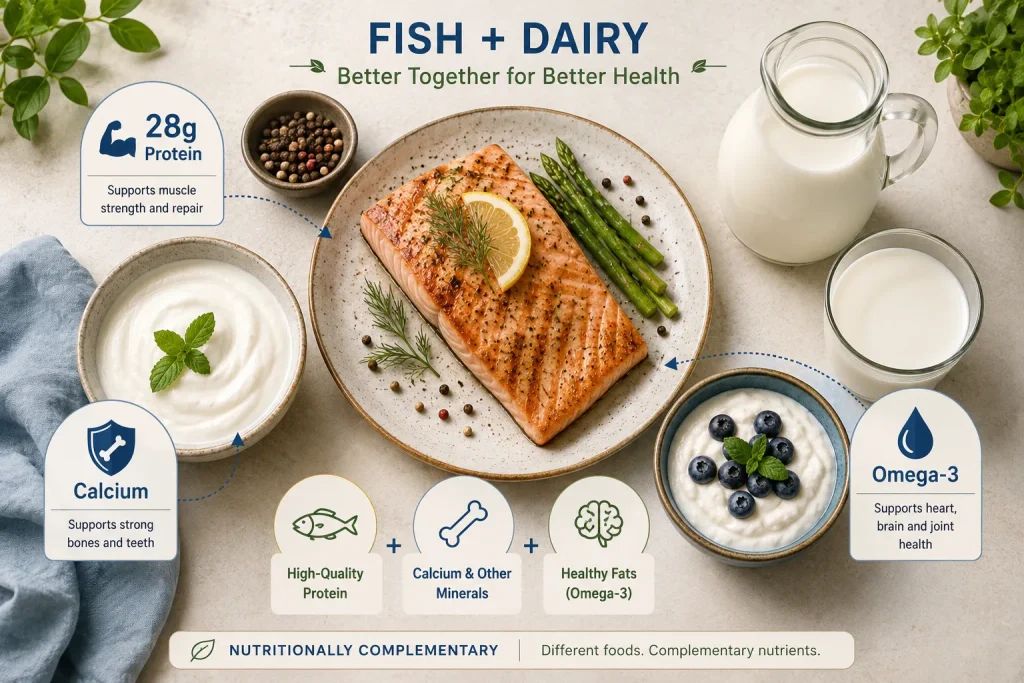
Combining fish and milk in the same meal is actually nutritionally excellent. Fish provides high-quality complete protein with all essential amino acids and omega-3 fatty acids. Milk adds casein and whey, calcium, and vitamin D. Together, they provide a broad amino acid spectrum and support muscle protein synthesis effectively. The combination is not just harmless — it is beneficial for anyone with protein or micronutrient targets to meet.
If You Are From a Cultural Background Where This Belief Is Strong
Changing a belief that your family has held for generations requires more than a single article. The practical approach is not to fight the belief in family settings but to understand that eating fish and milk together at a restaurant, at a friend’s house, or in a recipe that combines the two, does not put you at any physiological risk. What you choose to do at home, and what you choose to tell your parents, is a separate social question.
The Bottom Line
Milk and fish together are not harmful. This is the settled position of modern nutrition science, dermatology, and medical fact-checking in India. The vitiligo claim has no scientific support. The enzyme-incompatibility claim has no biochemical basis. The combination is eaten safely in cuisines around the world, including in Indian coastal communities that have done so for centuries.
The belief comes from Ayurvedic food-combination theory, which is a coherent internal system but not a framework that maps onto the biochemistry of protein digestion. Viruddha ahara as a concept is interesting cultural history. It is not medical evidence.
If you have lactose intolerance, be cautious about the milk, not the fish. If you have a fish allergy, avoid the fish, not the combination. For everyone else, this is one food myth you can safely set aside and stop worrying about.
People Also Ask
Is it safe to drink milk after eating fish?
Yes, it is safe to drink milk after eating fish for healthy adults. No scientific evidence links this combination to any health condition, including vitiligo, leucoderma, indigestion, or poisoning. The Indian Journal of Dermatology, Venereology and Leprology specifically examined the vitiligo claim and found no data supporting a causative association. The belief comes from Ayurvedic food-combination theory, not from modern medical research. People with lactose intolerance may experience bloating after consuming milk, but this is related to the dairy, not the fish.
Does eating fish and milk together cause white patches on skin?
No, eating fish and milk together does not cause white patches on the skin. White patches are caused by vitiligo, an autoimmune condition where the body’s immune cells destroy melanocytes, the cells that produce skin pigment. Vitiligo is driven by genetic predisposition, immune dysregulation, and oxidative stress. No peer-reviewed dermatology research has identified any dietary combination, including fish and milk, as a cause or trigger of vitiligo. Dermatologists at AIIMS New Delhi have publicly confirmed there is no scientific basis for this claim.
Why do Indians believe milk and fish together are harmful?
Indians believe milk and fish together are harmful because of Ayurveda’s concept of viruddha ahara, which classifies certain food combinations as incompatible due to opposing thermal properties. Fish is classified as heating and milk as cooling in Ayurvedic taxonomy. This belief appears in classical texts including Charaka Samhita. Over generations, it became reinforced by coincidental associations between the combination and conditions like vitiligo, which is actually an autoimmune disease unrelated to diet. Indian coastal communities that have eaten fish with yoghurt and curd for centuries show no evidence of elevated vitiligo rates.
Can fish and milk cause food poisoning?
Fish and milk together do not cause food poisoning as a specific combination. Food poisoning from fish comes from spoiled or undercooked fish containing bacteria like Salmonella, Vibrio, or Listeria, or from histamine buildup in poorly stored fish. These pathogens cause symptoms whether or not milk is consumed alongside. Before refrigeration was widespread in India, spoiled fish was a common source of illness, and the association between fish meals and sickness may have been incorrectly attributed to the milk-and-fish combination rather than to fish quality.
Are there any people who should avoid eating fish and milk together?
People with lactose intolerance should be mindful about the quantity of milk consumed, as it can cause bloating, gas, and digestive discomfort regardless of what they eat alongside it. People with diagnosed fish allergy should avoid fish entirely, not specifically the milk-and-fish combination. People with existing vitiligo who follow dietary restrictions as personal management should do so based on their dermatologist’s guidance, not on unverified traditional warnings. For healthy adults without these conditions, there is no reason to avoid fish and milk together.
Is fish with curd or yoghurt safe to eat?
Yes, fish with curd or yoghurt is entirely safe to eat and is a common preparation in multiple Indian and global cuisines. Bengali doi maach, Goan fish curries, and Mediterranean yoghurt-based fish dishes are examples. Curd has lower lactose content than fresh milk, making it better tolerated by people with mild lactose sensitivity. There is no chemical or enzymatic reaction between fish proteins and dairy proteins that produces harmful compounds. The combination has been eaten safely across cultures for centuries.
What does Ayurveda say about fish and milk and should I follow it?
Ayurveda classifies fish and milk as viruddha ahara, meaning incompatible foods, based on their opposing heating and cooling properties. Ayurveda’s framework is internally consistent and has cultural and historical value. However, its food-combination rules are not based on the biochemistry of digestion as understood by modern science. No study has validated the viruddha ahara framework by measuring digestive enzyme activity, serum toxin levels, or disease incidence in people who eat these combinations versus those who do not. Following it is a personal choice, but it should be understood as a cultural preference, not a medical requirement.
Sources and References
- Myth-buster: Consuming Fish and Milk Together Does Not Cause Vitiligo — First Check India. Fact-check citing IJDVL review and dermatologist Dr. Dilshad Akhtar Khan.
- Fact Check: Does Consuming Fish and Milk Together Cause Vitiligo? — The Week, February 2025. Source for AIIMS New Delhi nutritionist Dr. Kapil Umesh statement and IJDVL citation.
- Circulating Immune Cells and Vitiligo: A Bidirectional Two-Sample Mendelian Randomisation Study — Frontiers in Immunology, 2024. Source for vitiligo as an immune-mediated condition with autoimmune pathogenesis.
- Does Consuming Milk With Fish or Salt Cause White Patches on Skin? — THIP Media, June 2024. Source for Dr. Sachin Gupta, Dermatologist, Amrita Hospital statement on leucoderma and dietary combinations.