Caffeine is one of the few fat loss aids that actually has real science behind it, and also one of the most overhyped by supplement marketing.
Yes, caffeine for fat loss works, but only in a small, specific way. It raises your metabolic rate slightly, increases fat oxidation during exercise, and helps you push harder in a workout. It does not melt fat off your body on its own, and most of its benefit disappears if you rely on it without training or a calorie deficit.
For Indian readers, this topic comes with a twist most global articles miss. A huge number of people here already drink 3 to 5 cups of chai a day, which means many are getting meaningful caffeine intake without realizing it, long before they add a pre-workout or fat burner pill on top.
Here is what caffeine actually does inside your body, and where the real limit is.
The Short Answer
- Caffeine increases thermogenesis and resting energy expenditure by a small but measurable amount, roughly 100 kcal a day from about 600 mg spread across the day.
- It boosts fat oxidation more reliably during exercise than at rest, based on a large 2022 meta-analysis of 94 studies.
- Caffeine suppresses appetite mildly for most people, though this effect varies a lot between individuals.
- Its biggest real-world fat loss benefit is indirect: better workout performance means more calories burned per session.
- The FDA considers up to 400 mg a day safe for most healthy adults, but regular tea and coffee drinkers in India often underestimate how much they already consume.
How Does Caffeine Actually Help With Fat Loss?
Caffeine works mainly by blocking adenosine, a chemical in your brain that makes you feel tired. With adenosine blocked, your nervous system ramps up, releasing more adrenaline and noradrenaline, the hormones responsible for alertness and the “fight or flight” response.
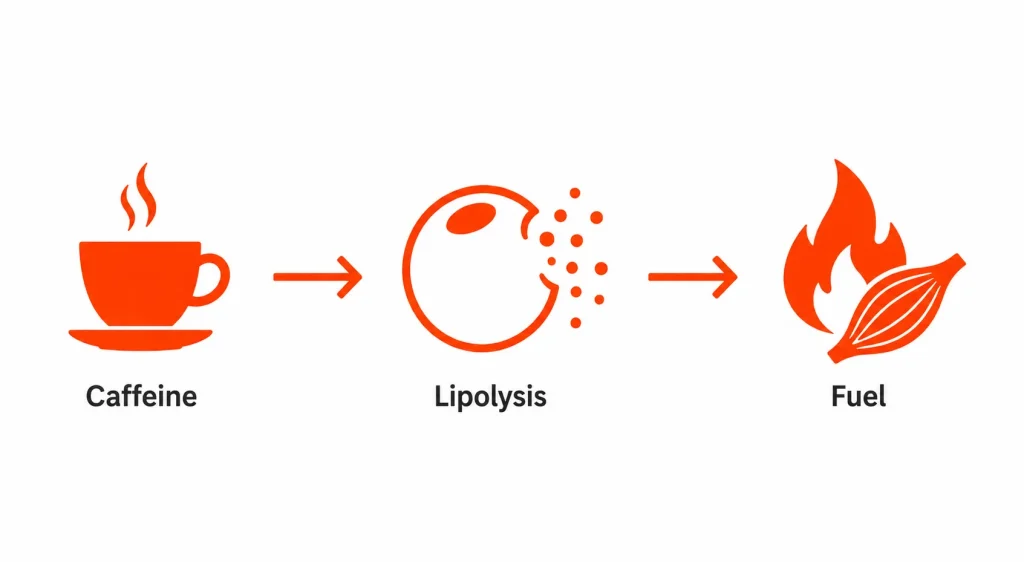
Those same hormones happen to trigger lipolysis, the breakdown of stored fat into fatty acids that your body can burn for energy. This is the core mechanism behind why caffeine is linked to fat loss at all.
The effect is real but modest. Caffeine is not a fat burner in the dramatic sense supplement labels suggest. It is closer to a small metabolic nudge that becomes meaningful only when combined with training and a calorie deficit.
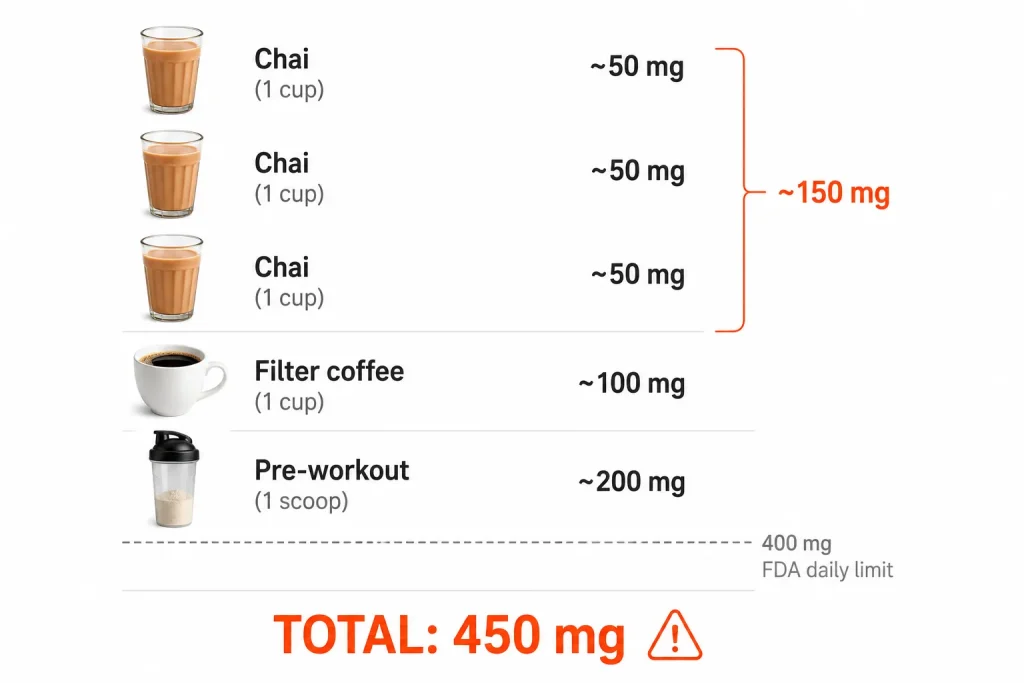
In India, this nudge gets complicated by how much caffeine people already consume through chai and filter coffee without tracking it. Someone drinking 4 cups of masala chai a day may already be near 200 mg of caffeine before they even open a pre-workout supplement, which changes how much additional benefit, or risk, a supplement actually adds. If you are building a full plan rather than relying on caffeine alone, our 3 Pillars of a Sustainable Fat Loss Plan covers what actually moves the needle.
What Caffeine Actually Does Inside Your Body
How Caffeine Boosts Thermogenesis and Calorie Burn
Caffeine raises thermogenesis, meaning your body generates slightly more heat and burns slightly more energy at rest after consuming it.
Research going back decades has shown that consuming around 600 mg of caffeine spread across 12 hours, roughly six cups of coffee, can increase daily energy expenditure by about 100 kcal. That is a real number, but it is also a small one, and most people are not consuming 600 mg spread carefully through the day.
Lower, more realistic doses of 100 to 200 mg still produce a measurable thermogenic effect, just proportionally smaller.
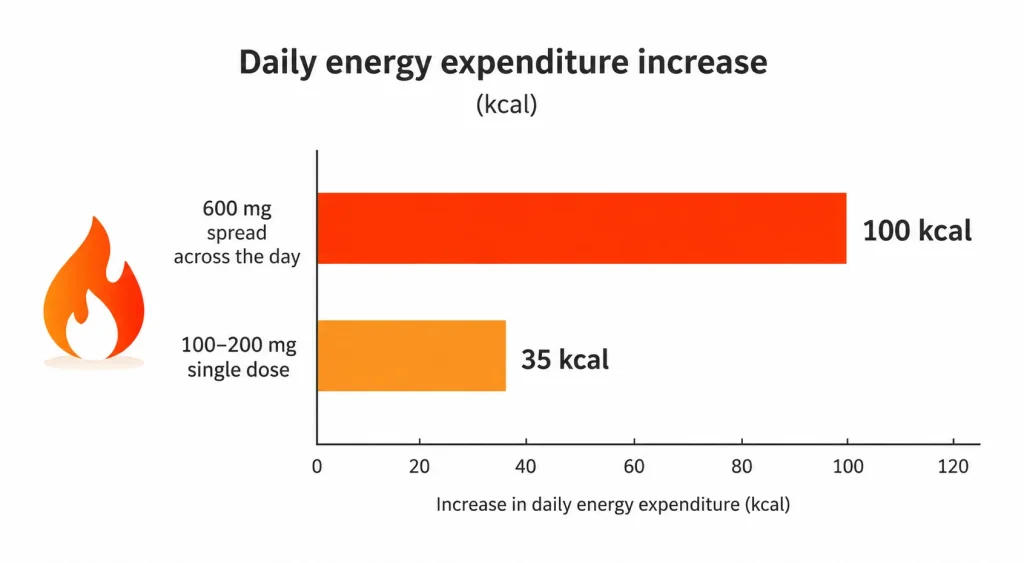
Verdict: real, but modest. Caffeine alone will not create a meaningful calorie deficit on its own.
How Caffeine Increases Fat Oxidation (Turning Fat Into Fuel)
Fat oxidation means your body is using fat as fuel instead of carbohydrate. Caffeine genuinely increases this, but the size of the effect depends heavily on context.
A large 2022 meta-analysis covering 94 studies and nearly 1,000 participants found caffeine ingestion produced a small but statistically significant increase in fat metabolism. The effect was noticeably stronger when measured through blood biomarkers like free fatty acids than through breath-based gas exchange testing, and stronger at rest than during exercise.
This means caffeine does shift your body toward burning more fat, but the word “small” matters here. It is a real, reproducible effect across dozens of studies, not a dramatic one.
Verdict: genuinely supported by research, just don’t expect it to show up as a visible difference on its own.
How Caffeine Suppresses Appetite and Cravings
Caffeine has a mild appetite-suppressing effect for many people, largely through its stimulation of the central nervous system and its effect on certain gut and brain signaling pathways.
This effect is inconsistent. Some people genuinely eat less after coffee or a caffeinated pre-workout. Others feel no difference, and a smaller group actually feels hungrier once the initial stimulant effect wears off.
If you notice caffeine reliably curbs your appetite, it can be a useful tool around meal timing. If it does not, do not force it as a strategy, since the appetite response varies too much person to person to count on.
Verdict: helpful for some, unreliable as a primary appetite control strategy.
How Caffeine Improves Workout Performance (Indirect Fat Loss Effect)
This is where caffeine earns most of its real-world fat loss credit, indirectly.
Caffeine before training reliably improves endurance, strength output, and perceived effort, meaning workouts genuinely feel easier and you can often push for more reps, more weight, or a longer session. More total work done in a session means more calories burned, which compounds over weeks far more than the direct thermogenic effect ever will.
This is also why caffeine timed 30 to 45 minutes before training tends to outperform caffeine taken at random times of day for fat loss purposes specifically.
Verdict: the most practically useful fat loss benefit caffeine actually offers.
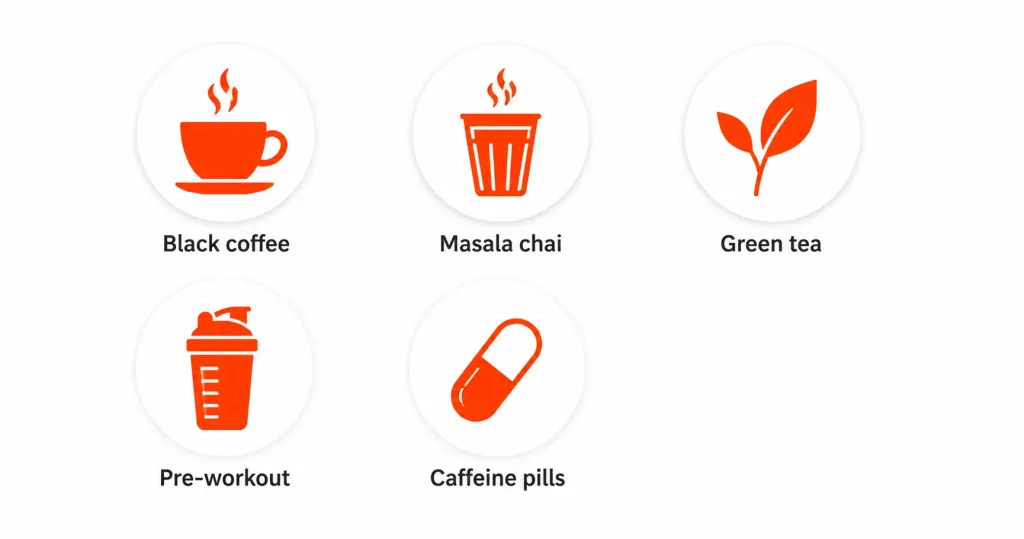
Common Caffeine Sources Compared
| Source | Typical Caffeine Content | Fat Loss Relevance | Verdict |
|---|---|---|---|
| Black coffee (1 cup) | 80 to 100 mg | Solid thermogenic and pre-workout option, zero calories | Best overall |
| Masala chai (1 cup) | 30 to 50 mg | Mild effect, but adds up fast across 3 to 5 cups a day | Situational |
| Green tea (1 cup) | 25 to 40 mg | Lower caffeine, added benefit from catechins, gentler on the system | Good, mild option |
| Pre-workout supplement | 150 to 300 mg per serving | Strong performance boost, easy to overshoot daily limit if combined with tea or coffee | Situational |
| Caffeine pills/tablets | 100 to 200 mg per pill | Precise dosing, but easiest to unintentionally overdo | Avoid unless dose-tracked |
How This Plays Out in Your Body
Caffeine is absorbed quickly, usually reaching peak blood levels within 30 to 60 minutes of consumption, and its effects can last 4 to 6 hours depending on your individual metabolism.
It works primarily by blocking adenosine receptors in the brain, which delays the feeling of fatigue, while simultaneously triggering the release of catecholamines, the hormones that drive lipolysis, the breakdown of stored fat into usable fatty acids.
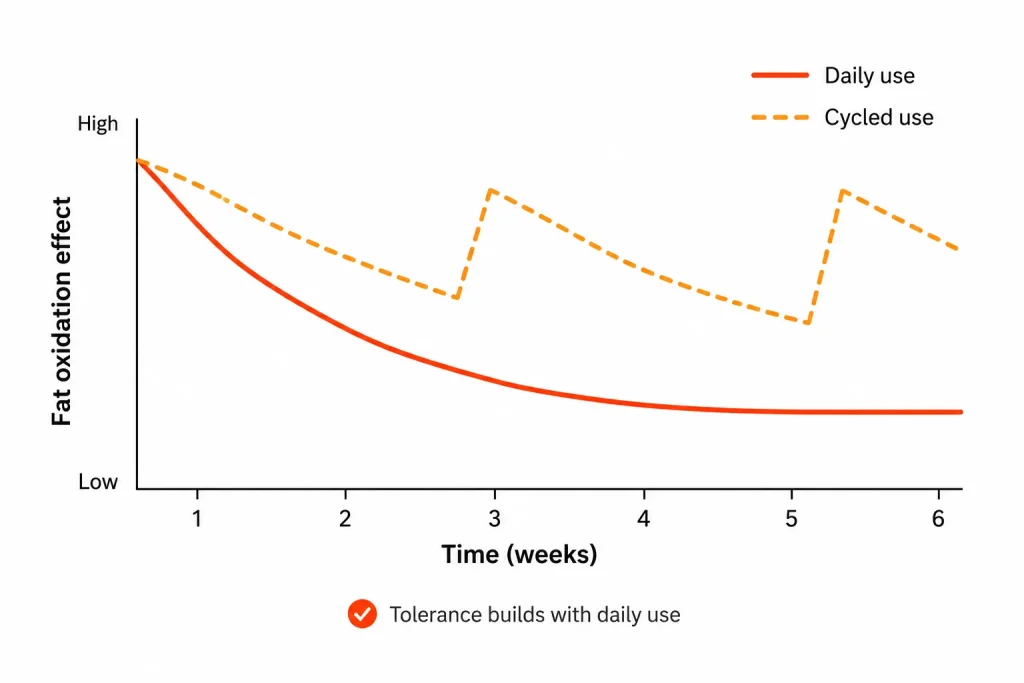
Tolerance builds with regular use. Studies point to habituation as a major reason coffee drinkers do not see ongoing weight loss from their daily cups, since the body adapts to the catecholamine response over time. This is why cycling intake, or keeping doses moderate rather than constantly increasing them, tends to preserve the fat-loss-relevant effects better than simply drinking more.
For fat loss specifically, timing caffeine before training, rather than first thing in the morning purely out of habit, gets you more practical benefit per milligram.
What the Research Actually Says
The research on caffeine and fat metabolism is genuinely solid, more so than most supplements marketed for fat loss.
A 2022 meta-analysis published in the International Journal of Sport Nutrition and Exercise Metabolism, covering 94 studies, found caffeine significantly increased fat metabolism with a small effect size, and that this effect was more consistent at rest than during exercise.
Older foundational research, commonly cited as the Dulloo et al. studies from the late 1980s, established the roughly 100 kcal per day increase in energy expenditure from higher caffeine doses spread through the day, a figure still referenced in current reviews on caffeine and thermogenesis.
“Caffeine may induce fat thermogenesis via the PGC-1α-UCP1 signaling pathway, thus increasing energy expenditure and ultimately exerting anti-obesity effects.” — Frontiers in Neuroscience review on caffeine and brown adipose tissue
The honest reality check: despite this real mechanism, there is little evidence that regular coffee or caffeine consumption alone produces significant long-term weight loss in humans, mainly because of habituation with prolonged daily use. The lab effect is real. The real-world weight loss effect, without training and diet changes alongside it, is much smaller than marketing suggests. For dosage safety context, the FDA’s official guidance on caffeine intake and the 2022 meta-analysis on caffeine and fat metabolism are both worth reading directly if you want the full data.
Side Effects and What to Watch Out For
Caffeine is safe for most healthy adults at reasonable doses, but a few things genuinely matter.
The FDA considers up to 400 mg a day safe for most healthy adults, roughly equivalent to 3 to 4 cups of brewed coffee. Going noticeably above that raises risk of anxiety, elevated heart rate, disrupted sleep, and in sensitive individuals, jitteriness even at lower doses.
People with anxiety disorders, uncontrolled high blood pressure, heart arrhythmias, or who are pregnant should be more cautious and ideally consult a doctor before adding a caffeine-based fat loss supplement on top of regular tea or coffee intake.
For Indian readers, the real risk is often stacking rather than any single source. Chai through the day, filter coffee, and then a pre-workout or fat burner pill can quietly push total intake well past 400 mg without anyone noticing, since none of these individually feels like “a lot” of caffeine.
Caffeine taken too late in the day is also a common, underrated problem. It can disrupt sleep quality even 6 or more hours after consumption in sensitive individuals, and poor sleep itself works against fat loss, something we cover in Does Lack of Sleep Cause Weight Gain?
Who Should Actually Use Caffeine for Fat Loss?
If your goal is fat loss and you train regularly
Time 100 to 200 mg of caffeine, roughly one strong cup of coffee, about 30 to 45 minutes before training. This is where caffeine’s fat-loss-relevant benefit is most reliable, through better workout output rather than the thermogenic effect alone.
If you already drink multiple cups of chai or coffee daily
Track your rough total before adding a supplement. If you are already near 200 to 300 mg a day from tea and coffee, a full-strength pre-workout on top can easily push you over the safe daily limit.
If you are sensitive to caffeine or get anxious easily
Start at 50 to 100 mg and assess how you feel before increasing. There is no fat loss benefit to pushing through jitteriness or anxiety, and the appetite-suppressing effect does not require a large dose to show up.
If you are choosing a fat loss supplement
Caffeine is one of the few ingredients in most fat burner formulas with real evidence behind it. If you are comparing full products rather than caffeine alone, our breakdown of the Best Fat Burner Supplement 2026 and 5 Best Fat Loss Supplements That Actually Work both cover where caffeine fits alongside other ingredients.
If you have a heart condition, anxiety disorder, or are pregnant
Talk to a doctor before adding caffeine specifically for fat loss purposes. The general population safety data does not automatically apply to these groups.
The Bottom Line
Caffeine for fat loss is not a myth, but it is not a shortcut either. The mechanism is real: it raises thermogenesis slightly, increases fat oxidation measurably, and most usefully, helps you train harder.
What it will not do is replace a calorie deficit or a real training plan. Treat it as a small, genuinely useful edge you time around your workouts, not a fat burner you take and wait for results from. Used that way, within the 400 mg daily limit, it earns its place in a fat loss plan far more than most supplements marketed alongside it.
People Also Ask
Does black coffee burn belly fat?
Not directly. Black coffee’s caffeine content mildly raises metabolism and fat oxidation, but it does not target belly fat specifically. Fat loss from any single area follows overall body fat reduction, not the source of caffeine.
How much caffeine should I take before a workout for fat loss?
Most research supports 100 to 200 mg, taken 30 to 45 minutes before training, as the range that improves performance without excessive side effects for most people.
Is caffeine better than green tea for fat loss?
Caffeine content is the main active driver in both, so coffee generally provides a stronger effect simply due to higher caffeine content. Green tea offers additional compounds like catechins, but the fat loss evidence for caffeine itself is stronger and more consistent.
Can I take caffeine and creatine together for fat loss and muscle gain?
Yes, they work through different mechanisms and are commonly used together, though some people report slightly reduced performance benefits from creatine when very high doses of caffeine are combined. Moderate doses of both together are generally fine for most people.
Does caffeine stop working for fat loss over time?
Tolerance does build with regular daily use, which reduces the size of the thermogenic and fat oxidation effects over weeks and months. Cycling intake or keeping doses moderate helps preserve more of the benefit long term.
Is it safe to drink chai and take a pre-workout with caffeine on the same day?
It can be, as long as your total caffeine across both stays under the 400 mg daily guideline for healthy adults. The risk is not either source individually, it is the combined total most people do not track.
Does caffeine cause weight gain if I stop taking it?
Caffeine itself does not cause weight gain when stopped. Any weight change after quitting usually comes from reduced training intensity if caffeine was supporting harder workouts, not from caffeine withdrawal directly affecting fat storage.
Sources and References
U.S. Food and Drug Administration. Spilling the Beans: How Much Caffeine Is Too Much? FDA.gov. https://www.fda.gov/consumers/consumer-updates/spilling-beans-how-much-caffeine-too-much
Tan, S., et al. (2022). Does Caffeine Increase Fat Metabolism? A Systematic Review and Meta-Analysis. International Journal of Sport Nutrition and Exercise Metabolism, 33(2). https://journals.humankinetics.com/view/journals/ijsnem/33/2/article-p112.xml
Dulloo, A. G., et al. (1989). Caffeine and thermogenesis in humans. Referenced in: Effects of Caffeine on Brown Adipose Tissue Thermogenesis and Metabolic Homeostasis: A Review, Frontiers in Neuroscience. [Search directly on PubMed for full original text]
Mayo Clinic Staff. Caffeine: How Much Is Too Much? Mayo Clinic. [Search directly on MayoClinic.org]