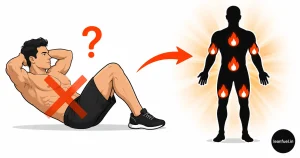
Introduction: The “Success” That Fails
Stop losing muscle just to regain fat. Discover a sustainable fat loss plan backed by 2025 research focusing on metabolic adaptation, protein leverage, and behavioral self-regulation.
Let me paint a picture you might recognize.
You start a new diet—let’s call it the “Detox Blast 3000.” You cut carbs, slash calories, and for four weeks, the scale moves like magic. You feel light. You feel victorious. But then, something shifts. The hunger creeps in. Your workouts feel flat. Eventually, you crack, order the pizza, and within a month, you are back to square one—often heavier than when you started.
If this sounds familiar, you are not weak; you are perfectly human. And you are fighting a biological machine designed for survival, not aesthetics.
The problem isn’t your willpower. The problem is that most diets focus on short-term weight rather than long-term body composition. To build a sustainable fat loss plan, you absolutely must stop trying to trick your body and start working with it.
Based on the latest 2025 clinical guidelines and metabolic research, here are the three non-negotiable things you have to get right.
1. Outsmarting Metabolic Adaptation (The “Slow Metabolism” Trap)
When you cut calories drastically, your body doesn’t think, “Great, I’m getting healthier.” It thinks, “Famine is here. Hunker down.”
According to a 2022 review in the Journal of Strength and Conditioning Research, the human body undergoes specific “metabolic adaptations” to weight loss. Your thyroid hormones dip, your resting energy expenditure drops, and your body becomes hyper-efficient at using fuel .
This is why your initial rapid weight loss grinds to a halt. You didn’t “break” your metabolism; it adapted perfectly to keep you alive.
The Solution: Strategic Energy Flux
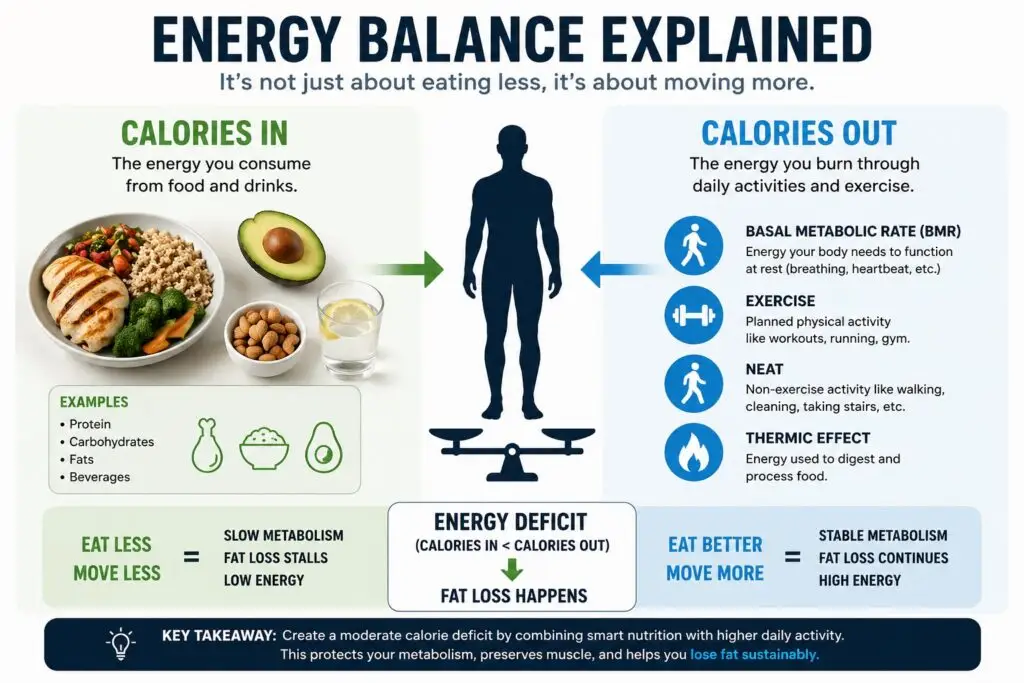
A sustainable fat loss plan doesn’t just cut energy; it manages energy flux. Instead of slashing calories to 1,200 and sitting on the couch (low calorie AND low activity), you should aim for moderate calorie reduction with HIGH physical activity.
Think of it like this:
- The Trap: Consume 1500 calories, burn 1800 (Deficit of 300).
- The Flux Upgrade: Consume 2300 calories, burn 2600 (Deficit of 300).
By keeping calories higher but increasing non-exercise activity thermogenesis (NEAT) and structured exercise, you signal to your body that the environment is abundant and active, preventing that metabolic shutdown . You get to eat more and lose fat. It’s a win-win.
| Approach | Calories In | Calories Out | Result |
|---|---|---|---|
| Standard Diet (High Risk) | Very Low (e.g., 1200) | Low (Sedentary) | Muscle loss, Metabolic slowdown, Rebound |
| Sustainable Plan (Optimal) | Moderate (e.g., 2300) | High (Active lifestyle) | High energy, Metabolic stability, Fat loss |
2. Protein & Resistance: Save Your Scaffolding
Here is the cruel irony of standard “weight loss”: about 20-30% of the weight you lose on a crash diet isn’t fat—it’s muscle and bone density .
Muscle is your metabolic furnace. Lose muscle, and you have to eat fewer calories forever just to stay at the same weight. Furthermore, research from Deakin University highlights that weight loss often has “detrimental effects on muscular strength and bone density” if you aren’t careful .
The “High-Protein” Lever
To build a sustainable fat loss plan, you must prioritize musculoskeletal health.
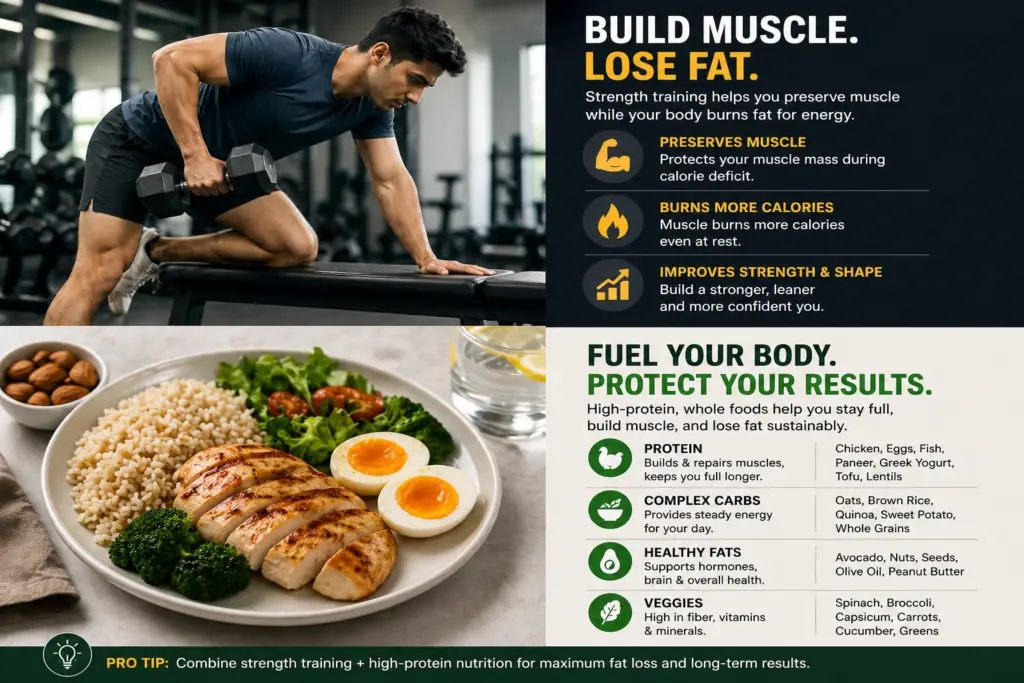
Dr. Jakub Mesinovic, who led a major 2025 review on the topic, recommends a protein intake of at least 1.2 grams per kilogram of body weight per day (though studies suggest going to 1.6g–2.2g/kg is superior for active individuals) .
But protein alone isn’t enough.
- The Cardio Trap: Running on a deficit burns calories, but it also breaks down muscle tissue.
- The Resistance Solution: Lifting weights tells your body, “Hey, I need this muscle to survive this famine.”
Progressive resistance training is the only signal that overrides the catabolic (breakdown) effects of dieting. It forces your body to tap into fat stores for energy while preserving the lean tissue .
3. The Psychology of Behavior Carried Over (Self-Regulation)
Let’s be honest: We all know what to eat. Vegetables are good. Sugar is tempting. The gap between knowledge and action is behavioral.
A fascinating 2025 study published in Health Education & Behavior looked at women in a weight loss program. The study found that successful long-term results weren’t dependent on knowing the diet plan. They depended on Self-Regulation .
The participants who succeeded did something specific: they learned to regulate their exercise habits first, and then they successfully carried over that skill to regulate their eating habits .
The “Carry-Over” Effect
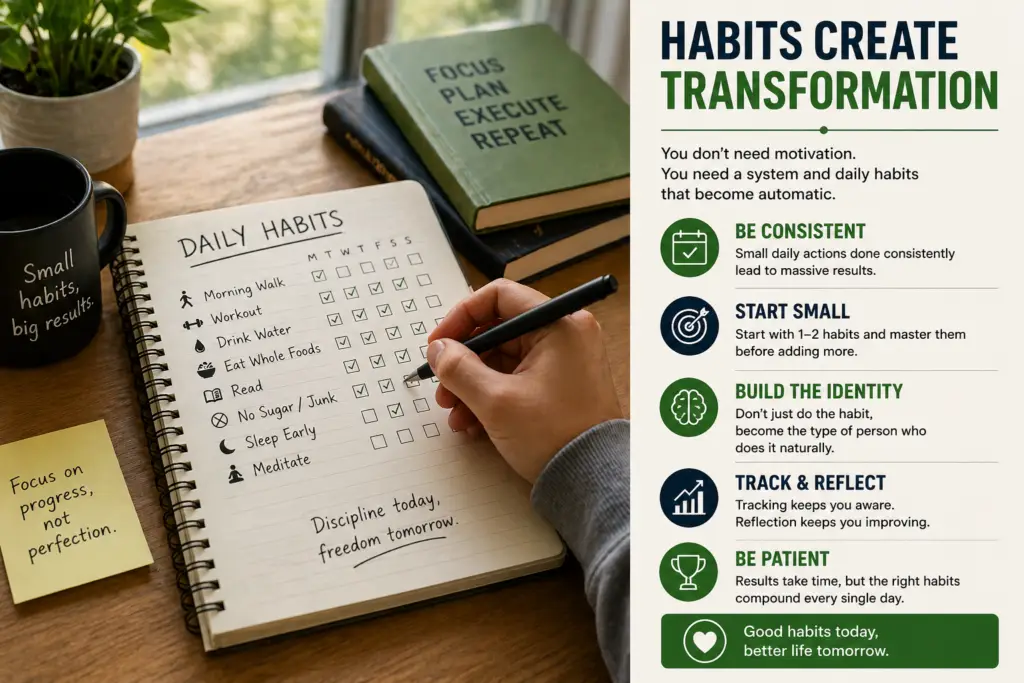
You cannot rely on motivation. Motivation is a feeling; regulation is a skill.
- Start with Exercise: Not for the calorie burn, but for the discipline. Commit to showing up for 10 minutes of walking or lifting. Do this until it is automatic (habituated).
- Bridge the Skill: Once the exercise habit is solid, you ask yourself: “How did I just make myself workout when I was tired? Can I apply that ‘just start’ rule to chopping these vegetables instead of ordering takeout?”
The Oxford Food and Behaviours (OxFAB) cohort study further supports this, noting that “dietary impulse control” and “weight loss planning and monitoring” were the specific cognitive strategies associated with the greatest loss . You need a system, not just a wish.
Summary: Your Actionable Checklist
If you are ready to ditch the yo-yo cycle, here is your framework for a sustainable fat loss plan.
✅ 1. Increase Your “Energy Flux”
- Action: Add 3,000–5,000 steps to your daily routine before you cut your calories drastically.
- Why: Keeps your metabolic rate high.
✅ 2. Prioritize Protein & Lifting
- Action: Eat +1.6g protein/kg of body weight. Lift heavy weights (or challenge your muscles) 3x per week.
- Why: Protects bone density and metabolic furnace .
✅ 3. Automate the Behavior
- Action: Link your new habits. “After I brush my teeth, I will walk for 15 minutes.” Use habit stacking to carry over self-regulation .
- Why: Removes decision fatigue when willpower is low.
Conclusion
The weight loss industry makes money by selling you urgency. But the biology of obesity is a chronic, relapsing condition . You cannot cure a chronic condition with a 30-day fix.
True success comes from viewing yourself as an athlete of life. You are not trying to get skinny; you are trying to build a resilient, strong, metabolically healthy body. The scale might move slower this way, but the mirror will change faster—and this time, the results will last.
Ready to stop dieting and start living?
If you found this framework helpful, share it with a friend who is currently “dreading” their Monday diet. Sometimes, the only thing standing between us and success is permission to do it the sustainable way.
What is the #1 habit you struggle to keep consistent? Let me know in the comments below!