
Magnesium glycinate does help with certain types of anxiety, but not because it works like a drug that directly blocks anxious thoughts. The effect is quieter than that. Magnesium regulates the nervous system’s ability to calm itself down, and a large number of people with anxiety are deficient in the mineral without knowing it. When that deficiency is corrected, the overactive fight-or-flight response dials back, sometimes within days.
This matters for the leanfuel.in reader in India because anxiety is rarely talked about as a nutritional problem. The conversation here usually goes straight to prescription medication or meditation apps, skipping the possibility that the brain is simply missing a mineral it needs to function. Magnesium is not a replacement for therapy or medical treatment, but for the kind of low-grade, persistent anxiety that sits in the chest and makes everything feel slightly harder than it should, correcting a deficiency can change the baseline. Most people online get this wrong by recommending magnesium as a generic “relaxation supplement” without explaining which form to take, why it works, or how to know if it will work for you specifically.
The most useful thing to understand upfront is that magnesium glycinate is not a sedative. It does not force calm. It restores the biochemical conditions that allow calm to happen naturally.
Before You Read Further
- Magnesium glycinate can reduce anxiety symptoms, particularly in people whose anxiety has a strong physical component such as muscle tension, restlessness, or a pounding heart.
- The strongest evidence supports its use in mild to moderate anxiety, especially when linked to magnesium deficiency, which is common in diets low in leafy greens, nuts, and whole grains.
- Magnesium works by regulating the body’s stress-response system, not by directly altering thoughts, so it is more effective for physical anxiety than for purely mental rumination.
- The glycinate form is preferred for anxiety because glycine itself is a calming neurotransmitter, and this form absorbs well without causing digestive distress.
- Clinical studies show improvements in anxiety scores within a few weeks of daily supplementation, with doses typically ranging from 200 to 400 mg of elemental magnesium from magnesium glycinate.
Why Most People Get This Wrong From the Start
The most common mistake is believing that magnesium works the same way for everyone who feels anxious. It does not. Anxiety is not one condition with one cause. Some anxiety is primarily cognitive, driven by thought patterns and life circumstances. Some anxiety is primarily physiological, driven by a nervous system stuck in overdrive. Magnesium glycinate is far more likely to help with the second kind.
Think of it this way. If your anxiety feels like a loud internal monologue that you cannot turn off, magnesium may help indirectly by improving sleep and lowering physical tension, but it is unlikely to be the full answer. If your anxiety feels like a body that will not settle down, a chest that stays tight, muscles that ache from constant bracing, and a nervous system that startles easily, then magnesium glycinate is directly addressing the mechanism that keeps you stuck.
In India, there is an additional layer of confusion because magnesium is mostly marketed as a muscle recovery supplement for gym-goers or as a laxative. The anxiety conversation is entirely missing from product labels and pharmacy counters. Meanwhile, the Indian diet has shifted dramatically away from traditional magnesium-rich foods. Millets like ragi and jowar, which were staples in previous generations, have been replaced by polished white rice. Leafy greens are cooked down to a fraction of their raw volume, and nut consumption remains low outside of festival seasons. A large-scale nutritional survey in India would likely reveal widespread suboptimal magnesium intake, but even without an exact number, the dietary pattern shift alone makes deficiency a legitimate concern for anyone dealing with unexplained anxiety.
How Magnesium Glycinate Calms an Overactive Brain
Magnesium calms the nervous system by blocking excess calcium from flooding into nerve cells, which reduces the constant firing that underlies physical anxiety.
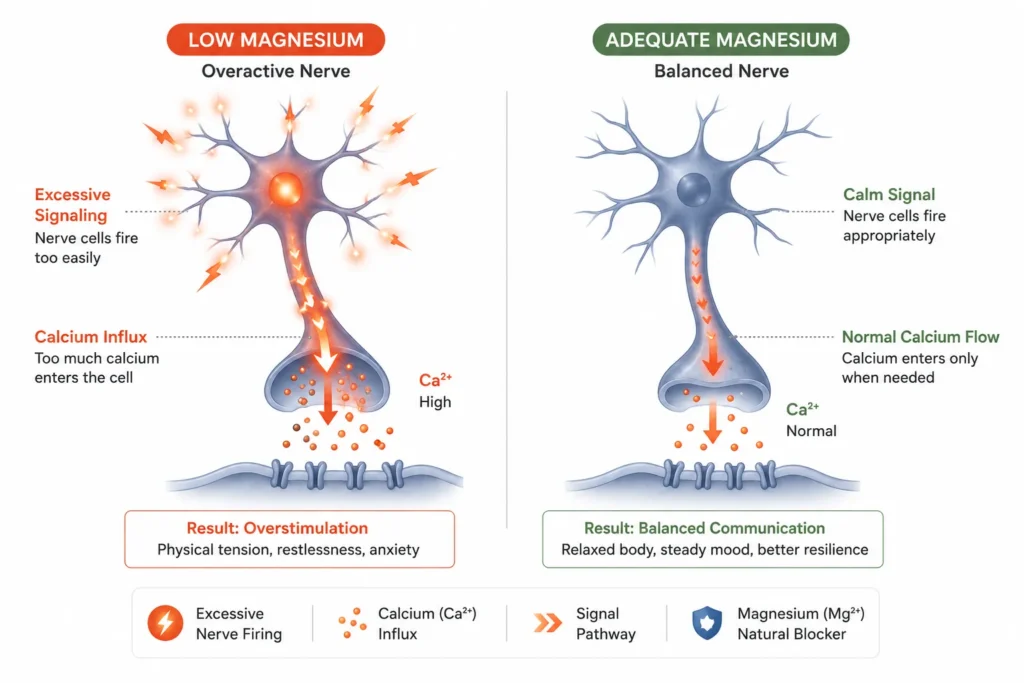
Nerve cells communicate through electrical signals. When a nerve fires, calcium rushes into the cell to trigger the release of neurotransmitters. Magnesium acts as a natural gatekeeper, blocking the calcium channel and preventing the nerve from firing too easily. When magnesium levels are low, nerve cells become hyper-excitable. They fire in response to stimuli that should not trigger a reaction. This is why magnesium deficiency often shows up as muscle twitching, startling easily, and a general sense of being on edge. The mechanism is called NMDA receptor antagonism, where NMDA stands for N-methyl-D-aspartate, a receptor that controls neuronal excitation. Magnesium is the body’s natural way of keeping that receptor in check.
The glycine part matters just as much. Glycine is an amino acid that functions as an inhibitory neurotransmitter in the brain. It binds to glycine receptors and quiets neural activity, producing a mild calming effect that is separate from magnesium’s own action. When you take magnesium glycinate, you get both the mineral’s channel-blocking effect and glycine’s direct calming signal. This is why magnesium glycinate outperforms other forms for anxiety and sleep. No other common form delivers a calming amino acid alongside the mineral.
Clinical research on magnesium and anxiety consistently shows a benefit, but the effect size depends heavily on the population studied and the baseline magnesium status.
The strongest evidence comes from a 2017 systematic review published in the journal Nutrients, which examined 18 studies on magnesium and subjective anxiety. The authors concluded that existing evidence suggests a beneficial effect of magnesium on anxiety, though they noted that the quality of the studies varied and that larger, well-designed trials were still needed. View on PubMed
A 2017 randomized clinical trial published in PLoS ONE took a slightly different angle. It studied magnesium supplementation in people with depression but measured anxiety as a secondary outcome using the Generalized Anxiety Disorder 7-item scale. The magnesium group showed a clinically significant reduction in anxiety scores over six weeks, taking 248 mg of elemental magnesium daily. View on PubMed This study is particularly relevant because it used magnesium chloride, not glycinate, but the mechanism is the same. The glycinate form would theoretically perform at least as well, given the added glycine benefit.
An earlier 2012 trial in elderly individuals with insomnia, published in the Journal of Research in Medical Sciences, also measured cortisol and found that magnesium supplementation lowered both sleep-related anxiety and stress hormone levels. View on PubMed The dose used was 500 mg of elemental magnesium daily, which is on the higher end and should be approached with caution.
One honest reality check is that the average person’s experience often diverges from study averages. Some people notice a dramatic calming effect within three days of starting magnesium glycinate. Others feel almost nothing after a month. The dividing line almost always comes down to whether the person was genuinely deficient. If your magnesium levels are already adequate, adding more will not reduce anxiety because the anxiety is coming from somewhere else entirely.
Magnesium oxide, the cheap form sold in most Indian pharmacies, is nearly useless for anxiety because almost none of it reaches the brain.
A study on magnesium absorption found that magnesium oxide has a bioavailability of roughly 4 percent, meaning only 4 out of every 100 mg of the mineral actually enter the bloodstream. Magnesium glycinate, by contrast, has bioavailability above 80 percent in many estimates. This matters because you need magnesium ions in the cerebrospinal fluid to influence the central nervous system. Oxide stays mostly in the gut and acts as a laxative. If you have been taking a cheap magnesium supplement and feeling nothing but loose stools, you were never treating your brain. You were just cleaning your colon.
One specific myth in Indian fitness circles is that all magnesium supplements are interchangeable and that buying the cheapest one is smart shopping. It is not. Magnesium oxide costs less because it is poorly absorbed. Magnesium glycinate costs more because it actually works. For anxiety, this difference is everything. If you want to understand the broader picture of how magnesium deficiency shows up beyond anxiety, the 7 Signs of Magnesium Deficiency Most People Ignore article covers what to look for.
The dose and the timing determine whether magnesium glycinate helps your anxiety or just makes you sleepy at the wrong time of day.
Anxiety does not only happen at night, and magnesium glycinate should not be reserved only for bedtime if anxiety is a daytime problem. A common effective dosing strategy is to split the total daily dose into two parts. Take half in the morning to keep the nervous system steady throughout the day, and half an hour before bed to support sleep and overnight recovery. A total of 300 to 400 mg of elemental magnesium from magnesium glycinate is a well-studied range. Start at 200 mg for the first week to see how your body responds before increasing.
Taking magnesium glycinate with food can reduce the small risk of digestive discomfort, but the glycinate form is gentle enough that most people tolerate it on an empty stomach without issue. Do not take it with high-dose calcium supplements at the same time, because calcium and magnesium compete for absorption in the gut. If you take both, space them out by at least two hours.
Magnesium Forms Compared for Anxiety Relief
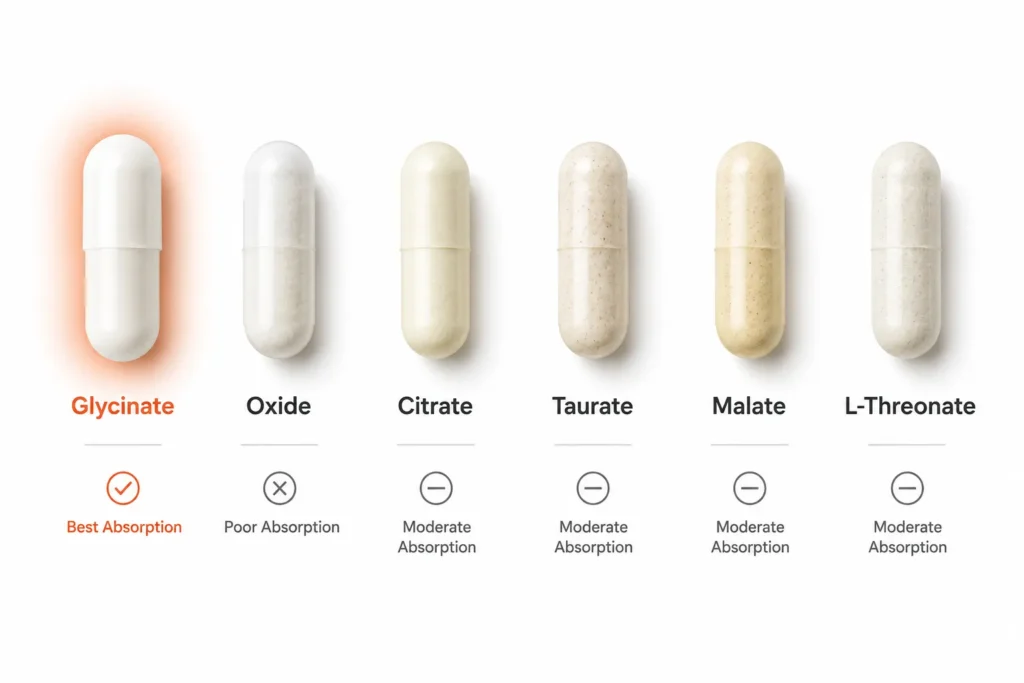
| Form | Bioavailability Estimate | GABA/Glycine Benefit | Digestive Tolerance | Best For | Verdict |
|---|---|---|---|---|---|
| Magnesium Glycinate | ~80% | Yes, glycine is calming | Excellent | Anxiety, sleep, no laxative effect | Best overall for anxiety |
| Magnesium Citrate | ~30-40% | No | Moderate, can cause urgency | Anxiety with constipation | Good but watch gut |
| Magnesium Oxide | ~4% | No | Poor, strong laxative | None for anxiety | Avoid for anxiety |
| Magnesium L-Threonate | High brain penetration | No glycine benefit | Good | Cognitive anxiety, memory | Promising but expensive |
| Magnesium Taurate | Moderate-high | Taurine has calming properties | Good | Heart palpitations with anxiety | Underrated option |
| Magnesium Malate | Moderate | No | Good | Anxiety with fatigue | Daytime energy option |
How Your Body Actually Processes Magnesium for Anxiety Relief
When you swallow a magnesium glycinate capsule, the compound dissociates in the stomach and small intestine. The magnesium ion and the glycine molecule separate. Magnesium is absorbed primarily in the ileum and colon through both passive and active transport mechanisms. Once in the bloodstream, magnesium crosses the blood-brain barrier through specific transporters, though this process is slow and tightly regulated. This is why brain magnesium levels do not rise dramatically after a single dose. Consistent daily intake over weeks gradually increases the available magnesium pool in the central nervous system.
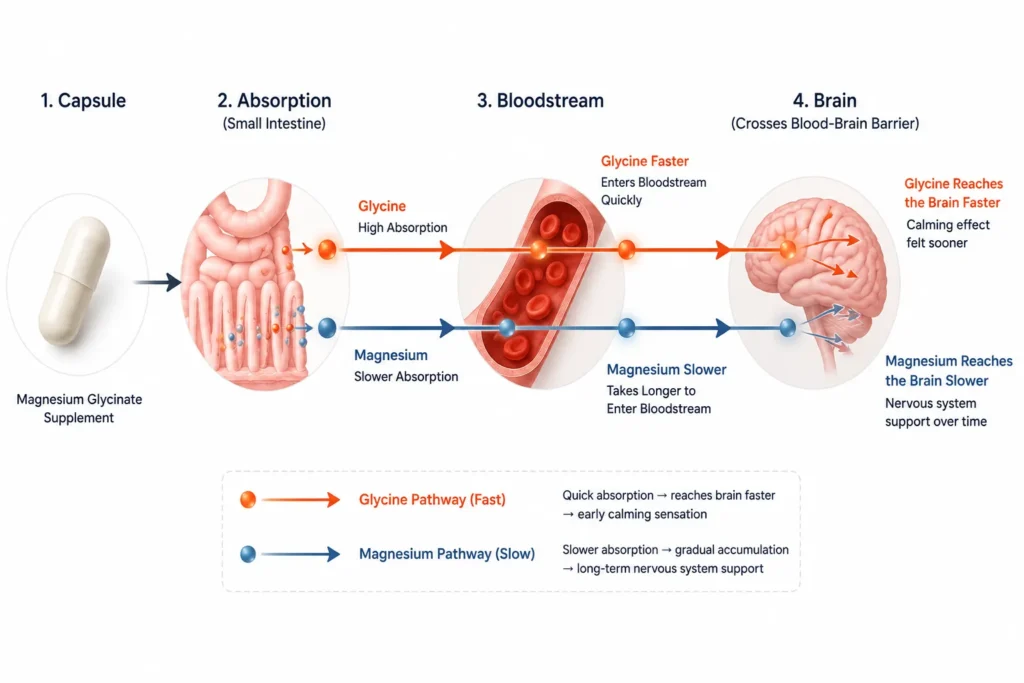
Glycine follows a faster path. It readily crosses the blood-brain barrier and directly activates inhibitory glycine receptors while also serving as a co-agonist for NMDA receptors, which helps fine-tune the balance between excitation and inhibition. This is why some people feel a mild calming effect within an hour of taking magnesium glycinate even before the magnesium itself has fully distributed. The glycine is doing real neurological work in that first hour.
One timing recommendation that fits Indian routines is to take the morning dose with breakfast around 8 or 9 AM, and the evening dose with a light snack or warm milk around 9 PM if sleep is the goal. Consistency matters more than the exact hour. Magnesium works cumulatively. Missing a day is not a crisis, but erratic intake will never produce the steady-state brain levels needed for consistent anxiety relief.
What the Research Actually Says, Without Overpromising
The 2017 systematic review by Boyle and colleagues in Nutrients is the most comprehensive look at magnesium and anxiety to date. The review included studies across a range of populations, from individuals with premenstrual syndrome to those with generalized anxiety disorder, and the overall direction was positive. However, the authors were careful not to overstate the case.
“Existing evidence suggests a beneficial effect of Mg on subjective anxiety… However, the quality of the existing evidence is poor and well-designed randomised controlled trials are required to further confirm the efficacy of Mg.” — Boyle et al., Nutrients, 2017
This is not a disclaimer that cancels the finding. It is an honest reflection that the research is promising but not yet definitive. The clinical signal is there, but large pharmaceutical trials cost millions and nobody is going to fund that for an unpatentable mineral. The absence of massive trials is not proof of ineffectiveness. It is proof of a funding gap.
The real-world experience of people who try magnesium glycinate for anxiety is often more positive than the cautious language of the studies suggests. This is likely because clinical trials recruit broadly, while real-world users self-select based on symptoms that strongly suggest deficiency. If you have physical anxiety, muscle tension, poor sleep, and a diet low in magnesium-rich foods, your odds of responding well are far higher than the average study participant’s.
The Things Worth Knowing Before You Start
Magnesium glycinate is one of the safest supplements available, but it is not completely without risk. People with kidney disease must avoid magnesium supplementation entirely because the kidneys regulate magnesium excretion, and impaired function can cause dangerous blood levels. If you have any degree of kidney impairment, this is not a supplement to experiment with. Check with your doctor.
The most common side effect at normal doses is mild digestive loosening, which affects perhaps one person in ten. This is usually temporary and resolves as the gut adjusts. At doses above 500 mg of elemental magnesium per day, the risk of diarrhea increases meaningfully. Start low and increase slowly. Do not jump straight to a high dose because you want faster relief. The nervous system does not work that way.
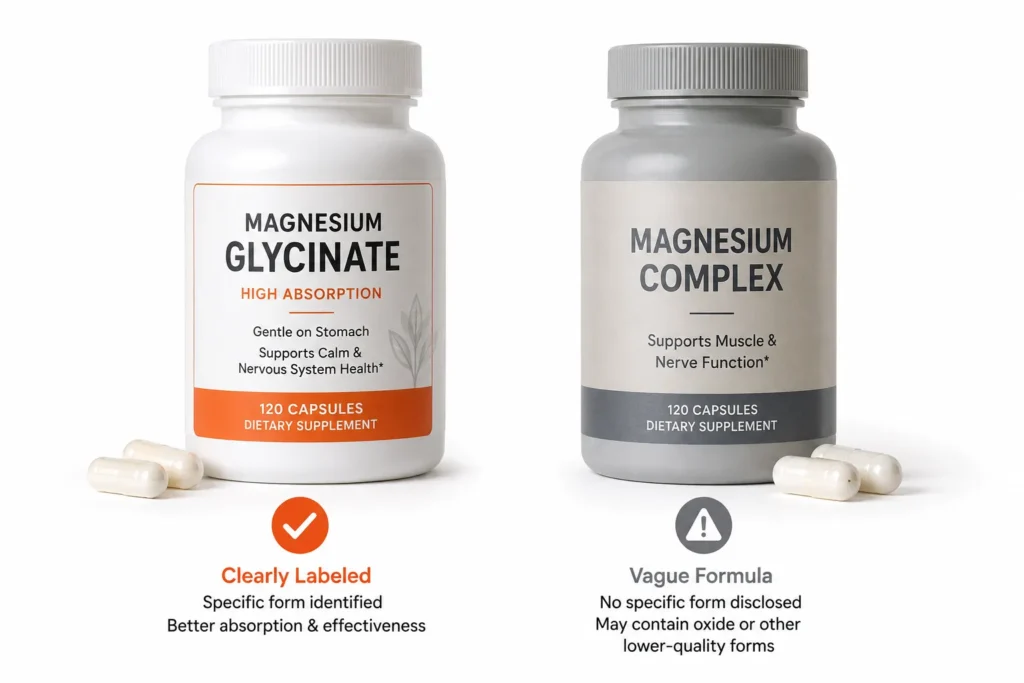
In India, one practical concern is the quality of the supplement supply chain. Many magnesium products on e-commerce platforms do not specify the form clearly or use vague terms like “magnesium complex” that hide the presence of cheap oxide. Read the label carefully. The ingredient list must say “magnesium glycinate” or “magnesium bisglycinate.” If it does not, assume you are buying oxide and move on. Price is a reasonable signal here. Real magnesium glycinate costs roughly two to three times more than the cheapest magnesium options, and that price difference reflects real differences in manufacturing cost and absorption.
Who Should Actually Try This, and Who Should Not

If your anxiety shows up mostly in your body rather than your thoughts.
You are the best candidate for magnesium glycinate. This means you feel tightness in your chest, muscle tension in your shoulders and jaw, a racing heart without a clear trigger, or a constant sense of physical unease that you cannot talk yourself out of. Take 300 mg of elemental magnesium from magnesium glycinate daily, split into two doses, and give it three to four weeks before deciding whether it works.
If your anxiety is mostly mental rumination and worry cycles.
Magnesium glycinate may help indirectly by improving sleep quality and reducing baseline physiological arousal, but it is unlikely to be the primary solution. Cognitive behavioral strategies, therapy, or in some cases medication will address the root issue more directly. Use magnesium as a supportive tool, not the main treatment.
If you are on a tight budget and can only afford one anxiety supplement.
Start with magnesium glycinate before trying anything else. The safety profile is excellent, the deficiency probability is high in the Indian dietary context, and the cost is lower than most other targeted anxiety supplements. A one-month supply of a good magnesium glycinate product in India typically costs between 500 and 900 rupees, which is reasonable for a daily supplement that also supports sleep, muscle recovery, and heart health. For a broader comparison of magnesium with other minerals, the Magnesium vs Zinc guide covers which mineral makes more sense for your specific symptoms.
If you already take medication for anxiety or depression.
Magnesium glycinate is generally safe to combine with SSRIs and most common psychiatric medications, but you must inform your doctor before adding it. Magnesium can theoretically influence neurotransmitter levels, and while adverse interactions are rare, the combination should be monitored. Never stop prescribed medication to try magnesium instead. That is not how this works.
If you are a vegetarian in India eating a typical rice-and-dal-heavy diet.
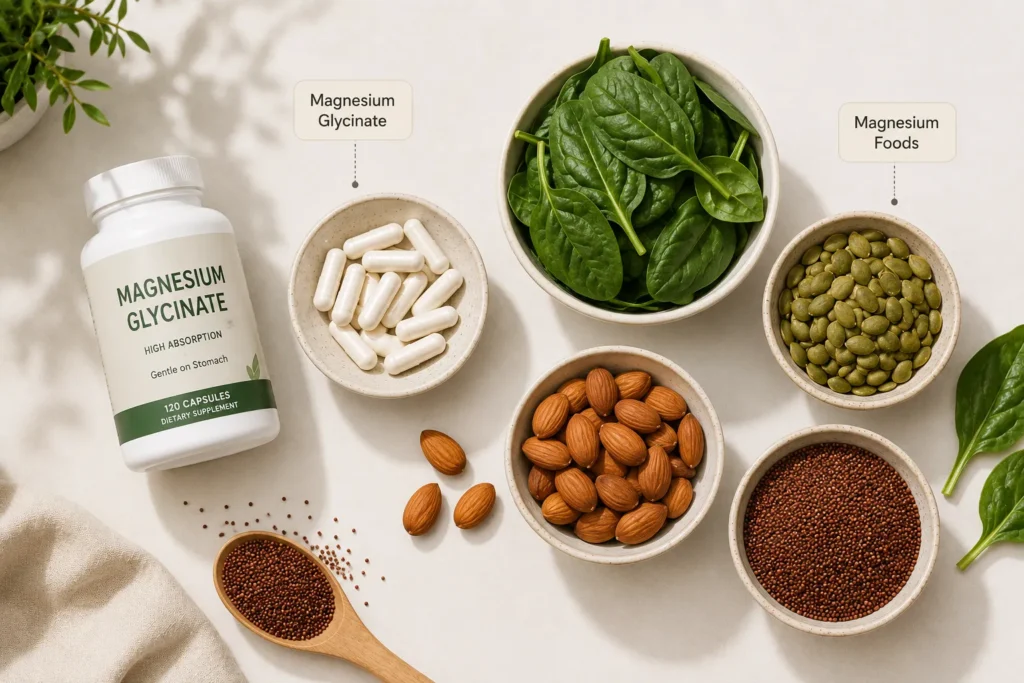
Your magnesium intake is almost certainly suboptimal. The foods richest in magnesium are pumpkin seeds, almonds, spinach, and whole millets, none of which appear in large quantities in the standard urban Indian vegetarian plate. Supplementing with magnesium glycinate is one of the most straightforward nutritional upgrades you can make, and the anxiety benefits may be a side effect of fixing an underlying deficiency you did not know you had.
If you are a complete beginner to supplements and do not know where to start.
Start with a single-ingredient magnesium glycinate product. Do not buy a blend that promises to fix everything. Do not buy a product with five different forms of magnesium and a proprietary blend. One ingredient, one clear dose on the label. Take it consistently for one month, track how you feel daily in a simple note on your phone, and decide based on your own data. Your body will tell you more than any article can.
The Bottom Line
Magnesium glycinate helps with anxiety, but it is not a magic pill. It works when anxiety is being driven or worsened by a magnesium deficiency that keeps the nervous system in a state of low-grade hyperarousal. When that deficiency is corrected, the body’s natural braking system comes back online, and the anxious edge softens. If your anxiety has nothing to do with magnesium status, the supplement will not do much beyond mild relaxation.
The hardest part is that you cannot know your magnesium status from a standard blood test. Serum magnesium is tightly regulated by the body and will appear normal even when tissue levels are low. The best diagnostic tool is a combination of dietary honesty and symptom pattern recognition. If you eat few leafy greens, few nuts, and few whole grains, and you feel physically anxious for no clear reason, the odds are strongly in your favor that magnesium glycinate will make a noticeable difference. Try it for a month. The body does not lie.
People Also Ask
How long does magnesium glycinate take to work for anxiety?
Some people notice a mild calming effect within a few hours of the first dose because of the glycine content. For full anxiety relief tied to correcting a magnesium deficiency, it typically takes two to four weeks of consistent daily use. The nervous system recalibrates slowly. Do not judge the results after a few days.
Can magnesium glycinate make anxiety worse at first?
No, there is no known mechanism by which magnesium glycinate would worsen anxiety. Some people experience temporary digestive discomfort when starting, which can feel uncomfortable but is not anxiety. If you feel more anxious after starting, the cause is likely unrelated to the magnesium, but you should stop and reassess.
What is the best magnesium for anxiety and panic attacks?
Magnesium glycinate is the best-studied form for anxiety because it combines magnesium’s nervous system regulation with glycine’s calming effect. Magnesium taurate is an alternative worth considering if anxiety includes heart palpitations or a pounding heartbeat. Avoid magnesium oxide entirely for anxiety purposes.
Is magnesium glycinate safe to take every day long-term for anxiety?
Yes, magnesium glycinate is safe for daily long-term use at recommended doses of 200 to 400 mg of elemental magnesium per day. The body excretes excess magnesium through the kidneys in healthy individuals. The only people who need to avoid long-term use are those with kidney disease or severe renal impairment.
Can magnesium glycinate replace anxiety medication?
No, magnesium glycinate is a nutritional supplement, not a pharmaceutical intervention. It can support nervous system health and may reduce mild to moderate anxiety, but it is not a substitute for prescribed medication. If you are on anxiety medication, do not stop it to try magnesium. Discuss any supplement additions with your doctor.
Why do I feel sleepy during the day after taking magnesium glycinate?
The glycine component has a mild sedative effect. If daytime sleepiness occurs, you are likely taking too high a dose during the day or taking it on an empty stomach when the calming effect hits faster. Split the dose into a smaller morning amount and a larger evening amount, and take it with food to slow absorption.
Sources and References
- Boyle, N.B., Lawton, C., & Dye, L. (2017). The Effects of Magnesium Supplementation on Subjective Anxiety and Stress—A Systematic Review. Nutrients, 9(5), 429. View on PubMed
- Tarleton, E.K., Littenberg, B., MacLean, C.D., Kennedy, A.G., & Daley, C. (2017). Role of magnesium supplementation in the treatment of depression: A randomized clinical trial. PLoS ONE, 12(6), e0180067. View on PubMed
- Abbasi, B., Kimiagar, M., Sadeghniiat, K., Shirazi, M.M., Hedayati, M., & Rashidkhani, B. (2012). The effect of magnesium supplementation on primary insomnia in elderly: A double-blind placebo-controlled clinical trial. Journal of Research in Medical Sciences, 17(12), 1161–1169. View on PubMed