
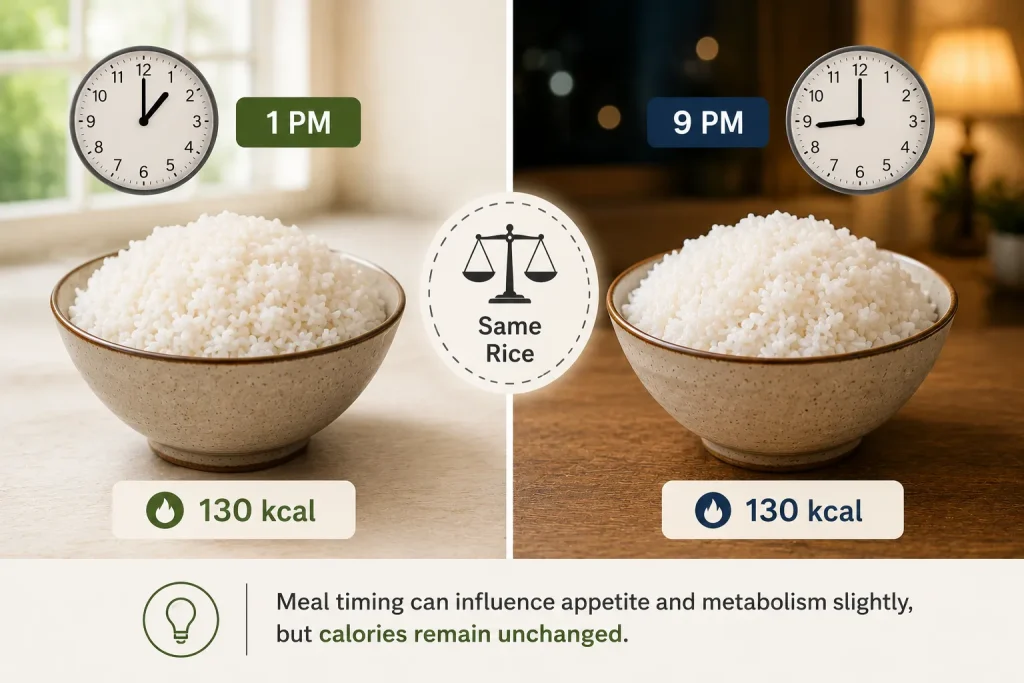
Eating rice at night does not cause weight gain on its own — weight gain is determined by total daily calorie intake, not the hour at which you eat any specific food. A bowl of rice eaten at 9 PM contains the exact same number of calories as a bowl of rice eaten at 1 PM, and your body does not suddenly convert carbohydrates into fat because the sun has set.
That said, the timing of food does have some modest biological effects on metabolism, hunger, and fat storage that are worth understanding honestly. The idea that rice at night is automatically fattening is wrong. The idea that meal timing is completely irrelevant is also an oversimplification. The truth sits in the middle, and it matters for a lot of Indians whose daily dinner is built around rice.
India’s per capita rice consumption reached approximately 105 kg per year in 2021 according to FAO data, making rice the single most consumed cereal in the country. For most Indians, rice is not just a dinner choice — it is a cultural anchor. The question of whether it is causing weight gain at night is therefore not an abstract nutrition debate. It is something that affects hundreds of millions of people making real food decisions every evening.
The answer depends on what you are actually asking, and the details below separate the myth from the genuine nuance.
What Actually Determines Whether Rice at Night Makes You Fat
- Total daily calories — not meal timing — is the primary driver of weight gain. A 2022 randomised crossover trial published in Cell Metabolism found no difference in total daily energy expenditure or weight loss between people who ate most of their calories in the morning versus the evening when total intake was identical.
- White rice has a glycemic index of approximately 72, which is high, meaning it raises blood sugar quickly. Pairing it with dal, sabzi, or curd significantly lowers the glycaemic response of the whole meal.
- Late-night eating patterns are associated with modestly increased hunger and reduced fat burning, per a 2022 Cell Metabolism study from Brigham and Women’s Hospital, but this effect is about the pattern across weeks, not a single meal.
- The reason night-time rice gets blamed for weight gain is usually portion size and total daily calories, not the rice or the timing specifically. People who eat a large rice-based dinner often skip breakfast or snack more at night, pushing their total intake higher without realising it.
- For most healthy Indians eating within a reasonable calorie budget, rice at dinner is not a weight gain problem and does not need to be eliminated or replaced.
Why the Rice-at-Night Fear Exists and Why It Is Largely Wrong
The belief that carbohydrates eaten at night are more fattening comes from two sources: a simplified understanding of insulin, and the observation that people who eat heavily at night tend to gain more weight over time.
The insulin argument goes like this: rice spikes blood sugar, blood sugar triggers insulin, insulin promotes fat storage, and since you are inactive at night, all that fat just sits there. The logic sounds plausible. It is also mostly wrong.
Insulin does promote fat storage after a carbohydrate meal. But it also promotes fat burning in the hours following the meal when blood sugar drops back down. The net effect on body fat depends on whether you ate more calories than you burned across the entire day, not on whether insulin spiked at 8 PM versus noon. Your body does not have a metabolic switch that permanently stores fat eaten after sunset.
The observational data linking night eating to weight gain is real, but the mechanism is largely behavioural rather than physiological. People who eat most of their calories at night tend to eat more total calories overall, snack more in the late hours, sleep less well, and skip breakfast. These behaviours collectively increase calorie intake. The night-eating pattern is the marker; the excess calories are the cause.
In India specifically, the rice-at-night anxiety is particularly widespread in urban fitness communities, where gym culture has imported the idea that carbs after 6 PM are forbidden. This has led to a large number of people eating dry rotis with sabzi for dinner while their south Indian or Bengali colleagues eat rice-based dinners and maintain the same body weight without issue. The difference, almost always, comes down to total calories and activity — not the rice.
Does Eating Rice at Night Cause Weight Gain? The Detailed Answer
Rice eaten at night does not cause weight gain independently of calorie surplus. This is the foundational principle of energy balance: weight change equals calories consumed minus calories burned over time. A 100g serving of cooked white rice contains approximately 130 calories, 28g of carbohydrates, 2.7g of protein, and 0.3g of fat. Those numbers do not change based on what time you eat it.
Does the Glycaemic Index of Rice Matter at Night?
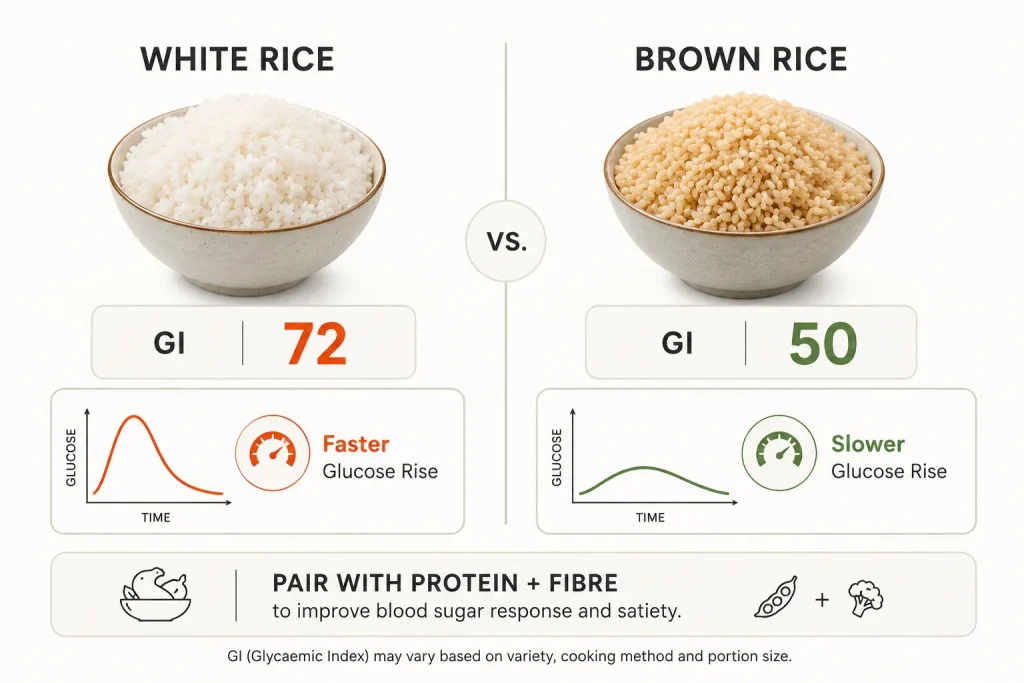
White rice has a glycaemic index (GI) of approximately 72, which puts it in the high GI category. The GI measures how quickly a food raises blood sugar relative to pure glucose. High GI foods cause a faster blood sugar spike and a correspondingly faster insulin response. Brown rice has a GI of approximately 50, which is meaningfully lower.
The concern about eating high-GI foods at night is that insulin sensitivity is slightly lower in the evening compared to the morning, meaning the same carbohydrate load produces a somewhat higher and more prolonged insulin response later in the day. This is a real biological effect, confirmed by multiple studies on circadian rhythm and metabolism. But the practical significance for a healthy person eating a normal portion of rice is modest.
The more important variable is what you eat rice with. Combining rice with protein (dal, paneer, egg, chicken), fibre (vegetables, sabzi), and fat (a small amount of ghee or oil) lowers the glycaemic load of the whole meal significantly. Glycaemic load, which accounts for both GI and portion size, is a more useful measure than GI alone. A 150g portion of cooked rice with a cup of dal and sabzi produces a far gentler blood sugar response than 300g of plain rice.
The one-sentence verdict: The high GI of white rice is a real consideration, especially for people with diabetes or insulin resistance, but it is manageable through portion control and meal composition rather than by banning rice from dinner.
Does Your Metabolism Slow Down at Night, Making Rice More Fattening?
Your metabolic rate does not drop to zero at night, but it does slow modestly compared to daytime activity levels. Basal metabolic rate (BMR), the calories your body burns simply to stay alive including organ function, breathing, and temperature regulation, continues at night and accounts for roughly 60 to 70% of your total daily energy expenditure.
The 2022 study from Brigham and Women’s Hospital published in Cell Metabolism found that eating later in the day increased hunger hormones, decreased satiety hormones like leptin, and modestly reduced the rate at which fat was burned from adipose tissue. These effects were real, but they occurred under a specific protocol comparing eating most calories between noon and 11 PM versus eating most calories between 8 AM and 5 PM. The study did not test a single bowl of rice at 8 PM in an otherwise well-managed diet.
Diet-induced thermogenesis (DIT), which is the energy your body uses to digest and process food and accounts for roughly 5 to 10% of daily energy expenditure for carbohydrates, is also slightly lower in the evening than in the morning. This means the body burns slightly fewer calories processing the same meal at night compared to in the morning. The difference is real but small — estimated at around 3 to 5% of the meal’s caloric content for most people.
The one-sentence verdict: Your metabolism does slow slightly at night and processes carbohydrates less efficiently than in the morning, but the effect is too small to make rice a forbidden food at dinner for anyone managing their overall calorie intake.
What Actually Happens When People Gain Weight Eating Rice at Night
The real weight gain mechanism for people who eat rice at dinner is almost never the rice timing. It is one or more of the following: eating a portion of rice that is too large relative to their total daily calorie target; not tracking or being aware of how many calories the full dinner contains; eating late at night when satiety signals are weaker, leading to overeating; consuming rice alongside heavy gravies, fried items, or papad that add significant hidden calories; and skipping physical activity in the evening while consuming a calorie-dense dinner.
A typical Indian dinner of 2 katoris (approximately 300g) of cooked rice with a cup of dal and a sabzi containing moderate oil is roughly 550 to 650 calories. That is a perfectly reasonable dinner within most adult calorie budgets of 1,800 to 2,200 calories per day. The problem arises when that same rice is eaten with mutton curry, three rotis, and a dessert on top of an already high-calorie day.
The one-sentence verdict: Rice at night causes weight gain when it pushes total daily calories into surplus, not because of any specific night-time fat storage mechanism.
Rice at Night vs Other Common Dinner Carbohydrates: What the Numbers Say
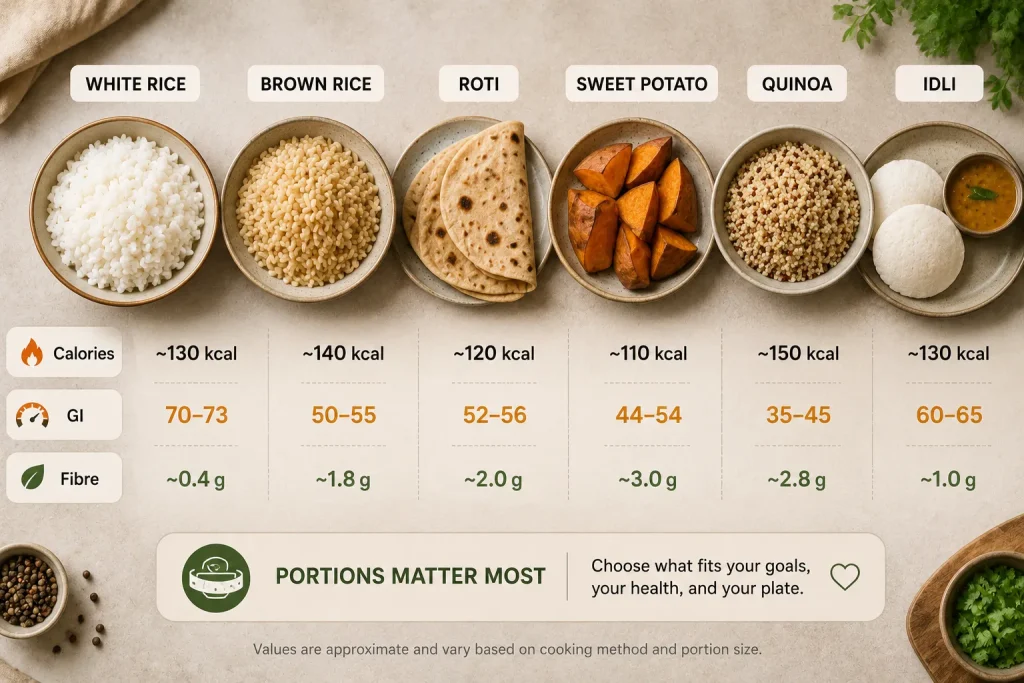
| Food (100g cooked) | Calories | Carbohydrates | Glycaemic Index | Fibre | Verdict for Night Eating |
|---|---|---|---|---|---|
| White rice | 130 kcal | 28g | 72 | 0.4g | Fine in controlled portions |
| Brown rice | 112 kcal | 23g | 50 | 1.8g | Better GI, slightly fewer calories |
| Whole wheat roti (1 piece) | 71 kcal | 15g | 62 | 1.9g | Lower GI than white rice |
| Idli (1 piece, 30g) | 39 kcal | 8g | 35 to 50 | 0.4g | Lower GI, lighter option |
| White bread (1 slice) | 79 kcal | 15g | 75 | 0.6g | Higher GI than rice |
| Sweet potato (boiled) | 86 kcal | 20g | 44 | 3g | Best GI, most fibre |
| Quinoa (cooked) | 120 kcal | 22g | 53 | 2.8g | Good GI, higher protein |
How Your Body Processes Rice at Night
The body digests and processes rice at night through the same mechanisms as during the day, with one modest difference: insulin sensitivity is approximately 15 to 20% lower in the evening than in the morning due to circadian regulation of glucose metabolism.
When you eat rice, salivary and pancreatic amylase break down the starch into glucose. This glucose enters the bloodstream through the small intestinal wall, raising blood sugar levels. The pancreas responds by releasing insulin, which moves glucose from the blood into cells — primarily muscle cells and the liver — where it is used for energy or stored as glycogen (the body’s carbohydrate storage form).
Glycogen storage capacity in the liver is approximately 100g and in muscles approximately 300 to 400g. When glycogen stores are full, excess glucose is converted to fat through a process called de novo lipogenesis (the creation of new fat from carbohydrates). In most healthy people eating reasonable amounts, glycogen stores are never full after a normal dinner, especially if they have been active during the day.
The circadian component is real. A 2025 review in Nutrients confirmed that consuming meals during the body’s active phase optimises insulin sensitivity and glucose tolerance, while evening eating is associated with modestly impaired glucose metabolism. Melatonin, the sleep hormone that begins rising in the evening, appears to reduce insulin secretion from the pancreas, contributing to the lower insulin sensitivity at night.
Timing recommendation: If you eat rice at dinner, aim to finish eating at least two hours before sleep. This gives digestion time to complete and reduces the overlap between peak blood glucose levels and the melatonin-driven reduction in insulin sensitivity. It does not make the meal harmless or harmful — it simply optimises how your body handles the glucose.
What the Research Actually Says
The most directly relevant controlled trial is the 2022 Cell Metabolism study from Brigham and Women’s Hospital comparing morning-loaded versus evening-loaded calorie intake in 30 subjects with overweight or obesity over two 4-week periods. The finding: no difference in total daily energy expenditure or weight loss between the two groups when total calories were identical. However, the morning group reported significantly lower hunger, suggesting that meal timing affects appetite hormones even when total intake is controlled.
A separate 2022 Cell Metabolism study, also from Brigham and Women’s Hospital, examined late versus early eating protocols and found that late eating increased hunger, decreased the satiety hormone leptin, and reduced fat oxidation. This study was careful to note that these effects create conditions that make overeating more likely — but they do not cause weight gain independently of actual calorie surplus.
A 2022 PMC review on meal timing and obesity risk summarised the broader evidence: epidemiological data suggests that eating at night increases long-term weight gain risk, primarily through changes in metabolism efficiency, appetite hormone dysregulation, and disruption of the gut microbiota through mistimed meals.
“No differences in total daily energy expenditure or resting metabolic rate were found related to the timing of calorie distribution, and no difference in weight loss.” — Cell Metabolism, Brigham and Women’s Hospital / Harvard Medical School, 2022.
The honest reality check: the research on meal timing is conducted on people eating at extreme windows — noon to 11 PM versus 8 AM to 5 PM. Most Indians eating rice at 8 or 9 PM for dinner are not in a metabolically damaging eating pattern. They are eating a normal dinner at a normal time.
What People with Specific Goals Should Know About Night-time Rice
The following applies mainly to people eating significantly more than the average, or people with metabolic conditions where the modest effects of evening carbohydrates become clinically meaningful.
People with Type 2 diabetes or insulin resistance are the group for whom evening GI genuinely matters. The 15 to 20% reduction in evening insulin sensitivity combined with white rice’s high GI of 72 can produce meaningfully higher post-meal glucose spikes at dinner compared to the same meal at lunch. Switching to brown rice (GI 50), keeping portions to one katori (approximately 150g cooked), and eating with substantial protein and fibre can help manage this. Discussing dinner carbohydrate timing with a diabetologist is worthwhile.
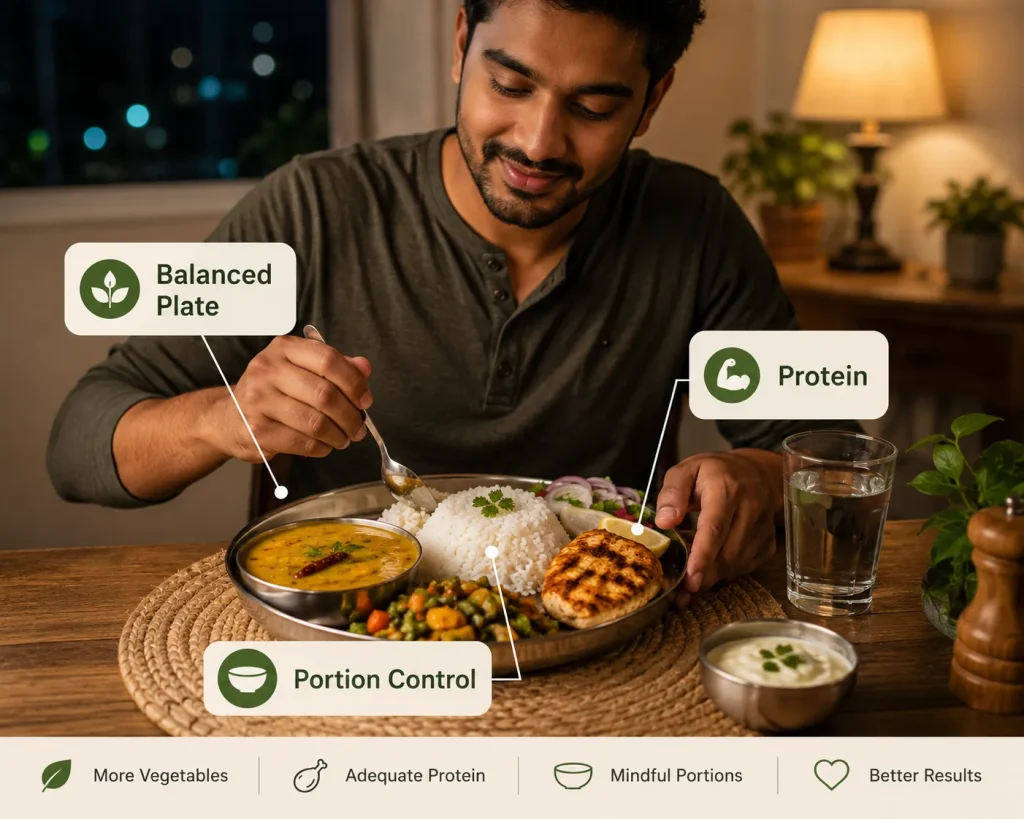
For everyone else, the most actionable guidance is simple: watch portion size, eat rice with protein and vegetables rather than alone or with heavy gravies, aim to finish dinner at least two hours before bed, and stay within your total daily calorie target. If you are doing those things, rice at dinner is not your problem.
How to Decide Whether Rice at Night Is Right for Your Situation
If Your Goal Is Fat Loss
You can eat rice at night while losing fat, provided it fits within your daily calorie deficit. For most people targeting fat loss, a single katori (150g cooked) of white rice with dal, sabzi, and a small amount of protein at dinner is around 500 to 600 calories and fits comfortably in a 1,600 to 1,800 calorie fat loss plan. What matters is the day’s total calories, not the timing. If counting feels overwhelming, the budget Indian diet plan for weight loss has practical meal structures worth using.
If Your Goal Is Muscle Gain
Rice at night is genuinely useful for muscle-building goals. After an evening workout, muscle glycogen stores are depleted and your muscles are primed to absorb carbohydrates efficiently. Eating rice at dinner after training is one of the most rational applications of night-time carbohydrate intake. Pair it with a protein source of at least 25 to 30g for optimal muscle protein synthesis stimulation.
If You Have Diabetes or Prediabetes
Reduce dinner rice portions to one katori or less, switch to brown rice or mix half white and half brown, always eat rice with dal and a vegetable, and check your post-meal blood glucose response. The combination of white rice’s high GI and evening insulin resistance makes this the one group where rice timing has real clinical implications. Discuss your specific targets with your doctor.
If You Are a Sedentary Desk Worker
A large rice-based dinner after a sedentary day will more often push you into a calorie surplus simply because you have not burned much throughout the day. This is a total calorie issue, not a rice-at-night issue. The practical fix is reducing the overall size of dinner rather than eliminating rice, or adding a short walk after dinner to improve post-meal glucose clearance.
If You Follow a South Indian or Bengali Diet
You eat rice at dinner as a cultural norm and you always have. The data from the 3 pillars of sustainable fat loss guide makes clear that total calorie balance across the day is what drives body composition outcomes. South Indians eating traditional rice-based dinners are not metabolically doomed. What matters is portion size, activity level, and total dietary pattern.
If You Are a Complete Beginner to Nutrition
Do not eliminate rice from dinner. It is unnecessarily restrictive and unsustainable for most Indians. Instead, measure your portions for two weeks to understand how much you are actually eating, add protein and vegetables to each rice meal, aim to finish dinner by 8 to 9 PM, and focus on increasing daily physical activity. That combination will move the needle far more than any food elimination strategy.
The Bottom Line
Rice at night does not cause weight gain. Excess calories cause weight gain, and rice can contribute to excess calories when portions are large and the rest of the diet is already at maintenance or above. The biological effects of evening carbohydrates are real but small for healthy people, and entirely manageable through sensible portions and meal composition.
The most useful mindset shift is this: stop asking when you ate something and start asking how much you ate across the whole day. A 150g serving of rice with dal and sabzi at 9 PM is not your weight problem. A 400g serving of rice with a heavy gravy, followed by sweets, every night on top of a sedentary day — that is a calorie problem that happens to involve rice at night.
Eat rice for dinner. Measure it. Pair it well. Move during the day. Those four things will do more for your body composition than any meal timing rule.
People Also Ask
Does eating rice at night cause weight gain?
No, eating rice at night does not inherently cause weight gain. Weight gain is determined by total daily calorie intake relative to calories burned, not by when specific foods are eaten. A 2022 randomised trial in Cell Metabolism found no difference in weight loss or energy expenditure between people eating most calories in the morning versus the evening when total intake was identical. Rice eaten at dinner contains the same calories as rice eaten at lunch. Portion size and total daily intake are what matter.
Is it OK to eat rice at night for weight loss?
Yes, you can eat rice at night while losing weight as long as it fits within your daily calorie deficit. A typical serving of 150g of cooked white rice contains approximately 195 calories. Paired with dal and vegetables, a rice-based dinner of 500 to 600 calories fits comfortably within a fat loss diet of 1,600 to 1,800 calories per day. The key variable is total daily calories, not the timing of the rice. Restricting rice specifically at dinner is unnecessary for most people aiming to lose fat.
Why do fitness people say avoid rice at night?
The advice to avoid rice at night comes from two concerns: the high glycaemic index of white rice (approximately 72), which raises blood sugar quickly, and the observation that insulin sensitivity is slightly lower in the evening compared to the morning. Both are real effects. However, they are too modest in magnitude to make rice forbidden at dinner for healthy people managing their total calorie intake. The advice is most relevant for people with diabetes or insulin resistance, not for healthy adults.
Is brown rice better than white rice for dinner?
Yes, brown rice is meaningfully better than white rice for dinner from a blood sugar management standpoint. Brown rice has a glycaemic index of approximately 50 compared to white rice at 72, it contains 1.8g of fibre per 100g cooked versus 0.4g in white rice, and it produces a slower and more sustained blood sugar response. For people with diabetes, prediabetes, or insulin resistance, switching to brown rice for dinner is a practical and effective strategy. For healthy adults, the difference is real but less critical.
What is the best time to eat rice to avoid weight gain?
There is no single “best time” to eat rice to avoid weight gain, because weight gain is caused by overall calorie surplus rather than meal timing. That said, eating rice earlier in the day, such as at lunch, takes advantage of better morning and midday insulin sensitivity and leaves more time for physical activity after the meal. If you eat rice at dinner, finishing the meal at least two hours before sleeping reduces the overlap between peak blood glucose levels and the melatonin-driven reduction in evening insulin sensitivity.
Does rice at night cause a big belly in Indians?
No, rice at night does not specifically cause belly fat accumulation in Indians. Visceral fat accumulation, which contributes to the belly, results from sustained calorie surplus over time combined with low physical activity and, in many Indians, a genetic predisposition toward central fat storage. Eating rice at dinner is a contributing factor only when it pushes total daily calories consistently above maintenance. The issue is total excess calories across the day, not specifically the rice or the timing.
Can rice at night affect sleep quality?
Rice’s high glycaemic index can cause a blood sugar spike followed by a drop, which may disturb sleep for some people if eaten very close to bedtime. The spike-and-crash pattern can trigger wakefulness or increase night-time hunger. Eating rice at least two hours before sleep, and pairing it with protein and fat to slow glucose absorption, largely eliminates this concern. There is no evidence that rice eaten at a reasonable hour with a balanced meal meaningfully impairs sleep quality in healthy adults.
Sources and References
- Timing of Daily Calorie Loading Affects Appetite and Hunger Responses Without Changes in Energy Metabolism: Cell Metabolism, 2022 — Brigham and Women’s Hospital / Harvard Medical School randomised crossover trial. Source for the finding that morning versus evening calorie loading produces no difference in total daily energy expenditure or weight loss.
- Late Isocaloric Eating Increases Hunger, Decreases Energy Expenditure, and Modifies Metabolic Pathways: Cell Metabolism, 2022 — Brigham and Women’s Hospital study. Source for late eating increasing hunger hormones, decreasing leptin, and modestly reducing fat oxidation.
- The Impact of Meal Timing on Risk of Weight Gain and Development of Obesity: PMC Review, 2022 — Source for epidemiological evidence on night eating and long-term weight gain risk, and the circadian disruption mechanisms involved.
- Chrononutrition and Energy Balance: How Meal Timing and Circadian Rhythms Shape Weight Regulation: Nutrients, 2025 — Source for the 15 to 20% reduction in evening insulin sensitivity, melatonin’s role in glucose metabolism, and early time-restricted eating benefits.
- Glycaemic Index of Rice Types and Influence of Boiling Time: PMC, 2025 — Source for white rice GI of approximately 72 and brown rice GI of approximately 50, and the role of amylose/amylopectin content in glycaemic response.