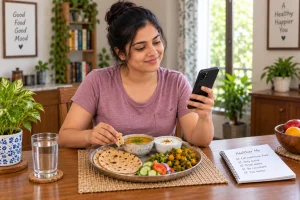
Budget Indian Diet Plan for Fat Loss (Realistic & Budget-Friendly)
Can you lose weight on just ₹150-₹200 per day? Yes. This budget Indian diet plan for weight loss uses local, affordable ingredients. No expensive “superfoods.” Just real desi food.
The “Healthy Food Is Expensive” Myth
Let me tell you about Priya.
Priya is a 26-year-old marketing executive in Pune. She wants to lose weight. But every time she opens Instagram, she sees influencers eating avocado toast, quinoa bowls, and imported protein powders. A quick mental math tells her that eating “healthy” would cost her ₹500-₹700 a day.
So she doesn’t even try.
And that’s exactly where most people fail.
Not because they lack discipline.
But because they believe a lie.
Here’s the truth Priya doesn’t know: You can build a powerful fat-loss diet for less than the cost of a large pizza.
I’ve done the math. I’ve visited local sabzi mandis. I’ve tracked prices across three different cities. And I’ve created a budget Indian diet plan for weight loss that costs just ₹150-₹200 per day—using ingredients available at your nearest kirana store.
No quinoa. No avocado. No expensive “superfoods.”
Just real desi food, portion-controlled, and strategically combined to keep you full, fueled, and burning fat.
Let me show you exactly how.

Why Most “Diet Plans” Fail Middle-Class India
Before we get to the plan, let’s address the elephant in the room.
Most weight loss advice online comes from a Western perspective. It assumes you have access to a Whole Foods, an air fryer, and a disposable income that allows you to buy organic chicken and almond butter.
That’s not reality for most Indians.
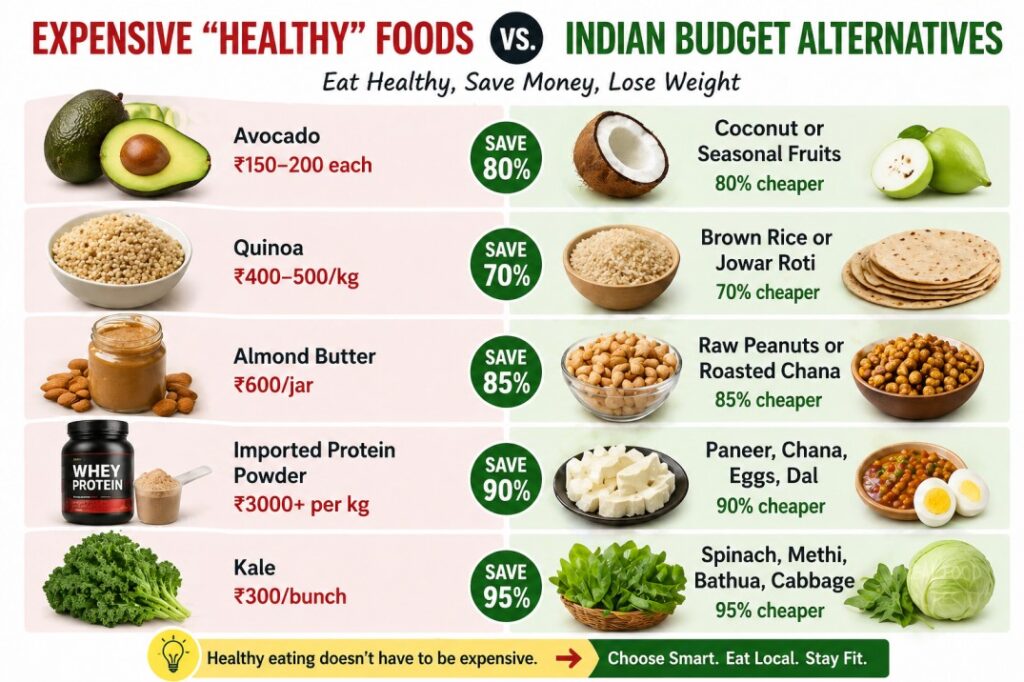
| Western “Health” Food | Indian Budget Alternative | Price Difference |
|---|---|---|
| Avocado (₹150-200 each) | Coconut or fresh seasonal fruit | 80% cheaper |
| Quinoa (₹400-500/kg) | Brown rice or jowar roti | 70% cheaper |
| Almond butter (₹600/jar) | Raw peanuts or roasted chana | 85% cheaper |
| Imported protein powder (₹3000+ per kg) | Paneer, chana, eggs, dal | 90% cheaper |
| Kale (₹300/bunch) | Spinach, methi, bathua, cabbage | 95% cheaper |
The budget Indian diet plan for weight loss isn’t about deprivation. It’s about substitution. Using what’s already available in your local market, cooking the way your grandmother cooked, and eating the foods your body actually recognizes.
The Science of Fat Loss on a Budget (What Actually Works)
Fat loss happens when you eat fewer calories than your body burns. That’s it. You don’t need expensive foods to create a calorie deficit.
But here’s the catch: If you just eat less of your current diet—two parathas instead of three, half the rice—you’ll feel hungry, irritable, and you’ll quit within a week.
The secret is nutrient density. You need foods that give you maximum fullness, protein, and fiber for minimum calories and cost.
Research consistently shows that dietary protein and fiber are the two most satiating nutrients. A 2024 meta-analysis found that higher protein intake significantly increases feelings of fullness while reducing subsequent calorie intake. Similarly, fiber slows digestion and stabilizes blood sugar.
The good news? Both protein and fiber are available in cheap, local Indian ingredients.
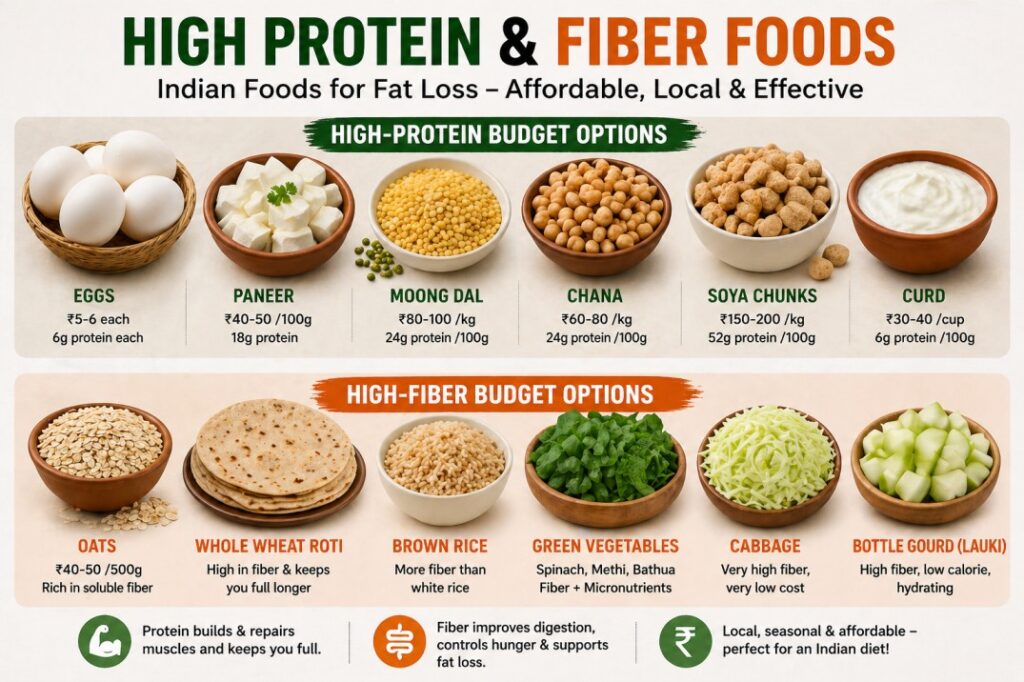
High-protein budget options: Eggs (₹5-6 each), paneer (₹40-50 for 100g), moong dal (₹80-100/kg), chana (₹60-80/kg), soya chunks (₹150-200/kg), curd (₹30-40 per cup)
High-fiber budget options: Besan, whole wheat roti, brown rice, oats (₹40-50 for 500g locally), seasonal green vegetables (₹20-40 per kg), cabbage (₹20-30 per kg), bottle gourd (₹20-30 per kg)
Combine these strategically, and you can eat satisfying, delicious meals for under ₹200 a day.
The Complete ₹150-₹200 Daily Meal Plan
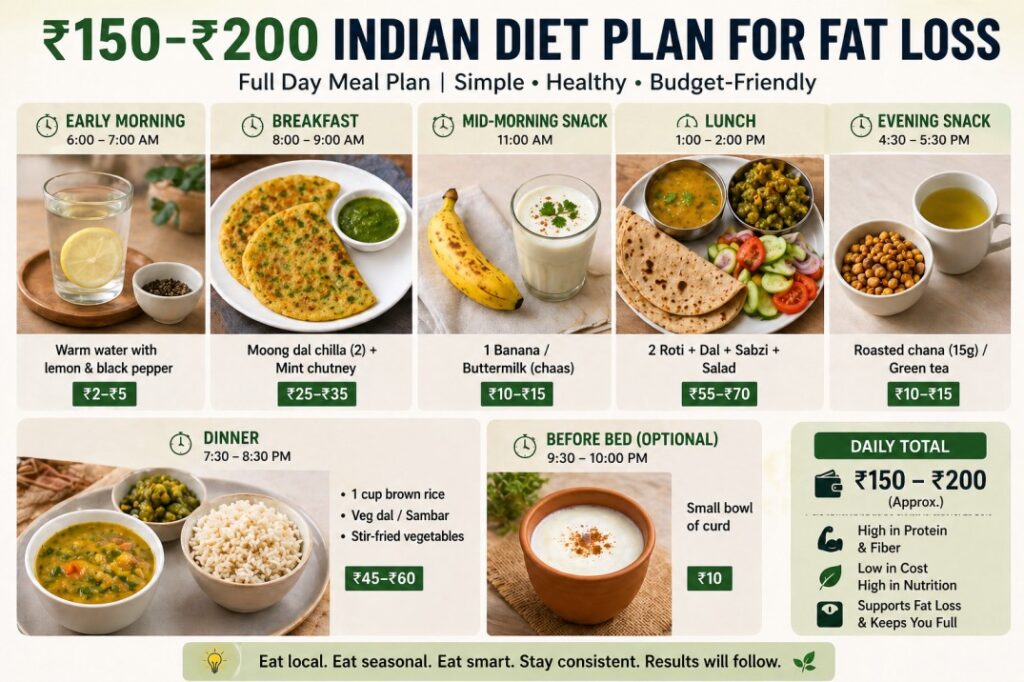
This plan is designed for a moderately active adult aiming to lose 0.5-1 kg per week. Adjust portion sizes based on your hunger and activity level.
Early Morning (6:00-7:00 AM) – ₹2-₹5
Option 1: 1 glass warm water with lemon and a pinch of black pepper (₹2)
Option 2: 1 cup unsweetened green tea (local brand – ₹5)
Why this works: Hydration kickstarts your metabolism. The lemon-pepper water may provide a mild digestive benefit.
Breakfast (8:00-9:00 AM) – ₹25-₹35
Option 1: 2 moong dal chillas (savory lentil pancakes) + mint chutney
Option 2: 1 bowl poha (using 1/2 cup dry poha + vegetables) + 1/4 cup curd
Option 3: 2 egg omelette with onions, tomatoes, and spinach
| Ingredient | Quantity | Cost (₹) |
|---|---|---|
| Moong dal (soaked) | 50g (dry) | ₹6 |
| Vegetables (onion, tomato) | 50g | ₹8 |
| Oil | 1 tsp | ₹2 |
| Chutney | 1 tbsp | ₹4 |
| Total | ₹20 |
Pro tip: Meal prep chilla batter the night before. It stays fresh for 24 hours in the fridge.
Mid-Morning Snack (11:00 AM) – ₹10-₹15
Option 1: 1 seasonal fruit (banana, apple, orange, papaya – whatever is cheapest locally)
Option 2: 1 cup buttermilk (chaas) with roasted cumin powder
Option 3: A handful of roasted chana (15g)
Why this works: A small snack prevents the 12 PM hunger crash that leads to binge eating at lunch.
Lunch (1:00-2:00 PM) – ₹55-₹70
This is your largest meal. Focus on protein + fiber + complex carbs.
Sample plate:
- 2 whole wheat rotis (or 1 cup brown rice)
- 150g seasonal green sabzi (bhindi, cabbage, lauki, tori, gawar – whatever is cheapest)
- 100g dal (any variety – toor, moong, masoor)
- Salad: 1/2 cup cucumber + tomato + carrot with lemon and black salt
| Ingredient | Quantity | Cost (₹) |
|---|---|---|
| Whole wheat flour | 40g (approx 2 rotis) | ₹6 |
| Seasonal sabzi | 150g | ₹15 |
| Dal (dry) | 30g (expands to 100g cooked) | ₹8 |
| Salad vegetables | 50g | ₹10 |
| Oil for cooking | 1.5 tsp | ₹3 |
| Total | ₹42 |
*Note: Cost varies by city and season. In Mumbai or Delhi, add ₹10-15. In smaller cities, you might spend less.*
Evening Snack (4:30-5:00 PM) – ₹15-₹20
Option 1: 1 cup green tea + 1 marie biscuit (just one)
Option 2: 1/2 cup sprouts salad with lemon juice
Option 3: 1 small bowl of vegetable soup (made from leftover sabzi water + onion-tomato)
Why this works: This is the danger zone. Most Indians snack on pakoras, samosas, or chai with biscuits. A light, protein-based snack kills the craving.
Dinner (7:00-8:00 PM) – ₹40-₹55
Dinner should be lighter than lunch. Your metabolism slows down at night, so heavy meals are more likely to be stored as fat.
Option 1: 1 bowl dal + khichdi (using rice and moong dal) + 1 cup buttermilk
Option 2: 2 besan chillas stuffed with grated vegetables
Option 3: 1 bowl vegetable soup + 1 egg white omelette + 1 slice brown bread (local bakery)
| Ingredient | Quantity | Cost (₹) |
|---|---|---|
| Broken wheat (dalia) or leftover roti | 1 small bowl | ₹10 |
| Moong dal | 25g (dry) | ₹6 |
| Vegetables (for khichdi) | 50g | ₹8 |
| Curd for buttermilk | 2 tbsp | ₹6 |
| Total | ₹30 |
Total Daily Cost: ₹147 – ₹207
| Meal | Cost Range (₹) |
|---|---|
| Early Morning | 2 – 5 |
| Breakfast | 20 – 35 |
| Mid-Morning Snack | 10 – 15 |
| Lunch | 42 – 70 |
| Evening Snack | 15 – 20 |
| Dinner | 30 – 55 |
| Total | ₹147 – ₹207 |
Weekly Shopping List (₹1,000 – ₹1,200 for 7 Days)
Here’s exactly what to buy at the start of the week. Adjust based on seasonal availability.
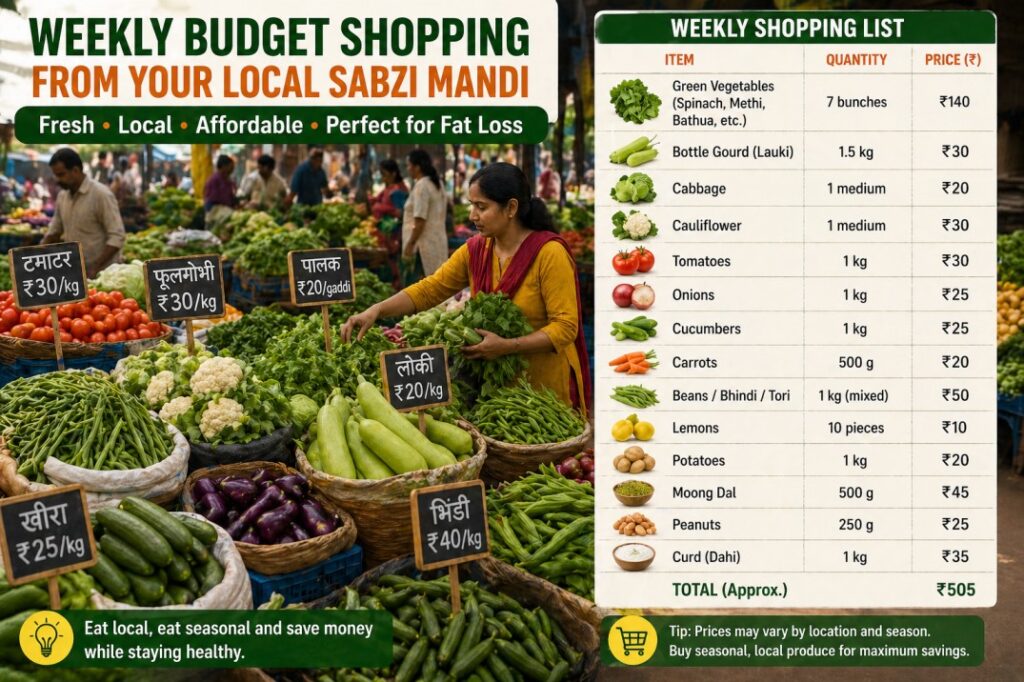
Staples (To buy once or every two weeks)
- Whole wheat flour – 2 kg (₹60-80)
- Brown rice – 1 kg (₹60-80)
- Moong dal – 1 kg (₹100-120)
- Toor dal – 500g (₹50-60)
- Chana dal – 500g (₹40-50)
- Poha (flattened rice) – 500g (₹30-40)
- Oats – 500g (₹50-60, optional)
- Oil (mustard or sunflower) – 500ml (₹50-60)
Weekly Fresh Purchase (₹700-₹800)
- Eggs – 1 dozen (₹60-70)
- Paneer – 200g (₹80-100)
- Curd – 1 kg (₹60-70)
- Seasonal vegetables (choose 5-6 varieties, 2-3 kg total) – ₹120-150
- Leafy greens (methi, spinach, bathua – 1 bunch) – ₹20-30
- Onions – 1 kg (₹30-40)
- Tomatoes – 500g (₹20-30)
- Potatoes – 500g (₹20-30) – use sparingly
- Fruits (seasonal – oranges, bananas, papaya in winter; watermelon, muskmelon in summer) – ₹80-100
- Lemon – 5-6 (₹20-30)
- Ginger-garlic paste – small pack (₹20-30)
Spices (Already in your kitchen)
Turmeric, red chili powder, cumin seeds, coriander powder, garam masala, black pepper, salt.
5 Money-Saving Hacks That Transform This Plan
1. Shop at Sabzi Mandis, Not Supermarkets
Local wholesale vegetable markets sell produce at 30-50% less than retail stores. Go early morning on Sunday. Buy enough for 3-4 days. Leafy greens last 2 days; root vegetables last a week.
One reader told me she reduced her weekly vegetable bill from ₹400 to ₹180 just by switching to the mandi.
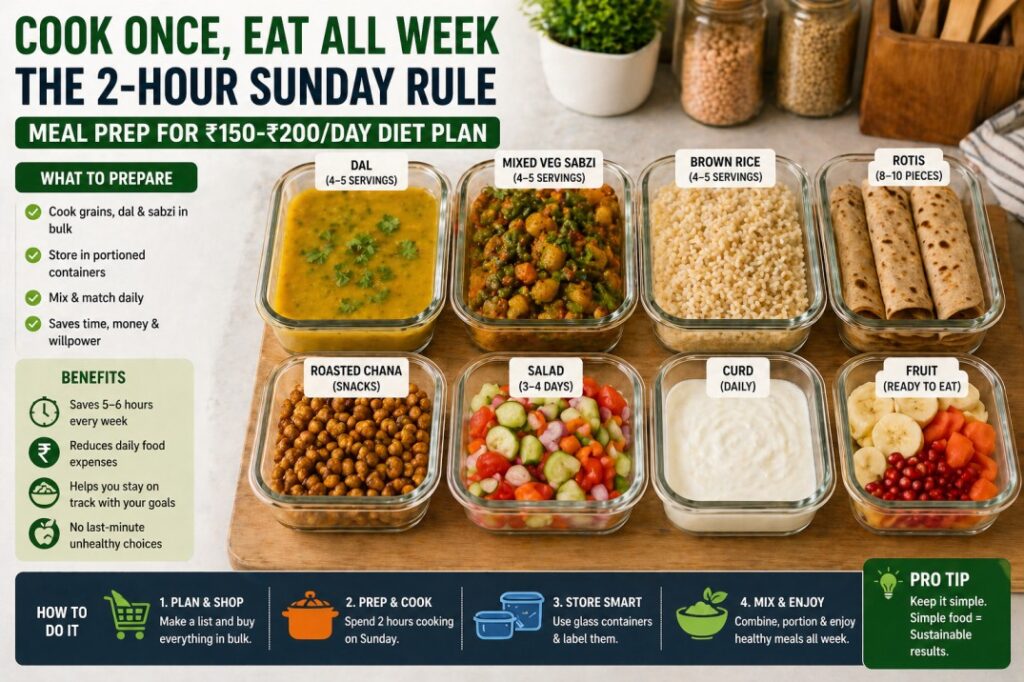
2. Cook in Batches (The 2-Hour Sunday Rule)
Spend two hours every Sunday prepping:
- Boil dal for 3 days (keep in fridge)
- Chop vegetables for Monday-Wednesday
- Make chilla batter
- Cook sprouts (refrigerate)
When healthy food is faster to eat than ordering zomato, you win.
3. Use the “Half-Plate Vegetable” Rule
Vegetables are the cheapest source of fullness. Fill half your plate with seasonal sabzi. They add volume, fiber, and micronutrients for almost zero calories.
The cheapest vegetables in India (per kg): Cabbage (₹20-30), bottle gourd (₹20-30), pumpkin (₹20-30), radish (₹15-25), spinach (₹20-30/bunch).
4. Don’t Throw Away Vegetable “Waste”
Save carrot peels, cabbage cores, onion skins, and tomato ends in a bag in your freezer. At the end of the week, boil them with salt and spices to make a zero-cost vegetable stock. Use it for soups or dal.
5. Replace One Meal with Leftovers
Cook dinner with 20% extra portion. That becomes tomorrow’s breakfast or lunch. No extra cooking. No extra cost. Less food waste.
Sample Day: What Eating Actually Looks Like
| Time | Meal | What’s on the Plate | Cost (₹) |
|---|---|---|---|
| 7:00 AM | Early Morning | Warm lemon water | ₹2 |
| 8:30 AM | Breakfast | 2 moong dal chillas + mint chutney | ₹20 |
| 11:00 AM | Mid-Morning | 1 small banana | ₹8 |
| 1:30 PM | Lunch | 2 rotis + bhindi sabzi + toor dal + salad | ₹48 |
| 5:00 PM | Evening | 1 cup green tea + 1 marie biscuit | ₹7 |
| 7:30 PM | Dinner | Dal khichdi + curd + lauki sabzi | ₹42 |
| Total | ₹127 |
Yes, that’s under ₹130. Some days you’ll spend less. Some days a bit more. But ₹150-₹200 per day is completely achievable.
Common Mistakes (And How to Fix Them)
Mistake #1: “I’ll Just Eat Less of My Regular Food”
Eating two parathas instead of three isn’t a diet. It’s starvation. You’ll feel hungry, tired, and you’ll binge by day three.
Fix: Replace high-calorie, low-nutrient foods with high-volume, low-calorie options. Swap one paratha for an extra bowl of sabzi or dal. Same fullness. Fewer calories.
Mistake #2: Avoiding Ghee and Oil Completely
Fat isn’t the enemy. Your body needs dietary fat to absorb vitamins A, D, E, and K. Fat also keeps you satiated.
Fix: Use 1-2 teaspoons of oil or ghee per meal. Just don’t deep fry. A 2024 review in Nutrition Reviews confirmed that moderate dietary fat intake (20-35% of calories) is optimal for weight management.
Mistake #3: Drinking Your Calories
Chai with sugar and biscuits. Packaged fruit juice. Sweet lassi. These are liquid calories that don’t fill you up.
Fix: Switch to unsweetened green tea, black coffee, or plain water. Buttermilk (chaas) without sugar is fine. One cup of sweet chai with two biscuits is easily 150-200 extra calories a day—that’s nearly your entire breakfast budget.
Mistake #4: Not Drinking Enough Water
Thirst often feels like hunger. Most Indians drink far less water than they need, especially in non-summer months.
Fix: Keep a 1-liter bottle on your desk. Finish it by lunch. Refill. Finish by 5 PM. If plain water bores you, add a slice of cucumber, lemon, or a few mint leaves.
The 30-Day Challenge
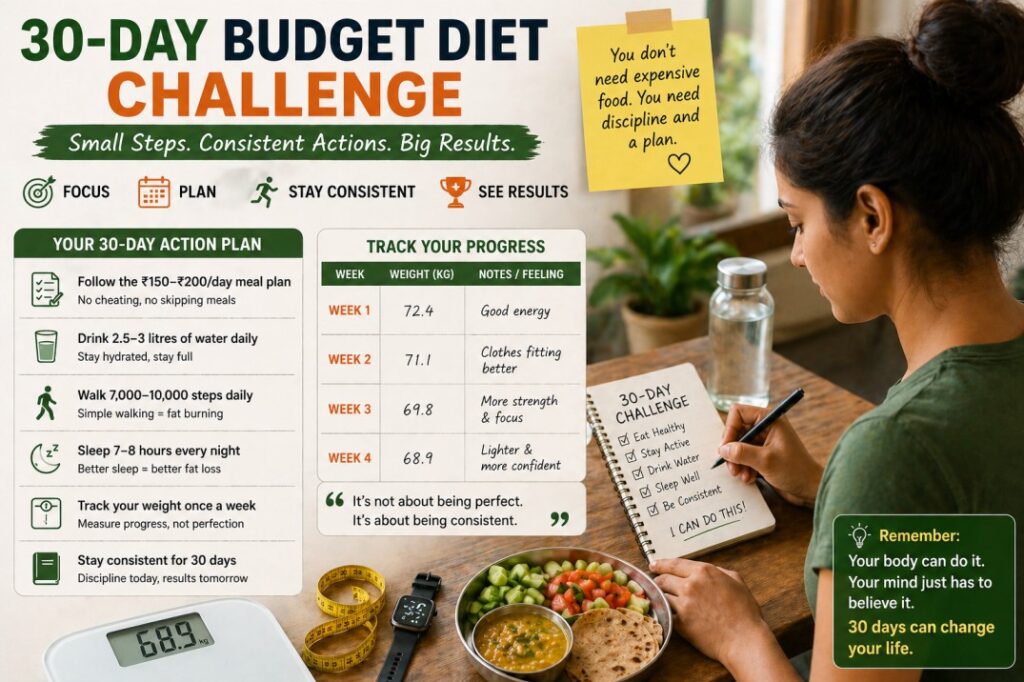
Here’s my challenge to you.
Follow this budget Indian diet plan for weight loss for 30 days. Don’t change anything else. Keep walking to the bus stop. Keep your normal activity level.
Track three things:
- How much money you save (compared to your previous food spending)
- How you feel after meals (full? satisfied? still hungry?)
- Your weight every Monday morning
I’ve seen dozens of people try this. The ones who succeed share one trait: They don’t try to be perfect.
Miss a day? Have a samosa at a family gathering? Eat a normal dinner out with friends? It’s fine. Just get back on the plan the next meal. Perfection is the enemy of progress.
Final Thoughts: You Don’t Need to Be Rich to Be Healthy
The weight loss industry wants you to believe that you need expensive supplements, exotic superfoods, and complicated meal plans.
That’s a lie.
Your grandmother’s kitchen—the one with the pressure cooker, the spice box, and the weekly sabzi mandi run—already has everything you need to lose weight, save money, and feel amazing.
This budget Indian diet plan for weight loss isn’t a temporary “diet.” It’s a template for how to eat for the rest of your life. Affordable. Sustainable. Rooted in real Indian food.
The only thing missing is your commitment.
Frequently Asked Questions
Can I eat non-vegetarian food on this budget?
Yes. Replace one dal meal with 100g of chicken (₹30-40 in most cities) or fish (₹40-60). Eggs are already included. The cost will be slightly higher (₹180-₹230 per day), but still very reasonable.
What if I’m vegetarian or vegan?
The plan above is already vegetarian. For vegan: Replace curd with homemade coconut or peanut curd. Skip paneer. Increase dal, chana, soya chunks, and sprouts for protein. Add a spoon of peanut or sesame seeds for healthy fats.
Will I feel hungry on this plan?
If you’re hungry, you’re not eating enough vegetables. Seriously. Add an extra half-plate of sabzi or salad to your lunch and dinner. Vegetables add bulk without significant calories. You should feel satisfied, not stuffed.
How much weight can I expect to lose?
With this calorie range (approximately 1200-1500 calories per day for most women, 1400-1700 for most men), expect 0.5-1 kg per week. Some weeks more, some weeks less. Sustainable weight loss is slow weight loss.
Can I eat out sometimes?
Yes. Choose a thali with roti, dal, sabzi, and salad. Avoid fried items, sweets, and extra parathas. Drink water, not sweet lassi or soda. One meal out won’t break your diet. Three meals out per week will.
Looking for More Science-Backed Strategies?
If you’re serious about transforming your body, here are three guides that pair perfectly with this budget meal plan:
👉 5 Best Fat Loss Supplements That Actually Work (Science-Based Guide) – Learn which supplements complement a solid diet and which are just expensive urine. [Read here]
👉 10 Best Workouts for Home: A Complete Guide to Get Fit Without a Gym – No equipment? No problem. These home workouts require zero investment and deliver real results. [Read here]
👉 Lose Weight in 30 Days: The Realistic, Science-Backed Plan That Works – A month-by-month blueprint that combines diet, exercise, and mindset for sustainable fat loss. [Read here]
Your Turn
You’ve read the plan. You’ve seen the math. You know it’s possible.
Now stop thinking and start doing.
Here’s your first step: Tomorrow morning, before you eat anything else, drink a glass of warm lemon water. Then make moong dal chillas for breakfast instead of aloo paratha. That’s it. One meal. One decision.
Do that for three days, and I promise you’ll feel the difference.
Drop a comment below and tell me: Which meal from this plan are you going to try first? Or share your own budget-friendly fat loss tip that works for you.
And if this guide helped you? Share it with a friend or family member who thinks healthy eating is too expensive. Let them know the truth: You don’t need to be rich to be fit.
तंदरुस्ती सस्ती है, बस सही रास्ता चुनना है। (Being fit is cheap—you just need to choose the right path.)
Disclaimer: This information is for general educational purposes only and does not constitute medical advice. Calorie needs vary based on age, gender, activity level, and medical conditions. Always consult a qualified healthcare provider before starting any weight loss plan, especially if you have diabetes, heart disease, or other chronic conditions.