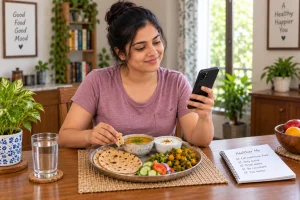
Drinking cold water after food does not cause serious digestive problems in healthy adults, and the fear that it solidifies fat, disrupts enzymes, or causes bloating is not supported by clinical evidence. The stomach returns cold water to body temperature within approximately 15 to 20 minutes of ingestion, well before it can meaningfully interfere with digestion.
That said, there is a small, real effect worth knowing about. Cold water does modestly slow the early phase of gastric emptying compared to warm water, and some people with sensitive digestive systems genuinely experience discomfort after cold drinks with meals. These effects are real but minor, and they do not apply to most healthy adults eating a normal meal.
The belief that cold water after food causes digestive problems is one of those household rules that feels right, has a long history across multiple cultures including Ayurveda, and contains a kernel of physiological truth wrapped around a significant overstatement. The full picture is more nuanced than either “completely harmless” or “always avoid.”
This article covers what actually happens in your stomach when you drink cold water after eating, which specific people have genuine reason to be cautious, and why the fear of cold water solidifying ghee or oil in your stomach is physiologically impossible.
The Cold Water After Food Belief and Where It Actually Comes From
The warning against drinking cold water after meals has two distinct origins that are often conflated, and separating them clarifies why the belief persists even when the science does not fully support it.
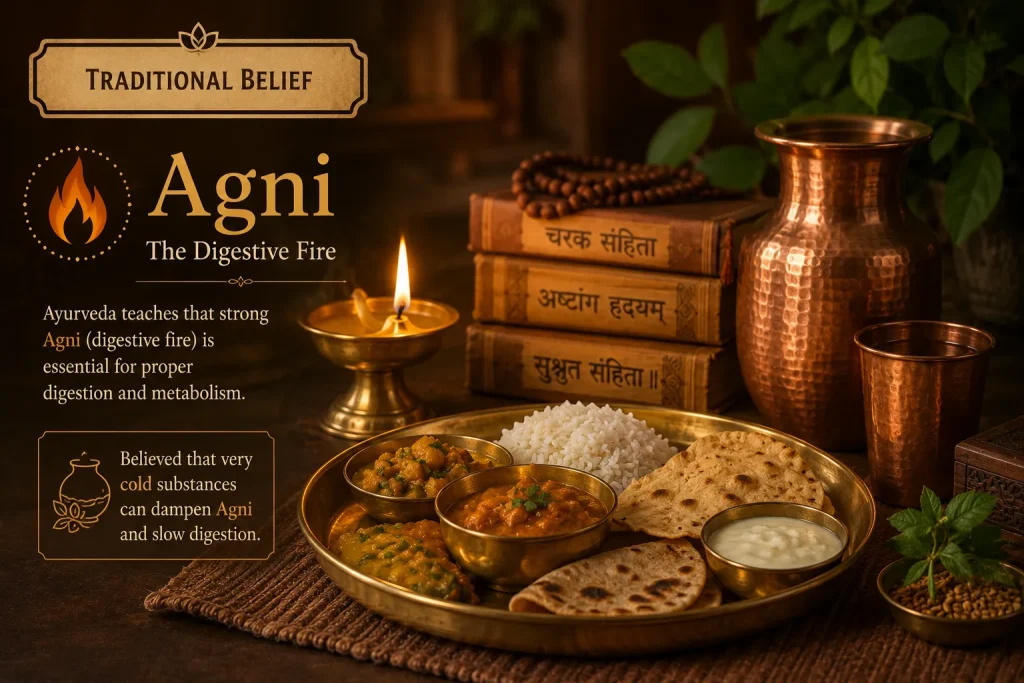
The first origin is Ayurvedic. In Ayurvedic medicine, the digestive system is governed by agni, or digestive fire, a concept describing the body’s metabolic capacity to process food. Cold substances are thought to dampen agni, reduce the efficiency of digestion, and allow ama, undigested toxic residue, to accumulate. This is an internally coherent framework, but it is a theoretical model of metabolism, not a description of measurable enzyme kinetics or gastric physiology.
The second origin is a specific viral claim that spread widely through email chains and social media, particularly in India and Southeast Asia, in the 2000s and 2010s. The claim states that cold water solidifies fats and oils eaten during the meal, creating a greasy sludge that then reacts with stomach acid and is absorbed by the intestinal wall as fat. This chain email attributed the resulting fat deposits to cancer risk. This specific claim has been reviewed and debunked by Snopes and multiple medical fact-checking organisations, who confirmed no credible physiological mechanism supports it.
In India specifically, the cold water belief is reinforced by the climate. In peak summer, cold water feels like a relief after a hot meal, but parents historically warned against it, associating the combination with throat infections, indigestion, and weight gain. The summers are also when ghee and oil-heavy meals are common in northern India, making the “oil solidification” story feel plausible. None of this makes the belief correct, but it does explain why it has survived so long in such a specific form.
Does Cold Water After Food Actually Cause Digestive Problems?
Cold water after food does not cause serious digestive problems in healthy adults, but it does produce one real, measurable, minor effect: it modestly slows the early phase of gastric emptying compared to body-temperature or warm water. This is what the research confirms, and it is neither alarming nor irrelevant.
Does Cold Water Solidify Fat in the Stomach?
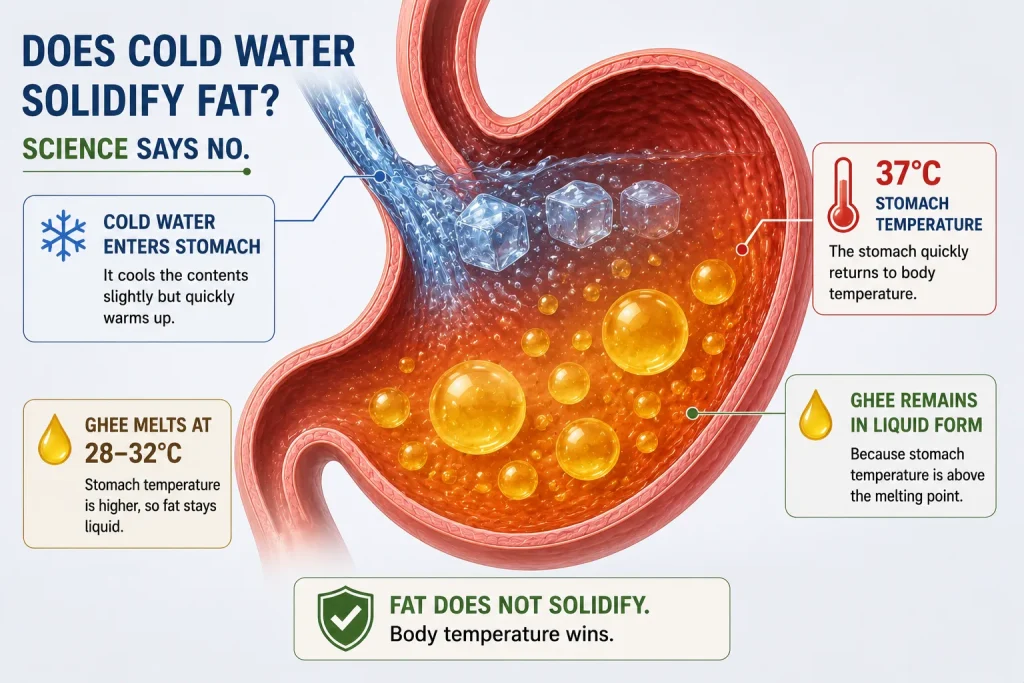
Cold water cannot solidify dietary fat in the human stomach, and this is not even a close call physiologically. The stomach maintains a core temperature of approximately 37 degrees Celsius. When cold water, even at 4 degrees Celsius which is refrigerator temperature, enters the stomach, the gastric contents and the insulating tissue surrounding the stomach rapidly bring it to body temperature.
A foundational study by McArthur and Feldman, published in the American Journal of Clinical Nutrition in 1989, directly measured intragastric temperature after infusing coffee at 58 degrees Celsius, 37 degrees Celsius, and 4 degrees Celsius into human subjects via nasogastric tube. The stomach returned to body temperature within 16.7 minutes after the hot meal and within 23.8 minutes after the cold meal. Both hot and cold temperatures normalised to body temperature rapidly, with no lasting disruption to gastric acid secretion.
Dietary fats melt at temperatures well below 37 degrees Celsius. Ghee melts at approximately 28 to 32 degrees Celsius. Butter melts at approximately 32 to 35 degrees Celsius. The human stomach at 37 degrees is already warmer than the melting point of the fats most commonly eaten in Indian households. Cold water cannot solidify something that is already liquid at body temperature.
The one-sentence verdict: Cold water solidifying fat in the stomach is physiologically impossible because stomach temperature returns to 37 degrees Celsius within approximately 20 minutes of any cold drink.
Does Cold Water Disrupt Digestive Enzymes?
Cold water does not meaningfully disrupt digestive enzyme activity in healthy adults because digestive enzymes in the stomach operate in an environment so strongly acidic that a temporary temperature fluctuation does not override their function. Pepsin, the primary gastric enzyme responsible for protein digestion, has optimal activity at a pH of approximately 1.5 to 2, which is the normal gastric pH. Amylase, lipase, and the pancreatic enzymes that continue digestion in the small intestine operate at body temperature and resume full activity as the cold water equilibrates.
The claim that cold water causes enzymes to “cancel out” or freeze comes from the food-combining movement, which incorrectly argues that different foods require incompatible digestive environments. As covered in the milk and fish article on leanfuel.in, this theory has no support in biochemistry. Digestive enzyme activity is primarily pH-dependent, not temperature-dependent within the range of normal food and drink temperatures.
There is one honest nuance here. Enzymes do perform optimally at 37 degrees Celsius, and a brief reduction in gastric temperature could theoretically reduce enzyme efficiency for the few minutes before temperatures equalise. Research has not produced a clinically significant finding from this transient effect in healthy adults. It is a real mechanism with a negligible practical consequence.
The one-sentence verdict: Digestive enzymes are not meaningfully disrupted by cold water because stomach temperature returns to normal within 20 minutes and enzyme function is primarily pH-dependent, not temperature-dependent.
Does Cold Water After Food Cause Bloating or Slow Digestion?
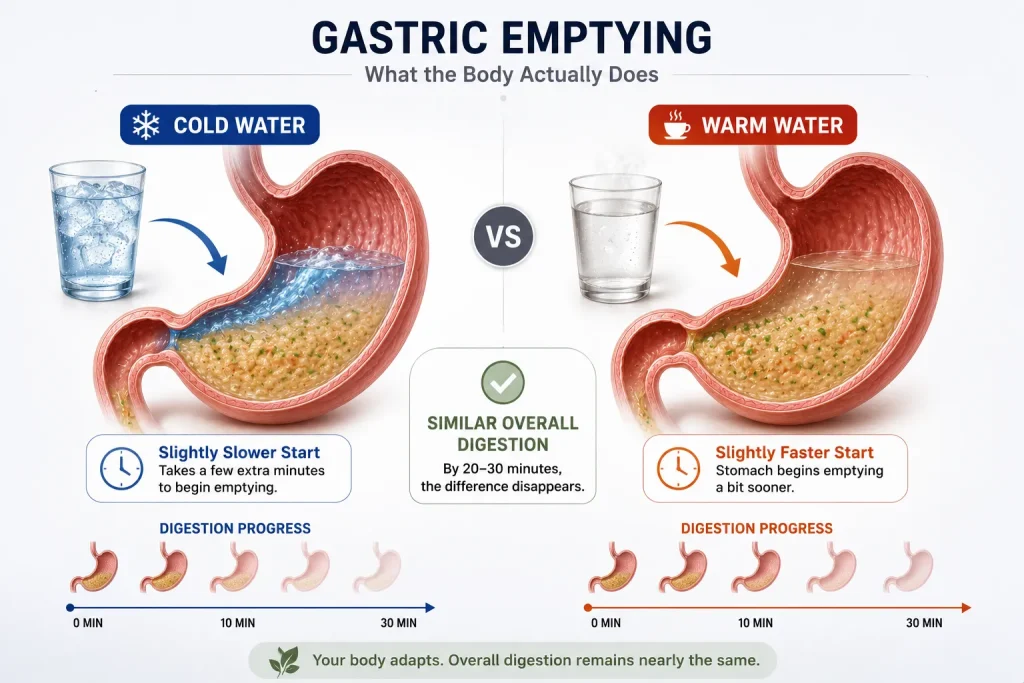
Cold water does slightly slow the early phase of gastric emptying compared to warm water, and this is supported by direct measurement in humans. A study examining the effects of meal temperature and volume on gastric emptying, published in the British Journal of Pharmacology, measured gastric emptying via real-time ultrasound in healthy volunteers drinking water at 12 degrees Celsius versus 37 degrees Celsius. The cold drink produced a significantly reduced 5-minute gastric volume, meaning the stomach retained more content in the initial rapid emptying phase. However, the subsequent half-life of emptying, which measures how quickly the stomach clears overall, was not significantly different between cold and warm water.
What this means practically: cold water may slightly delay how quickly the stomach begins moving contents to the small intestine in the first few minutes after a meal. This is unlikely to cause noticeable bloating in most people. In people with pre-existing conditions such as irritable bowel syndrome (IBS), acid reflux, or functional dyspepsia, this transient slowing may be enough to worsen symptoms.
The bloating many people experience after cold water with meals is more likely explained by swallowing air while drinking quickly, carbonation if the cold drink is fizzy, or a large volume of liquid diluting gastric acid temporarily. These are not cold-water-specific problems.
The one-sentence verdict: Cold water modestly slows the initial phase of gastric emptying but does not clinically impair digestion in healthy adults; bloating attributed to cold water is usually caused by drink volume or swallowed air rather than temperature.
Cold Water vs Warm Water After Food: What the Data Shows
| Scenario | Effect of Cold Water (4 to 15 degrees C) | Effect of Warm Water (37 to 50 degrees C) | Clinically Significant? | Verdict |
|---|---|---|---|---|
| Intragastric temperature normalisation | Returns to 37C in approx 24 min | Returns to 37C in approx 17 min | No | Both normalise quickly |
| Early gastric emptying (0 to 5 min) | Slightly reduced initial emptying | Faster initial emptying | Mild effect only | Minor difference |
| Overall gastric emptying half-life | No significant difference | No significant difference | No | Equivalent overall |
| Digestive enzyme activity (pepsin, lipase) | Briefly reduced, normalises with temperature | Optimal throughout | No clinically relevant impact | Negligible effect |
| Fat solidification in stomach | Does not occur | Not applicable | No mechanism exists | Complete myth |
| Acid reflux symptoms | May worsen in sensitive individuals | May be better tolerated | Yes, in GERD/IBS only | Avoid if symptomatic |
| Post-exercise rehydration | Superior cooling effect | Less effective cooling | Yes, for athletes | Cold water preferred |
What Actually Happens in Your Body When You Drink Cold Water After Eating
When you drink cold water after a meal, your stomach uses its thermal mass and blood supply to warm the incoming fluid to body temperature, a process that takes approximately 15 to 24 minutes and produces no lasting physiological disruption in healthy individuals.
The stomach is not a passive bag. It is an active, muscular organ surrounded by blood vessels that maintain its temperature close to 37 degrees Celsius. When cold water enters, thermoreceptors in the gastric wall detect the temperature change and the body responds by increasing local blood flow to the stomach lining, which speeds up heat transfer from the surrounding tissue to the liquid contents.
Gastric motility, which refers to the muscular contractions of the stomach wall that churn food and move it toward the small intestine, does respond to cold. Research suggests that cold liquids reduce the frequency of gastric contractions temporarily. This is the mechanism behind the modestly slower early emptying observed in studies. The effect is transient and resolves as temperature normalises.
The digestive hormones gastrin, which stimulates gastric acid secretion, and cholecystokinin (CCK), which triggers bile and pancreatic enzyme release, both function based on the chemical composition of stomach contents, not their temperature. Cold water does not interfere with these hormonal signals.
Timing recommendation: If you have a sensitive stomach, IBS, or experience regular bloating, drinking water before a meal or at least 20 to 30 minutes after finishing eating gives digestion a head start without the theoretical temperature effect. For healthy adults, there is no timing rule that matters. Drink when you are thirsty.
What the Research Actually Says
The most directly relevant human data comes from the McArthur and Feldman 1989 study in the American Journal of Clinical Nutrition, which remains the foundational clinical study on meal temperature and gastric physiology in humans. It established that: intragastric temperature normalises within approximately 24 minutes after a cold drink; initial temperature of the meal had no effect on gastric acid secretion; and there was no meaningful difference in digestive function between hot, warm, and cold liquid meals.
The gastric emptying temperature study published in Gut, which measured gastric emptying in eight healthy volunteers using real-time ultrasound, found that cold water modestly reduced the initial rapid emptying phase but produced no significant difference in the half-life of overall gastric emptying.
Research on cold water and digestive enzyme disruption is limited in human subjects, but the established biochemistry of pepsin activity, which is governed primarily by pH and not temperature across the range of cold drink temperatures, does not support clinically meaningful enzyme interference in healthy adults.
“The body is extremely efficient at bringing any ingested fluid to equilibrium with core temperature, whether it is cold or hot. That means the long-term impact on digestion is minimal.” — Dr. William Li, medical researcher and author of Eat to Beat Disease.
The honest reality check: millions of Indians drink cold water after meals during summer every year. If cold water after food were causing meaningful digestive harm, gastroenterology departments in India would be overwhelmed with cases directly linked to the behaviour. They are not. The symptom people attribute to cold water, namely bloating, is almost always explained by meal composition, eating speed, or individual gut sensitivity.
When Cold Water After Food Is Genuinely Worth Avoiding
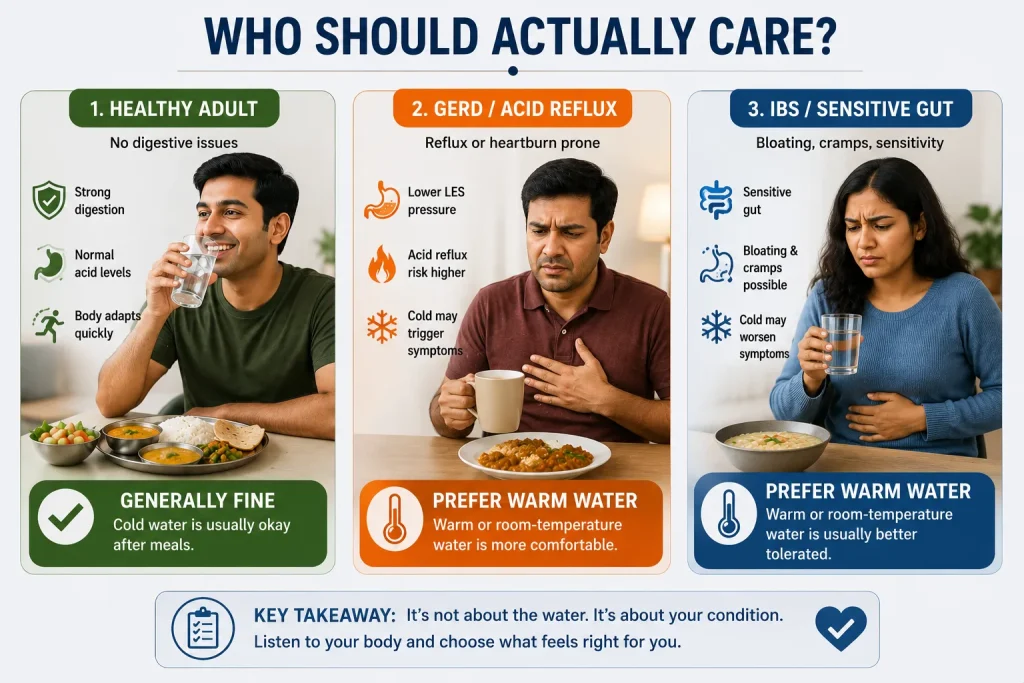
Cold water after food is mostly harmless for healthy adults, but a few situations warrant genuine care rather than dismissal.
People with gastroesophageal reflux disease (GERD) may find that cold water temporarily affects the lower oesophageal sphincter tone, potentially worsening reflux symptoms. Cold-triggered sphincter changes are documented in some individuals with reflux. Warm or room-temperature water is a reasonable precaution.
People with IBS or functional dyspepsia report worsened symptoms with cold beverages, consistent with the transient gastric motility effects described above. For these individuals, avoiding cold drinks immediately after meals is practical advice backed by their own symptom history.
People with achalasia or other motility disorders of the oesophagus may find cold liquids trigger oesophageal spasms. This is a medical condition requiring specific management, not a general dietary warning.
People prone to sore throats and tonsillar infections may find the contrast between a hot meal and ice-cold water causes throat discomfort. This is not a digestive issue, but it is a real physical sensation that many Indians associate with cold water after food. The concern is reasonable for people with recurrent tonsillitis, even if it has nothing to do with digestion.
In Indian summers, the temptation to drink very cold water, including ice water from a fridge at 4 degrees Celsius or cooler, immediately after eating is strong. For healthy adults this is fine. For children with sensitive stomachs or adults with any of the conditions above, room-temperature water or a small wait of 15 to 20 minutes after the meal is practical precaution.
How to Think About Cold Water After Meals Based on Your Situation
If You Are a Healthy Adult With No Digestive Conditions
Drink cold water after meals without concern. The fat solidification myth is false. The enzyme disruption claim is not supported by evidence. The modest gastric emptying effect is real but clinically insignificant for you. If cold water tastes better and keeps you hydrated, the benefit of staying hydrated outweighs any theoretical temperature effect by a significant margin. Dehydration impairs digestion far more meaningfully than cold water temperature ever could.
If You Have GERD or Acid Reflux
Switch to room-temperature water with meals and after eating. Cold water is not the primary driver of your reflux, but it can be a contributing trigger for some people. This is a simple, low-cost change that may reduce symptom frequency. Dietary changes, eating smaller meals, and not lying down after eating matter far more for reflux management.
If You Have IBS or Functional Dyspepsia
Avoid cold water immediately after meals. Your gut has heightened sensitivity to temperature changes, and the transient gastric motility effect of cold water is more likely to translate into noticeable discomfort for you than for someone with a typical digestive system. Drink water before meals or 20 to 30 minutes after finishing.
If You Are an Athlete or Exercising
Cold water is actually preferable for post-exercise hydration. Research consistently shows that cold water at approximately 15 to 22 degrees Celsius is more effective at reducing core body temperature during recovery from exercise in the heat, improving rehydration efficiency, and being voluntarily consumed in greater quantities because people find it more palatable. For anyone finishing a workout in Indian summer heat, cold water is not just safe but physiologically beneficial. For a complete picture of how to structure diet and hydration around training, the is poha actually healthy guide covers practical pre and post-workout food options common in Indian diets.
If Your Parents or Family Insist on This Rule
You do not need to argue about it. If drinking room-temperature or warm water after meals is a comfortable habit and your digestion is fine, there is no reason to change it. If you prefer cold water and have no digestive conditions, you are not harming yourself. The belief is culturally well-established, mildly protective in the specific case of people with GERD or IBS, and physiologically overblown for everyone else. Both positions can coexist peacefully at the dinner table.
The Bottom Line
Cold water after food does not solidify fat, does not destroy digestive enzymes, and does not cause serious digestive harm in healthy people. The stomach returns all ingested liquids to body temperature within approximately 20 minutes, which is before meaningful digestion of most foods is complete in the small intestine. The fat solidification claim is biologically impossible. The enzyme disruption claim is not supported by evidence.
There is one real, modest effect: cold water slightly slows the early phase of gastric emptying. This matters for people with GERD, IBS, or functional dyspepsia, who should reasonably prefer room-temperature water with and after meals. For everyone else, it is a minor finding with no practical consequence.
Stay hydrated. Drink the temperature of water you prefer. For people with sensitive guts, warm or room-temperature water is a sensible precaution. For everyone else, the summer cold water habit is not something to feel guilty about.
People Also Ask
Does cold water after food cause digestive problems?
Cold water after food does not cause serious digestive problems in healthy adults. The stomach returns cold water to body temperature within approximately 20 minutes of ingestion. The only confirmed effect is a modest slowing of the initial gastric emptying phase, which is not clinically significant for healthy people. People with GERD, IBS, or functional dyspepsia may experience worsened symptoms from cold drinks after meals and should prefer room-temperature water.
Does cold water solidify fat in the stomach after eating?
No, cold water cannot solidify fat in the stomach. Ghee melts at approximately 28 to 32 degrees Celsius and butter at 32 to 35 degrees Celsius. The human stomach maintains a temperature of approximately 37 degrees Celsius, which is warmer than the melting point of any commonly eaten fat. Cold water normalises to body temperature within 20 minutes of entering the stomach. No research has found a mechanism by which a cold drink solidifies dietary fat inside the human digestive tract.
Is it bad to drink cold water after meals in summer?
Drinking cold water after meals in summer is safe for healthy adults. The belief that it causes indigestion or solidifies oil in the stomach is not supported by evidence. Staying hydrated in Indian summers is genuinely important, and cold water is more palatable to most people, which means they drink more of it. Adequate hydration supports digestion and prevents constipation. People with GERD or IBS may prefer room-temperature water, but this is not a rule that applies to everyone.
Can cold water after food cause bloating?
Cold water can contribute to bloating in some people, but temperature is usually not the main cause. Bloating after cold water with a meal is more often caused by swallowing air while drinking quickly, drinking carbonated cold beverages, or consuming a large volume of liquid with food that dilutes gastric acid temporarily. In people with IBS or sensitive digestive systems, the mild gastric motility effect of cold water may worsen bloating. For most people, the bloating blamed on cold water is actually from the meal itself.
Why do Indian households say not to drink cold water after food?
Indian households warn against cold water after food primarily because of Ayurvedic tradition, which holds that cold substances extinguish digestive agni or fire. This belief spread widely and was reinforced by a viral email chain in the 2000s that falsely claimed cold water solidifies fat and causes cancer, a claim that has been debunked by Snopes and multiple medical fact-checkers. The Ayurvedic caution has a partial basis in the real but modest gastric motility effect of cold water, which matters for people with sensitive digestion but not for healthy adults.
Is warm water better than cold water for digestion?
Warm water is marginally better than cold water for the specific purpose of supporting gastric motility, because it does not produce the transient slowing of gastric contractions associated with cold drinks. For people with digestive conditions, warm water is a practical recommendation. For healthy adults, the difference is too small to matter meaningfully. Hydration status, meal composition, eating speed, and physical activity have far greater effects on digestion than water temperature.
Should I avoid cold water after food if I have acidity or reflux?
Yes, if you have diagnosed GERD or frequent acid reflux, avoiding cold water immediately after meals is a reasonable precaution. Cold temperature can affect lower oesophageal sphincter tone in some people with reflux, potentially worsening symptoms. Room-temperature or warm water is a better choice for people managing acid reflux. However, temperature is a minor factor in reflux management compared to meal size, eating speed, meal composition, weight management, and not lying down within two hours of eating.
Sources and References
- Gastric Acid Secretion, Gastrin Release, and Gastric Emptying in Humans as Affected by Liquid Meal Temperature — McArthur K.E. and Feldman M., American Journal of Clinical Nutrition, 1989. Primary source for the finding that intragastric temperature returns to body temperature within approximately 17 to 24 minutes after hot or cold meals, and that initial meal temperature has no effect on gastric acid secretion.
- Effects of Meal Temperature and Volume on the Emptying of Liquid From the Human Stomach — Published in Gut. Source for the finding that cold water at 12 degrees Celsius produced a modestly reduced 5-minute gastric volume compared to warm water at 37 degrees Celsius, but no significant difference in the overall gastric emptying half-life.
- Fact Check: Does Drinking Cold Water After Meals Cause Cancer? — Snopes.com. Source for the debunking of the viral fat-solidification and cancer claim, with confirmation from medical review that no physiological mechanism supports the cold water solidifying dietary fat in the human stomach.
- Vera Files Fact Check: Five Myths About Drinking Cold and Warm Water Debunked — Vera Files, March 2022. Source for the expert statement that cold water may slightly lower gastrointestinal temperature but cannot cause ingested fats to solidify in the digestive tract.