Withanolides are the active compounds in ashwagandha that produce its documented effects on stress, cortisol, sleep, and cognitive function — and without knowing what percentage of withanolides a product contains, you have no reliable way to know whether you are taking a therapeutic dose or an expensive placebo. This is the detail that most supplement labels obscure and most buyers never ask about.
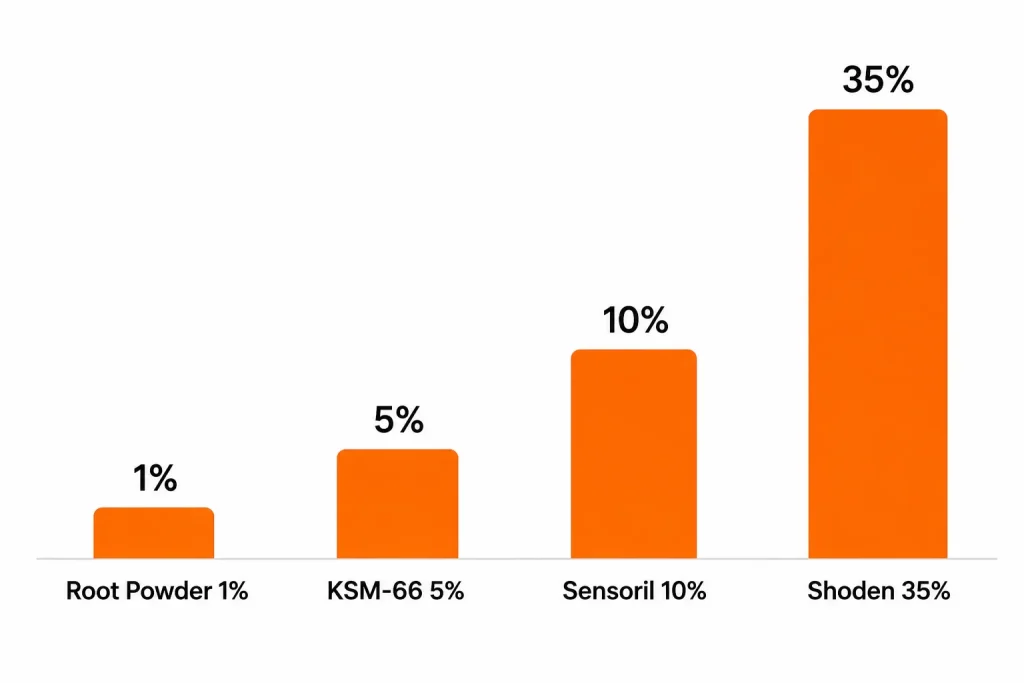
Ashwagandha root powder contains withanolides at roughly 0.5% to 1% by weight in its natural, unprocessed form. A standardised extract concentrates this to 2.5%, 5%, or in some branded forms, much higher. The clinical trials that people cite when they talk about ashwagandha reducing cortisol, improving sleep, or lowering stress used standardised extracts at specific withanolide percentages — not generic root powder. Taking 600mg of raw root powder and taking 600mg of a 5% withanolide extract are not the same thing at all.
The Indian supplement market is flooded with ashwagandha products that list milligrams without disclosing withanolide percentage. Knowing what to look for on a label, and why the percentage matters more than the milligrams, is the single most useful thing you can learn before buying ashwagandha.
Why the Milligram Number on Your Ashwagandha Label Tells You Almost Nothing
The core confusion in ashwagandha supplementation comes from treating milligrams as a meaningful measure of potency. They are not. Milligrams measure how much material is in a capsule. They say nothing about how much of the active compound — withanolides — is present in that material.
Consider the arithmetic. Raw ashwagandha root powder contains approximately 0.5% to 1% withanolides by weight. A 500mg capsule of raw powder therefore delivers roughly 2.5 to 5mg of withanolides. A 300mg capsule of an extract standardised to 5% withanolides delivers 15mg of withanolides. The extract capsule is smaller in milligrams but delivers three to six times more active compound.
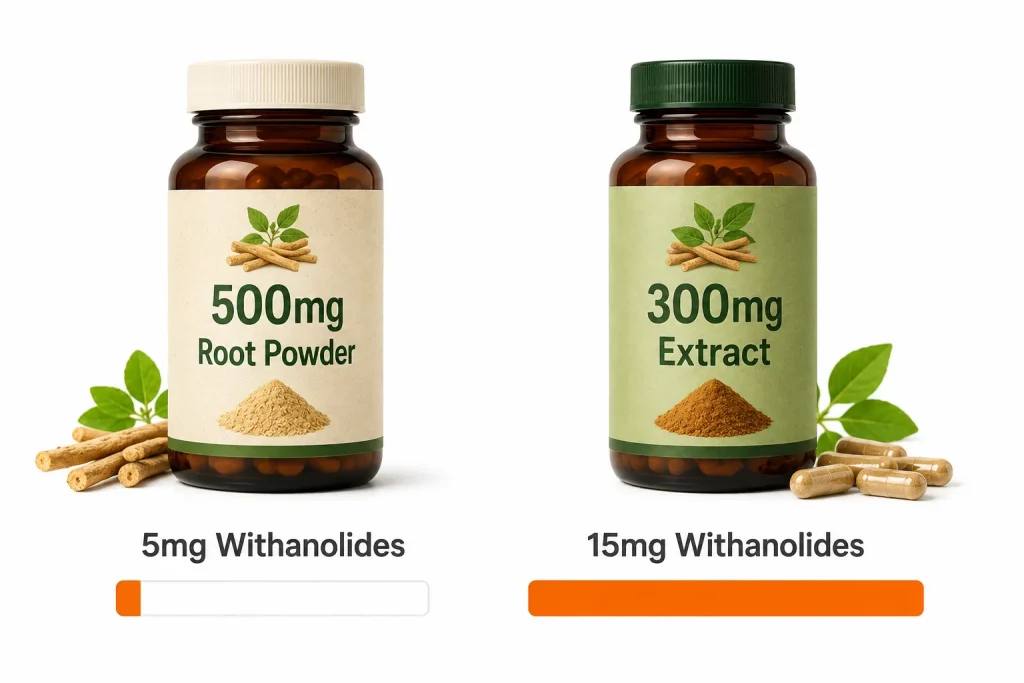
This is not a trivial difference. The Chandrasekhar et al. 2012 study, the most widely cited human trial on ashwagandha’s stress effects, used 300mg of KSM-66 extract twice daily – standardised to 5% withanolides – and found a 27.9% reduction in serum cortisol over 60 days. That finding applies to that specific extract at that specific concentration. It does not apply to a generic 600mg root powder capsule with no withanolide disclosure.
In India specifically, the ashwagandha supplement market ranges from cheap powders sold in local kirana stores and pharmacies to expensive branded extracts available in gyms and online. Products from Patanjali, Himalaya, and dozens of unbranded manufacturers typically use root powder or low-concentration extracts without clear withanolide labelling. International branded extracts like KSM-66 (made by Ixoreal Biomed, a Hyderabad-based company, which is relevant for Indian consumers to know) command a higher price but provide the standardisation that makes dosing predictable.
What Withanolides Actually Are and What They Do
Withanolides are a class of naturally occurring steroidal lactones found primarily in Withania somnifera -the ashwagandha plant – and they are the compounds responsible for its adaptogenic, anti-stress, and anti-inflammatory effects. The word “steroidal lactone” does not mean they are steroids in the hormonal sense that gym culture worries about. It refers to their chemical ring structure, which resembles steroids but is functionally distinct.
What Withanolides Do Inside the Body
Withanolides act through several mechanisms, all of which are relevant to the effects people take ashwagandha for. Their primary action is on the hypothalamic-pituitary-adrenal (HPA) axis, which is the body’s central stress response system. When you perceive a threat or stressor, the hypothalamus signals the pituitary gland, which signals the adrenal glands to release cortisol. Withanolides appear to modulate the sensitivity of this axis, reducing the cortisol output for a given stressor rather than suppressing cortisol entirely.
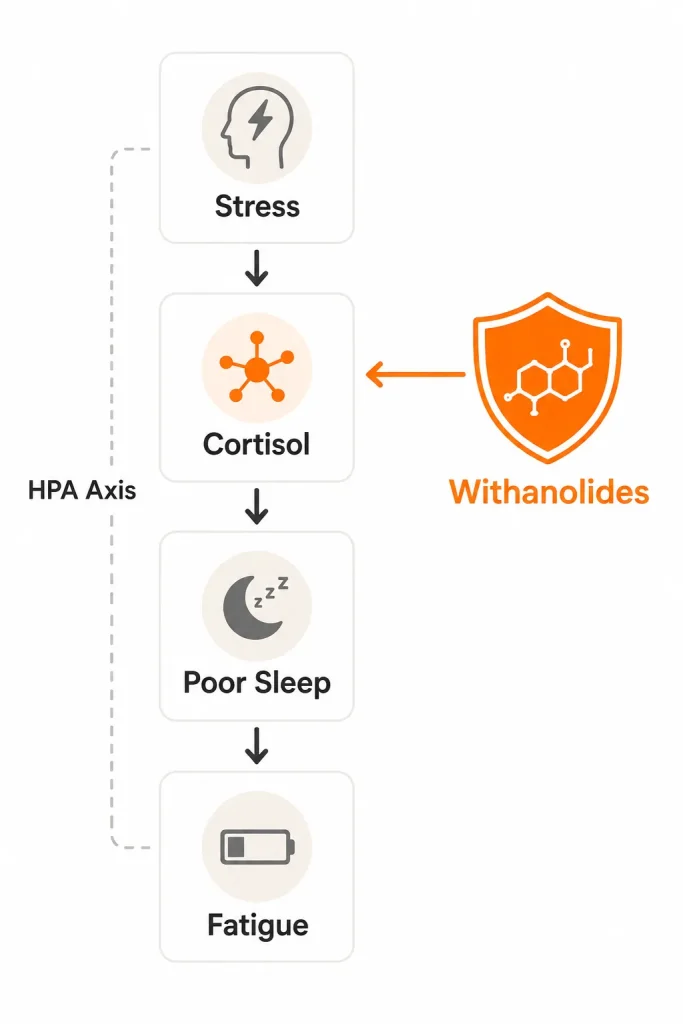
Specific withanolides including withaferin A and withanolide A also act on the NF-kB pathway, a cellular signalling route that controls the expression of inflammatory genes. Inhibiting NF-kB reduces systemic inflammation, which is why ashwagandha has both stress-reduction and anti-inflammatory applications in the research literature.
A 2024 PMC pharmacokinetics review confirmed that withanolides are detectable in human plasma after oral administration, with withaferin A showing oral bioavailability of approximately 32% in one study. This is meaningful: it confirms these compounds actually reach systemic circulation in humans rather than being degraded in the gut, which is a genuine question for plant-based bioactive compounds.
The one-sentence verdict: Withanolides are the pharmacologically active compounds in ashwagandha, acting primarily on the stress-response axis and inflammatory pathways, and they are detectable in human plasma after oral consumption.
What Ashwagandha Root Powder vs Extract Actually Means
Raw ashwagandha root powder and ashwagandha extract are not the same product, and the distinction matters enormously for dosing. Raw root powder is simply dried and ground ashwagandha root with no concentration of active compounds. It contains whatever withanolide level was present in the plant at harvest — typically 0.5% to 1% by weight, though this varies with cultivation, soil, and season.
An extract is produced by taking raw plant material and using a solvent – water, ethanol, or a combination – to isolate and concentrate specific compounds. The withanolide content of the resulting extract is then measured and standardised to a guaranteed minimum percentage. When a product label says “standardised to 5% withanolides,” it means every batch has been tested to confirm at least 5% of the extract’s weight is withanolides.
KSM-66 is a root-only extract standardised to 5% withanolides, produced using an aqueous extraction process without alcohol or synthetic solvents, and backed by over 22 human clinical trials. Sensoril is a root-and-leaf extract standardised to 10% withanolides. Shoden is standardised to 35% withanolides and used at lower doses of 120mg rather than 300 to 600mg.
The clinical research base is overwhelmingly based on KSM-66 and Sensoril. When a study shows ashwagandha reducing cortisol or improving sleep, it used one of these standardised branded extracts, not a generic powder.
The one-sentence verdict: Root powder and extract are chemically the same plant but functionally different products -extract provides predictable, measurable withanolide concentration while root powder does not.
What Percentage of Withanolides Should an Ashwagandha Product Have?
The clinically validated range for withanolide percentage is 2.5% to 5% for root-only extracts at doses of 300 to 600mg daily, based on the trials that produced the results most commonly cited in ashwagandha research. Most well-designed human clinical trials used KSM-66 standardised to 5% withanolides at 300mg twice daily.
A product with 1% withanolides at 300mg delivers 3mg of active compound. A product with 5% withanolides at 300mg delivers 15mg. Both have the same milligram capsule size. The first is about one-fifth the therapeutic dose of the second.
Higher percentages – like Sensoril’s 10% or Shoden’s 35% – allow lower doses while delivering equivalent or greater amounts of active compound. A 120mg capsule of Shoden at 35% withanolides delivers 42mg of withanolides – more active compound than a 600mg capsule of 5% extract. This is why comparing products by milligrams without reference to withanolide percentage is genuinely misleading.
There is one important caveat about high withanolide percentage products from leaf-and-root extracts. Withaferin A, one of the withanolides found predominantly in the leaf, is considered cytotoxic at elevated concentrations in cell and animal studies. Root-only extracts like KSM-66 deliberately minimise withaferin A content. India’s Ministry of AYUSH specifically endorses root extract formulations as the traditional and time-tested form of ashwagandha supplementation.
The one-sentence verdict: Look for products standardised to at least 2.5% to 5% withanolides; a product that does not disclose its withanolide percentage gives you no way to assess whether the dose is therapeutic.
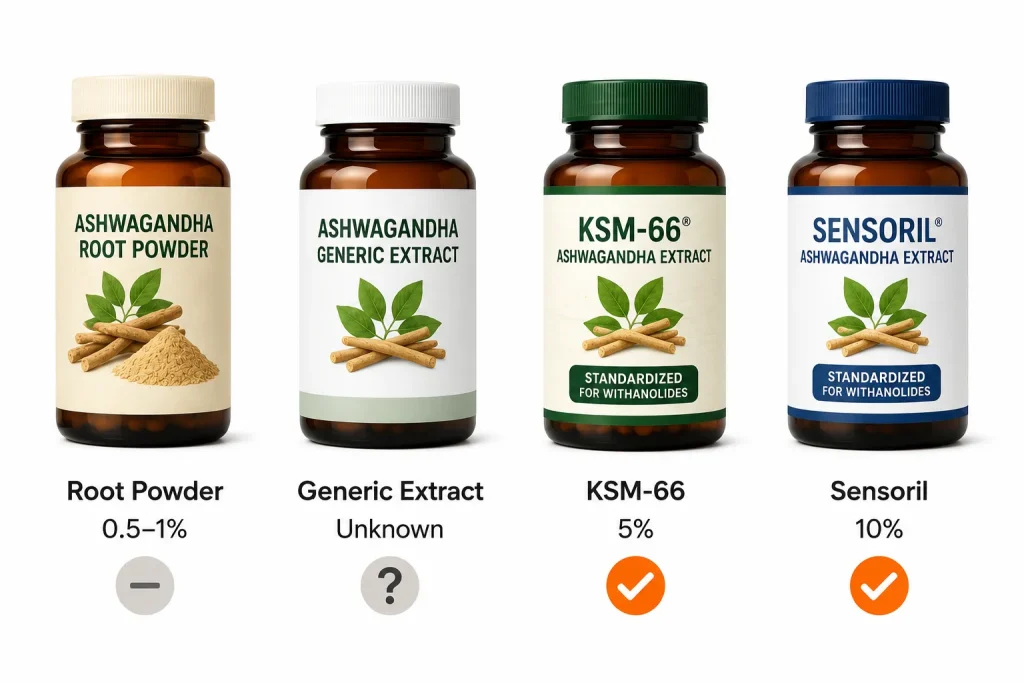
Ashwagandha Product Comparison: What the Numbers Actually Mean
| Product Type | Withanolide % | Typical Dose | Active Compound Per Dose | Clinical Trials | Verdict |
|---|---|---|---|---|---|
| Generic root powder | 0.5 to 1% | 500 to 1000mg | 2.5 to 10mg | None using this form | Unpredictable dose |
| Generic extract (undisclosed %) | Unknown | 300 to 600mg | Unknown | Not applicable | Avoid if unlabelled |
| KSM-66 (root only) | 5% minimum | 300 to 600mg | 15 to 30mg | 22+ human RCTs | Best-studied form |
| Sensoril (root + leaf) | 10% minimum | 125 to 250mg | 12.5 to 25mg | 12+ human trials | Best for sleep |
| Shoden (root + leaf) | 35% minimum | 120mg | 42mg | Limited human trials | High potency, less data |
| Patanjali/Himalaya ashwagandha | Typically unlisted | 250 to 500mg | Unknown | None standardised | Cannot assess |
How Your Body Absorbs and Uses Withanolides
Withanolides are absorbed in the small intestine and reach systemic circulation in measurable concentrations, though their oral bioavailability varies significantly between individual compounds and between different extract formulations.
After ingestion, withanolides undergo first-pass metabolism in the liver before entering general circulation. A 2023 pharmacokinetics study published in Heliyon examined two commercial ashwagandha extracts with equal total withanolide content but different formulations and found that the glycoside-rich formulation (WS-35) was 280 times more bioavailable in plasma than the lower-glycoside formulation (WS-2.5). This is a remarkable finding that has not yet filtered into mainstream supplement advice: the form in which withanolides occur in an extract affects how much reaches your bloodstream, not just the total percentage on the label.
Once in circulation, withanolides act through multiple pathways. They modulate the hypothalamic-pituitary-adrenal (HPA) axis – the body’s central stress response system – reducing excess cortisol production under chronic stress conditions. They inhibit NF-kB, a transcription factor that controls inflammation. Withaferin A specifically has been studied for GABAergic activity, meaning it may interact with the same neurotransmitter system as anti-anxiety medications, though at far lower potency.
The half-life of withanolides in plasma is approximately 2 to 4 hours for most individual compounds, which is why twice-daily dosing (morning and evening) produces more consistent serum levels than a single large daily dose. Research consistently shows effects developing over 4 to 8 weeks of daily use rather than acutely after a single dose.
Timing recommendation: Take ashwagandha with food, twice daily if possible, with consistent daily use for a minimum of 6 to 8 weeks before evaluating effect. Morning and evening dosing maintains more stable plasma withanolide levels than a single daily dose. Taking it with a meal containing fat may improve absorption of these fat-soluble compounds.
What the Research Actually Says About Withanolide Dosing
The most cited human trial on ashwagandha’s stress effects is the Chandrasekhar et al. 2012 study published in the Indian Journal of Psychological Medicine. In a 60-day double-blind, randomised, placebo-controlled trial of 64 adults with chronic stress, subjects receiving 300mg of KSM-66 extract twice daily (600mg total, 5% withanolides) showed a 27.9% reduction in serum cortisol compared to placebo, alongside significant improvements across multiple stress assessment scales.
Research consistently shows that products not disclosing withanolide percentage may deliver a fraction of the withanolide content used in clinical trials. A product standardised to 1% withanolides at 600mg delivers 6mg of withanolides. The KSM-66 trial used 600mg at 5%, delivering 30mg. These are not equivalent doses regardless of the matching milligram figure.
A 2023 bioavailability study in Heliyon further demonstrated that formulation affects how much withanolide reaches plasma, meaning that two products with identical withanolide percentages by weight can produce different serum levels depending on the extraction process.
“Products that do not disclose their withanolide concentration may be delivering a fraction of what the research actually tested.” — Noble Nature, reviewing the clinical basis for standardised ashwagandha extracts.
The honest reality check: most Indians buying ashwagandha at a local pharmacy or from a kirana store are buying root powder or low-percentage extracts at doses that may produce little measurable benefit, while believing they are taking the same product studied in clinical trials. The gap between what the research tested and what the market sells is significant.
What to Be Careful About When Buying Ashwagandha in India
The Indian ashwagandha supplement market has specific problems worth naming directly.
Adulteration is a documented issue. Multiple independent lab tests on Indian ashwagandha products — including some from well-known Ayurvedic brands — have found inconsistent withanolide content, contamination with heavy metals, or substitution with non-ashwagandha plant material. Choosing products with third-party testing certificates, or branded extracts like KSM-66 that carry Informed Sport or Clean Label Project certification, significantly reduces this risk.
Leaf extract versus root extract matters in India because of AYUSH guidelines. India’s Ministry of AYUSH specifically endorses root-only ashwagandha formulations as the traditional and historically validated form. Products using leaf extract or combined leaf-and-root extracts without clear disclosure are outside traditional Ayurvedic parameters and carry greater theoretical cytotoxicity risk from higher withaferin A content.
Pregnant and breastfeeding women should not take ashwagandha. Ashwagandha has been associated with abortifacient activity in animal studies. This is not a theoretical concern: it is a clear contraindication, and the risk applies regardless of withanolide percentage or product form.
People with autoimmune conditions including thyroid disease, rheumatoid arthritis, and lupus should consult a doctor before using ashwagandha. Its immunomodulatory effects, which are part of what makes it effective as an adaptogen, can potentially exacerbate autoimmune activity in sensitive individuals.
For anyone looking to understand whether ashwagandha is a suitable addition alongside other supplements commonly used in Indian fitness culture, the ashwagandha vs magnesium at night comparison covers the specific sleep and stress context where both are commonly used together.
How to Choose Ashwagandha Based on What You Are Trying to Achieve
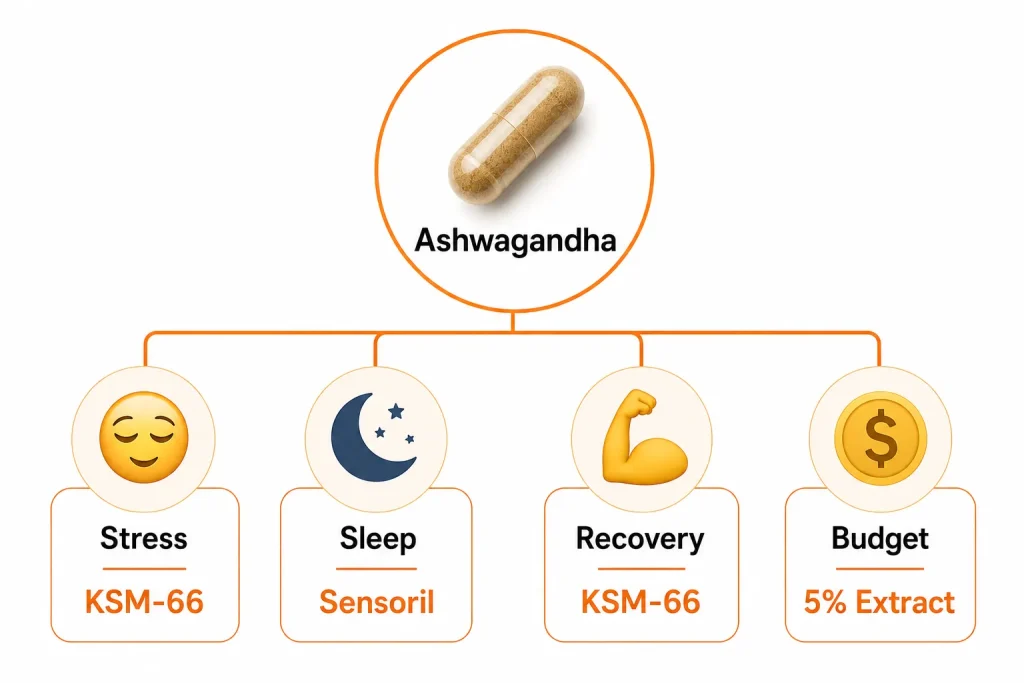
If Your Goal Is Stress Reduction and Cortisol Management
Choose a KSM-66 standardised root extract at 300mg twice daily (600mg total), standardised to 5% withanolides. This is the most researched form for cortisol reduction, with the Chandrasekhar 2012 trial showing a 27.9% cortisol reduction over 60 days. Do not substitute generic root powder at the same milligram dose — the withanolide content is not equivalent.
If Your Goal Is Sleep Quality
Sensoril at 125 to 250mg standardised to 10% withanolides has the strongest evidence base specifically for sleep quality improvement. For the full picture of how ashwagandha with milk at night works as a traditional practice with modern scientific rationale, the ashwagandha with milk at night guide covers the combination specifically.
If You Are a Gym-Goer Looking for Recovery and Strength Benefits
KSM-66 at 300 to 600mg daily has the most clinical data for athletic populations — strength, VO2 max, and recovery from training. Consistency for 8 weeks minimum is required before evaluating athletic benefit. The effect is real but modest; it is not a substitute for sleep, nutrition, and programming.
If You Are on a Tight Budget
A product that discloses withanolide percentage is better than a cheaper product that does not, even at the same milligrams. Himalaya and some Patanjali products are tested to some internal standard but do not always disclose withanolide percentages clearly. If budget is the primary constraint, contact the manufacturer directly to ask for the withanolide percentage on their extract before purchasing.
If You Are Completely New to Supplements
Start with a product clearly labelled with its withanolide percentage — 2.5% minimum, 5% preferred. Ignore milligrams as the primary measure. Expect effects to take 4 to 8 weeks to become noticeable. Take it consistently. The effects build over time; inconsistent use does not produce the cortisol changes observed in trials.
The Bottom Line
Withanolides are the active compounds in ashwagandha that produce its documented effects, and knowing the withanolide percentage of a product is more important than its milligram dose. Clinical trials showing ashwagandha reduces cortisol, improves sleep, and supports cognitive function used standardised extracts at 2.5% to 5% withanolides — not generic root powder, and not products with undisclosed concentrations.
Before buying any ashwagandha product, check the label for withanolide percentage. If it is not listed, the manufacturer either does not know or is deliberately obscuring an unflattering number. Neither is a reason to trust the product.
KSM-66 and Sensoril are the most extensively researched forms. Both are produced in India. Both have the clinical trial data to back their dose recommendations. If you are going to supplement with ashwagandha, use one of these and take it at the studied dose for the studied duration. Everything else is guesswork dressed up in milligrams.
People Also Ask
What are withanolides in ashwagandha and why do they matter?
Withanolides are steroidal lactones, the primary bioactive compounds in ashwagandha (Withania somnifera) that produce its adaptogenic effects on stress, cortisol, and inflammation. They act on the hypothalamic-pituitary-adrenal axis to modulate the body’s stress response and inhibit NF-kB inflammatory pathways. They matter because the clinical research on ashwagandha’s documented benefits used products standardised to specific withanolide percentages — typically 2.5% to 5% — and a product without disclosed withanolide content cannot be reliably dosed.
Does higher mg ashwagandha mean better results?
No, higher milligrams of ashwagandha do not mean better results. Milligrams measure the total weight of the capsule contents, not the active compound concentration. A 500mg capsule of raw root powder at 1% withanolides delivers 5mg of active compound. A 300mg capsule of extract standardised to 5% withanolides delivers 15mg of active compound. The extract is smaller in milligrams but three times more potent. Withanolide percentage, not milligrams, determines effective dose.
What percentage of withanolides should good ashwagandha have?
A good ashwagandha supplement should be standardised to at least 2.5% withanolides, with 5% being the level used in most well-designed human clinical trials. KSM-66, the most studied form, is standardised to 5% withanolides and is used at 300mg twice daily. Sensoril is standardised to 10% withanolides and used at 125 to 250mg daily. Products that do not disclose their withanolide percentage cannot be assessed for therapeutic equivalence to any clinical research.
What is the difference between ashwagandha root powder and extract?
Ashwagandha root powder is dried and ground root with naturally occurring withanolides at approximately 0.5% to 1% by weight. Extract is processed to concentrate withanolides to a guaranteed minimum percentage — typically 2.5%, 5%, or higher depending on the product. The same milligram dose of root powder delivers significantly less active compound than an equivalent dose of standardised extract. Clinical trials used standardised extracts, not root powder, which means efficacy data from trials does not directly apply to root powder products.
Is KSM-66 better than normal ashwagandha?
KSM-66 is not a different plant — it is the same ashwagandha root processed to a standardised 5% withanolide concentration by Ixoreal Biomed in Hyderabad, India. Compared to generic root powder, KSM-66 delivers predictable, measurable withanolide content per dose, which is why it has been used in over 22 human clinical trials. Whether it is “better” depends on whether you define better as having more research backing and more reliable dosing — in which case yes — or whether you define it as being more traditional, in which case root powder predates extracts.
Can I take ashwagandha every day long-term?
Daily use of standardised ashwagandha root extract at 300 to 600mg is considered safe for most healthy adults based on clinical trials lasting up to 60 days, with some safety data extending to 90 days. Long-term data beyond 90 days in humans is limited. Cycling ashwagandha, such as taking it for 8 to 12 weeks followed by a break, is commonly recommended as a precaution, though no specific adverse effect has been identified that makes this medically necessary for most people. Pregnant women, people with autoimmune conditions, and those on thyroid medication should consult a doctor.
Why do Indian ashwagandha brands not list withanolide percentages?
Many Indian ashwagandha brands — including some large Ayurvedic companies — do not list withanolide percentages because they use raw root powder or low-concentration extracts that would show unflattering numbers if disclosed. There is no regulatory requirement in India currently compelling withanolide disclosure on ashwagandha labels. The absence of a disclosed percentage is itself information: it typically means the product has not been standardised to a specific withanolide content, which makes therapeutic dosing unreliable.
Sources and References
- Chandrasekhar K, Kapoor J, Anishetty S. A Prospective, Randomized Double-Blind, Placebo-Controlled Study of Safety and Efficacy of a High-Concentration Full-Spectrum Extract of Ashwagandha Root in Reducing Stress and Anxiety in Adults. Indian Journal of Psychological Medicine, 2012 — Primary source for 27.9% cortisol reduction at 600mg KSM-66 daily over 60 days, and for the stress scale improvements across PSS, GHQ-28, and DASS.
- Quantifying Withanolides in Plasma: Pharmacokinetic Studies and Analytical Methods. Speers AB, Lozano-Ortiz A, Soumyanath A. Nutrients, PMC, 2024 — Source for withanolide plasma pharmacokinetics, withaferin A oral bioavailability data, and the analytical confirmation that withanolides reach systemic circulation in humans.
- Pharmacokinetics and Bioequivalence of Withania somnifera Extracts: A Double Blind, Crossover Study in Healthy Adults. Heliyon, 2023 — Source for the finding that the glycoside-rich formulation (WS-35) was 280 times more bioavailable per mg of withanolides than WS-2.5, highlighting the role of formulation beyond total withanolide percentage.