
If you struggle with racing thoughts the moment your head hits the pillow, ashwagandha and magnesium are the two supplements you will hear about the most. The direct answer is that magnesium glycinate is generally better for purely physical sleep onset, while ashwagandha is more effective when anxiety or high cortisol is the root cause keeping you awake. They work through completely different biological pathways, and for some people the best answer is actually both, but not in the way most articles suggest.
This is not just another supplement comparison that ends with “it depends.” For the leanfuel.in reader in India, where sleep disruption from stress, heat, irregular work hours, and late-night screen use is absurdly common, picking the wrong one means wasting money on something that does nothing for your specific problem. Most people online treat ashwagandha as an Ayurvedic sleep herb and magnesium as a muscle relaxant and leave it there. That surface-level take is why so many people buy one, try it for a week, and quit. The real difference is in what each compound actually does inside your nervous system, and once you understand that, the choice becomes obvious.
What is rarely discussed is that ashwagandha and magnesium are not direct competitors. One works upstream on the stress signaling system. The other works downstream on neurotransmitter balance and muscle relaxation. Knowing which system is failing you at night is how you solve this for good.
The Honest Answer
- Ashwagandha lowers cortisol, the primary stress hormone, which directly reduces anxiety-driven nighttime wakefulness.
- Magnesium glycinate increases GABA activity and reduces neuromuscular excitability, helping your body physically power down for sleep.
- For someone whose mind races at night, ashwagandha is usually the stronger first choice because it targets the overactive stress response that causes the mental chatter.
- For someone who feels physically restless, tense, or gets calf cramps and twitching at night, magnesium is the more direct fix.
- Both can be taken at night safely, but ashwagandha requires consistent use over days to show effects, while magnesium can work the first night.
- Taking both together is not dangerous, but the combined sedative effect can sometimes leave you groggy in the morning if doses are too high.
Why Most People Get This Wrong From the Start
The biggest mistake in the ashwagandha versus magnesium conversation is treating them like they are two versions of the same thing. They are not. Ashwagandha is an adaptogenic herb that modulates the hypothalamic-pituitary-adrenal axis, the system that controls your body’s long-term stress output. Magnesium is an essential mineral that acts as a cofactor for over 300 enzymatic reactions, including those that produce calming neurotransmitters and regulate muscle contraction.
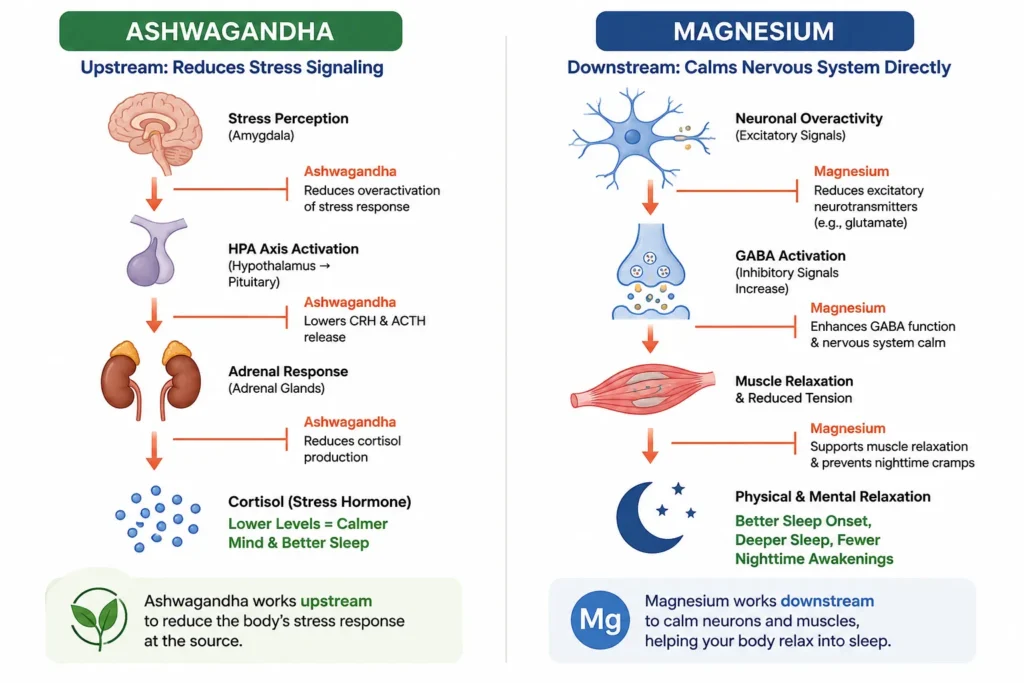
Think of it this way. Ashwagandha is like turning down the volume on a loudspeaker that keeps blaring stress signals. Magnesium is like oiling the machinery so the parts stop grinding against each other. Different problems, different tools.
In India specifically, the confusion runs deeper because ashwagandha is embedded in cultural memory as a general health tonic, often taken with warm milk, while magnesium is a relatively newer supplement conversation mostly happening in fitness circles. Many Indian consumers default to ashwagandha because their grandmother recommended it, without ever asking whether their actual problem is mineral depletion. Meanwhile, magnesium deficiency is shockingly widespread in India due to soil depletion, high consumption of refined grains, and low intake of leafy greens and nuts in the average daily diet. A 2017 study in the Indian Journal of Clinical Biochemistry noted that a significant proportion of the urban Indian population has suboptimal magnesium levels, often without knowing it. This means a lot of people are reaching for ashwagandha when what their body actually lacks is a mineral they are not eating enough of.
How Ashwagandha Actually Affects Sleep and Anxiety
Ashwagandha works by lowering cortisol, and that matters more for sleep than most people realise.
Cortisol follows a natural daily rhythm. It peaks in the morning to wake you up and should hit its lowest point around midnight so you can sleep deeply. Chronic stress flattens and elevates that nighttime dip, leaving you physically exhausted but mentally alert at 11 PM. Ashwagandha directly reduces serum cortisol levels. A 2019 double-blind, randomized, placebo-controlled study published in Medicine (Baltimore) found that participants taking 240 mg of a standardized ashwagandha extract daily experienced a statistically significant reduction in cortisol compared to placebo, alongside improvements in sleep quality and reduced anxiety scores. View study on PubMed
This is why ashwagandha works so reliably for the “tired but wired” type of insomnia. It is not a sedative. It does not force sleep. It removes the biochemical barrier that stress has built. The effect builds over several days to weeks because it takes time for the HPA axis to recalibrate. The first night you take it, do not expect to feel knocked out. By day seven to ten, many people notice they are simply less anxious at bedtime, and sleep comes without the usual internal negotiation.
A separate 2019 placebo-controlled study in Cureus tested ashwagandha root extract in people with insomnia and anxiety and found significant improvements in sleep onset latency, total sleep time, and sleep efficiency after eight weeks. View study on PubMed The study used a 300 mg dose taken twice daily, with one dose close to bedtime.
One specific myth in Indian fitness circles is that ashwagandha works like a sleeping pill and can be used on demand. That is wrong. Ashwagandha is not a quick fix. It is an adaptogen that retrains your stress response. If you take it at 10 PM expecting to be asleep by 10:30, you will be disappointed. The herb does its real work during the day, lowering baseline stress so that nighttime naturally returns to a restful state.
The Ayurvedic tradition of taking ashwagandha with milk at night is not just cultural nostalgia — it has a functional basis.
Milk contains tryptophan, a precursor to serotonin and melatonin, and the fat in milk improves the absorption of ashwagandha’s fat-soluble withanolides. If you want to go deeper on this specific ritual, the Ashwagandha with Milk at Night guide on leanfuel.in covers the science and method in detail.
How Magnesium Affects Sleep and Anxiety
Magnesium calms the nervous system directly by regulating GABA receptors and controlling calcium influx into neurons.
Gamma-aminobutyric acid, or GABA, is the brain’s primary inhibitory neurotransmitter. It tells neurons to slow down. Magnesium binds to GABA receptors and enhances their function, producing a calming effect that is immediate and physiological. At the same time, magnesium blocks calcium from flooding into nerve cells excessively, which reduces neuromuscular excitability. This is why magnesium deficiency often presents as muscle twitching, cramps, restless legs, and an inability to physically settle down at night.
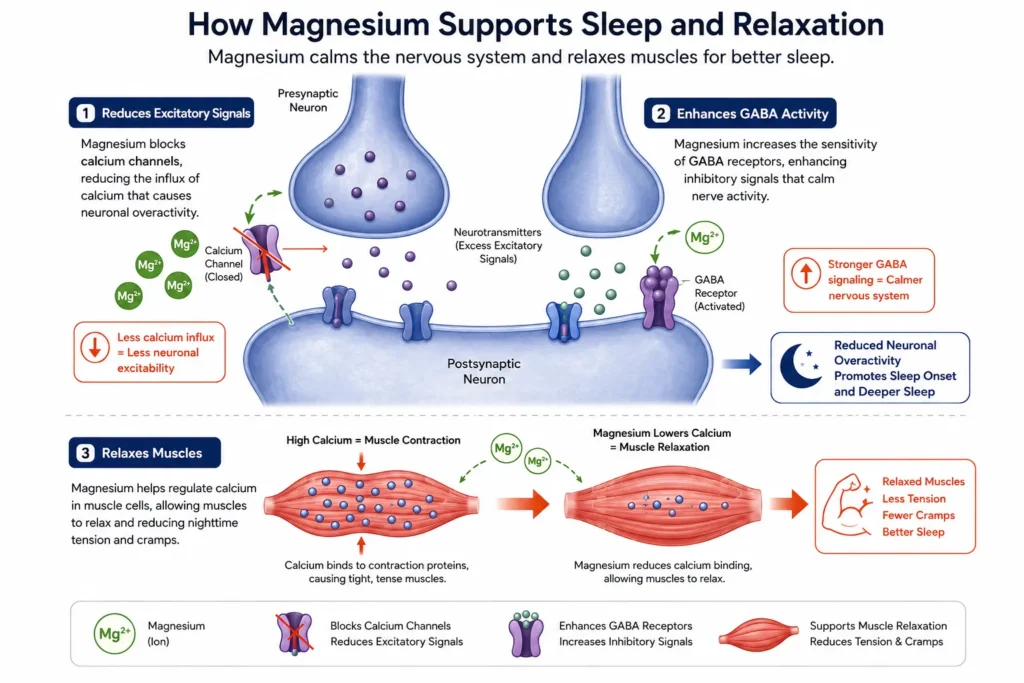
A 2012 randomized, double-blind, placebo-controlled trial published in the Journal of Research in Medical Sciences tested 500 mg of magnesium daily in elderly individuals with insomnia. The magnesium group showed significant improvements in sleep efficiency, sleep time, and sleep onset latency, along with reduced early morning awakening and lower cortisol levels. View study on PubMed This study is important because it demonstrates that magnesium can improve sleep even when cortisol is a factor, though its primary mechanism remains neuromuscular and GABAergic.
The form of magnesium matters enormously. Magnesium oxide, the cheap form sold in many Indian pharmacies, is poorly absorbed and mostly works as a laxative. Magnesium glycinate is the form specifically studied for sleep because glycine itself is an inhibitory neurotransmitter that enhances sleep quality. Magnesium citrate offers a middle ground but can cause digestive urgency at higher doses. For sleep, magnesium glycinate is the clear winner. If you want to understand the full landscape of magnesium deficiency symptoms beyond sleep, the 7 Signs of Magnesium Deficiency Most People Ignore covers what to look for.
A meta-analysis published in 2021 in Complementary Therapies in Medicine reviewed randomized controlled trials and concluded that magnesium supplementation significantly improves sleep quality, particularly in individuals with baseline magnesium insufficiency. View meta-analysis on PubMed The effect sizes were modest but consistent, and the safety profile was excellent.
One detail that rarely gets mentioned in Indian contexts is that high calcium intake without corresponding magnesium intake can worsen magnesium deficiency. India’s heavy dairy consumption in vegetarian diets, combined with low magnesium intake from greens and nuts, can create a calcium-to-magnesium ratio that keeps the nervous system in a state of mild hyperexcitability. This means some people who drink milk at night for sleep are actually making things worse, not better, if they are magnesium deficient.

Direct Comparison Data Table
| Compound | Primary Mechanism | Onset of Action | Key Study Outcome | Best For | Verdict |
|---|---|---|---|---|---|
| Ashwagandha (KSM-66 or equivalent) | Lowers cortisol via HPA axis modulation | 7–14 days for full effect | 2019 study: reduced cortisol, improved sleep quality and anxiety scores | Anxiety-driven insomnia, overthinking at night | Best for mental restlessness |
| Magnesium Glycinate | Enhances GABA activity, blocks excess calcium influx in neurons | 1 night (mild) to 1 week (consistent) | 2012 trial: improved sleep efficiency, reduced nighttime awakenings | Physical restlessness, cramps, muscle tension | Best for physical sleep difficulty |
| Magnesium Citrate | Same GABAergic effect but less glycine benefit | Same as glycinate | Equivalent sleep benefits but higher digestive side effect risk | Constipation plus sleep issues | Good if digestion also needed |
| Ashwagandha + Magnesium (combined) | Dual pathway: stress reduction + neuromuscular calm | Cumulative | No large-scale combination trials yet | Severe stress with physical tension | Use with dose caution |
| Magnesium Oxide | Minimal central nervous system effect | Minimal | Not recommended for sleep; poorly absorbed | None for sleep | Avoid for sleep |
How Your Body Responds to Each at Night
When you take ashwagandha, the withanolides, which are steroidal lactones and the active compounds in the root, enter your bloodstream and begin interacting with receptors in the brain that govern the stress response. The key pathway is the downregulation of the hypothalamic-pituitary-adrenal axis, which reduces corticotropin-releasing hormone and subsequently lowers adrenocorticotropic hormone and cortisol output. This process takes hours to days to meaningfully shift cortisol levels, which is why ashwagandha is not a same-night solution. Peak effects on cortisol are typically observed after 30 to 60 days of consistent use.
Magnesium glycinate, by contrast, begins working within 30 to 60 minutes of ingestion. Glycine rapidly crosses the blood-brain barrier and binds to glycine receptors, which are co-agonists for NMDA receptors and also have independent inhibitory effects. Magnesium ions then enhance GABA-A receptor function, creating a net inhibitory effect on the central nervous system. This is why magnesium can produce a noticeable physical relaxation the first time you take it before bed, especially if you were deficient.
Timing recommendation is straightforward. Take magnesium glycinate 30 to 45 minutes before your intended sleep time, with or without food. Ashwagandha can also be taken at night, but consistency matters more than the specific hour. If you are taking both, lower the dose of each slightly to avoid morning grogginess. A common effective pairing is 300 mg of ashwagandha and 200 mg of magnesium glycinate, which is half the standard full dose of each, taken together an hour before bed.
What the Research Actually Says
The clinical evidence for ashwagandha and magnesium as sleep interventions is moderate in size but consistent in direction. The ashwagandha research is dominated by small to medium randomized controlled trials, most conducted in India. The 2019 Cureus study mentioned earlier is frequently cited and methodologically sound. The magnesium literature includes multiple trials with older adults showing improvements in sleep quality scores, though the effect sizes are often small, in the range of a 15 to 20 percent improvement on standardized scales.
One honest reality check is that the average person’s experience often overperforms the formal study data, particularly for ashwagandha. This is likely because studies recruit participants with a broad range of baseline cortisol levels, while real-world users self-select precisely because their stress is high. If your cortisol is already normal at night, ashwagandha will do very little for your sleep. If it is elevated, the effect can feel dramatic.
A key quote from the magnesium meta-analysis authors captures the current state of the evidence well:
“Magnesium supplementation appears to improve subjective measures of insomnia and sleep quality, but the optimal dose, formulation, and treatment duration remain to be fully clarified.” — Arab et al., Complementary Therapies in Medicine, 2021
This is not a settled science with massive multinational trials. It is a space with real, replicable signals that have not yet received the level of funding that pharmaceutical sleep drugs command. That does not make the supplements ineffective. It means you should treat the evidence as encouraging but not monolithic, and pay attention to your own response more than any abstract.
The Things Worth Knowing Before You Start
Ashwagandha is generally safe for most people, but it can cause thyroid hormone fluctuations. If you have hyperthyroidism or are on thyroid medication, check with a doctor before starting. Some people also report mild digestive upset or drowsiness the next morning, especially with higher doses above 600 mg. In rare cases, ashwagandha can trigger apathy or emotional blunting because of the way it dampens the stress response. If you feel strangely flat after a few weeks, lower the dose or cycle off.
Magnesium glycinate is extremely well tolerated, but taking too much will cause loose stools, though less aggressively than magnesium citrate. The bigger watch-out is that people with kidney disease need to be cautious with any magnesium supplementation because the kidneys regulate magnesium excretion, and impaired function can lead to dangerous accumulation.
In India, one specific concern is the quality and standardization of ashwagandha supplements. Many local products do not specify withanolide content, which is the active compound percentage that determines potency. A product labelled “ashwagandha powder 500 mg” without a withanolide specification, typically 2.5 percent or 5 percent, is unreliable. Look for extracts standardized to at least 2.5 percent withanolides from reputable brands. For magnesium, the trap is buying cheap magnesium oxide thinking it is the same thing. It is not. If the label says magnesium oxide, move on.
Who Should Actually Choose What

If your mind races at night and you feel anxious without a clear physical cause.
Start with ashwagandha. This is the classic “can’t turn off your brain” scenario. Take 300 to 600 mg of a standardized extract with dinner or an hour before bed, and give it at least ten days before judging the result. The mental quiet that ashwagandha produces is subtle but real. If you also have physical tension, add a low dose of magnesium glycinate after the first week.
If you feel physically restless, have muscle cramps, or your legs feel jumpy at night.
Magnesium glycinate is your first move. Take 200 to 400 mg of elemental magnesium from magnesium glycinate about 40 minutes before bed. This is especially relevant if you train hard, sweat a lot in India’s heat, or eat a low-vegetable diet. Magnesium depletion from sweat and poor dietary intake is far more common than most people assume.
If you are a vegetarian in India with a dairy-heavy diet.
You are likely getting enough calcium but not nearly enough magnesium. This imbalance can create exactly the type of subclinical neuromuscular irritability that disrupts sleep without any obvious anxiety. A magnesium supplement, paired with more leafy greens and pumpkin seeds in your diet, can resolve sleep fragmentation that years of overthinking could not fix.
If you are on a tight budget and can only afford one supplement.
Choose magnesium glycinate. It has broader systemic benefits beyond sleep, including muscle recovery, blood sugar regulation, and cardiovascular health, and it addresses a genuine dietary deficiency that is widespread in India. Ashwagandha is more targeted. Magnesium is foundational. If you can afford both, the combination is powerful, but never sacrifice quality for quantity. One good supplement is better than two cheap ones with unknown standardization.
If you have high blood pressure or are on blood pressure medication.
Magnesium glycinate is a gentler choice and may even provide modest blood pressure reduction as a secondary benefit. Ashwagandha can lower blood pressure in some people and could theoretically interact with antihypertensive drugs. Neither is dangerous in isolation, but if you are already medicated, magnesium is the lower-risk starting point.
The Bottom Line
Ashwagandha and magnesium are not rivals. They solve different problems that happen to share the same symptom of bad sleep. If your sleep issue is anxiety-driven, your mind will not shut up, and you feel stressed during the day, ashwagandha is the answer. If your sleep issue is physical, your body feels wound up, and you get cramps or twitches, magnesium is the answer. If both are true, which is common, the combination works, but start one at a time so you know what is helping.
The real mistake is staying stuck in analysis paralysis while doing nothing. You know which category you fall into. Pick the supplement that matches your actual nighttime experience, buy a quality version, and take it consistently for two weeks. The body keeps score, and it will tell you clearly whether you chose right. For more on how magnesium compares to other minerals for overall health, the Magnesium vs Zinc guide covers the bigger picture.
Trust your own response more than any article, including this one.
People Also Ask
Can I take ashwagandha and magnesium together at night?
Yes, you can. The combination is safe for most people because the compounds do not have negative interactions. Ashwagandha lowers cortisol while magnesium enhances GABA activity, so the effects can complement each other. Start with half the standard dose of each to see how your body responds, because the combined calming effect can sometimes cause morning grogginess.
Which is better for anxiety, ashwagandha or magnesium?
For generalized anxiety that persists throughout the day and spikes at night, ashwagandha is generally more effective because it directly lowers cortisol. Magnesium is better for the physical symptoms of anxiety, such as muscle tightness, tension headaches, and a pounding heart. If your anxiety is mostly mental and worry-driven, choose ashwagandha first.
How quickly does ashwagandha work for sleep compared to magnesium?
Magnesium can produce a noticeable physical calming effect within 30 to 60 minutes of the first dose. Ashwagandha typically takes seven to fourteen days of consistent use before sleep improvements become obvious because it works by gradually lowering baseline stress hormones rather than directly inducing sleep.
Is magnesium glycinate the best form of magnesium for sleep in India?
Yes. Magnesium glycinate is the most studied form for sleep because glycine itself has calming effects on the brain, and the absorption is high without digestive side effects. Magnesium oxide, which is cheaper and more common in Indian pharmacies, is poorly absorbed and not effective for sleep. Always check the label for magnesium glycinate, not just magnesium.
Does ashwagandha cause weight gain or hormonal issues if taken at night?
Ashwagandha does not directly cause weight gain. In some people, lowering chronically high cortisol can actually support fat loss, especially around the abdomen. However, ashwagandha can increase thyroid hormone activity, so individuals with hyperthyroidism or those on thyroid medication should consult a doctor before using it.
Why do I feel groggy the next morning after taking magnesium or ashwagandha?
Grogginess the next morning usually means the dose was too high for your individual sensitivity. For magnesium, doses above 400 mg of elemental magnesium can be excessive for some people. For ashwagandha, doses above 600 mg can cause residual sedation. Lower the dose by half and see if the grogginess resolves while the sleep benefit remains.
Can ashwagandha solve sleep problems caused by late-night screen use?
Ashwagandha cannot undo the melatonin suppression caused by blue light exposure from screens. If your sleep problem is driven primarily by late-night phone or laptop use, ashwagandha will help only marginally. The most effective fix is still reducing screen exposure one hour before bed. Ashwagandha can help if stress compounds the screen-induced wakefulness, but it is not a substitute for sleep hygiene.
Sources and References
- Lopresti, A.L., Smith, S.J., Malvi, H., & Kodgule, R. (2019). An investigation into the stress-relieving and pharmacological actions of an ashwagandha (Withania somnifera) extract: A randomized, double-blind, placebo-controlled study. Medicine (Baltimore), 98(37), e17186. View on PubMed
- Salve, J., Pate, S., Debnath, K., & Langade, D. (2019). Efficacy and Safety of Ashwagandha (Withania somnifera) Root Extract in Insomnia and Anxiety: A Double-blind, Randomized, Placebo-controlled Study. Cureus, 11(9), e5797. View on PubMed
- Abbasi, B., Kimiagar, M., Sadeghniiat, K., Shirazi, M.M., Hedayati, M., & Rashidkhani, B. (2012). The effect of magnesium supplementation on primary insomnia in elderly: A double-blind placebo-controlled clinical trial. Journal of Research in Medical Sciences, 17(12), 1161–1169. View on PubMed
- Arab, A., Rafie, N., Amani, R., & Shirani, F. (2021). The effects of magnesium supplementation on sleep quality: a systematic review and meta-analysis of randomized controlled trials. Complementary Therapies in Medicine, 58, 102689. View on PubMed