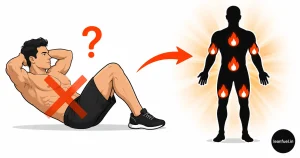
Spot reduction, the idea that exercising one body part burns fat from that exact spot, does not work the way most people think it does. Crunches will strengthen your abs. They will not specifically melt the fat sitting on top of them. Multiple controlled studies using MRI scans have confirmed this again and again.
If you have spent months doing ab circuits hoping for a flat stomach, or thigh exercises hoping to slim your legs, and seen almost nothing change in that specific area, you are not doing it wrong. You are chasing something that biology mostly does not allow.
For Indian gym-goers this myth is everywhere. Every trainer at a local gym seems to have a “reduce belly fat in 15 days” routine built entirely around crunches and side bends. It sells because it feels logical. Work the muscle, burn the fat sitting near it. Your body just does not distribute fat loss that way.
By the end of this you will know exactly what the research says, where it gets genuinely interesting, and what to actually do instead if belly fat or thigh fat is your real target.
The Short Answer
- Spot reduction, losing fat from one targeted area through localized exercise, does not meaningfully work for most people.
- Your body draws fat from stores across your whole system, not primarily from the muscle you are training.
- A landmark MRI study on arm training found no extra fat loss in the trained arm compared to the untrained one.
- Where you lose fat first is largely controlled by genetics and hormones, not by which exercise you choose.
- The only proven way to reduce fat anywhere, including stubborn areas, is a sustained calorie deficit combined with consistent training.
Why Does Everyone Believe You Can Target Fat Loss?
The belief is not stupid. It is intuitive, and that is exactly the problem.
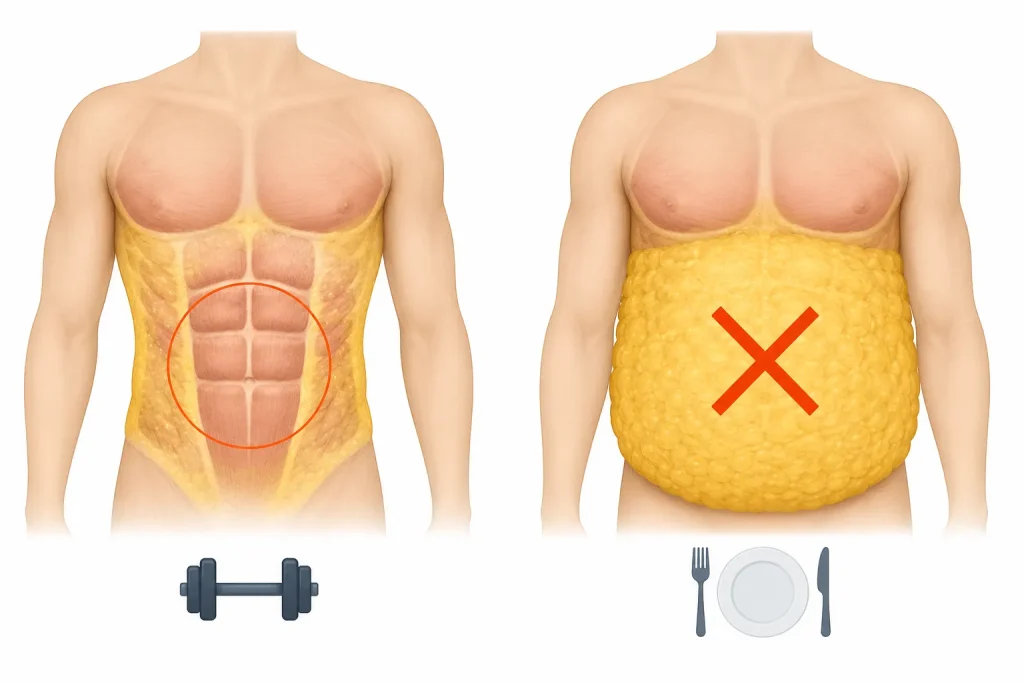
When you train a muscle, blood flow to that area increases. You feel it burning. It is reasonable to assume the fat sitting right there is being used as fuel first. That assumption turns out to be mostly wrong.
Fat is stored in adipose tissue as triglycerides. When your body needs energy, hormones release those fatty acids into your bloodstream. From there, your circulatory system distributes them to wherever energy is needed, which is often muscles far from the one you just trained. Your body does not have a direct pipe from your abdominal fat to your abdominal muscles.
In India, this myth gets extra fuel from gym culture built around “reduce belly in a week” promises and social media reels showing dramatic transformations from ab-only routines. What those reels rarely show is the diet and full-body training running in the background, which is almost always doing the actual work.
What Happens Inside Your Body When You Train One Area
Genetics largely decide where your body stores fat first and loses it last, which explains why the same workout produces completely different results on two different people.
Does exercising a body part burn fat specifically from there?
No, not in any way that matters practically. Your body pulls stored fat from a systemic pool, not from the tissue directly beneath the working muscle.
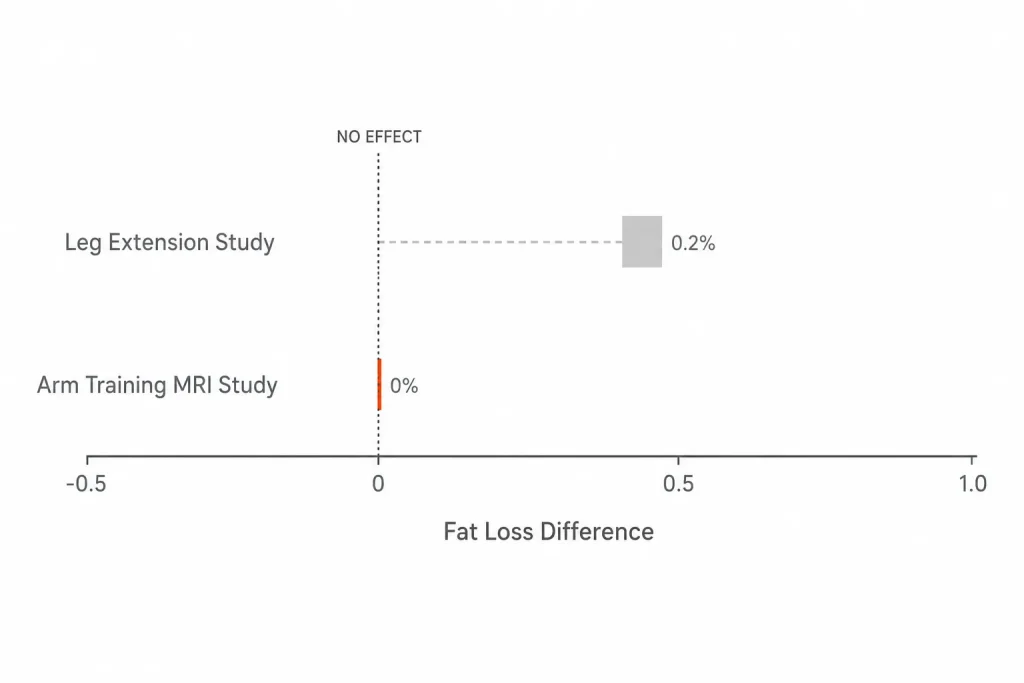
One of the most cited studies on this, a University of Copenhagen trial covered by Fox News Health where men performed single-leg extensions for 30 minutes, found that blood flow and fat breakdown in the exercising leg increased compared to the resting leg. That sounds like proof of spot reduction. It is not. The difference was so small it had no real-world significance.
The same report describes a separate and more decisive study on arm training specifically. Researchers had 104 participants train their non-dominant arm for 12 weeks, then used MRI scans to measure fat in both arms. The trained arm showed no meaningful advantage over the untrained one. If spot reduction worked reliably, this is exactly the kind of study that should have shown it clearly.
Verdict: Localized training can trigger tiny, clinically insignificant local effects, but nothing close to what marketing promises.
Does ab training actually reduce belly fat?
Direct ab training has one of the largest bodies of research behind it, and the results are still mostly negative for spot reduction specifically. The University of Sydney’s review of this research points to a randomised 12-week clinical trial that found no greater improvement in reducing belly fat between people who did targeted abdominal exercise and those who did not.
That does not mean ab training is useless. It builds core strength and definition once fat drops. It just does not selectively strip fat off the stomach faster than any other form of exercise burning the same calories.
Verdict: Great for core strength. Not a fat loss shortcut for the belly specifically.
What did the biggest review of the evidence conclude?
The clearest picture comes from pooled data across many studies rather than any single trial. A Consensus.app summary of the evidence points to a 2021 systematic review and meta-analysis that combined 13 high-quality studies with 1,158 participants and found no significant difference in localized fat loss between trained and untrained limbs after targeted exercise. The pooled effect size was essentially zero regardless of exercise type, age, or sex.
This is about as strong as evidence gets in exercise science. Thirteen separate research groups, over a thousand participants combined, and the same conclusion every time.
Verdict: At a population level, spot reduction through targeted exercise does not hold up.
Is there any legitimate exception to this rule?
There is a small, genuinely interesting exception, and it deserves an honest mention rather than being ignored.
Exercise scientist Menno Henselmans, in a detailed breakdown of the spot reduction literature, highlights one study, Kordi et al. (2015), that compared two groups of overweight women, one doing diet alone and one doing diet plus ab training, and found a modest additional reduction in abdominal fat in the ab-training group. It remains one of the very few controlled trials to show this. It has not been consistently replicated at the same scale as the negative findings above.
Verdict: One legitimate signal exists, but it is the exception, not something to build a training plan around.
If you can’t target fat loss, why do some people lose belly fat first and others lose it last?
This comes down almost entirely to genetics and hormones, not your choice of exercise.
Fat distribution patterns, whether you store more around your belly, hips, or thighs, are strongly inherited, with some research suggesting genetics account for as much as 60 percent of where your body stores and releases fat. Fat also tends to leave the body in reverse order to how it was gained, meaning the last place you gained weight is often the first place you lose it, and vice versa.
This is exactly why two people on the identical diet and training plan see completely different results in the same 12 weeks. It is not a flaw in their effort. If you’re building a full plan around this reality rather than fighting it, our 3 pillars of a sustainable fat loss plan breaks down what actually drives results.
Verdict: Genetics set the order. Your job is total fat loss, not the sequence.
Spot Reduction: What the Evidence Actually Shows
| Claim Being Tested | Study Type | Result | Verdict |
|---|---|---|---|
| Single-leg training reduces leg fat | Localized blood flow trial | Increase too small to matter | Not significant |
| Arm training (12 weeks) reduces arm fat | MRI-measured RCT, 104 participants | No difference vs. untrained arm | Disproven |
| Ab training (12 weeks) reduces belly fat | Randomised clinical trial | No greater improvement vs. no ab training | Disproven |
| Pooled evidence across exercise types | Meta-analysis, 13 studies, 1,158 people | Effect size essentially zero | Disproven |
| Diet + ab training vs. diet alone | Controlled comparison, overweight women | Small extra abdominal fat reduction | Exception, unreplicated at scale |
How Fat Loss Actually Works in Your Body
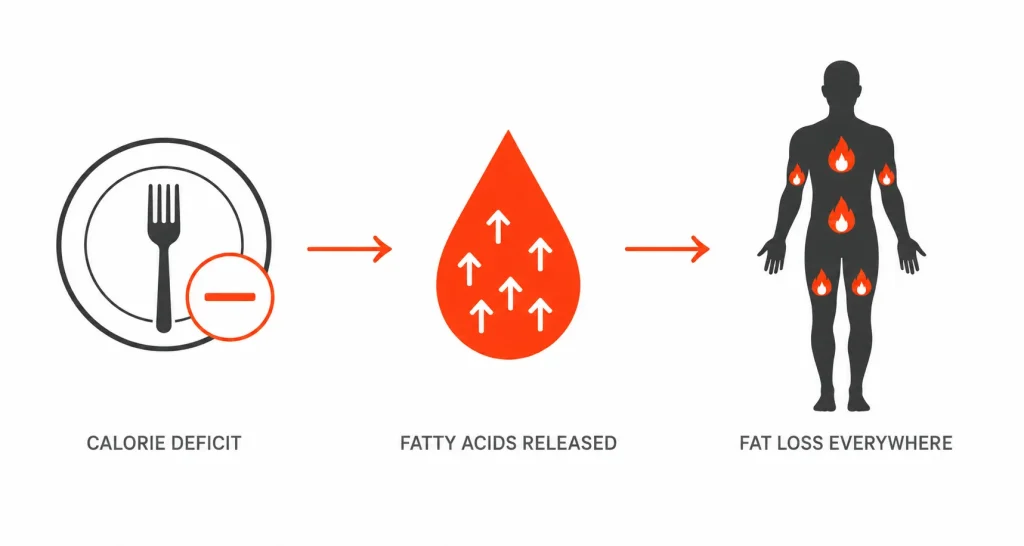
Fat loss is systemic, meaning your body draws energy from stores across your entire system based on a calorie deficit, not from the specific muscle you just trained.
When you eat fewer calories than you burn, your body releases stored fat as fatty acids into the bloodstream through a hormone-driven process. Those fatty acids travel wherever they are needed for energy, which includes your liver, your resting muscles, and your actively working muscles, largely determined by overall hormonal signaling rather than which specific area you exercised.
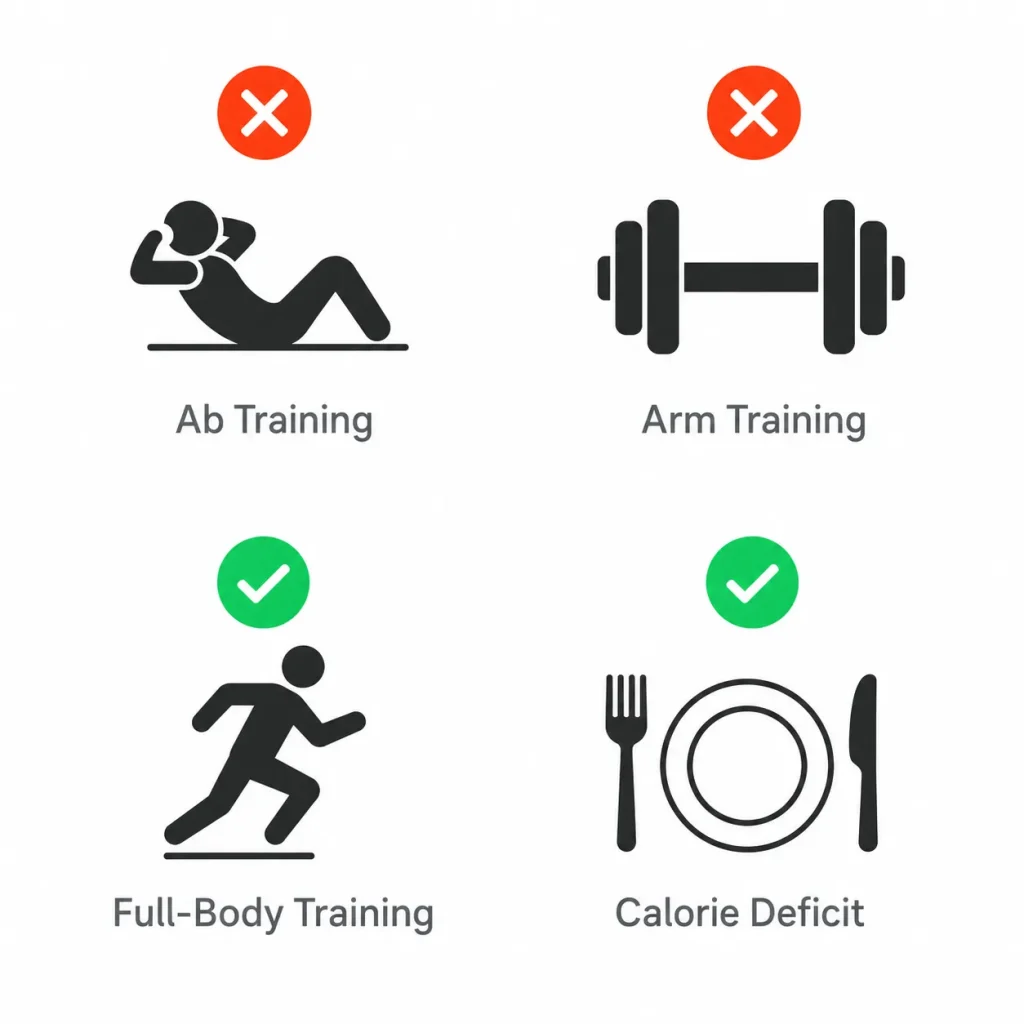
This is why total training volume and calorie balance matter more than which specific exercise you pick. A person doing full-body strength training and walking daily will lose fat everywhere, including their belly, faster than someone doing ab crunches alone with no calorie deficit.
The practical takeaway: timing your fat loss efforts around total activity and diet consistency beats obsessing over which specific move targets which specific spot.
What the Research Says
The strongest evidence against spot reduction comes from studies designed specifically to catch it if it exists, and it mostly does not show up.
A 2021 meta-analysis pooling 13 studies and over 1,100 participants found the pooled effect size for localized fat loss was essentially zero, which is about as close to a definitive answer as exercise science gets on a contested topic. Earlier work, including the MRI-based arm training study, reached the same conclusion using imaging rather than skinfold calipers, which matters because less precise measurement methods have sometimes suggested minor localized fat loss that more accurate MRI scans do not confirm.
The honest reality check: most people experience visible change in a stubborn area eventually, just not faster than the rest of their body. It happens through total fat loss, and genetics decide when that specific area’s turn comes.
Side Effects and What to Watch Out For
Chasing spot reduction itself is not dangerous, but the programs built around it often are, and the disappointment that follows can quietly derail consistency.
Overtraining one muscle group. Doing hundreds of daily crunches hoping for a flat stomach can lead to lower back strain and hip flexor overuse, especially without proper form.
Giving up too early. Many Indian gym-goers abandon a program after 3 to 4 weeks of ab-focused training when belly fat does not visibly drop, not realizing the actual driver, calorie deficit, was never properly in place.
Budget waste on gadgets. Waist trimmers, fat-burning belts, and “targeted” supplements marketed specifically at belly or thigh fat have no meaningful evidence behind them and drain money better spent on food quality or a trainer.
None of this is catastrophic. It is mostly wasted time and misplaced expectations, which is arguably the more common cost.
Who Should Actually Focus On What?
If your goal is losing belly fat specifically
Focus on a sustained calorie deficit through diet, combined with full-body resistance training and daily walking, rather than isolated ab work. Ab training can stay in your routine for core strength, just not as your primary fat loss strategy. Our guide on walking to lose fat covers why consistent low-intensity movement often outperforms intense but inconsistent training for this exact goal.
If you are trying to lose thigh or hip fat
Full-body strength training two to three times a week, paired with the same calorie deficit principle, will reduce fat there over time, just likely later than areas you gained weight in more recently.
If you carry weight mainly around your midsection despite a slim frame
This is an extremely common pattern in Indian body types. Our piece on why Indians tend to be skinny fat explains the specific mechanisms behind this and what actually addresses it.
If you are new to structured training entirely
Start with a full-body routine you can do consistently rather than a niche “targeted” program. Our home workout guide is built for exactly this starting point, no gym required.
If you have already been doing ab-only or thigh-only routines for months with no result
Do not add more volume to the same isolated area. Redirect that same effort toward total calorie deficit and full-body training instead. The area you are targeting will respond eventually, just as part of overall fat loss, not ahead of it.
The Bottom Line
Spot reduction is not entirely a myth in the absolute sense, the evidence shows one small legitimate exception exists, but for nearly everyone, in nearly every practical scenario, it does not work the way it is marketed.
Your body decides the order fat comes off in, largely through genetics and hormones you cannot override with more crunches. What you can control is total fat loss through diet and consistent full-body training, and that eventually reaches every stubborn area you were trying to target directly.
I have watched people burn out doing 300 daily crunches waiting for a flat stomach that was never going to come from crunches alone. Fix the total picture, and the specific spot takes care of itself, just on its own schedule.
People Also Ask
Can targeted ab exercises give you a six-pack faster than other workouts?
No, ab exercises build and strengthen the muscle underneath, but they do not remove the fat covering it any faster than full-body training would. A visible six-pack depends primarily on low overall body fat, which comes from total calorie deficit, not from how many crunches you do.
Why do I lose weight from my face first but not my stomach?
This is a genetics-driven pattern rather than something you are doing wrong. Fat tends to leave the body in reverse order to how it was gained, and facial fat is often among the first areas to reduce for many people, while areas like the stomach or hips tend to hold on longer.
Do waist trainers or slimming belts actually reduce belly fat?
No, these products can create temporary water loss or a compressed appearance, but they do not reduce actual fat tissue underneath. There is no credible evidence that external compression or heat from these products triggers localized fat loss.
Is it true that Indian body types store more belly fat compared to other body types?
Yes, this pattern is well documented. Many Indians carry proportionally more visceral fat around the abdomen even at a normal overall weight, a pattern often described as being skinny fat, which is influenced by genetics and metabolic factors rather than anything specific to targeted exercise choices.
If spot reduction doesn’t work, why do some people say ab workouts helped them lose belly fat?
In most cases, the actual driver was the calorie deficit and increased total activity happening alongside the ab workouts, not the ab exercises themselves. A small subset of research has shown modest additional abdominal fat loss when ab training is combined with diet, but this has not been consistently repeated at large scale.
How long does it take to see fat loss in a stubborn area like the belly or thighs?
This varies significantly by individual, but noticeable change in a genetically stubborn area often takes longer than in other parts of the body, sometimes several months into a consistent calorie deficit. Patience with the overall process matters more than switching exercises hoping for a shortcut.
Does cardio work better than weight training for reducing belly fat specifically?
Neither has been shown to selectively target belly fat over weight training or vice versa. Both contribute to the same underlying driver, total calorie deficit, so the better choice is whichever type you can do consistently and sustainably long term.
Sources and References
Sydney University News. (2023). Spot reduction: why targeting weight loss to a specific area is a myth. The University of Sydney.
Henselmans, M. (2024). New science: spot reduction is not a myth. mennohenselmans.com.