
A personalized diet plan for weight loss is not a stricter version of a generic diet. It is a completely different approach built around your specific caloric needs, your food preferences, your daily routine, and your metabolic reality.
Generic diet plans fail most people not because the person lacks discipline but because the plan was never built for them in the first place. A 28-year-old woman in Chennai with a desk job, a vegetarian diet, and a thyroid condition needs a fundamentally different plan than a 32-year-old man in Delhi who eats non-vegetarian food, works a physical job, and has 20 kilos to lose. Giving both of them the same 1,200 calorie meal plan and calling it a diet is not nutrition coaching. It is guesswork with a calorie number attached.
This matters especially in India, where the standard Western diet advice circulating online is built around chicken breast, broccoli, and foods that most Indian households either cannot afford regularly or simply do not eat. A plan you cannot follow for more than two weeks is not a plan. It is a temporary punishment.
What You Need to Know First
- A personalized diet plan calculates your specific caloric target based on your current weight, height, age, activity level, and fat loss goal, not a generic number applied to everyone.
- Protein requirements for fat loss sit between 1.6 and 2.2 grams per kilogram of bodyweight per day. For a 70 kilogram person that means 112 to 154 grams of protein daily, an amount most Indians significantly undereat.
- Indian vegetarian diets can fully support fat loss when protein sources like dal, paneer, curd, soya chunks, and eggs are structured correctly across the day.
- Meal timing matters less than total daily calories and protein. Eating roti at night does not cause fat gain. Eating more calories than your body burns does.
- Sustainable fat loss happens at a deficit of 300 to 500 calories below your maintenance level. Anything more aggressive produces faster initial results and faster rebound.
Why Generic Diet Plans Fail Indian Bodies Specifically
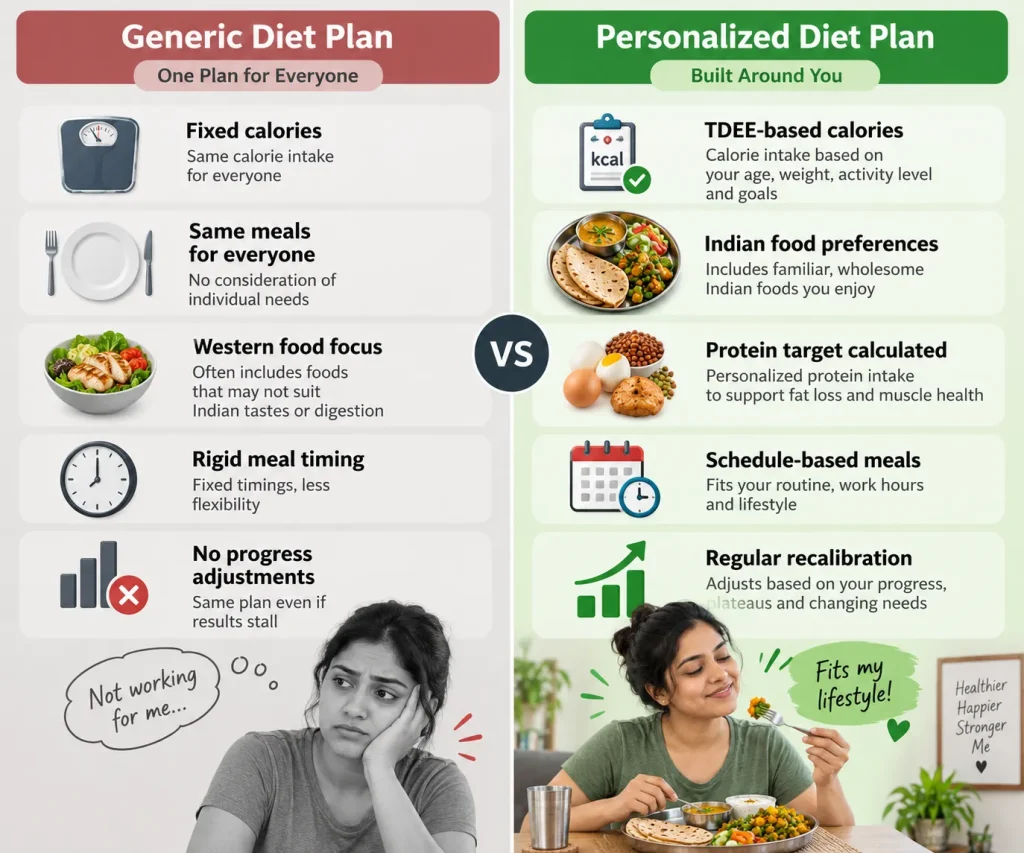
The Indian body has specific metabolic characteristics that most generic Western diet advice completely ignores. South Asians have a higher tendency toward central adiposity, meaning fat storage around the abdomen, at lower body weight thresholds compared to Western populations. This is documented across multiple studies on South Asian metabolic health and has real implications for how caloric targets and macronutrient ratios should be set.
The traditional Indian diet is heavily carbohydrate-dominant. Rice, roti, dal, sabzi, and fruit make up the majority of calories for most Indians. This is not inherently bad. Complex carbohydrates from whole grains and legumes provide fiber, micronutrients, and sustained energy. The problem arises when protein is chronically low, which it is for most Indians eating a standard diet, and when total caloric intake exceeds maintenance without anyone noticing because the foods feel light and healthy.
A 2019 analysis of dietary patterns in urban India found that protein intake among vegetarian Indians averages approximately 0.6 to 0.8 grams per kilogram of bodyweight per day, which is roughly half the minimum recommended for fat loss with muscle preservation. This gap is the single biggest nutritional problem in Indian weight loss attempts, and it is the first thing a genuinely personalized diet plan addresses.
The other failure point is adaptability. Generic plans do not account for festivals, weddings, travel, office canteen food, or the reality that most Indians eat what their family cooks rather than meal-prepping individually. A personalized plan that cannot survive a week of Diwali sweets or a corporate lunch buffet is not built for real Indian life.
If you want to understand how nutrient gaps affect your energy and recovery before starting any fat loss plan, the 7 early signs of nutrient deficiency most Indians ignore is worth reading first.
What a Genuinely Personalized Diet Plan for Weight Loss Includes
Your Caloric Target Is Calculated, Not Guessed
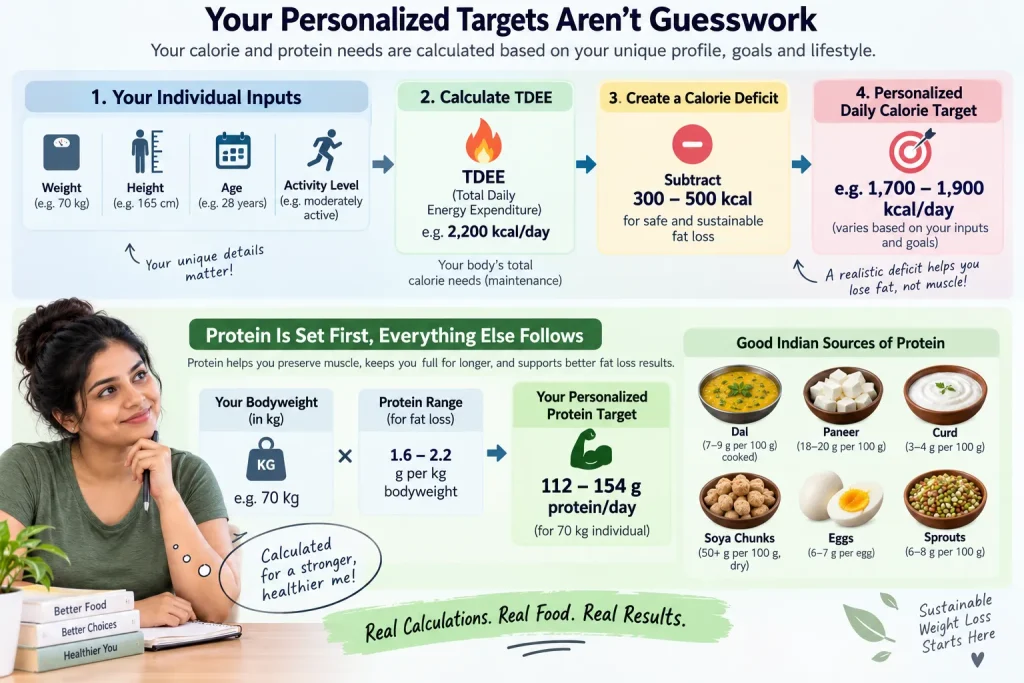
A real personalized diet plan starts with calculating your Total Daily Energy Expenditure, known as TDEE, which is the total number of calories your body burns in a day accounting for your basal metabolic rate and your activity level. Basal metabolic rate, or BMR, is the number of calories your body burns at complete rest just to maintain basic functions like breathing, circulation, and cell repair.
Your fat loss caloric target is set at 300 to 500 calories below your TDEE. This deficit is large enough to produce consistent fat loss of approximately 0.3 to 0.5 kilograms per week without triggering the aggressive metabolic adaptation that happens with very low calorie diets. Metabolic adaptation is the process by which your body reduces its energy expenditure in response to prolonged caloric restriction, essentially slowing your metabolism to protect against what it perceives as starvation.
A 1,200 calorie diet applied to everyone ignores the fact that a 90 kilogram sedentary man has a TDEE of approximately 2,400 calories while a 55 kilogram active woman has a TDEE of approximately 1,800 calories. The same number applied to both is wrong for at least one of them, and usually both.
Protein Is Set First, Everything Else Follows
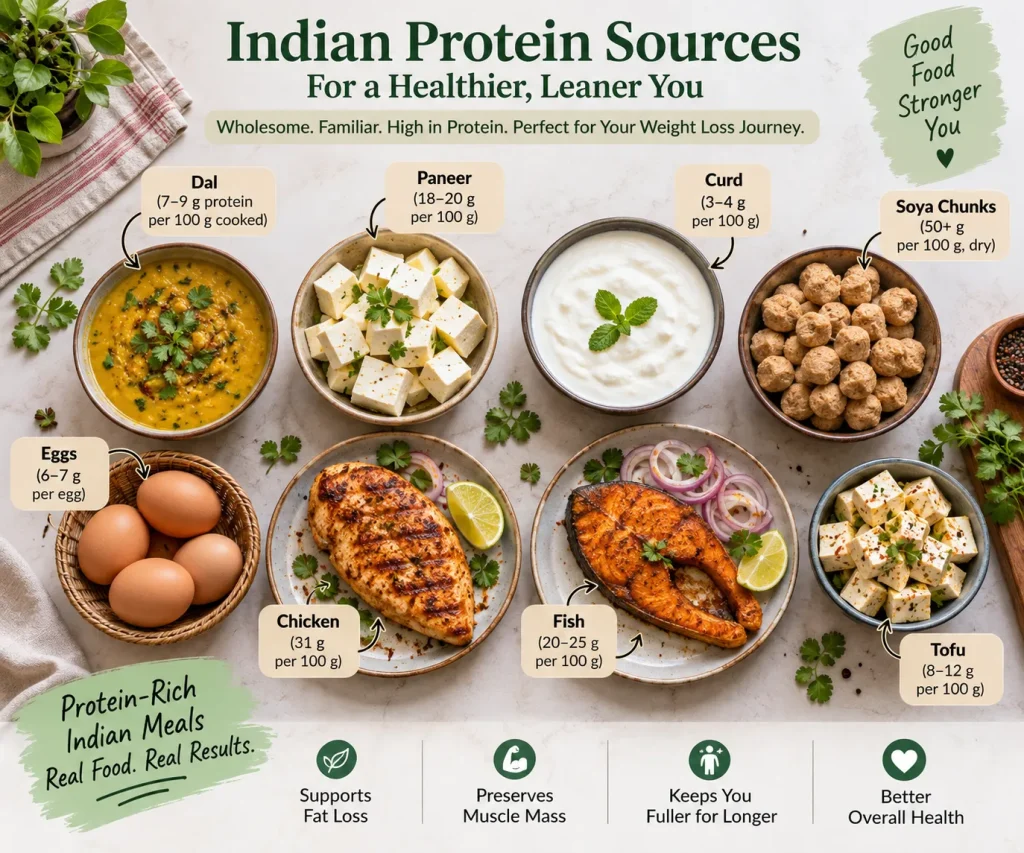
Protein is the most important macronutrient for fat loss, and it is the one most Indians are most deficient in. During a caloric deficit, adequate protein intake preserves lean muscle mass while your body burns fat for fuel. Without sufficient protein, a significant portion of your weight loss comes from muscle rather than fat, which reduces your metabolic rate and makes maintaining results harder.
The target for fat loss with muscle preservation is 1.6 to 2.2 grams of protein per kilogram of bodyweight per day. For Indian vegetarians, hitting this target requires deliberate structuring of meals around high-protein Indian foods. Dal alone does not cover it. A combination of dal, paneer, curd, soya chunks or tofu, and eggs if included, spread across three to four meals, gets most vegetarians to their target without requiring supplements.
For non-vegetarians, chicken, eggs, and fish make hitting protein targets significantly easier. The challenge is usually cost and preparation time rather than availability.
Carbohydrates Are Adjusted, Not Eliminated
Eliminating carbohydrates is not required for fat loss and is not sustainable for most Indians whose entire food culture is built around grains and legumes. What a personalized plan does is adjust the quantity and timing of carbohydrates to fit within the caloric target while keeping protein high.
Roti, rice, oats, poha, and upma are all compatible with fat loss when portioned correctly. The glycemic index, which measures how quickly a food raises blood sugar, matters somewhat but less than total caloric intake for most people without diabetes or insulin resistance. Two rotis at dinner will not cause fat gain. Two rotis at dinner on top of a day’s worth of food that already exceeds your caloric target will.
A personalized plan tells you exactly how many rotis, how much rice, and what portions of each food fit your specific daily target. Generic plans tell everyone to avoid carbs after 7pm, which is not evidence-based advice for healthy people.
Meal Structure Is Built Around Your Actual Life
The difference between a personalized diet plan and a template is that a personalized plan asks what you actually eat before telling you what to change. If you eat idli and sambar for breakfast every day, your plan should work with that. If your office provides a canteen lunch, your plan should account for what is actually available there. If your family eats together at 9pm, your plan should not demand that you eat alone at 6pm.
Meal frequency, which is how many times you eat per day, does not significantly affect fat loss outcomes when total calories and protein are matched. Three meals and two snacks produces the same results as two larger meals if the total numbers are identical. What matters is that the structure is one you can actually follow consistently.
Adjustments Happen Based on Your Real Progress
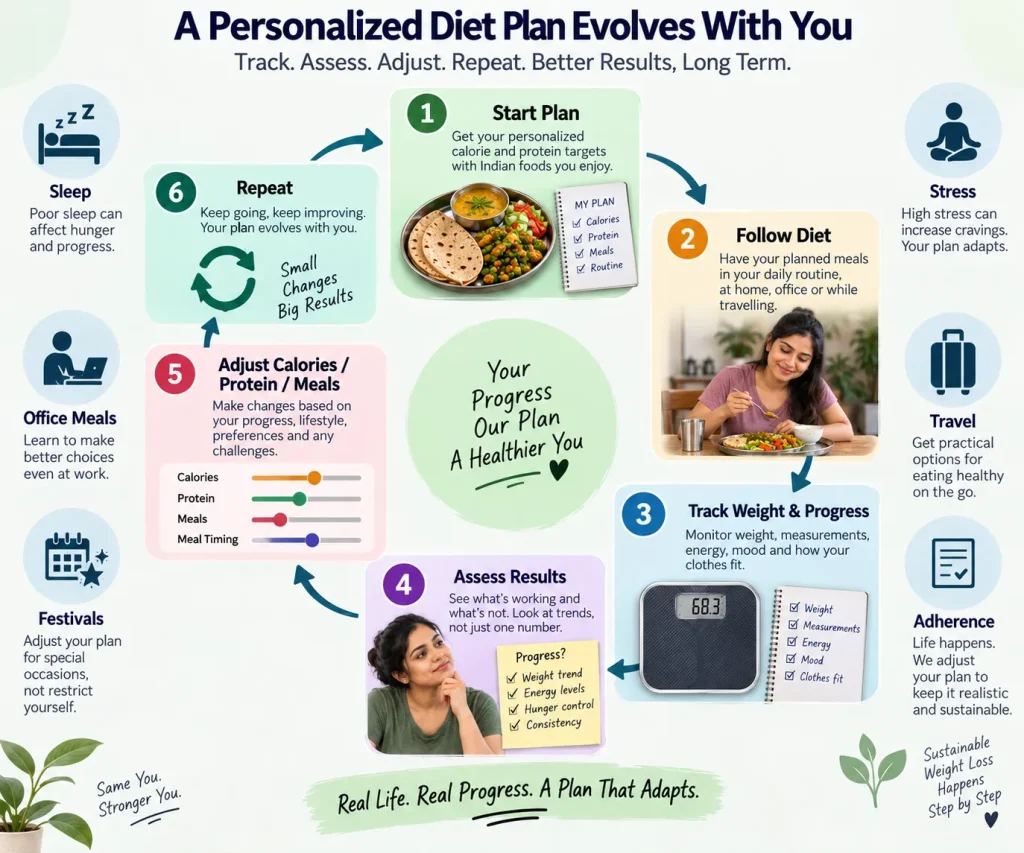
A personalized diet plan is not a fixed document. It is a living system that changes based on what your body actually does over time. If you lose weight faster than expected in weeks 1 to 4, your caloric target may need a small upward adjustment to avoid excessive muscle loss. If your weight loss stalls in weeks 6 to 8, your caloric target or protein intake may need recalibration.
This is the part generic plans and apps cannot do. An algorithm can track your calories. It cannot notice that your weight has not moved in 10 days, ask whether your sleep has been poor due to work stress, recognize that cortisol elevation from that stress is blunting fat loss, and adjust your plan accordingly. A human coach can.
Personalized Diet Plan: Key Variables and What They Mean for Your Results
| Variable | Generic Plan Approach | Personalized Plan Approach | Impact on Results |
|---|---|---|---|
| Caloric target | Fixed number for all | Calculated from individual TDEE | High. Wrong target = wrong results |
| Protein target | Vague or ignored | 1.6 to 2.2g per kg bodyweight | High. Determines muscle preservation |
| Food choices | Western foods, chicken, broccoli | Built around actual Indian diet | High. Determines adherence |
| Meal timing | Rigid rules, no carbs at night | Flexible around your schedule | Low to moderate for healthy people |
| Progress adjustment | None | Weekly recalibration | Very high. Prevents plateaus |
| Festival and travel handling | Not addressed | Built into the plan | High. Determines long-term success |
| Vegetarian accommodation | Poor or generic | Full protein structuring for Indian veg diet | High for 40% of Indian population |
How Your Body Actually Responds to a Caloric Deficit
When you eat fewer calories than your body burns, it draws on stored energy to make up the difference. The primary stored energy source targeted during a sustained moderate deficit is adipose tissue, which is body fat. This process is called fat oxidation, and it produces the actual fat loss results you are trying to achieve.
The body also draws on glycogen, which is stored glucose in the muscles and liver, particularly in the early days of a deficit. This is why scale weight drops quickly in the first week of a diet and then slows. The initial drop is largely water weight associated with glycogen depletion, not fat loss. Genuine fat loss of 0.3 to 0.5 kilograms per week becomes visible on the scale from week 2 or 3 onward.
Insulin, the hormone released by the pancreas in response to carbohydrate intake, plays a role in fat storage and fat mobilization. When insulin levels are lower, the body more readily accesses fat stores for energy. This is the biological basis for low-carbohydrate diets. However, you do not need to eliminate carbohydrates to keep insulin at levels that support fat loss. A moderate caloric deficit with adequate protein achieves the same metabolic environment for most people without requiring the elimination of rice and roti from an Indian diet.
Timing matters most around training. Consuming adequate protein within 2 hours after a workout supports muscle protein synthesis, the process by which your muscles repair and grow after exercise. For fat loss with muscle preservation, this post-workout protein window is worth structuring deliberately even if meal timing is flexible the rest of the day.
What the Research Actually Says About Personalized Versus Generic Diet Plans
Research comparing personalized dietary interventions to standardized diet plans consistently shows that personalization improves adherence, and adherence is the variable that determines fat loss outcomes more than any specific dietary approach.
A landmark study published in Cell in 2015 by Zeevi and colleagues examined glycemic responses to identical foods across 800 participants and found dramatic individual variation in how different people responded to the same meals. Two people eating the same food at the same time produced significantly different blood sugar responses based on their gut microbiome composition, body metrics, and lifestyle factors. This is direct evidence that the same diet plan produces different results in different people, which is the biological case for personalization.
Research on protein intake and fat loss consistently supports targets above 1.6 grams per kilogram of bodyweight per day for preserving lean mass during caloric restriction. This finding is robust across multiple meta-analyses and applies directly to the chronic protein underConsumption seen in standard Indian vegetarian diets.
The honest reality check: most people who follow a well-designed personalized plan lose 4 to 8 kilos in the first 8 to 12 weeks. Most people who follow a generic plan lose 2 to 3 kilos, plateau, and abandon the plan by week 6. The difference is not willpower. It is fit between the plan and the person.
For a practical understanding of how Indian foods stack up as protein sources, the guide on best protein sources for muscle gain and fat loss in India covers the numbers clearly.
Things Worth Knowing Before You Start Any Diet Plan
Anyone with a diagnosed medical condition including type 2 diabetes, hypothyroidism, PCOS, or chronic kidney disease should work with both a doctor and a nutrition coach before starting a caloric deficit. These conditions affect how the body responds to dietary changes in ways that require medical oversight alongside coaching guidance.
Crash diets below 1,000 calories per day produce rapid initial weight loss followed by equally rapid regain in most cases. The metabolic adaptation triggered by severe restriction can take months to reverse and makes subsequent fat loss attempts harder. A moderate deficit maintained consistently over 16 to 24 weeks produces better total fat loss and far better maintenance of results than any crash approach.
Supplements are not required for a personalized diet plan to work. Whey protein is useful for hitting protein targets when whole food sources are insufficient or inconvenient, but it is a convenience tool, not a necessity. A plan built around Indian whole foods can hit every required target without any supplements if structured correctly.
Indian women specifically should be aware that iron deficiency is extremely prevalent in India, affecting approximately 53 percent of women of reproductive age according to National Family Health Survey data. Iron deficiency causes fatigue that can be misread as low motivation or poor fitness. If you feel consistently exhausted during a diet and exercise program, getting iron levels checked before assuming the plan is not working is worth doing.
Which Type of Person Gets the Most From a Personalized Diet Plan
If You Have Tried Multiple Diets and Keep Failing
You are not failing because you lack discipline. You are failing because you have been following plans built for someone else. A personalized plan that calculates your specific caloric target, builds meals around food you actually eat, and adjusts when your progress stalls is a fundamentally different experience from a generic PDF diet. This is the profile that sees the most dramatic difference between generic and personalized approaches.
If You Are a Vegetarian Struggling to Lose Weight
The most common reason vegetarian Indians fail at fat loss is chronically low protein intake combined with a high carbohydrate diet that keeps calories higher than expected from foods that feel light and healthy. A personalized plan structures your protein intake deliberately across meals using dal, paneer, curd, soya chunks, and other Indian protein sources. This single change produces visible results for most vegetarian Indians within 4 to 6 weeks. LeanFuel’s personalized plans are built specifically around Indian vegetarian food patterns, which is the core gap most generic coaching services miss entirely.
If You Have a Medical Condition Like PCOS or Thyroid Issues
PCOS and hypothyroidism both affect how your body responds to caloric deficits and carbohydrate intake. Generic plans applied to these conditions produce frustratingly slow results and create the false impression that fat loss is impossible with these conditions. It is not. It requires a plan calibrated to the specific hormonal and metabolic reality of your condition. LeanFuel’s coaching process accounts for medical context as part of the personalization intake, and the weekly adjustment model means your plan responds to how your body is actually behaving rather than following a fixed template regardless of results.
If You Are on a Budget
A personalized diet plan does not require expensive superfoods or imported ingredients. Dal, eggs, curd, soya chunks, seasonal vegetables, and whole grains are among the most cost-effective fat loss foods available in India. The budget Indian diet plan for weight loss shows exactly how to structure fat loss eating under ₹200 per day. A personalized coaching plan that builds around affordable Indian staples costs far less than the money most people waste on supplements and fad diets that do not work.
If You Have Never Dieted Before
Starting with a personalized plan rather than a generic one is the single best decision a first-time dieter can make. You build correct habits from the beginning, you understand why each part of your plan works, and you avoid the cycle of restriction and rebound that makes subsequent fat loss attempts progressively harder. LeanFuel’s Starter Pack at ₹499 per month gives first-time dieters a structured ready-made plan with the Indian food foundation built in. The Transformation Plan at ₹999 per month takes it further with full personalization and bi-weekly check-ins for people who want a plan built specifically around their numbers and food preferences.
The Bottom Line
A personalized diet plan for weight loss works because it is built around you. Your caloric target, your protein needs, your Indian food preferences, your schedule, and your actual results over time. Generic plans fail most people not because dieting is hard but because following a plan designed for someone else is hard.
The gap between knowing what to eat and having a plan that accounts for your specific reality is where most Indian weight loss attempts collapse. Filling that gap is exactly what personalized coaching does.
LeanFuel builds every diet plan around Indian food, Indian budgets, and Indian lives. The Transformation Plan at ₹999 per month gives you a fully personalized diet and workout plan with your calories and macros already calculated and bi-weekly coach access on WhatsApp. The Pro Coaching Plan at ₹1,899 per month updates your plan every week based on your actual progress, includes daily WhatsApp access to your coach, and comes with a plateau break strategy built in from the start.
These results are not cherry-picked from a company page. LeanFuel’s independent Google reviews tell the same story from people who had no reason to say anything other than what they actually experienced. Read them here.
If you have been stuck in the cycle of generic plans that work for two weeks and then fall apart, see what a plan built around your actual situation looks like.