Why Indians Are Skinny Fat: Causes, Risks & How to Fix It
Understanding why Indians are skinny fat is the first step to losing belly fat. Learn the skinny fat vs normal fat difference and how to build a stronger, healthier body.
The Paradox That Affects Millions of Indians
Meet Raj.
Raj is 28 years old. He weighs 68 kilograms. By every traditional measure, he’s “normal weight.” His BMI is 22. His family tells him he looks fine. His clothes fit. He’s not “fat.”
But when Raj takes off his shirt, there’s a soft belly that spills over his belt. His arms are thin. His chest is flat. He feels tired by 4 PM. And no matter how little he eats, that stubborn belly fat won’t budge.
Raj isn’t alone. He’s not “overweight” in the conventional sense. He’s something else entirely.
He’s skinny fat.
And across India, millions of people just like Raj have no idea why their bodies look and feel this way—or how to fix it.
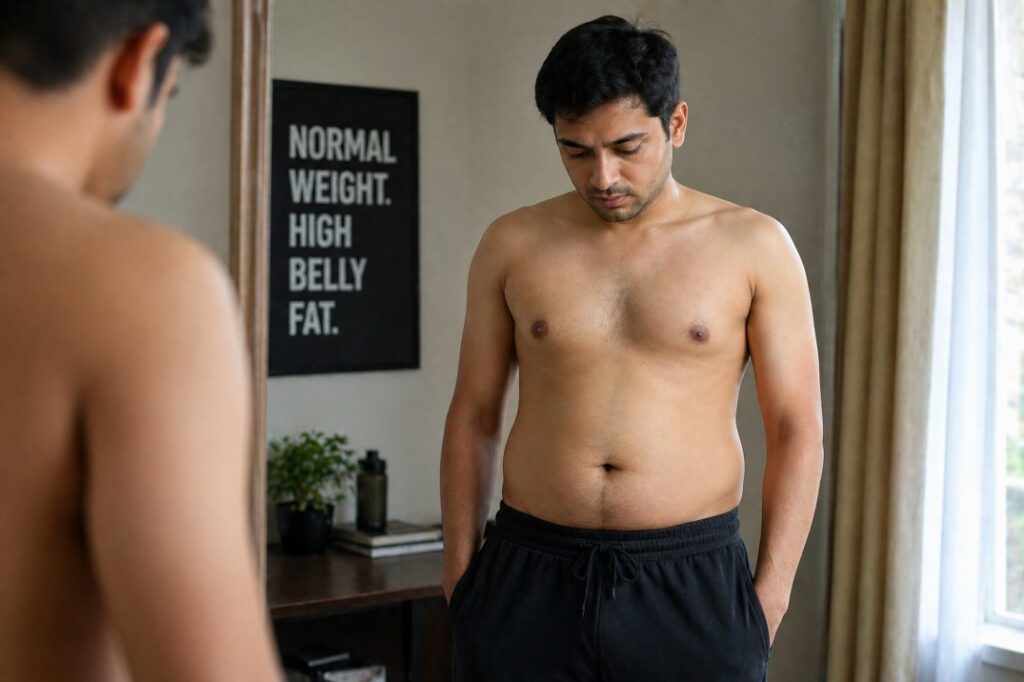
In this guide, I’ll explain exactly why Indians are skinny fat, break down the crucial skinny fat vs normal fat difference, and give you a practical, science-backed plan to finally lose that belly fat the right way.
What Actually Is “Skinny Fat”? (And Why BMI Lies)
Let’s start with a clear definition.
The term “skinny fat” refers to a person who appears slim or normal weight but has a high body fat percentage and dangerously low muscle mass . In medical literature, this condition is called MONW (Metabolically Obese, Normal Weight) .
Here’s what that means in plain language:
| Metric | “Skinny Fat” Person | What It Looks Like |
|---|---|---|
| Body Weight | Normal (BMI 18.5–23) | Fits into “medium” clothes |
| Muscle Mass | Low | Thin arms, flat chest, little definition |
| Body Fat % | High (above 25% for men, above 35% for women) | Soft belly, love handles, “jiggly” appearance |
| Fat Location | Visceral (around organs) | Belly sticks out despite normal weight |
A person can have a completely “normal” BMI and still carry excess fat—especially around the abdomen. This visceral fat is the dangerous kind. It wraps around your internal organs and is directly linked to insulin resistance, diabetes, and heart disease .
The skinny fat vs normal fat difference comes down to one thing: body composition, not body weight.
A “normal fat” person (what we’d call overweight or obese) has excess fat and often maintains some muscle mass just to carry their body weight. A skinny fat person has the worst of both worlds: low muscle and high fat.
The result: A slower metabolism, higher disease risk, and a body that looks and feels weak despite a “healthy” weight.
The Hard Truth: Indians Are Genetically Predisposed to Being Skinny Fat
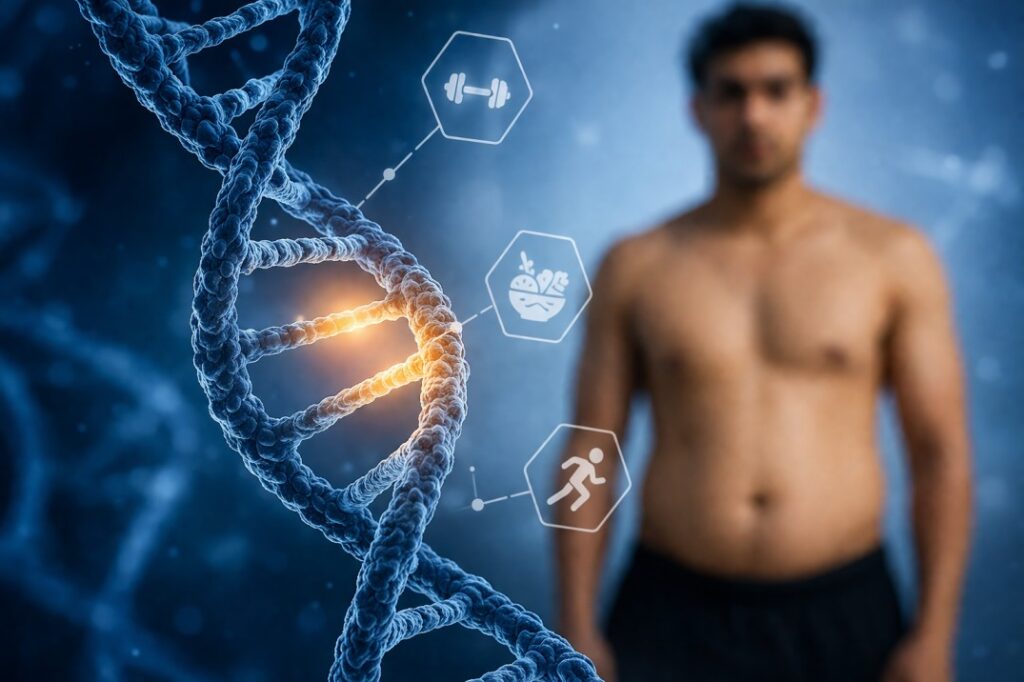
Here’s where we need to talk about something uncomfortable: genetics.
Research has consistently shown that South Asians have a higher body fat percentage at any given BMI compared to White Caucasians . What does this mean? An Indian person with a BMI of 23 might have the same body fat percentage as a European person with a BMI of 27.
This isn’t a theory. This is peer-reviewed, replicated science.
The Myostatin Gene Connection
One of the most fascinating discoveries comes from a study on the Myostatin gene in North Indians . Myostatin is a protein that limits muscle growth. Certain genetic variants cause higher myostatin activity—meaning your body is literally programmed to hold onto less muscle.
The study found that specific variants of the Myostatin gene (A55T and K153R polymorphisms) were significantly associated with:
- Higher body fat percentage
- Lower lean body mass (muscle)
- Increased waist circumference (abdominal obesity)
- Higher risk of obesity and metabolic syndrome
In other words: Many Indians are genetically predisposed to the skinny fat body type. Their bodies naturally struggle to build muscle while easily storing fat—especially around the belly.
The “Thin-Fat Phenotype” at Birth
The problem doesn’t start in adulthood. It starts before birth.
Research has documented that the thin-fat phenotype is present at birth in Indian babies . Indian infants are among the smallest in the world at birth, but they have a higher percentage of body fat than babies from other populations.
Decades of intergenerational undernutrition have shaped the Indian body type. Your body, programmed by generations of scarcity, has become extremely efficient at storing fat—because fat is survival fuel. But it has not been programmed to build muscle, because muscle requires consistent protein that wasn’t always available.
This isn’t a personal failing. It’s biology. But understanding it is the first step to fixing it.
The New Science: Why BMI Fails Indians (iBMI and dBMI Explained)
Conventional BMI has always been a flawed tool. But for South Asians, it’s practically useless.
In July 2025, a major new study published on medRxiv proposed two new metrics that better capture metabolic risk in Indian populations: iBMI (Improvised BMI) and dBMI (Delta BMI) .
Here’s how they work:
- iBMI = (Weight × Waist Circumference) ÷ Height
- Unlike BMI, iBMI accounts for where your fat is located—not just how much you weigh
- dBMI = (iBMI – BMI) ÷ Height
The study analyzed 331 adults and found that dBMI strongly correlated with insulin resistance (AUC = 0.81)—comparable to DEXA scans that cost thousands of rupees .
Why this matters for you: The iBMI/BMI nomogram developed in this study allows you to visually assess your risk. If your waist circumference is high relative to your height and weight, you may be skinny fat—even if your BMI looks “normal.”
The Lifestyle Factors Making It Worse
Genetics loads the gun. Lifestyle pulls the trigger.
Problem #1: The High-Carb, Low-Protein Indian Diet
A traditional Indian meal is built around rice or roti—with dal and sabzi as “sides.” Typical macronutrient breakdown: 70-80% carbohydrates, 10% protein, 10-15% fat .
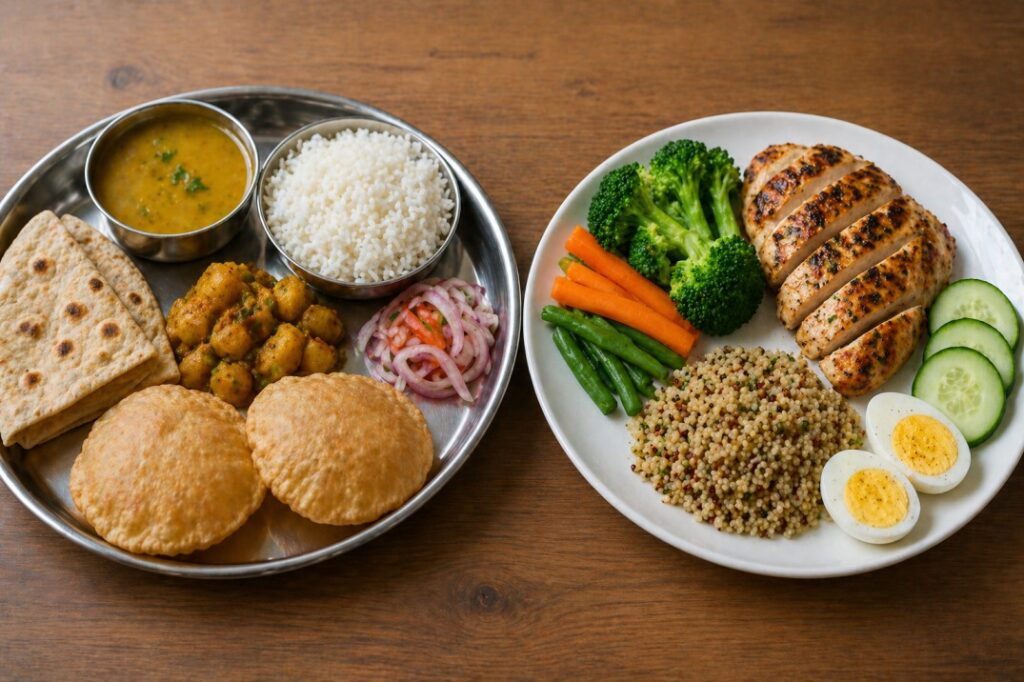
This isn’t a moral judgment. Our cuisine is delicious and culturally meaningful. But for fat loss? It’s problematic.
Protein is the only macronutrient that directly supports muscle growth. And most Indians are eating less than 50 grams of protein per day—when a 70 kg active adult needs at least 100-120 grams .
Result: Your body has no building blocks for muscle. Meanwhile, all those refined carbs (white rice, white bread, biscuits, sugary chai) spike your insulin, promoting fat storage .
Problem #2: The Strength Training Gap
Go to any park in India at 6 AM. What do you see? Walking. Jogging. Yoga. All good things—but none of them build muscle.
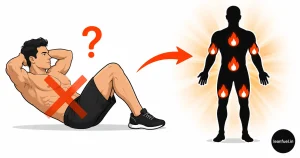
Cardio burns calories during the activity. Strength training builds muscle, which raises your resting metabolic rate—meaning you burn more calories 24/7, even while sleeping.
Most Indians focus on “weight loss” (scale goes down) instead of “body recomposition” (fat goes down, muscle goes up). This is a critical mistake .
Problem #3: Chronic Stress and Poor Sleep
High cortisol (the stress hormone) tells your body to store fat—specifically in the abdominal region. With urban Indian lifestyles characterized by long commutes, desk jobs, screen time, and irregular sleep, cortisol stays chronically elevated .
Poor sleep also disrupts ghrelin and leptin (hunger hormones), making you crave high-calorie foods the next day.
How to Lose Belly Fat the Right Way (A 3-Step Plan)
Now for the solution. This isn’t a crash diet. This is how you permanently change your body composition.
Step 1: Fix Your Protein Intake (Non-Negotiable)
You cannot fix skinny fat without protein. Period.
Your target: 1.6–2.2 grams of protein per kilogram of body weight.
For a 70 kg person: 112–154 grams of protein per day.
Affordable Indian protein sources:
| Food | Protein (per serving) | Approx Cost (₹) |
|---|---|---|
| Eggs | 6g per egg | ₹5-6 per egg |
| Paneer | 18g per 100g | ₹40-50 |
| Soya chunks | 52g per 100g | ₹150/kg (very cheap) |
| Moong dal | 18g per cup cooked | ₹8-10 per serving |
| Curd (Greek style) | 10g per 100g | ₹30-40 per cup |
| Chicken breast | 31g per 100g | ₹80-100 |
| Whey protein (optional) | 25g per scoop | ₹80-100 per serving |
One real-life example: A 26-year-old who lost 7 kg in 47 days ate 4 whole eggs for breakfast, paneer with soya chunks and rice for lunch, and 2 chapatis with sabzi for dinner. His protein intake: 70g/day initially, ramping up to 130g/day .
Step 2: Start Strength Training (Cardio Is Not Enough)

You need to build muscle. Muscle is what changes your shape and raises your metabolism.
Do this 3-4 times per week:
- Squats (bodyweight or with a backpack full of books)
- Push-ups (knee push-ups are fine to start)
- Lunges
- Pull-ups or rows (use a sturdy table edge)
- Planks
Progressive overload: Each week, do 1-2 more reps or add a little weight. Your muscles must be challenged to grow.
Step 3: Rebalance Your Plate
Stop cutting calories. Start changing what those calories are.
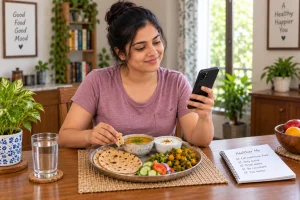
The new plate formula:
- ½ plate: Vegetables (fiber for fullness)
- ¼ plate: Protein (paneer, dal, eggs, chicken, soya)
- ¼ plate: Complex carbs (brown rice, millets, quinoa, whole roti)
What to reduce (not eliminate—reduce):
- Refined carbs (white rice, white bread, maida, biscuits)
- Sugary beverages (chai with 2 spoons of sugar, packaged juices, soda)
- Fried snacks (samosa, pakora, vada—special occasion only)
The Skinny Fat vs Normal Fat Difference: A Quick Summary
| Skinny Fat | Normal Fat (Overweight) | |
|---|---|---|
| BMI | Normal (18.5–23) | High (25+) |
| Muscle Mass | Low | Often normal or high |
| Fat Distribution | Visceral (belly, around organs) | Subcutaneous (under skin, more evenly distributed) |
| Appearance | Thin limbs, soft belly | Larger overall, but may have some shape |
| Health Risk | High (silent—diabetes, heart disease) | High (visible, so often addressed earlier) |
| Solution | Build muscle first, then lose fat | Lose fat first, preserve muscle |
The skinny fat body is more dangerous than classic obesity in some ways because it goes unnoticed. You can have a “healthy” BMI and still be pre-diabetic. In fact, the study on iBMI and dBMI found that visceral fat—not BMI—is the dominant predictor of cardiometabolic risk .
A Sample Day of Eating (130g Protein, ~1800 Calories)
Breakfast (35g protein):
- 3 whole eggs scrambled (18g)
- 1 slice whole wheat toast with 1 tbsp peanut butter (7g)
- 1/2 cup Greek yogurt (10g)
Lunch (40g protein):
- 150g soya chunks curry (35g)
- 1 roti (3g)
- Large salad
Evening Snack (15g protein):
- 1 cup paneer or chicken tikka (15g)
Dinner (40g protein):
- 200g dal (mung or masoor) (15g)
- 150g vegetable sabzi (3g)
- 1 cup quinoa or brown rice (8g)
- 1 cup buttermilk (4g)
Total: ~130g protein, 1800 calories
Your 90-Day Roadmap
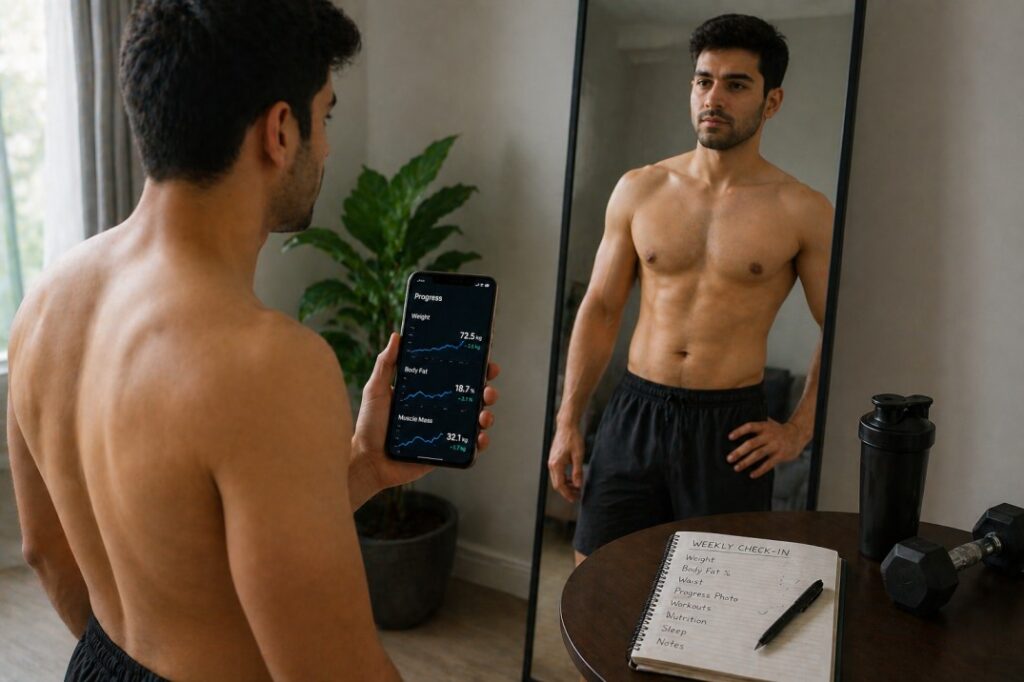
Month 1: The Foundation
- Prioritize protein at every meal
- Start strength training 3x/week (bodyweight is fine)
- Replace one refined carb meal with millets/whole grains
- Goal: Feel stronger, less hungry between meals
Month 2: The Build
- Increase protein to target (1.6-2.2g/kg)
- Add weight/resistance to your exercises
- Track your waist circumference (not just weight)
- Goal: Visible change in belly size, better energy
Month 3: The Transformation
- Fine-tune portions (reduce carbs slightly if belly fat persists)
- Add cardio 2x/week (walking, jogging, cycling)
- Take progress photos (the mirror doesn’t lie)
- Goal: Noticeably leaner waist, defined arms/legs
The Bottom Line
You are not broken. You are not “lazy” or “undisciplined.”
Why Indians are skinny fat comes down to a perfect storm: genetic predisposition (myostatin variants, the thin-fat phenotype), a historically carbohydrate-based diet, and a culture that prioritizes cardio over strength training.
But here’s the good news: You can fix it.
The skinny fat vs normal fat difference is not permanent. Once you understand that your problem isn’t excess weight—it’s lack of muscle and excess visceral fat—the solution becomes clear.
Build muscle. Eat protein. Lift heavy things. Sleep well.
Do that for 90 days, and the person in the mirror won’t recognize themselves.
Frequently Asked Questions
Can I lose belly fat without gaining muscle?
Technically yes—through extreme calorie restriction. But you’ll end up even more skinny fat (less muscle, slightly less fat). That’s not a win. Build muscle first.
How long until I see results?
Most people notice changes in 8-12 weeks of consistent strength training and high-protein eating. Belly fat is often the last fat to leave—be patient.
Do I need supplements?
No. Whole foods are better and cheaper. Whey protein is convenient but not required. Eggs, paneer, dal, and soya chunks can get you there.
What about intermittent fasting?
It can work, but it’s not magic. If fasting makes it harder to eat enough protein, skip it. For skinny fat individuals, regular protein feeding (3-4 meals/day) is often more effective.
Is this the same for women?
Yes. The principles are identical. Women tend to store fat differently (hips, thighs) but the solution—strength training and high protein—is the same.
Ready to Make the Change?
You now know why Indians are skinny fat and exactly how to fix it. The science is clear. The path is simple.
But knowing isn’t enough. Action is everything.
Here’s your first step: Tomorrow, eat eggs or paneer for breakfast. Then do 20 squats before your morning shower. That’s it. That’s the start.
And if you want to go deeper, here are three guides that pair perfectly with this one:
👉 5 Best Fat Loss Supplements That Actually Work (Science-Based Guide) – Learn which supplements support fat loss and which are just expensive marketing. [Read here]
👉 10 Best Workouts for Home: A Complete Guide to Get Fit Without a Gym – No equipment? No problem. These home workouts require zero investment. [Read here]
👉 Lose Weight in 30 Days: The Realistic, Science-Backed Plan That Works – A month-by-month blueprint for sustainable transformation. [Read here]
Drop a comment below and tell me: Have you experienced the skinny fat struggle? What’s the one change you’re going to make starting tomorrow?
And if this guide helped you understand your body better, share it with someone else who needs to hear it.
Apna dhyan rakho. Strong bano, sirf patla nahi. (Take care of yourself. Be strong, not just thin.)
Disclaimer: This information is for educational purposes only and is not medical advice. Always consult a qualified healthcare provider before starting any new diet or exercise program, especially if you have pre-existing health conditions.