Curd at night is not bad for most people. That statement contradicts what your mother, your grandmother, and possibly your family doctor may have told you, but it is what the science says. The Ayurvedic warning against eating curd at night is real, ancient, and specific. The question is whether it holds up when tested against modern nutritional research, and the honest answer is: partly yes, mostly no, and almost never for the reason people think.
This is one of those Indian food beliefs that has been repeated so often it feels like established fact. Millions of Indians skip dahi at dinner out of fear of mucus, weight gain, indigestion, or some unspecified harm to the body. Some of that fear is rooted in genuine Ayurvedic reasoning. Most of it has drifted into myth through decades of retelling.
What Ayurveda actually says about curd at night is more nuanced than a simple ban. And what modern science says is more nuanced than a simple green light. Both deserve a fair hearing.
The Short Answer
- For most healthy adults, eating curd at night is safe and nutritionally beneficial. The science finds no evidence that timing alone makes curd harmful.
- The mucus claim is a myth. Multiple clinical studies have found no link between dairy consumption and increased mucus production.
- Ayurveda’s actual position is conditional, not absolute. Charaka Samhita allows curd at night with specific additions like ghee, honey, or amla. The outright ban is a simplification.
- Curd may actually support sleep. It contains tryptophan, calcium, and probiotics, all of which have research-backed connections to sleep quality.
- People with specific conditions including severe acid reflux, lactose intolerance, or chronic respiratory issues may genuinely benefit from avoiding heavy curd at night, for reasons science supports independently of Ayurveda.
What Does Ayurveda Actually Say About Curd at Night?
This is the part most people get wrong, including people who cite Ayurveda in defence of the rule.
Charaka Samhita, one of the foundational classical Ayurvedic texts, does contain a specific instruction about curd at night. The relevant passage, from Sutrasthana Chapter 7, verses 61 and 62, states: one should not take curd at night. However, the very same passage also states: if one desires to take curd at night, it can be taken along with ghee, sugar, green gram soup, honey, or amla.
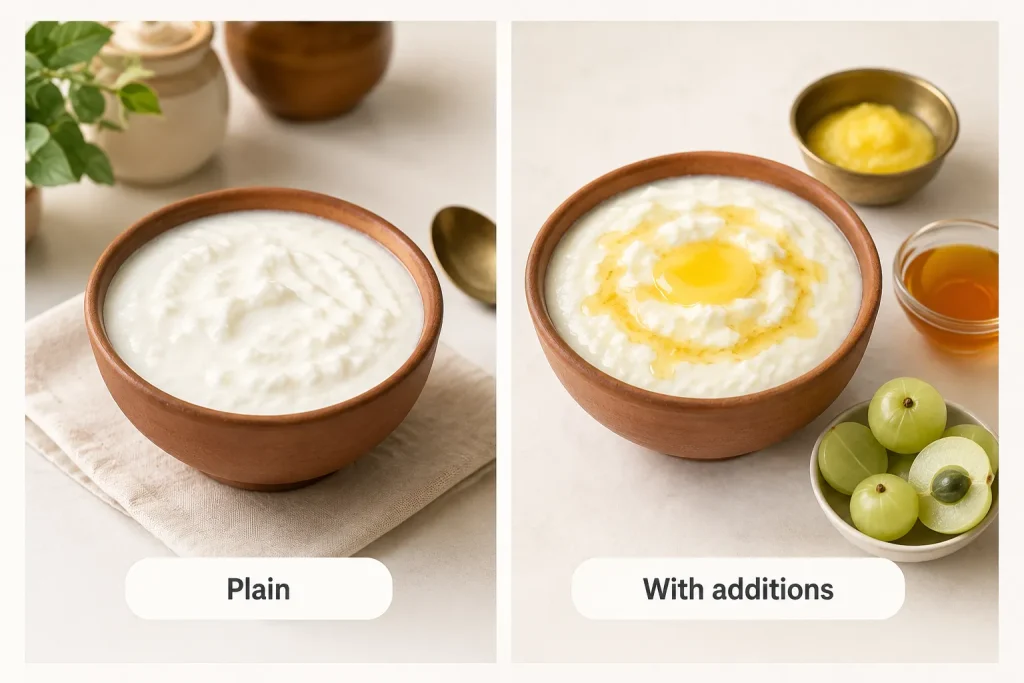
That is not a ban. That is a conditional guideline with explicitly stated exceptions.
Ayurveda classifies curd as Dadhi, a fermented food that is described as sour, heavy, and ushna, which means heating in quality. It is also described as abhishyandi, meaning it has a tendency to obstruct or congest the body’s channels. The concern in Ayurvedic thinking is not that curd is toxic at night but that its heaviness and heating quality are considered unsuitable during the Kapha-predominant evening hours, when the body’s digestive fire is thought to be lower.
The original Ayurvedic logic is internally consistent within its own framework. Kapha dosha governs structure and lubrication, and its dominance in the evening is considered to make dense, fermented, sour foods harder to process. Adding ghee, honey, or amla was the Ayurvedic solution to balance those properties, not an afterthought.
What happened over generations is that the nuance was dropped and the prohibition remained. The “you can modify it like this” became “just never do it,” and that simplified version spread through Indian households as received wisdom.
The Ashtanga Hridayam, another major classical Ayurvedic text, similarly classifies curd as heavy and heating but does not contain an absolute prohibition on nighttime consumption either.
Understanding the original reasoning matters because it changes how you evaluate the modern science. Ayurveda was not claiming that eating curd after 8pm causes mucus on a biochemical level. It was working within a different model of physiology entirely. The two frameworks are not directly comparable, and treating them as competitors on the same terms misunderstands both.
What the Science Says: Claim by Claim
Does Curd at Night Cause Mucus or Congestion?
No. This is the most persistent claim about nighttime dairy, and it is the one most thoroughly debunked by research.
A landmark study by Pinnock et al., published in the American Review of Respiratory Disease, challenged 60 healthy adult volunteers with rhinovirus-2, the most common cold-causing virus, and tracked their dairy consumption and mucus-related symptoms over ten days. The researchers found no statistically significant overall association between milk and dairy product intake and symptoms of mucus production in healthy adults, whether asymptomatic or symptomatic.
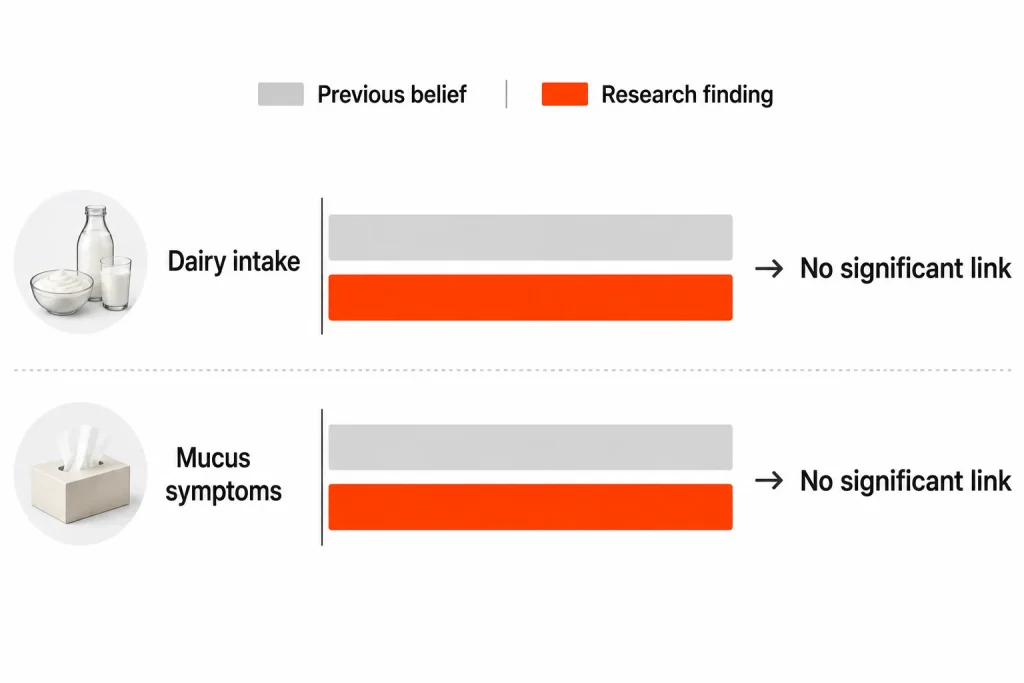
A 2019 literature review by Dr. Ian Balfour-Lynn, a paediatric pulmonologist at London’s Royal Brompton Hospital, published in Archives of Disease in Childhood, reviewed decades of evidence on this question. The review concluded there is virtually no connection between dairy products and upper respiratory mucus, and noted the myth may be preventing children with conditions like asthma or cystic fibrosis from getting enough calcium.
Research also found that people who believed milk causes mucus reported more symptoms like difficulty swallowing and thick saliva. However, they did not actually produce higher levels of mucus than those who did not hold the belief. The belief itself was producing the perception of symptoms. The curd was not.
The mucus claim against curd at night is not Ayurvedic in origin. The abhishyandi concept in Ayurveda refers to channel-congestion in a broader systemic sense, not to nasal mucus production after a cold. That specific connection was added later and has no basis in either the original texts or in modern physiology.
Verdict: The dairy-mucus link is one of the most studied food myths in nutritional science. It does not hold up.
Does Eating Curd at Night Cause Weight Gain?
No, not on its own. Weight gain comes from sustained caloric surplus, not from the timing of any single food. Plain whole-milk curd contains approximately 3.5g of protein and around 60 to 98 calories per 100g, depending on fat content, according to USDA FoodData Central data.
Curd eaten at night does not behave metabolically differently from curd eaten at noon. The body processes protein, fat, and carbohydrates the same way regardless of the clock. What does differ slightly at night is that overall physical activity is lower, so total daily energy expenditure is lower. This applies to every food eaten at night, not specifically to curd.
The does eating rice at night cause weight gain article covers this same timing myth for a different food and reaches the same conclusion: timing is a much smaller factor than total intake across the day.
If nighttime curd is contributing to excess calories, that is a quantity problem, not a curd-at-night problem. A small bowl of plain curd after dinner is, by calorie count, a reasonable and protein-dense food choice for most people.
Verdict: Curd at night does not cause weight gain. Eating too much of any food while being insufficiently active does.
Does Curd at Night Worsen Digestion or Cause Acidity?
This depends entirely on the individual and the context. For most people with healthy digestive systems, curd is one of the easier foods to digest. The fermentation process partially breaks down lactose and protein, making curd more digestible than fresh milk for most people.
However, sour or very fermented curd is genuinely high in lactic acid. For people with pre-existing acid reflux or gastro-oesophageal reflux disease, eating anything acidic or heavy close to sleep can worsen symptoms. This is not unique to curd. The lying-down position after eating makes reflux more likely regardless of the food.
The Ayurvedic concern about curd’s heaviness and sourness affecting digestion at night is not entirely unfounded when viewed through the lens of acid reflux physiology. The mechanism is different from what Ayurveda described, but the practical outcome in acid-prone individuals can align.
For people without reflux, plain curd at night causes no digestive difficulty in the research literature. The does cold water after food cause digestive problems article explores a related Indian food belief and is worth reading alongside this one.
Verdict: For most people, no. For those with reflux or severe lactose intolerance, there are genuine reasons to moderate nighttime dairy, but those reasons are individual, not universal.
Can Curd at Night Actually Help Sleep?
This is where the science goes in a direction most people do not expect.
Curd contains three compounds with direct connections to sleep quality: tryptophan, calcium, and probiotics.
Tryptophan is an amino acid that serves as a precursor to serotonin, which is then converted to melatonin, the hormone that regulates the sleep-wake cycle. A 2023 review in Advances in Nutrition confirmed that dairy products provide tryptophan along with zinc and magnesium, the cofactors required for its conversion to serotonin and melatonin, making dairy one of the more complete dietary sources for supporting this pathway.
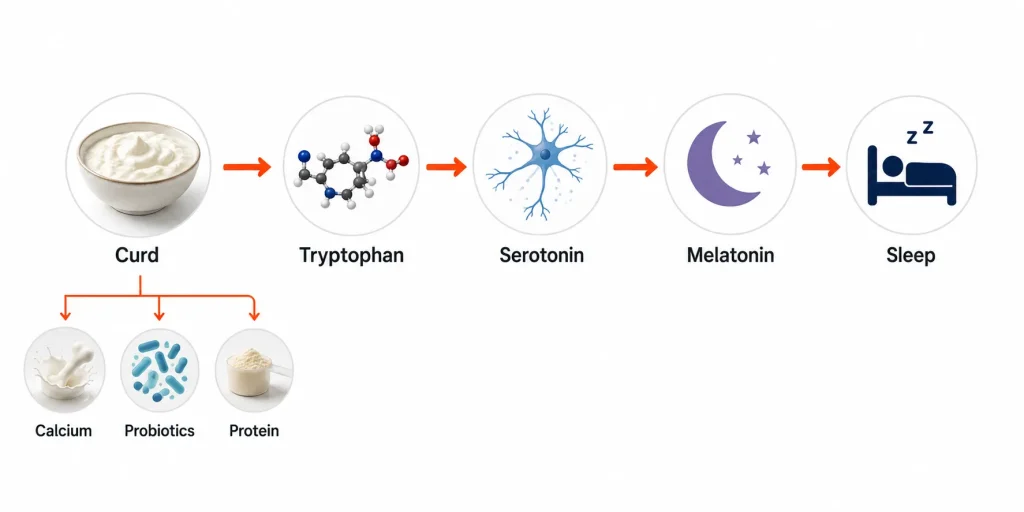
Calcium works alongside tryptophan. Research shows calcium helps the brain use tryptophan to manufacture melatonin. Curd is a rich source of both, which makes it nutritionally interesting specifically as an evening food.
A 2024 study published in Heliyon and indexed on PubMed analysed NHANES data from over 26,000 US adults and found that yogurt and probiotic consumption were associated with a reduced risk of sleep disturbances, particularly among males and those with a normal BMI.
A 2025 systematic review and meta-analysis published via PMC specifically reviewed the evidence on milk and dairy products and sleep quality and concluded that the presence of sleep-regulating compounds including melatonin and tryptophan in dairy products supports a hypothesis that dairy may have a beneficial effect on sleep quality.
This does not mean curd is a sleep aid. It means that the biological plausibility for a sleep-supporting effect exists, and the observational evidence points in a positive rather than negative direction.
Verdict: Curd at night is not a sedative, but the science supports a mildly beneficial rather than harmful relationship with sleep quality.
Curd at Night: Science vs Ayurveda at a Glance
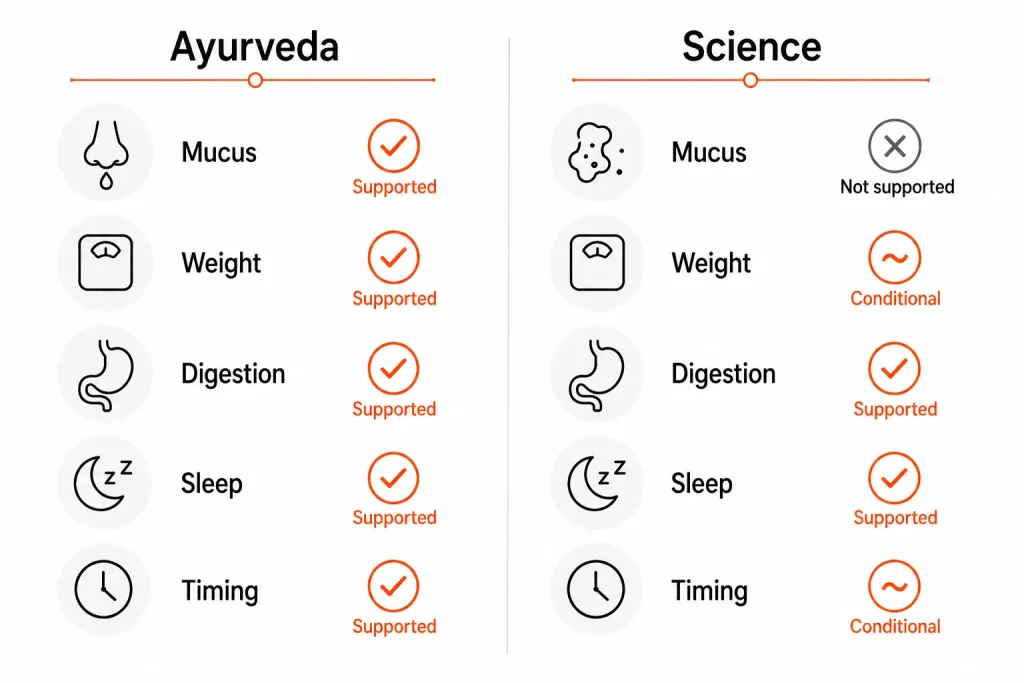
| Claim | Ayurvedic Position | Scientific Evidence | Verdict |
|---|---|---|---|
| Curd causes mucus at night | Abhishyandi (channel-congesting), avoided | No link found in multiple clinical studies | Myth |
| Curd causes weight gain at night | Heavy food, hard to metabolise at night | No evidence timing affects fat storage | Myth |
| Curd worsens digestion at night | Heavy, sour, pitta-aggravating | True for acid reflux sufferers, not general population | Conditional |
| Curd is heating, bad for Kapha time | Ushna (hot quality), Kapha-dominant evening | No modern physiological equivalent for this framework | Not testable as stated |
| Curd can be eaten at night with modifications | Allowed with ghee, honey, amla, or green gram | Modifications may reduce acidity and improve palatability | Nuanced |
| Curd supports sleep at night | Not addressed in classical texts | Tryptophan, calcium, probiotics support sleep pathways | Supported |
| Avoid curd with certain conditions | Respiratory issues, skin problems, bleeding disorders | Acid reflux and lactose intolerance are valid contraindications | Partially supported |
How Curd Actually Works in Your Body at Night
When you eat curd, the fermentation-produced lactic acid bacteria begin interacting with your gut microbiome within minutes of consumption. Unlike fresh milk, the partial pre-digestion of lactose in curd means most people, including many with mild lactose intolerance, can tolerate it well.
The protein in curd is primarily casein, a slow-digesting protein. Casein digests gradually over several hours, which means it provides a sustained release of amino acids overnight. This is the same reason casein protein powder is marketed as a nighttime supplement for muscle recovery in the fitness world. For anyone trying to maintain or build lean mass, the nighttime protein delivery from curd is actually an argument for eating it at night, not against.
The probiotic bacteria in curd, primarily Lactobacillus bulgaricus and Streptococcus thermophilus, continue supporting gut microbiome activity during sleep. Since approximately 90% of the body’s serotonin is produced in the gut, a healthy gut microbiome is relevant to both mood and sleep quality. This gut-brain axis connection is why fermented foods have attracted research attention for mood and sleep outcomes.
Calcium absorption is also worth mentioning. Some evidence suggests the body absorbs calcium more efficiently during sleep, which would make an evening serving of curd a reasonable contribution to bone health.
The practical recommendation: a small bowl of plain, unsweetened curd, roughly 100 to 150g, taken 30 to 60 minutes before sleep is nutritionally sound and potentially beneficial. A large bowl of sweet lassi, full of sugar, immediately before lying down is a different calculation.
What the Research Shows
The Pinnock et al. rhinovirus study challenged healthy adults with rhinovirus and found no statistically significant association between milk and dairy intake and symptoms of mucus production in either asymptomatic or symptomatic participants. This directly addresses the most common fear around curd at night.
The 2023 Advances in Nutrition review explored the role of dairy in sleep quality and found that dairy products provide tryptophan alongside zinc, magnesium, and calcium as cofactors in the melatonin synthesis pathway, making them biologically plausible sleep-supporting foods.
The 2024 NHANES-based study in Heliyon confirmed an association between yogurt and probiotic consumption and reduced sleep disturbance risk in a large adult population.
A systematic review published in Clinical Nutrition ESPEN in 2024 found that probiotics may improve sleep quality as measured by validated sleep scales, with the effect attributed to the gut-brain serotonin pathway.
The honest reality check: most of the sleep-supporting evidence is associational, not interventional. These studies cannot prove that curd at dinner caused better sleep. They show a pattern worth taking seriously, not a certainty. The absence of harm from nighttime curd, however, is quite well established.
“Dairy products are notably rich in tryptophan, a key substrate for serotonin and melatonin production, which are instrumental for initiating and maintaining sleep.” — Advances in Nutrition, 2023 review on dairy and sleep
Who Should Actually Avoid Curd at Night
The blanket rule does not apply. But some people have genuine reasons to be cautious.
People with acid reflux or GERD should avoid heavy, acidic foods close to bedtime. Sour curd specifically increases stomach acidity, and lying down within an hour of eating it can worsen reflux symptoms. Switching to fresh, mildly sour curd or diluting it as chaas is often a workable alternative.
People with severe lactose intolerance may experience bloating and discomfort from curd at any time, though fermentation reduces lactose content significantly compared to fresh milk. Individual tolerance varies. Most people with mild intolerance handle curd well.
People with chronic sinusitis or active respiratory infections who genuinely experience more congestion after dairy might benefit from reducing intake temporarily. The physiology here is not about mucus production but about the thickening of existing secretions that some individuals report. This is a sensory experience, not a production increase, as the Pinnock study showed. But if it consistently worsens your experience, that is worth respecting regardless of the mechanism.
People with certain skin conditions who are advised to reduce dairy as part of a dietary elimination trial should follow their treating doctor’s specific guidance, not a general rule.
For everyone else, including the majority of Indian adults without these conditions, nighttime curd is simply food. The is milk and fish together harmful and is ghee bad for heart health articles cover similar Indian food myths through the same science-first lens.
Who Should Do What: The Practical Guide
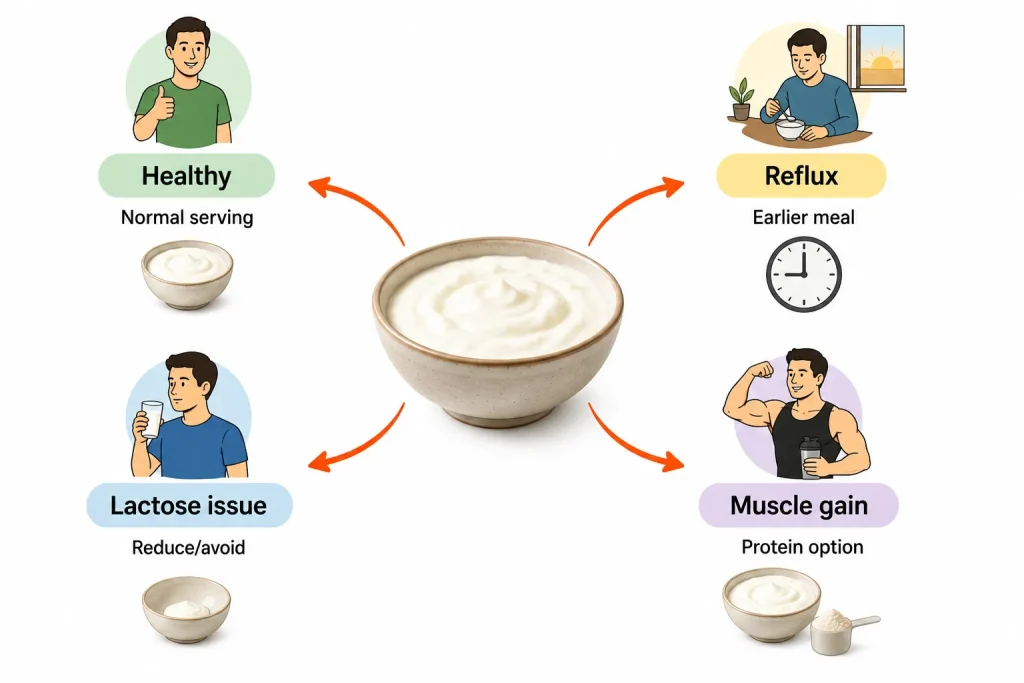
If You Are Healthy With No Digestive Issues
Eat curd at night without hesitation. A 100 to 150g serving of plain, unsweetened curd is a protein source, a probiotic food, and a mild sleep supporter. It fits into any calorie budget sensibly. Avoid sweetened variants and large portions immediately before lying down, for the same common-sense reasons that apply to any food eaten late.
If You Follow Ayurveda and Want to Honour the Tradition
Follow the actual Charaka Samhita guideline, not the popularised version. Add a pinch of black pepper, a small amount of honey, or a teaspoon of amla powder to your curd at night if it concerns you. This was the original recommendation. The text itself did not say never. It said not plain, and not in excess.
If You Have Acid Reflux
Choose fresh, lightly fermented curd rather than sour curd, and eat it at least two hours before lying down. Consider diluting it as chaas with a pinch of cumin and rock salt, which reduces both the acidity and the volume. Avoid curd on nights where reflux is already active.
If You Are Focused on Muscle Gain or Recovery
Nighttime curd is an excellent choice. The slow-digesting casein protein provides a sustained amino acid supply during the recovery window of sleep. Pair it with a small amount of fruit for the tryptophan-insulin interaction that supports melatonin production. Our guide on best protein sources for muscle gain and fat loss in India covers how to use curd alongside other Indian protein sources strategically.
If You Have Sleep Difficulties
A small bowl of plain curd, possibly with a light carbohydrate like a few pieces of fruit or a small serving of curd rice, 30 to 60 minutes before bed is worth trying. The tryptophan-calcium combination in curd has plausible biological support for improving sleep onset. Avoid sweet, heavy preparations. Plain curd or a light raita is the appropriate form.
The does warm milk before bed help you sleep article covers the overlapping science of dairy and sleep in more detail, since the tryptophan mechanism applies to both milk and curd.
The Bottom Line
Curd at night is not bad for you. For most people, it is a good food eaten at a reasonable time, with the added benefit of casein protein and a modest boost to gut and sleep health.
The Ayurvedic caution was never a blanket prohibition. It was a conditional guideline with practical modifications built in, and it was operating within a different model of physiology than modern science uses. Both deserve respect on their own terms.
What you do not need to do is avoid dahi at dinner because your body will start producing mucus, gaining fat, or suffering in some undefined way. The evidence does not support any of that. What you may need to do, if you have reflux or lactose sensitivity, is adjust how and how much you eat, and that advice applies whether the clock says 7pm or 11pm.
Eat your curd. Just do not drown it in sugar and eat it right before lying down. That is the whole rule, and it applies to most food, not just this one.
People Also Ask
Is it okay to eat curd daily at night?
Yes, for most healthy adults. Plain, unsweetened curd consumed in moderate amounts, roughly 100 to 150g, is safe and nutritionally beneficial as a nightly food. It provides protein, calcium, and probiotics, and the research does not support the common claims that it causes mucus, weight gain, or indigestion in the general population. People with acid reflux or lactose intolerance should adjust quantity and preparation, not necessarily eliminate it entirely.
What does Ayurveda actually say about curd at night?
Charaka Samhita, one of the foundational Ayurvedic texts, says curd should not be taken at night without modification, but explicitly allows it when taken with ghee, honey, sugar, green gram soup, or amla. The concern is based on curd’s Ayurvedic classification as a heavy, heating, and channel-congesting food that is considered harder to process during the Kapha-dominant evening hours. The outright blanket prohibition that most people have heard is a simplification of a more nuanced guideline.
Does curd at night cause mucus or cold?
No. Multiple clinical studies have found no association between dairy consumption and increased mucus production. A well-known study by Pinnock et al. challenged adults with the common cold virus and tracked their dairy intake and mucus symptoms, finding no statistically significant link. People who believe dairy causes mucus tend to perceive more symptoms, but do not actually produce more mucus. Colds are caused by viruses, not by the timing of dairy consumption.
Can curd at night cause weight gain?
No, not directly. Weight gain is caused by a sustained caloric surplus over time, not by eating any specific food at night. Curd contains approximately 60 to 98 calories per 100g depending on fat content. Eating a moderate portion at night does not affect fat storage differently than eating it during the day. If total daily calorie intake is managed appropriately, nighttime curd is not a weight gain risk.
Is curd at night good for sleep?
There is reasonable scientific basis for a mild sleep-supporting effect. Curd contains tryptophan, an amino acid that is a precursor to melatonin, the hormone that regulates sleep. It also contains calcium, which helps the brain use tryptophan to produce melatonin, and probiotics, which support the gut-brain serotonin pathway. Research has found associations between yogurt consumption and reduced sleep disturbance risk. Curd is not a sleep medication, but the biological plausibility for a benefit exists.
Who should actually avoid curd at night?
People with diagnosed acid reflux or GERD, severe lactose intolerance, or who are on a supervised dairy elimination protocol for skin or respiratory conditions. For people with reflux specifically, sour or heavy curd eaten within an hour of lying down can worsen symptoms. For everyone else in good digestive health, avoidance is not supported by evidence.
Is curd rice at night bad for you?
Curd rice is one of the lightest, most easily digested meals in Indian cuisine. The combination of cooked rice and curd provides carbohydrates and protein, and the tryptophan from curd, aided by the insulin release from rice, may actually support sleep onset. This is why curd rice has survived as a traditional South Indian dinner for centuries. The primary risk of curd rice at night is overeating, not the food itself. A moderate, plain preparation is fine for most people.
Sources and References
Balfour-Lynn, I.M. (2019). Milk, mucus and myths. Archives of Disease in Childhood.