
The New Green Superfood in Indian Kitchens
Let me introduce you to a green bean that’s quietly taking over Indian freezers.
A few years ago, if you mentioned “edamame” to anyone outside a five-star restaurant, you’d get a blank stare. Today? It’s in quick-commerce apps, frozen food sections, and even showing up in Indian noodle products like moong & edamame spaghetti .
Import data backs this up. foods&inns ltd. , a major Indian importer, has been consistently bringing in IQF shelled edamame from China throughout 2025 and 2026 . This isn’t a trend. It’s a shift.
But is all this hype justified? Specifically, how does edamame protein stack up against our desi champions like paneer and soya chunks? Is it worth the extra rupees, or is it just another “exotic” food that Indians don’t actually need?
In this deep-dive, I will analyze the edamame protein content, its quality, and give you a brutally honest comparison with the foods you already eat.
What Exactly is Edamame?
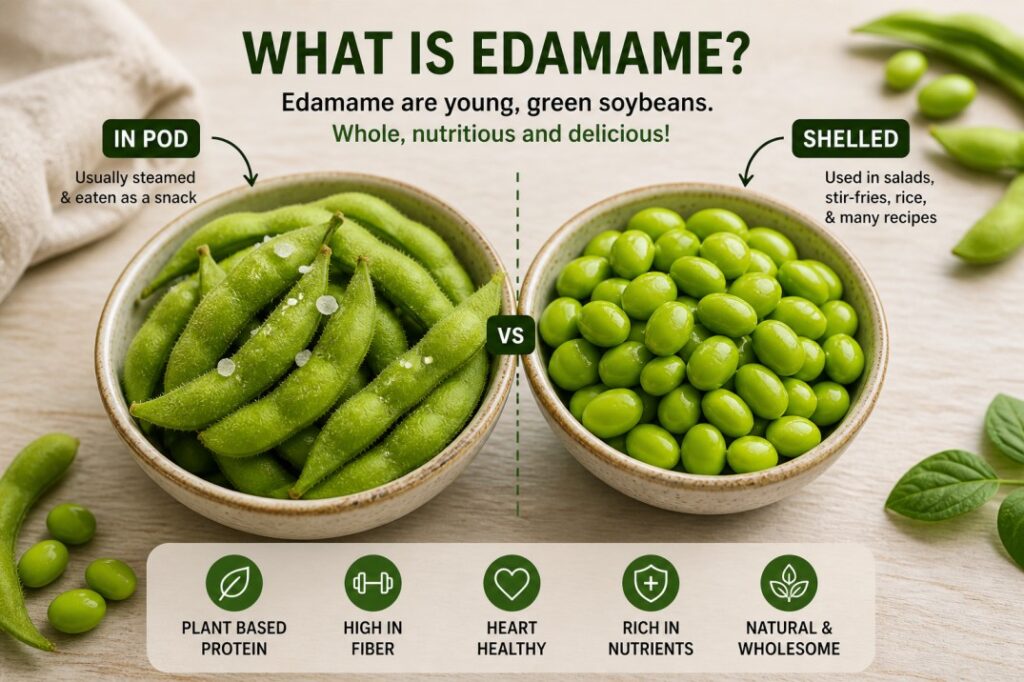
First, let’s clear the air. Edamame is simply young, immature soybeans.
Soya chunks and tofu are made from mature soybeans that have been processed. Edamame is the whole food, picked early, usually steamed in its pod or shelled. This is crucial because the processing changes the nutritional profile entirely .
Think of it as the difference between fresh green peas (edamame) and dried yellow peas (mature soy).
Edamame Protein per 100g: The Raw Numbers (Fresh vs. Roasted)
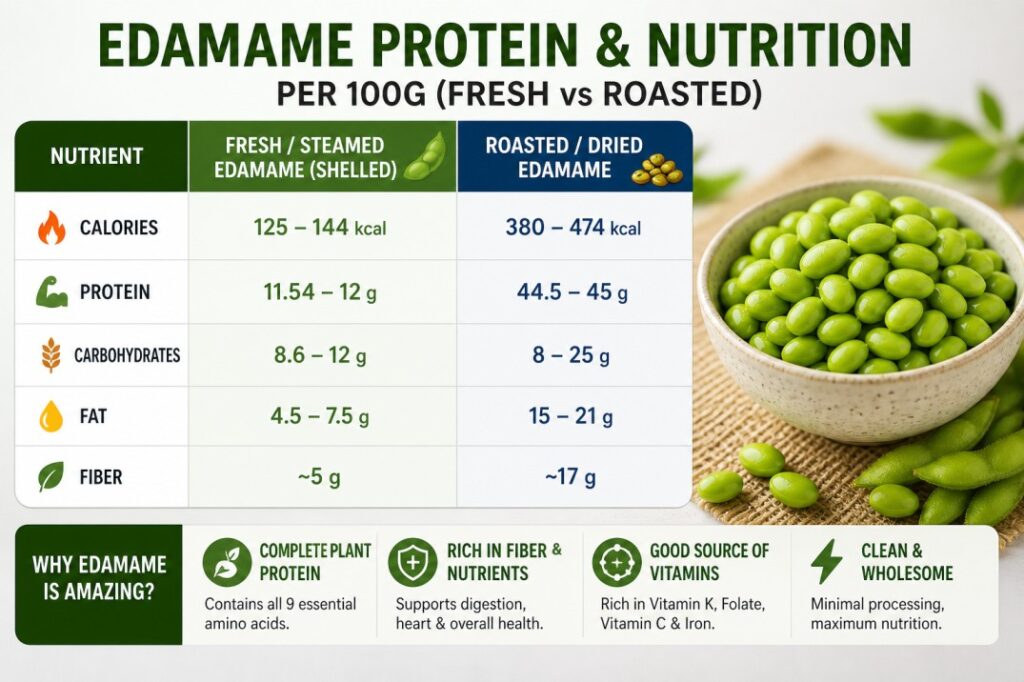
Let’s get straight to the data. The amount of protein changes drastically depending on whether you eat it fresh or dried/roasted.
According to the US Department of Agriculture and verified by nutrition trackers, here is the breakdown :
Fresh / Steamed Edamame (Shelled)
This is the “whole food” version.
| Nutrient | Amount per 100g |
|---|---|
| Calories | ~125-144 |
| Protein | ~11.54g – 12g |
| Carbohydrates | ~8.6g – 12g |
| Fat | ~4.5g – 7.5g |
| Fiber | ~5g (Excellent) |
Roasted / Dried Edamame (Snack form)
This is the “protein bomb” version. When the water is removed, the nutrition concentrates significantly.
| Nutrient | Amount per 100g |
|---|---|
| Calories | ~380 – 474 |
| Protein | ~44.5g – 45g |
| Carbohydrates | ~8g – 25g |
| Fat | ~15g – 21g |
| Fiber | ~17g (Massive) |
Key Takeaway: If you want a snack that rivals protein powder, roasted edamame is a powerhouse. However, for meal additions, the fresh/steamed version is the standard.
The Head-to-Head: Edamame vs. Paneer vs. Soya Chunks
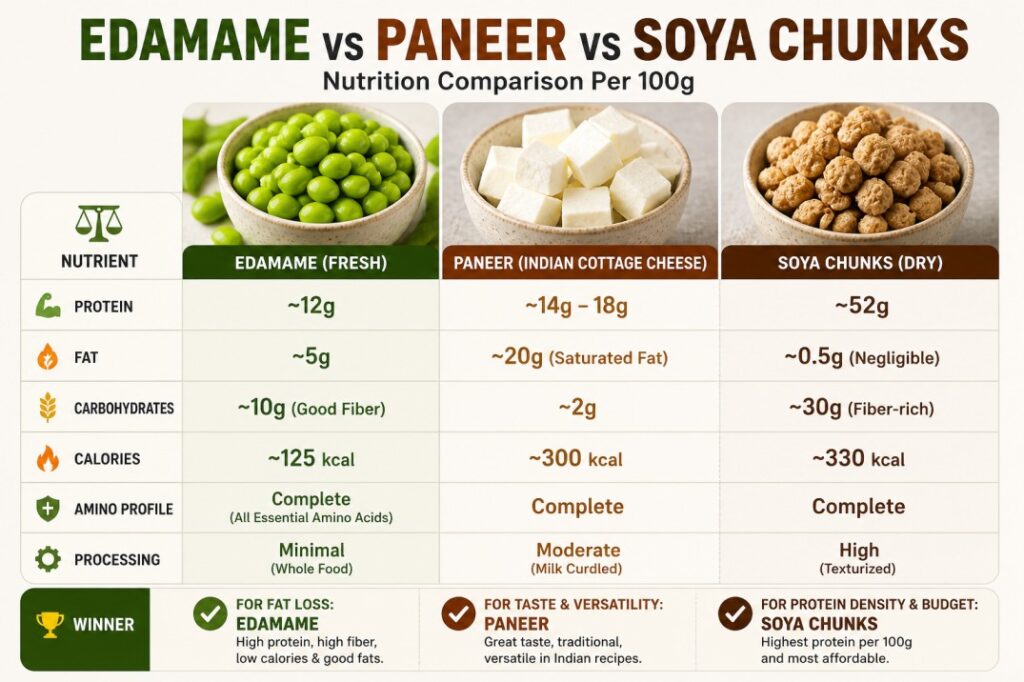
Now, for the main event. Is edamame “better” than paneer? This depends entirely on your health goal. Here is how they compare per 100g :
| Feature | Edamame (Fresh) | Paneer (Indian Cottage Cheese) | Soya Chunks (Dry) |
|---|---|---|---|
| Protein | ~12g | ~14g – 18g | ~52g |
| Fat | ~5g (Healthy Fats) | ~20g (Saturated Fat) | ~0.5g (Negligible) |
| Carbs | ~10g (Good Fiber) | ~2g | ~30g (Fiber-rich) |
| Calories | ~125 | ~300 | ~330 |
| Amino Profile | Complete (All EAA) | Complete | Complete |
| Processing | Minimal (Whole food) | Moderate (Milk curdled) | High (Texturized) |
Winner: Protein Density? Soya Chunks.
Let’s be honest. If you purely look at the protein per rupee or protein per gram, nothing beats soya chunks in the vegetarian world. 52g of protein per 100g is a mountain. You cannot out-eat soya chunks with edamame or paneer.
Winner: Fat Loss? Edamame.
This is where edamame shines. Paneer is delicious, but it comes with 20g of fat per 100g . If you are in a calorie deficit, eating 300 calories of paneer gives you less volume than eating 125 calories of edamame.
Edamame gives you “slow carbs” (fiber) with your protein. Paneer gives you saturated fat. For a lean physique, edamame is superior to paneer because it provides protein without the heavy caloric load.
Winner: Taste & Versatility? Paneer.
We have to be culturally honest. Paneer butter masala exists. Paneer tikka exists. Edamame stir-fry is tasty, but it does not hit the “desi comfort food” spot in the same way paneer does .
The “Complete Protein” Advantage (Why Quality Beats Quantity)
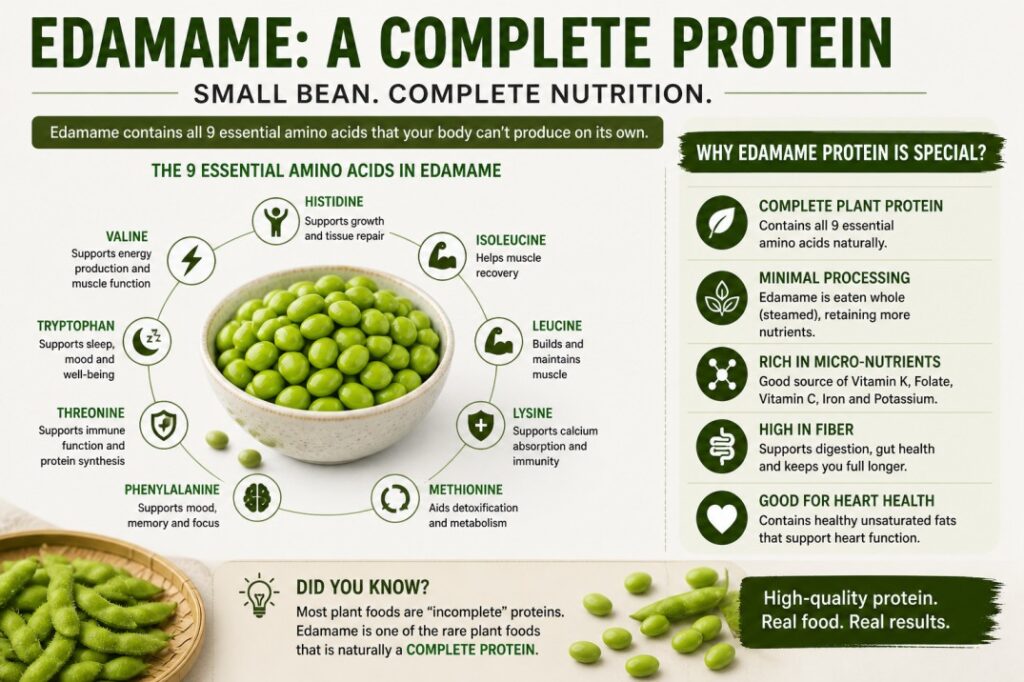
Here is a unique insight most people miss. While soya chunks have more protein, edamame is arguably the highest quality plant protein you can eat.
Why? Because it is a complete protein in its whole, unprocessed state.
A protein is “complete” if it has all nine essential amino acids your body cannot make on its own. Usually, vegetarians have to combine dal and rice to get this.
Edamame naturally has all of them .
The Freshness Factor: When soybeans are processed into chunks, they lose some of their heat-sensitive micronutrients (like Vitamin C and certain B vitamins). With edamame, you are eating the soybean raw (steamed). You get the protein plus the 5g of fiber and the vitamins (A, C, K, Folate) that are often stripped out of processed protein sources .
Three Unique Ways to Eat Edamame (The Indian Way)
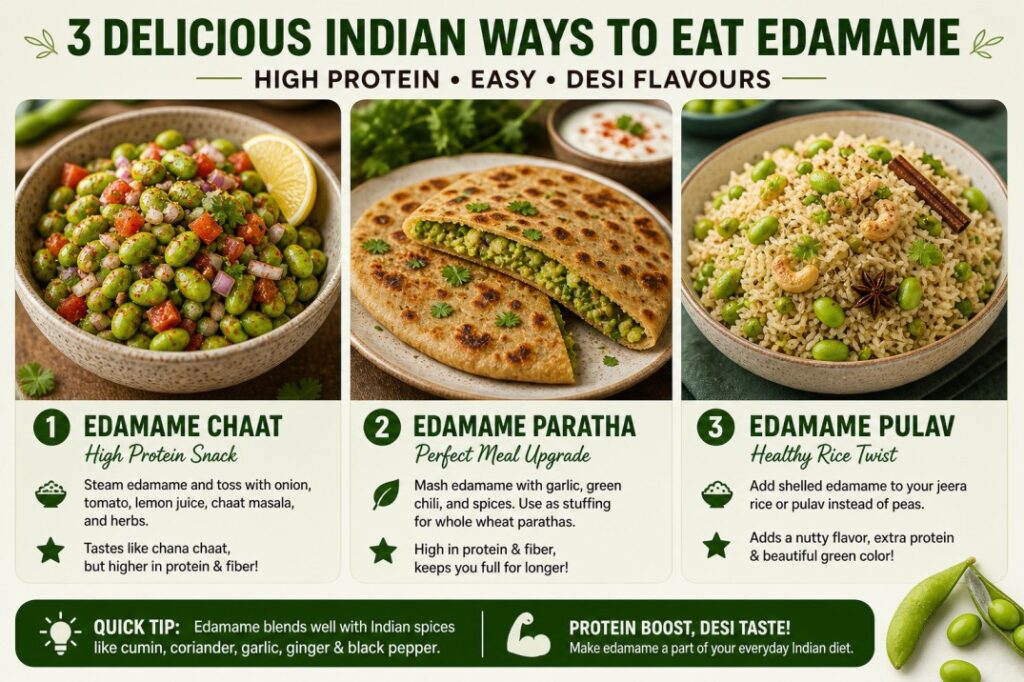
Here is the problem: Most Indians boil edamame and eat it plain. It’s boring. Here is how to integrate it into our cuisine:
1. The “Chaat” Fix (Snack)
Steam 100g of shelled edamame. Toss it with chaat masala, lemon juice, finely chopped onions, tomatoes, and a pinch of red chili powder.
Why it works: It mimics the texture of chana chaat but doubles the protein and slashes the carbs.
2. The Paratha Stuffing
Mash steamed edamame coarsely (like you do with boiled aloo). Mix with garlic, green chilies, and dhania. Use this as a stuffing for whole wheat parathas.
Result: Green parathas that are high in protein and fiber, preventing the 3 PM sugar crash.
3. Edamame Rice (Edamame Pulav)
Instead of green peas, use shelled edamame in your pulav or jeera rice. Since edamame holds its shape better than peas, it adds a nutty texture and turns a carb-heavy rice dish into a balanced meal .
The Cost-Benefit Analysis
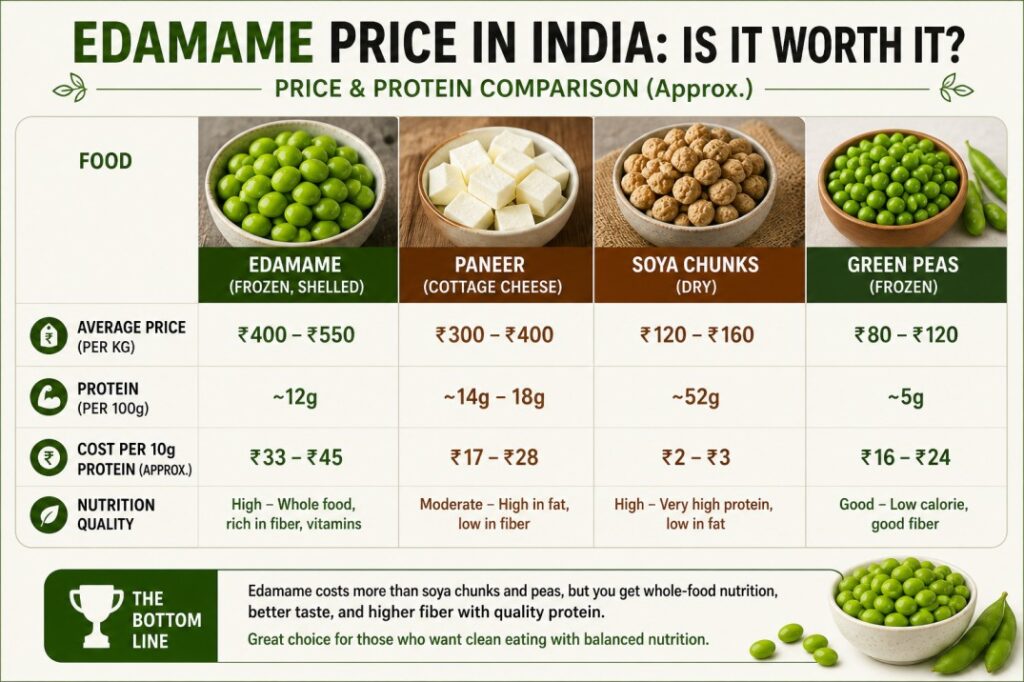
Is it worth the price?
- Paneer: ~₹400-500 per kg
- Edamame (Frozen, Imported): ~₹500-700 per kg
- Soya Chunks: ~₹150-200 per kg
From a pure economic survival standpoint, soya chunks win.
However, variety matters. Nutritionists suggest rotating your protein sources. If you eat soya chunks every day, you might get bored or digestive issues (due to high fiber).
The Verdict: Keep soya chunks for your daily protein “fuel.” Use edamame as a premium side dish or snack when you want to cut fat intake but keep volume high.
Expert Verdict: Is Edamame Better?
Let’s settle the debate with specific use-cases:
Choose Paneer IF:
You are bulking, you are not worried about calories, or you are making a rich curry. Paneer wins on taste and texture in traditional gravy dishes.
Choose Soya Chunks IF:
You want the absolute maximum protein for the lowest cost and lowest fat. This is the budget bodybuilder’s choice.
Choose Edamame IF:
You are on a fat loss diet and need volume. You want to eat a large bowl of food for under 150 calories. You want the gut health benefits of fiber. Or, you want a “complete” plant protein without any processing.
The Bottom Line
No single food is “the best.” But if you are currently eating a bowl of white rice and dal, replacing that rice (or half of it) with edamame is a massive upgrade. If you are snacking on aloo bhujia, replacing it with roasted edamame will change your body composition faster than any supplement.
Edamame protein per 100g might not be the highest numerical number on the chart, but its ratio of Protein + Fiber + High Satiety makes it arguably the healthiest vegetarian protein source available in India right now.
Frequently Asked Questions
1. Is edamame an “exotic” food or can I find it easily?
It is available in most Tier-1 and Tier-2 cities now via Blinkit, Zepto, or BigBasket in the frozen section. You can also buy dried/roasted edamame online easily .
2. Does edamame cause gas like other beans?
Because it is a young soybean, it is actually easier to digest than mature soy chunks or chickpeas. However, if you are not used to fiber, start with a small portion (50g).
3. Can I eat edamame every day for fat loss?
Yes. 100-150g of steamed edamame is an excellent daily addition. It will keep you full and provide high-quality amino acids. Pair it with a roti or rice for a complete meal.
4. Is it safe for men? (The Soy Myth)
Despite old rumors, eating whole soy foods like edamame is safe for men. It does not lower testosterone. In fact, the phytoestrogens in soy are too weak to affect male hormones and are linked to lower cancer risks.
The Bottom Line
Let’s be honest with ourselves. Indians need more protein. We often rely on paneer (too fatty) or dal (incomplete amino profile). Edamame solves both problems.
It gives you a protein density close to paneer, without the heavy fat. It gives you the complete amino profile of an egg, but from a plant source. And when you roast it, the edamame protein content skyrockets to rival even meat.
Is it better than soya chunks? No. Soya chunks are the king of quantity.
Is it better than paneer? For weight loss? Yes.
Stop asking which is “best.” Start asking which fits your goal today. If your goal is a flat stomach and defined muscles, swap your evening toast or your heavy paneer sabzi for steamed edamame with chaat masala.
Ready to Optimize Your Diet?
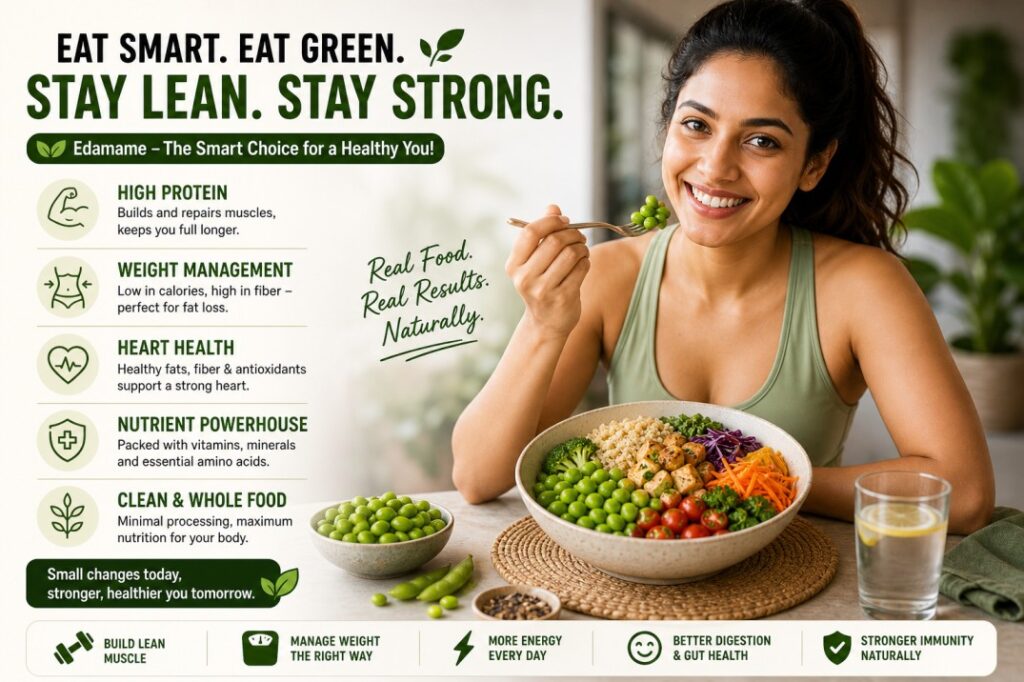
You now know exactly how edamame stacks up against the desi classics. The key to results is not in finding a “magic bean” but in consistency.
If you want to build a body that is lean and strong, you need more than just protein knowledge.
👉 Why Indians Are “Skinny Fat” – And How to Lose Belly Fat the Right Way – Because eating protein alone won’t fix everything if you are genetically skinny fat. [Read here]
👉 10 Best Workouts for Home: A Complete Guide to Get Fit Without a Gym – Pair your high-protein edamame with movement. [Read here]
👉 Budget Indian Diet Plan for Weight Loss Under ₹200/Day – Learn how to fit edamame into a tight budget without breaking the bank. [Read here]
Tell me in the comments: Have you tried the Edamame Chaat recipe? Or do you think Paneer still reigns supreme? Let’s discuss!
Eat smart, stay strong, and embrace the green bean. 🌱





One Response
Good breakdown and practical comparisons. But the conclusion leans a bit too much toward edamame for fat loss. Satiety isn’t just about calories—it’s also about protein per serving, and rehydrated soya chunks will likely keep you fuller than the same amount of edamame. Also, calling edamame “higher quality” is debatable since both come from soy and have similar amino profiles—the main difference is processing and micronutrients. A more balanced takeaway would be to rotate all three based on your goal, budget, and digestion rather than treating edamame as superior.
And if someone is targeting 70–80g protein/day on a budget, how would edamame realistically compete with soya chunks in terms of cost per gram of protein?