
Introduction: The ₹200 Question Every Indian Kitchen Asks
Your grandmother replaces sugar with jaggery in your tea. Your favorite wellness influencer claims it “detoxes the liver.” The local health store sells jaggery powder at three times the price of regular sugar.
And you’re left wondering: Is jaggery a good sugar replacement or just another marketing gimmick dressed in brown?
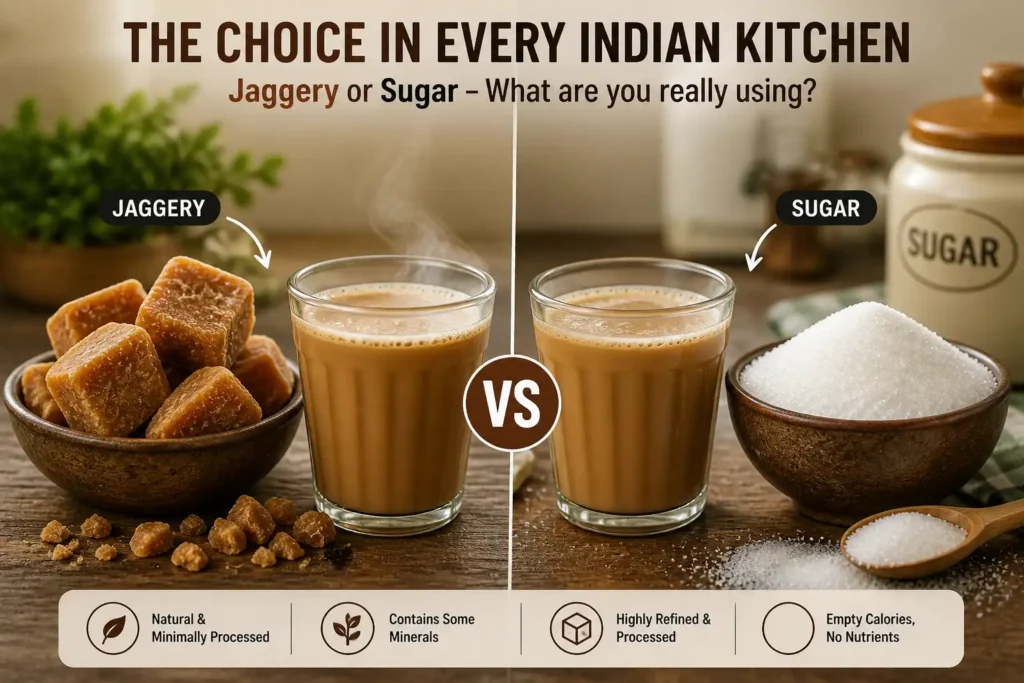
Let me answer this directly—right now, in the next sentence.
No, jaggery is NOT a “healthy” sugar replacement for weight loss or diabetes management. It is still sugar. It still has calories. It still spikes your blood sugar. The differences between jaggery and white sugar are so small that they won’t move the needle on your health goals.
But—and this is important—jaggery does have some advantages in specific contexts. Just not the ones the influencers are selling you.
In this article, I’ll show you exactly when jaggery makes sense, when it doesn’t, and why “natural” doesn’t automatically mean “good for you.”
Quick Answer: Is Jaggery a Good Sugar Replacement?
Direct answer: No, jaggery is NOT a good sugar replacement for weight loss, diabetes, or general health improvement. It provides negligible micronutrient benefits while containing almost the same calories and sugar content as white sugar.
Key facts you need to know:
- Calorie difference: Jaggery has ~383 calories per 100g vs. sugar’s ~387 calories (virtually identical)
- Sugar content: Both are ~95-98% sucrose (table sugar by another name)
- Glycemic Index: According to a 2020 study on jaggery’s glycemic index, jaggery GI ranges from 84-85 vs. sugar’s GI of ~65-68 (jaggery spikes blood sugar higher)
- Micronutrients: Jaggery has tiny amounts of iron and magnesium—but you’d need to eat 500 calories of jaggery to match the iron in one spinach leaf
- Weight loss impact: Both contribute equally to calorie surplus and fat gain
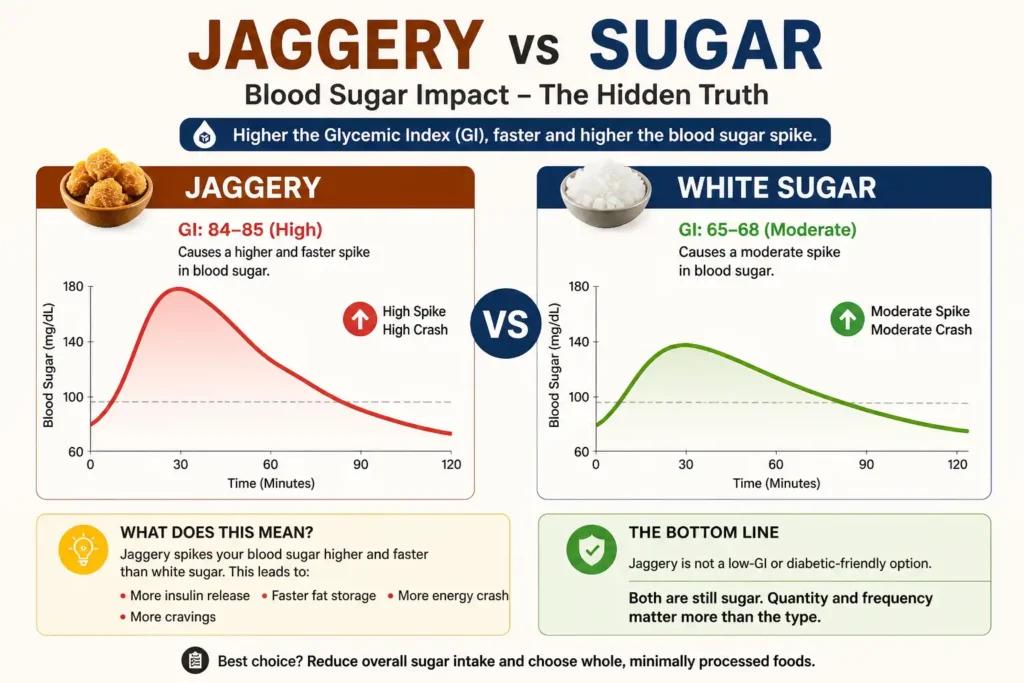
Bottom line: Replacing sugar with jaggery in your chai or desserts will NOT help you lose weight, control blood sugar, or become healthier. The only real difference is taste and processing method.
What Is Jaggery vs Sugar? (The Simple Explanation)
Let’s break this down without the pseudoscience.
White Sugar (Refined Sugar)
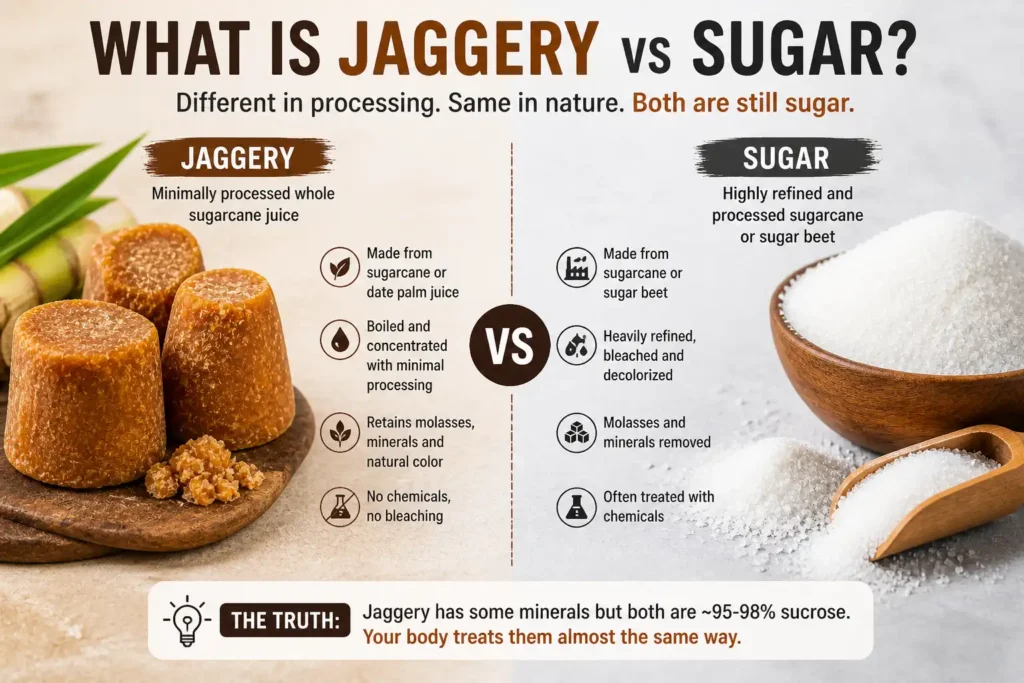
White sugar is made by extracting juice from sugarcane or sugar beets, then subjecting it to intense refining. This process removes all molasses, minerals, and color. What remains is pure sucrose—a simple carbohydrate that your body rapidly absorbs.
Jaggery (Unrefined Sugar)
Jaggery is also made from sugarcane juice (or date palm). The difference? It undergoes minimal processing. The juice is boiled, clarified, and then cooled into blocks without removing the molasses. This leaves behind some minerals and gives jaggery its characteristic brown color.
Here’s the critical truth: Both are still sugar. The refining process doesn’t create new calories or change the fundamental molecular structure. Your body doesn’t care whether the sugar came from a white crystal or a brown block—it still breaks down into glucose and fructose.
| Aspect | White Sugar | Jaggery |
|---|---|---|
| Source | Sugarcane/sugar beet | Sugarcane or date palm |
| Processing | Highly refined (molasses removed) | Minimally processed (molasses retained) |
| Primary composition | ~99.5% sucrose | ~95-98% sucrose + water + minerals |
| Color | White | Brown/golden |
| Taste | Clean, neutral sweetness | Caramel-like, earthy sweetness |
| Cost | ₹40-50 per kg | ₹80-150 per kg |
Nutritional Comparison: Jaggery vs Sugar (The Table That Tells the Truth)
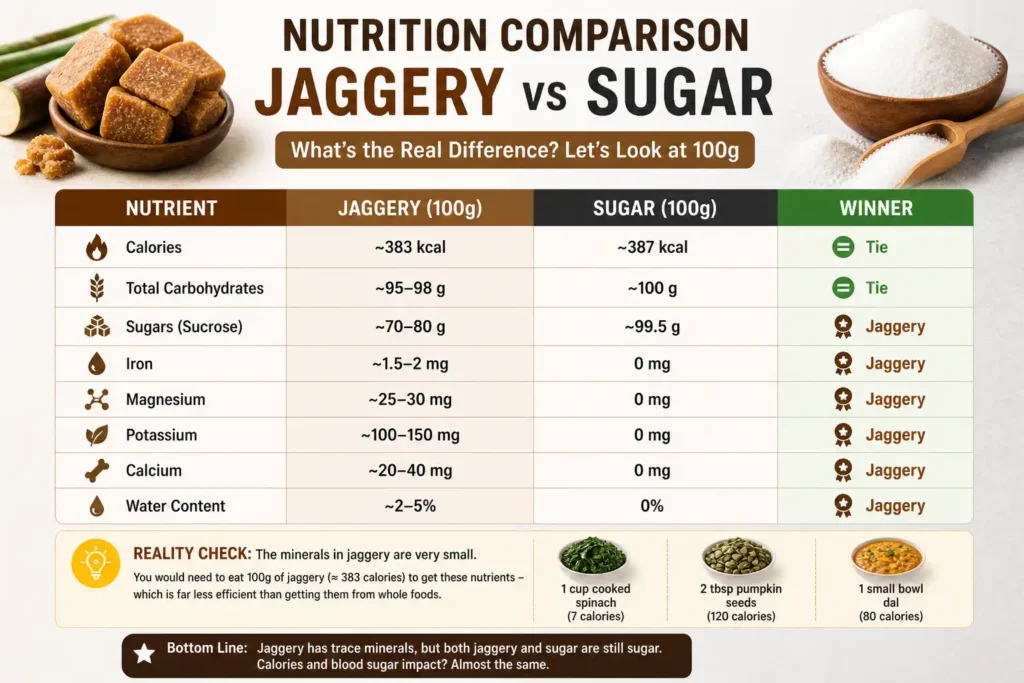
Here’s where the marketing falls apart. Let’s compare 100g of each:
| Nutrient | White Sugar (100g) | Jaggery (100g) | Winner |
|---|---|---|---|
| Calories | ~387 kcal | ~383 kcal | Tie (negligible difference) |
| Total Carbohydrates | ~100g | ~95-98g | Tie |
| Sugars (sucrose) | ~99.5g | ~70-80g | Jaggery (slightly less) |
| Water content | 0% | ~2-5% | Jaggery (irrelevant) |
| Iron | 0mg | ~1.5-2mg | Jaggery (but see note below) |
| Magnesium | 0mg | ~25-30mg | Jaggery |
| Potassium | 0mg | ~100-150mg | Jaggery |
| Calcium | 0mg | ~20-40mg | Jaggery |
The reality check on those minerals:
To get meaningful iron from jaggery, you’d need to eat 100g (383 calories). That’s roughly 20 teaspoons of jaggery—about the amount in 10-15 cups of sweetened chai. The same amount of iron is found in:
- 1 cup of cooked spinach (7 calories)
- 2 tablespoons of pumpkin seeds (120 calories)
- 1 small bowl of dal (80 calories)
Jaggery is NOT a mineral supplement. It’s sugar dressed up with trace nutrients.
Blood Sugar Impact: Glycemic Index and Insulin Response
This is where jaggery actually performs worse than white sugar.
The Glycemic Index (GI) measures how quickly a carbohydrate raises your blood sugar. Higher GI = faster, sharper spike.
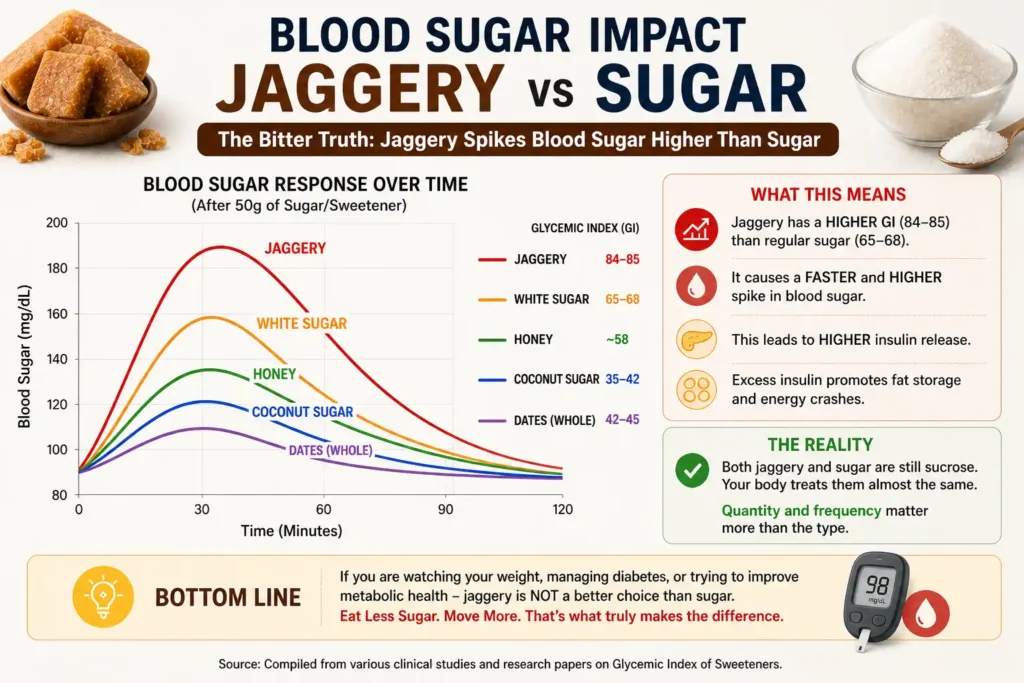
| Sweetener | Glycemic Index (GI) | Insulin Response |
|---|---|---|
| White Sugar (Sucrose) | ~65 | Moderate spike |
| Jaggery | ~84-85 | Higher spike |
| Honey | ~58 | Moderate spike |
| Coconut Sugar | ~35-42 | Lower spike |
| Dates | ~42-45 (whole fruit) | Lower spike (fiber matters) |
Why jaggery has a higher GI:
The minimal processing of jaggery leaves behind some impurities, but it also leaves the sucrose molecules highly accessible. Without the high fiber content found in whole fruits (dates, fruits), your body rapidly absorbs jaggery’s sugar.
A 2020 analysis published in the Journal of Food Science and Technology found that jaggery’s GI ranges from 84-85, placing it in the “high GI” category (above 70 is considered high). White sugar sits at ~65 (medium-high).
What this means for you:
If you’re trying to control blood sugar (diabetes, pre-diabetes, insulin resistance), jaggery is WORSE than white sugar. It spikes your glucose higher and faster.
Weight Loss & Fat Gain Reality: What Actually Matters
Here’s the simple math that the “natural sugar” marketers don’t want you to see.
Weight loss requires a calorie deficit. Period. No sweetener—jaggery, honey, coconut sugar, or maple syrup—changes this equation.
| Sweetener (1 teaspoon ≈ 5g) | Calories | To burn off, you’d need to… |
|---|---|---|
| White sugar | ~20 kcal | Walk 500 steps |
| Jaggery | ~19 kcal | Walk 475 steps |
| Honey | ~21 kcal | Walk 525 steps |
The difference is statistically irrelevant.
If you add 2 teaspoons of jaggery to your chai every day, that’s 40 calories daily = 14,600 calories per year = approximately 2 kg of fat gain annually (if you don’t cut calories elsewhere).
Replace that with white sugar? 2 teaspoons = 40 calories = 14,600 calories = 2 kg of fat gain.
There is no difference.
The only way jaggery helps with weight loss is if it reduces your overall sugar consumption—for example, if the stronger taste means you use one teaspoon of jaggery instead of two teaspoons of sugar. But that’s a portion control benefit, not a jaggery benefit.
If you’re serious about fat loss, check out our Budget Indian Diet Plan for Weight Loss Under ₹200/Day to build a sustainable eating pattern.
Common Myths: Jaggery Edition (Busted)
Myth 1: “Jaggery is natural, so it’s healthy.”
Truth: Arsenic is natural. Snake venom is natural. “Natural” doesn’t mean “good for you.” Jaggery is still sugar—a substance that, in excess, contributes to obesity, diabetes, inflammation, and fatty liver disease.
Myth 2: “Jaggery detoxifies the liver.”
Truth: Your liver is a self-cleaning organ. It doesn’t need “detox” foods. A comprehensive review on liver detoxification confirms that no food “detoxes” the liver. In fact, excess sugar (including jaggery) is a primary cause of non-alcoholic fatty liver disease.
Myth 3: “Jaggery is good for diabetics.”
Truth: With a GI of 84 (higher than white sugar), jaggery is terrible for diabetics. The American Diabetes Association states that all added sugars—regardless of source—should be minimized for blood sugar control.
Myth 4: “Jaggery is less fattening than sugar.”
Truth: The caloric difference between jaggery and sugar is 4 calories per 100g—less than a single almond. Weight gain is determined by total calorie intake, not the source of sugar.
Myth 5: “Jaggery has iron, so it’s good for anemia.”
Truth: The iron in jaggery is poorly absorbed (non-heme iron). The National Institutes of Health notes that non-heme iron absorption is significantly lower than heme iron from animal sources. You’d need to eat 500-600 calories of jaggery daily for months to see any meaningful change in hemoglobin. Meanwhile, you’d also gain significant weight. Eat spinach, dal, or take an iron supplement instead.
When Jaggery IS Better (Honest Use Cases)
Despite everything I’ve said, jaggery does have three legitimate advantages—just not the ones you think.
1. Flavor and Culinary Use
Jaggery has a complex, caramel-like, earthy sweetness that white sugar lacks. In traditional Indian sweets (chikki, gajak, payasam) and savory dishes (sambar, rasam), jaggery adds depth of flavor that sugar cannot replicate.
Use it here: Traditional recipes, not daily sweetening.
2. Less Processing (Personal Preference)
If you prefer to avoid highly refined foods, jaggery is less processed than white sugar. This is a valid personal choice—but it does not translate to health benefits.
Use it here: If you prioritize whole foods and are willing to pay the premium.
3. Slightly Lower Sugar Content (Portion Control)
Because jaggery has a stronger taste, some people naturally use less of it. If switching to jaggery cuts your sugar intake from 4 teaspoons to 2 teaspoons daily, that’s a genuine benefit—but it’s a portion control benefit, not a jaggery benefit.
Use it here: As a tool for reducing overall sweetener intake.
When Jaggery Is NOT Better (Most Cases)
Here’s where jaggery fails—and these are the use cases that matter for most people.
| Goal | Should you use jaggery? | Why |
|---|---|---|
| Weight loss | ❌ No | Same calories as sugar. No difference. Combine with 10 Best Workouts for Home for results instead. |
| Diabetes control | ❌ No | Higher GI than white sugar (84 vs 65). Worse choice. |
| Preventing blood sugar spikes | ❌ No | Choose low-GI sweeteners like stevia or monk fruit. |
| Iron deficiency | ❌ No | Poorly absorbed iron, high calorie cost. Use real iron sources instead. |
| Daily chai/coffee | ❌ No | Unnecessary calories. Train your palate to drink without sweetener. |
| Baking and desserts | 🟡 Maybe | Works for flavor, but calories still count. Use sparingly. |
| Traditional recipes | ✅ Yes | For authentic taste, okay in moderation. |
If you’re struggling with belly fat that won’t budge, understanding why Indians are skinny fat might help you see the bigger picture beyond just sugar.
Final Verdict: The Honest Truth About Jaggery
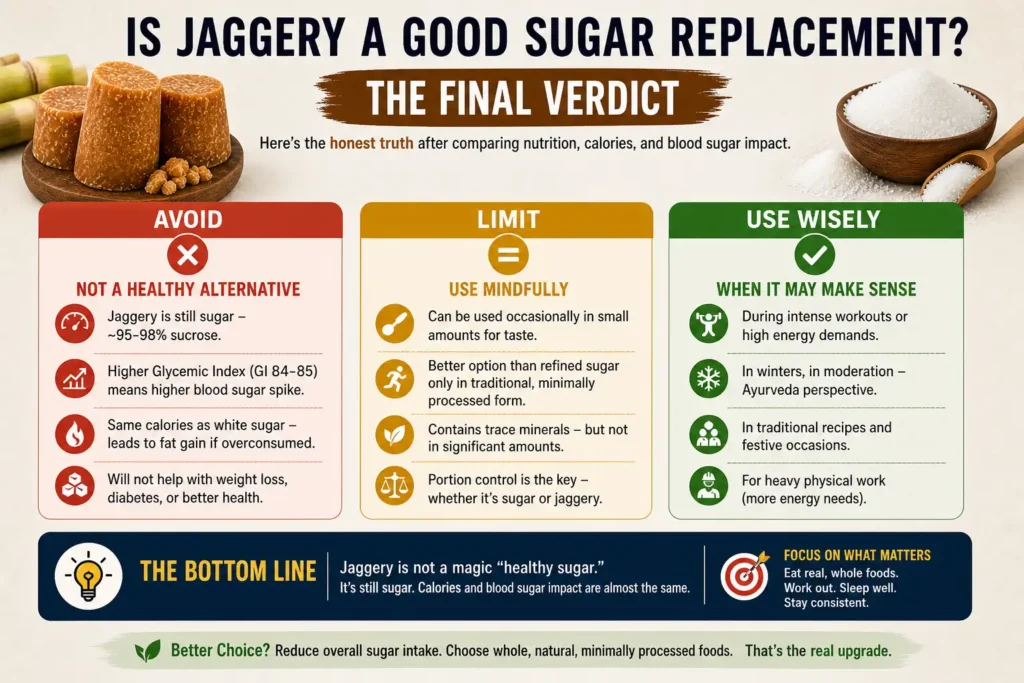
Let me be direct.
Is jaggery a good sugar replacement?
For weight loss? No. The calorie difference is negligible.
For diabetes? No. It spikes blood sugar higher than white sugar.
For general health? No. It’s still added sugar with all the same risks.
Jaggery’s only real advantages are:
- It tastes different (better for some traditional dishes)
- It’s less processed (if that matters to you personally)
- The stronger flavor might help you use less (but that’s on you, not the jaggery)
Here’s what I recommend instead:
- For weight loss: Eliminate all added sugars—white, brown, jaggery, honey. Your palate will adjust in 7-10 days. Pair this with our Budget Indian Diet Plan for Weight Loss Under ₹200/Day for maximum results.
- For diabetes: Use non-nutritive sweeteners (stevia, monk fruit) or develop a taste for unsweetened beverages. Consult the Indian Council of Medical Research (ICMR) dietary guidelines for diabetes-specific advice.
- For general health: Treat jaggery as a condiment, not a health food. A teaspoon occasionally for taste is fine. Daily consumption? Not recommended.
The simple rule: If it tastes sweet and it’s not a whole fruit with fiber, it’s added sugar. And your body doesn’t care what color it is.
Frequently Asked Questions
1. Is jaggery healthier than white sugar for weight loss?
No. Jaggery contains 383 calories per 100g vs. sugar’s 387 calories—a negligible difference. Weight loss depends on total calorie deficit, not the source of sugar. Neither helps you lose weight.
2. Can diabetics eat jaggery instead of sugar?
No. According to a 2020 study on jaggery’s glycemic index, jaggery has a glycemic index of 84-85, which is HIGHER than white sugar’s GI of 65. For blood sugar control, diabetics should avoid both and use non-nutritive sweeteners like stevia instead.
3. What is the difference between jaggery and sugar besides taste?
The main differences are processing (jaggery is less refined) and trace minerals (jaggery has tiny amounts of iron, magnesium, and potassium). However, the mineral content is nutritionally insignificant unless you eat large quantities (which would cause weight gain).
4. Is jaggery good for fatty liver?
No. Fatty liver is caused by excess sugar consumption—particularly fructose. The National Institute of Diabetes and Digestive and Kidney Diseases (NIDDK) confirms that reducing all added sugars is essential for fatty liver management. Jaggery contains significant fructose (as part of sucrose). Replacing sugar with jaggery will not improve fatty liver; only reducing total sugar intake will help.
5. Which is better for chai: jaggery or sugar?
Neither is “better” for health. If you must sweeten your chai, use the smallest amount possible of either. Jaggery adds a caramel flavor that some prefer, but the health impact is identical to sugar.
Ready to Rethink “Healthy” Sugar?
You now know the truth: Jaggery is sugar. Brown, natural, traditional—still sugar.
The real path to fat loss and blood sugar control isn’t finding “healthier” sugar. It’s learning to live with less sweetness overall.
If this article changed how you think about “natural” sweeteners, share it with someone who still adds jaggery to their “diet chai.”
Drop a comment below: Were you believing the jaggery myths? What will you change after reading this?
And if you’re serious about fat loss, read these next:
👉 Why Indians Are “Skinny Fat” – And How to Lose Belly Fat the Right Way – Understand why added sugar is a major driver of the skinny-fat body type. [Read here]
👉 Budget Indian Diet Plan for Weight Loss Under ₹200/Day – Use your grocery budget wisely on real food, not “healthy” sugar. [Read here]
👉 10 Best Workouts for Home: A Complete Guide to Get Fit Without a Gym – Pair good nutrition with effective exercise. [Read here]
Disclaimer: This information is for educational purposes only. Consult a qualified healthcare provider or registered dietitian before making significant dietary changes, especially if you have diabetes, fatty liver disease, or other metabolic conditions.