
Most vegetarians are deficient in B12 — and most of them have no idea. Unlike iron or calcium, B12 deficiency does not announce itself with obvious symptoms right away. It creeps in slowly, quietly wrecking your energy, nerves, and mental clarity over months or years. The good news: vitamin B12 foods for vegetarians do exist — and if you eat strategically, you can cover your requirements without going anywhere near meat.
The short version: dairy products, eggs, fortified foods, and nutritional yeast are your primary B12 sources as a vegetarian. But how much each actually delivers — and how well your body absorbs it — varies enormously.
Here’s what no article tells you upfront: most plant foods marketed as B12 sources either contain an inactive form your body can’t use, or provide so little that you’d need to eat unrealistic quantities. Knowing the difference between a real source and a myth could genuinely change your health.
Quick Answer
The best vitamin B12 foods for vegetarians:
- Dairy products (milk, paneer, curd, cheese) — practical daily sources in the Indian diet, though amounts per serving are modest
- Eggs — especially egg yolks, a solid and underrated B12 source for lacto-ovo vegetarians
- Fortified foods — B12-fortified plant milks, breakfast cereals, and nutritional yeast are among the most reliable options
- Nutritional yeast — only if the label says “fortified”; unfortified yeast contains almost no usable B12
- Supplementation — for most strict vegetarians, a weekly or daily supplement remains the most reliable safety net
What Is Vitamin B12 and Why Do Vegetarians Struggle with It
B12 is a water-soluble vitamin that your body needs for three things that matter a great deal: making red blood cells, maintaining the protective sheath around your nerves, and synthesizing DNA. Without enough of it, you get tired, your nerves start misfiring, and your brain does not work as well as it should.
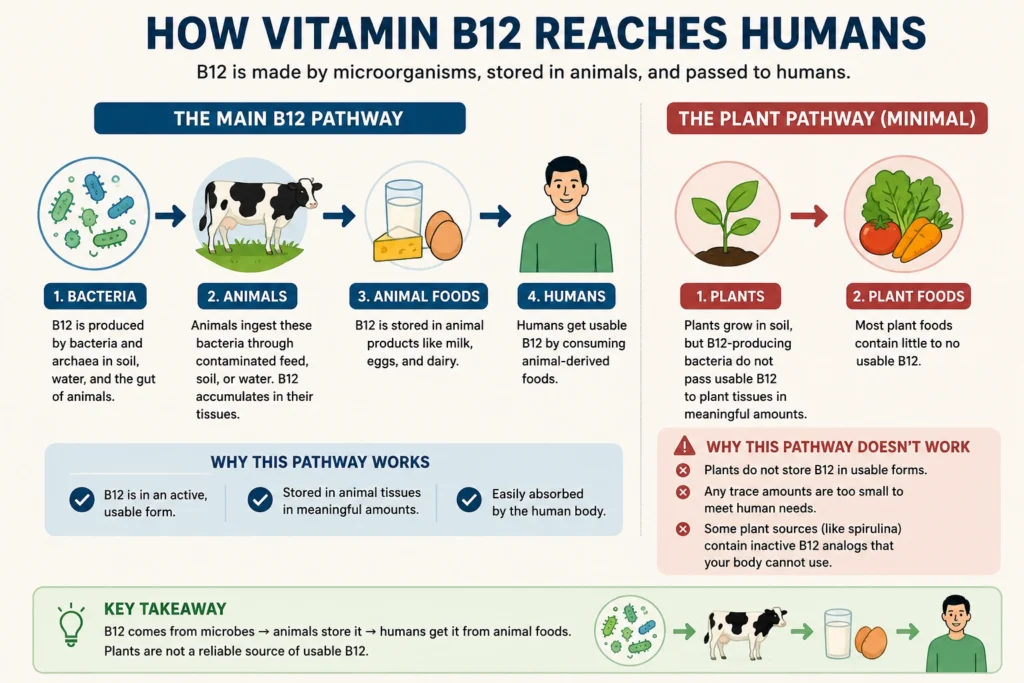
The reason vegetarians specifically struggle is simple: B12 is produced almost exclusively by bacteria and archaea, and it accumulates in the tissues of animals that eat food contaminated by those bacteria or are raised on B12-supplemented feed. Animals are essentially walking B12 storage units. Plants are not.
Think of it this way – plants grow in soil, and while soil bacteria can technically produce B12, the amounts are too small to reach meaningful levels in the plant itself. And since most modern vegetables are thoroughly washed before sale, even that trace contamination is gone.
The daily requirement for an adult is just 2.4 mcg. That sounds small. But the challenge is not the number — it’s consistency. B12 builds up in the liver over time, which means a deficiency can take 3-5 years to become clinically obvious. By the time blood tests confirm it, the damage to nerves and cognition may already have begun.
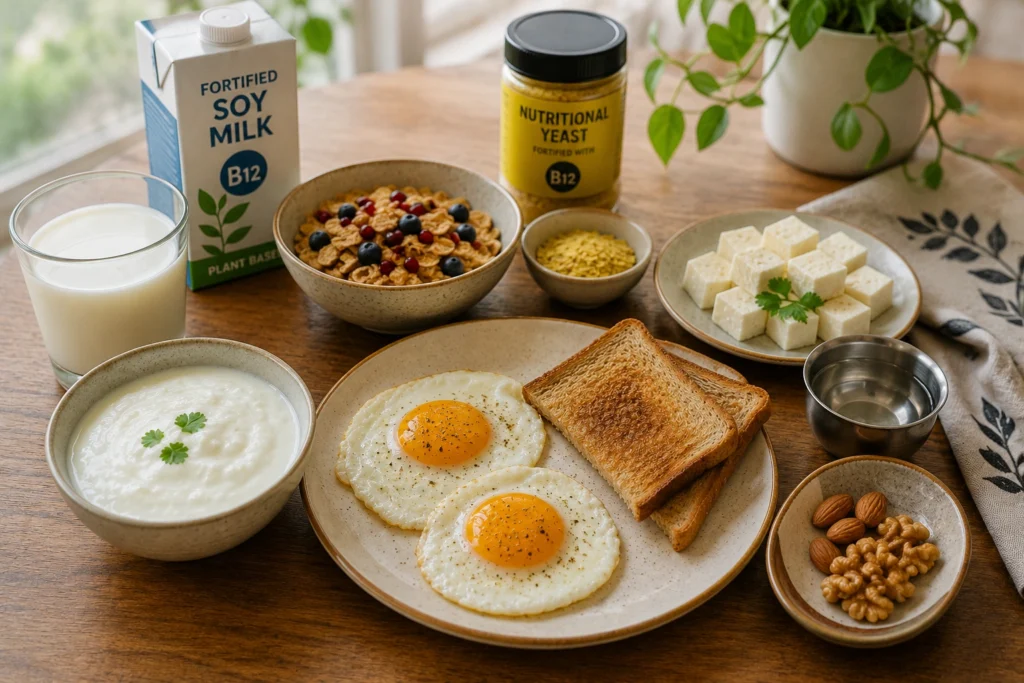
Vitamin B12 Foods for Vegetarians
Milk and Dairy Products
Milk is the most accessible B12 source in the Indian vegetarian diet – and it is genuinely useful, not just theoretical. One cup (240 ml) of full-fat cow’s milk delivers approximately 1.2 mcg of B12, which is about 50% of your daily requirement.
Curd (dahi) contains a similar amount per serving. Paneer, made by curdling milk, has somewhat less — roughly 0.3-0.5 mcg per 100g. The fermentation process in curd does not destroy B12, so dahi is a reliable daily option.
Verdict: Good daily foundation. Two servings of dairy per day covers most of your B12 needs. The problem: many Indians are partially lactose intolerant and reduce dairy intake without realizing it affects their B12.
Eggs
An egg is a surprisingly solid B12 source. One large egg provides approximately 0.6 mcg, mostly concentrated in the yolk. Eat two eggs and you’re getting half your day’s requirement from one meal.
For lacto-ovo vegetarians — which is the majority of self-described vegetarians in India — eggs are probably the most bioavailable non-supplement source available. The protein matrix in eggs may actually slow B12 absorption slightly, but the amounts delivered are still meaningful in a daily context.
Verdict: Underrated. If you eat eggs and are not eating them regularly, you’re leaving a reliable B12 source unused. Two to three eggs daily can genuinely move the needle.
Fortified Plant-Based Milks
Soy milk, almond milk, and oat milk sold by reputable brands are frequently fortified with B12. A 200 ml serving of fortified soy milk typically contains 0.6-1.0 mcg, depending on the brand and fortification level.
The catch is simple: you must check the label. Unfortified plant milks contain essentially zero B12. In India, the range of fortified options is narrower than in Western markets, and fortification levels are not always standardized. Amul’s range of plant milks and some premium imports do carry B12, but it’s not universal.
Verdict: Good option if fortified – zero use if not. Always verify the nutrition label. Do not assume.
Nutritional Yeast
Nutritional yeast has become a staple recommendation in vegetarian nutrition circles, and it deserves its reputation – but with a critical caveat. Only fortified nutritional yeast contains meaningful B12. Unfortified nutritional yeast, despite being made from yeast, provides negligible amounts of the active cobalamin your body needs.
Two tablespoons of fortified nutritional yeast typically provides 2.4-4.0 mcg of B12 – enough to cover your entire daily requirement. It has a mildly cheesy, umami flavor that works reasonably well in Indian cooking if you add it to gravies or sprinkle it on food.
Brands like Bragg’s (imported) and a few domestic options now available online do provide fortified versions. The price point is higher than dairy-based options, but for vegans or those who avoid dairy, it’s one of the best whole-food fortified sources available.
Verdict: Excellent — if fortified. Buy only brands that specify “with B12” or “fortified” on the packaging. This one distinction determines whether you’re getting any B12 at all.
Cheese
Hard cheeses — particularly Swiss, gouda, and cheddar – contain meaningful B12. Swiss cheese delivers around 0.9 mcg per 30g serving, which is notable. The softer cheeses common in India, like processed cheese slices, often contain less, though they still contribute something.
In an Indian household, cheese is typically used in smaller quantities, so it’s more of a supplemental source than a primary one. But if you’re eating a cheese-heavy meal, you’re getting more B12 than you might think.
Verdict: Useful secondary source. Not your foundation, but adds up across a week.
Fortified Breakfast Cereals
Some cereals — particularly imported brands like Kellogg’s —0 are fortified with B12 at levels of 1.5-6 mcg per serving. This is a case where the food vehicle genuinely delivers, but the sugar and refined grain content means this should not be your primary nutritional strategy.
Still, if you eat fortified cereal regularly, you’re likely getting a meaningful B12 contribution that many people overlook when calculating their intake.
Verdict: Works, but don’t build your health plan around cereal. Use it as a supporting source.
Tempeh, Seaweed, and Spirulina — Setting the Record Straight
These are often cited as plant-based B12 sources. They are not reliable ones.
Spirulina and most algae contain pseudovitamin B12 – an inactive analogue that can actually block the absorption of real B12 in your body. Consuming spirulina as a B12 strategy can make your blood test look better while your actual B12 status worsens. This is not a minor caveat. It’s a real risk.
Tempeh’s B12 content varies wildly based on fermentation conditions and is too inconsistent to rely on. Some batches contain meaningful B12; many contain almost none.
Verdict: Do not count these. If anything, avoid using spirulina as your B12 “solution.”
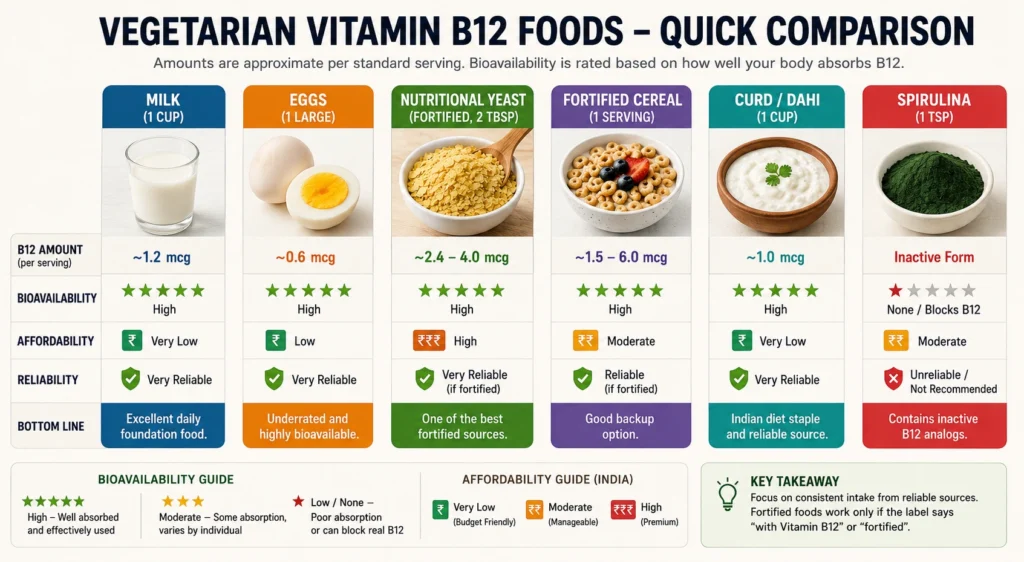
Vitamin B12 Sources for Vegetarians
| Food | B12 per Serving | Bioavailability | Cost (India) | Best For | Verdict |
|---|---|---|---|---|---|
| Cow’s Milk (1 cup) | ~1.2 mcg | High | Very low | Daily baseline | Reliable |
| Egg (1 large) | ~0.6 mcg | High | Low | Daily use | Underrated |
| Fortified Soy Milk (200ml) | ~0.6-1.0 mcg | High | Moderate | Dairy-free diet | Good if fortified |
| Fortified Nutritional Yeast (2 tbsp) | ~2.4-4.0 mcg | High | High | Vegans, daily coverage | Excellent if fortified |
| Swiss Cheese (30g) | ~0.9 mcg | High | Moderate-High | Secondary source | Solid add-on |
| Fortified Cereal (1 serving) | ~1.5-6 mcg | High | Moderate | Backup source | Works, not optimal |
| Curd/Dahi (1 cup) | ~1.0 mcg | High | Very low | Indian diet staple | Reliable |
| Spirulina | Inactive form | Blocks real B12 | Moderate | Nothing | Avoid as B12 source |
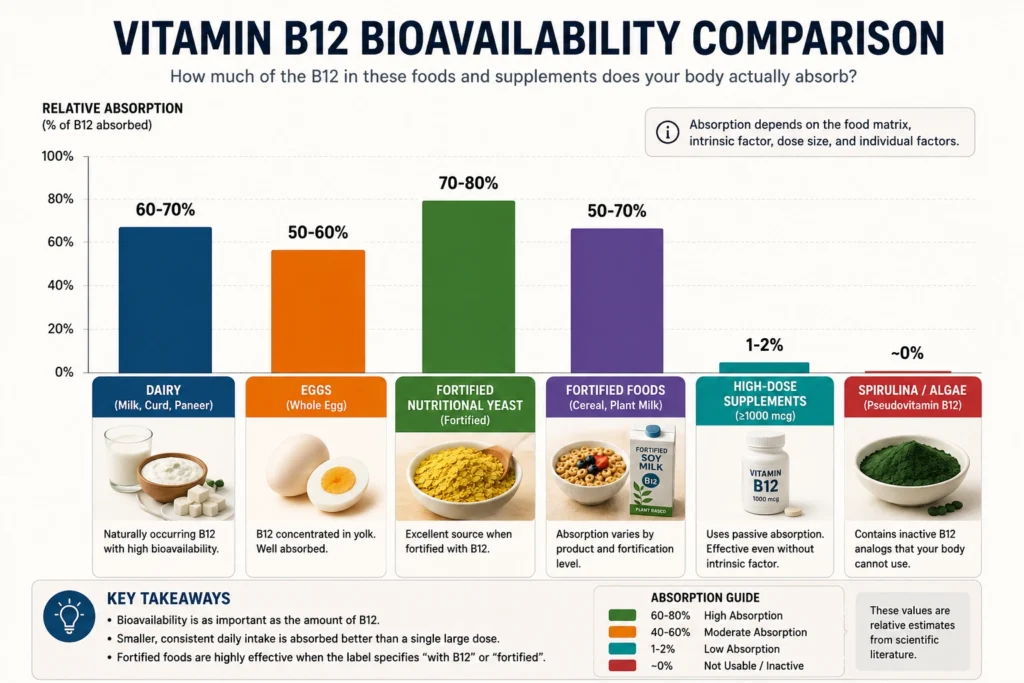
Absorption and Bioavailability: Why It Is More Complicated Than a Number
The amount of B12 on a nutrition label is not the amount your body absorbs. This matters more with B12 than with almost any other nutrient.
B12 absorption depends on a protein called intrinsic factor, produced by cells in your stomach lining. Intrinsic factor binds B12 and carries it through the intestinal wall. The problem: this system saturates easily. At a single dose of around 1.5-2 mcg, intrinsic factor-mediated absorption becomes the bottleneck, and absorption efficiency drops sharply.
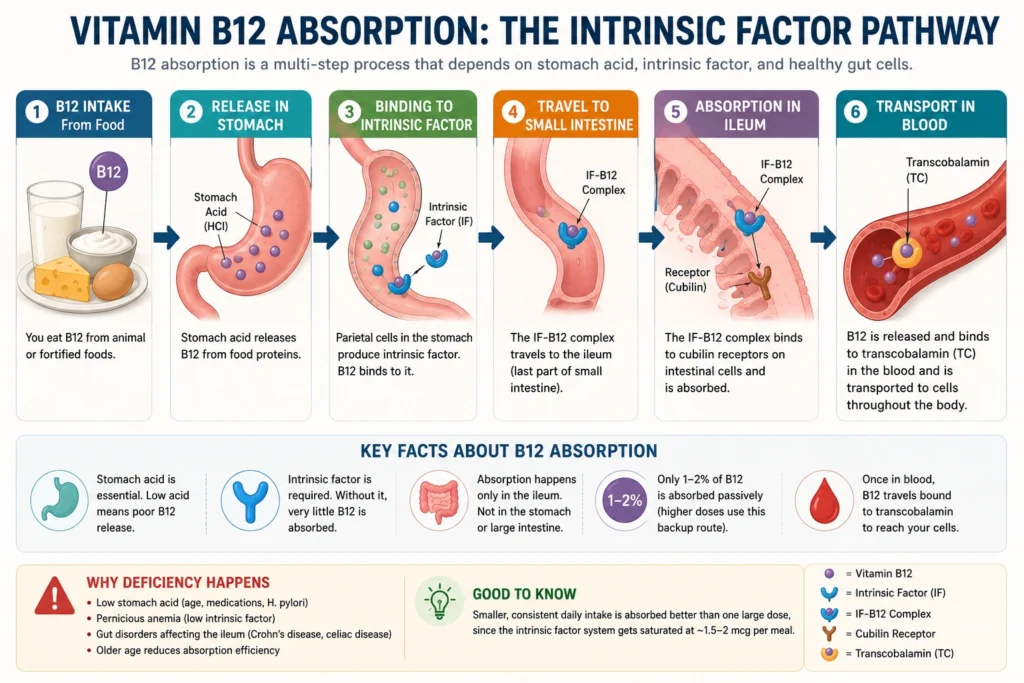
This is why eating one massive B12-rich meal once a week does not work as well as spreading your intake across the day. Smaller, frequent doses are absorbed more efficiently than one large hit.
There is a secondary, passive absorption pathway – about 1% of any dose is absorbed without intrinsic factor. This is why high-dose supplements (1000 mcg/day) can still raise B12 levels in people with absorption disorders. But for food-based sources delivering 1-2 mcg per serving, the intrinsic factor pathway is what you’re relying on.
Practical implication: two or three dairy servings spread across the day covers your needs more effectively than drinking a litre of milk at dinner.
What the Research Actually Shows
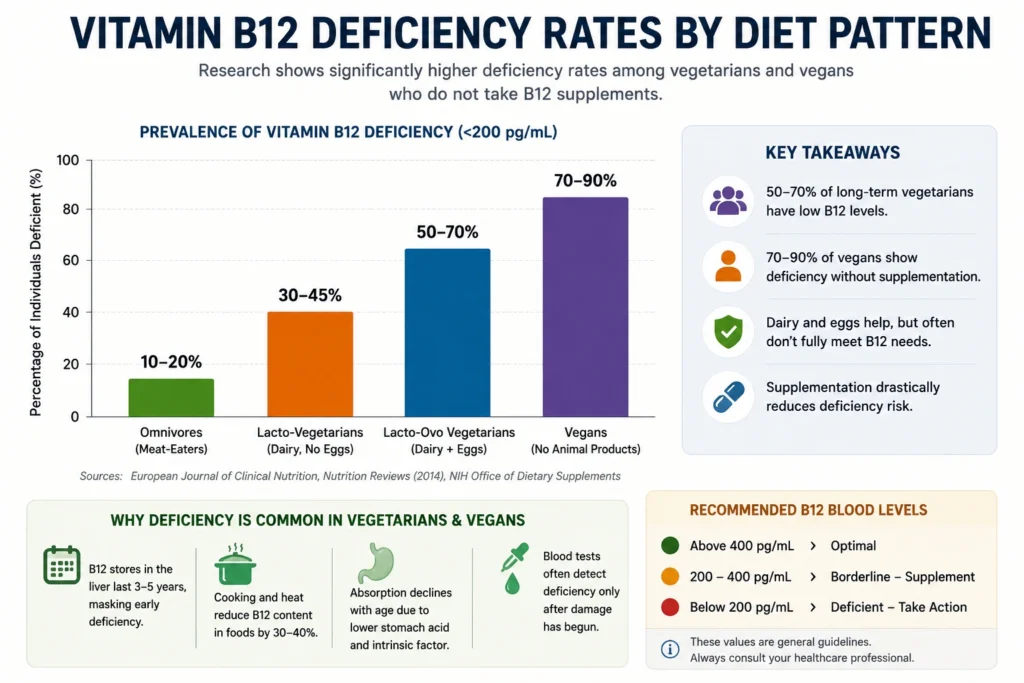
The evidence on vegetarian B12 status is fairly consistent and somewhat alarming. Studies published in the European Journal of Clinical Nutrition have found that 50-70% of long-term vegetarians and vegans show B12 blood levels below the normal range when they do not supplement.
A 2014 review in Nutrition Reviews confirmed that while dairy and eggs provide bioavailable B12, they often do not deliver enough to fully meet requirements in people who depend on them exclusively, particularly as cooking and heat processing reduce B12 content in food by 30-40%.
Research from the NIH Office of Dietary Supplements confirms that the recommended daily amount is 2.4 mcg for adults, rising to 2.6-2.8 mcg during pregnancy and lactation — periods when many Indian vegetarian women rely entirely on diet without supplementation.
Reality check: most vegetarians who think their diet covers their B12 are often maintaining their levels by slowly depleting liver stores. The liver holds 3-5 years’ worth of B12, which is why deficiency often goes undetected for so long. By the time symptoms appear, nerve damage may already be occurring.
Side Effects, Digestibility, and Real Concerns
B12 itself has no known upper limit and does not cause toxicity — the body excretes what it does not need. So there is no real concern about overdoing it through food or standard supplements.
The practical concerns are different:
For lactose-intolerant individuals — a significant portion of the Indian population – heavy reliance on dairy for B12 means either digestive discomfort or quietly reducing intake and inadvertently reducing B12 intake with it. Yogurt (curd) is often better tolerated than milk because the lactose is partially digested by bacteria, making it a smarter dairy choice for people with mild intolerance.
For older adults, B12 absorption from food declines with age because stomach acid production decreases, and intrinsic factor output drops with it. After age 50, even people with adequate dietary intake may need supplementation specifically because their absorption has become inefficient. This is not commonly discussed in Indian health conversations.
For pregnant vegetarians, B12 deficiency carries serious risks for the developing fetus’s nervous system. Antenatal B12 supplementation is not as universally recommended in India as folic acid, but the evidence supporting it is strong.
Who Should Do What
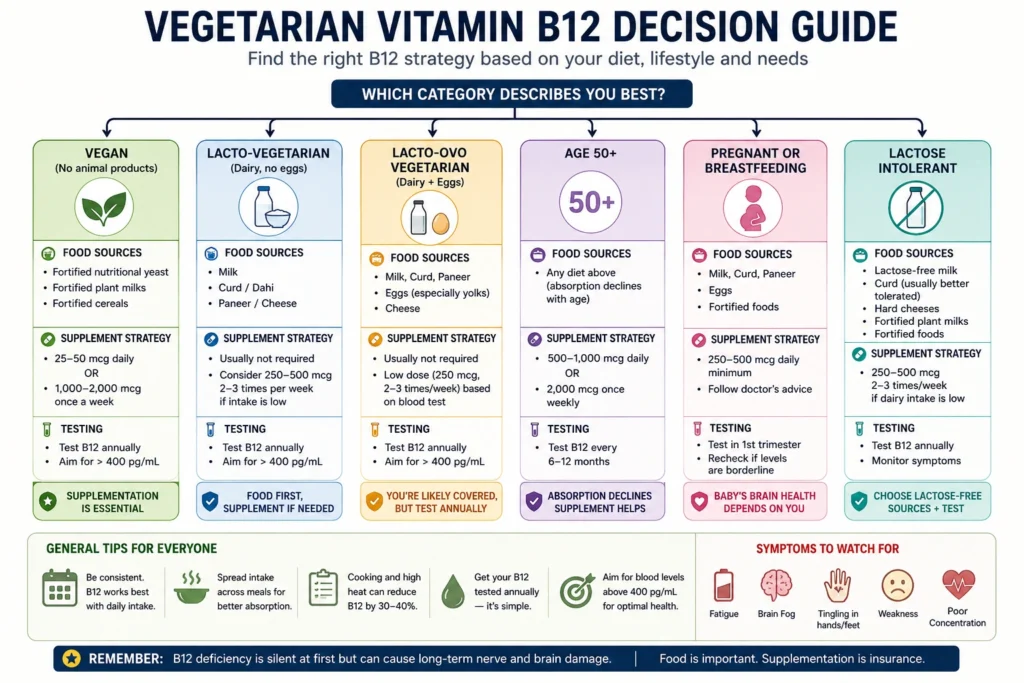
If You Are a Lacto-Vegetarian Who Eats Dairy Daily
You are probably in reasonable shape, but do not assume. Two cups of milk or equivalent dairy per day, spread across meals, should theoretically cover your 2.4 mcg requirement. Get a blood test annually to verify. If your serum B12 is below 300 pg/mL, consider adding a low-dose supplement even if you’re eating dairy regularly.
If You Are Vegan
Diet alone will not reliably cover your B12 needs. Fortified nutritional yeast and fortified plant milks help, but the amounts are inconsistent across brands and cooking reduces them further. A weekly 2000 mcg cyanocobalamin supplement, or a daily 25-50 mcg supplement, is not optional – it is necessary. If you want food sources, check out our guide to the best vegetarian protein sources in India, which also covers how vegans can optimize their overall micronutrient intake.
If You Are Lacto-Ovo Vegetarian
Eggs plus dairy together make a solid combination. Two eggs daily plus one to two dairy servings puts you at or near your daily requirement. Still worth testing blood levels yearly, particularly if you avoid eggs and rely primarily on milk.
If You Are Over 50
Regardless of your dietary pattern, B12 absorption declines with age. A sublingual B12 supplement or a supplement in cyanocobalamin form is a sensible addition. Do not wait for symptoms.
If You Are Pregnant
Supplementation is advisable even if you eat dairy and eggs regularly. The developing baby’s neurological health is not a situation where you want to rely on dietary estimates. Discuss specific dosing with your obstetrician, and consider getting your B12 levels tested in the first trimester.
If You Are on a Tight Budget
Milk and curd are your best friends. At ₹50-70 per litre, cow’s milk is one of the cheapest sources of bioavailable B12 available. Curd made at home is even cheaper. Two cups of milk per day across meals — in tea, with meals, or straight – is an affordable daily strategy. Eggs, at ₹6-8 each, add an excellent additional source at minimal cost.
The Bottom Line
Dairy and eggs are your most practical vitamin B12 foods as a vegetarian – specifically in the Indian context where both are affordable and widely available. Fortified nutritional yeast is excellent if you can access and afford it. Fortified plant milks are solid if you verify the label.
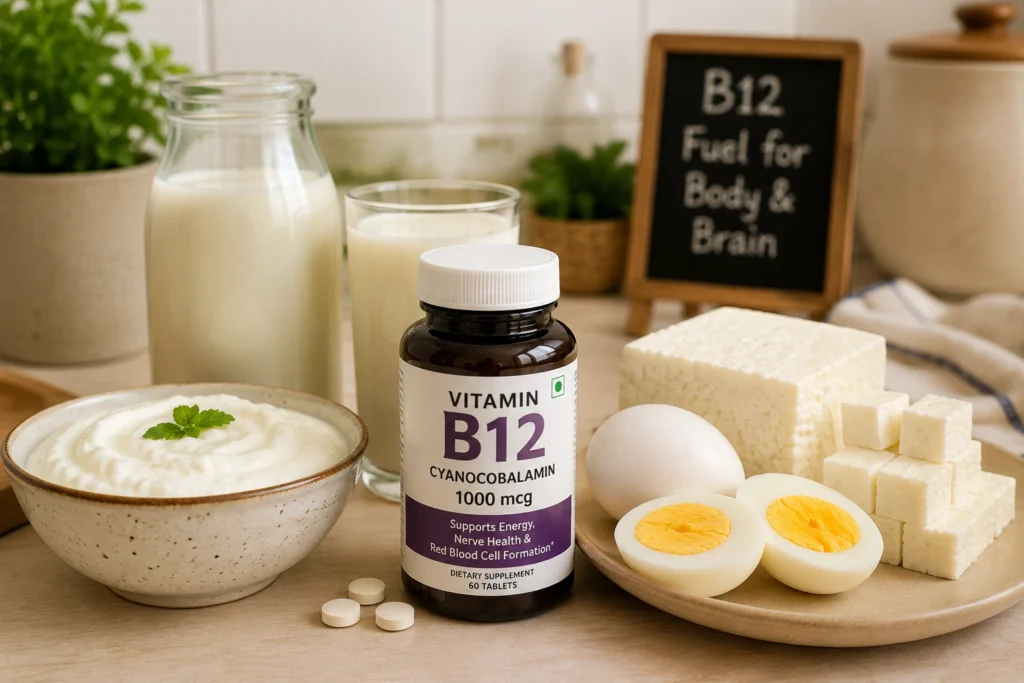
Spirulina and tempeh are not substitutes, no matter what wellness content online tells you. And the idea that a balanced vegetarian diet naturally covers B12 is a myth that has caused real, measurable harm.
The hard truth: most vegetarians, especially those who avoid eggs, need to supplement. A cyanocobalamin supplement taken weekly is cheap, evidence-backed, and the most reliable safety net available. Food sources are useful and should be prioritized, but they’re rarely sufficient on their own for strict vegetarians over the long term.
Get your B12 tested at your next blood panel. If it’s below 200 pg/mL, act immediately. If it’s between 200-300 pg/mL, start supplementing. If it’s above 400 pg/mL, your strategy is working — keep it up.
If you’re also dealing with low energy and want to understand the full picture, our article on 7 early signs of nutrient deficiency most Indians ignore covers how B12 interacts with iron, vitamin D, and magnesium in ways that make deficiencies hard to spot individually.
FAQs
Can vegetarians get enough B12 from food alone?
Technically yes — but practically, it depends heavily on how much dairy and eggs you consume and how consistently you eat them. Most studies show that strict vegetarians who avoid eggs struggle to maintain adequate B12 through food alone. Lacto-ovo vegetarians who eat two to three dairy servings and one to two eggs daily can come close, but cooking losses and absorption variability mean a low-dose supplement is still a smart safety net.
Is paneer a good source of B12 for vegetarians?
Paneer contains B12, but in smaller amounts than liquid milk — roughly 0.3-0.5 mcg per 100g. Since most people eat 50-100g of paneer at a time, it is a modest contributor, not a primary source. Paneer is valuable for protein, but do not rely on it as your main B12 strategy. Curd and milk deliver more per serving.
Does cooking destroy B12 in food?
Yes, to a meaningful degree. Heat degrades B12, and high-temperature cooking — boiling milk at high heat, for example — can reduce B12 content by 30-40%. This is one reason why blood B12 levels in vegetarians who eat dairy are often lower than their estimated dietary intake would predict. Minimize prolonged boiling where possible.
Is spirulina a good B12 source for vegetarians? The truth.
No. Spirulina contains pseudovitamin B12 — an analogue that is biologically inactive and actually competes with real B12 for absorption receptors. Using spirulina as your B12 strategy can make your lab results look marginally better while your functional B12 status worsens. This is well-documented in nutritional literature. Avoid using spirulina as a B12 substitute.
What is the best B12 supplement form for vegetarians in India?
Cyanocobalamin is the most stable and widely studied form, and it is what most generic B12 supplements contain. It is cheap, effective, and converts well inside the body. Methylcobalamin is another option — it is the active form — but evidence that it outperforms cyanocobalamin in healthy individuals is limited. For most vegetarians, a 500-1000 mcg cyanocobalamin supplement two to three times per week is adequate. For vegans or those with suspected absorption issues, daily use or a higher weekly dose may be warranted.
How do I know if I’m B12 deficient?
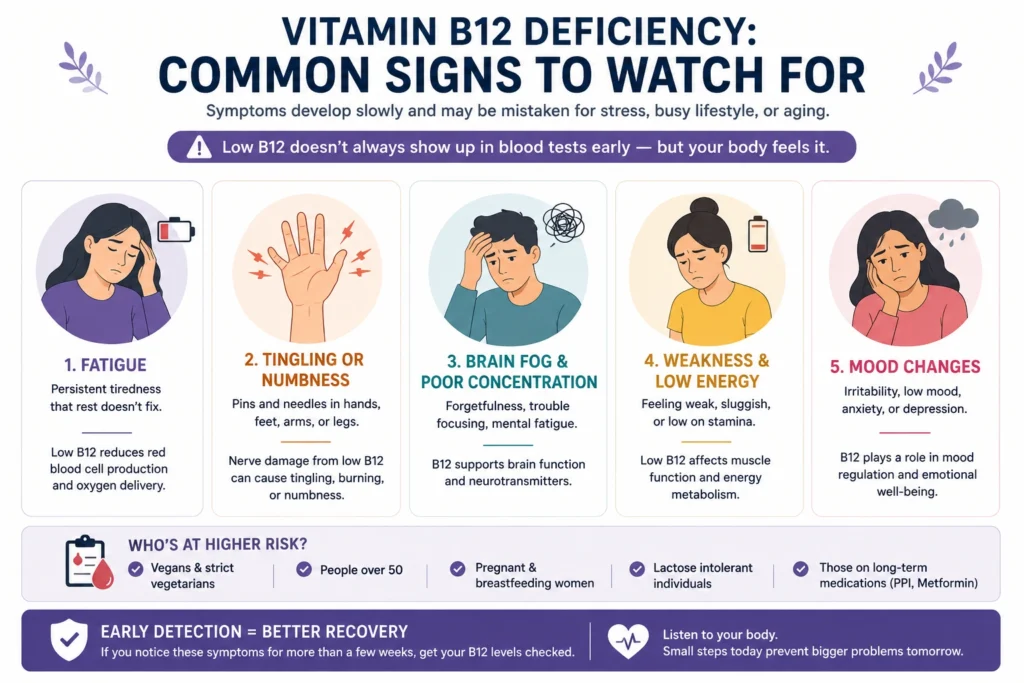
Get a serum B12 blood test — it is inexpensive and widely available in India. Normal range is typically 200-900 pg/mL. Values below 200 pg/mL indicate clear deficiency. Values between 200-300 pg/mL are considered borderline and worth addressing through supplementation. Symptoms like fatigue, tingling in hands or feet, brain fog, and difficulty concentrating can all suggest deficiency, but they overlap with many other conditions — the blood test is the only reliable way to know.
What to Do Next
Start with a B12 blood test if you have not had one recently — it costs under ₹500 at most diagnostic labs and takes the guesswork out of everything. Once you know where you stand, adjust your diet using this guide and add a supplement if needed. Small, consistent changes here genuinely matter for how you feel and how well your brain and body function years from now.