Does Creatine Cause Hair Loss? Science Says No (2025 Study)
Does creatine cause hair loss? A 2025 study finally settles the debate. Learn what the science actually says about DHT, genetics, and creatine safety.
Introduction: The Fear That Keeps Guys Away from the Best Supplement
Walk into any Indian gym. Ask the guy benching 100 kilos why he doesn’t take creatine. Nine times out of ten, you’ll hear the same answer.
“Bro, main bald ho jaunga.” (Bro, I’ll go bald.)
I get it. You’ve probably seen the same WhatsApp forwards I have. The ones claiming creatine fries your hair follicles and leaves you looking like your grandfather by age 30. The fear is real—and it’s keeping millions of men away from one of the most researched, effective, and affordable supplements in existence.
So let’s settle this once and for all.
Does creatine cause hair loss?
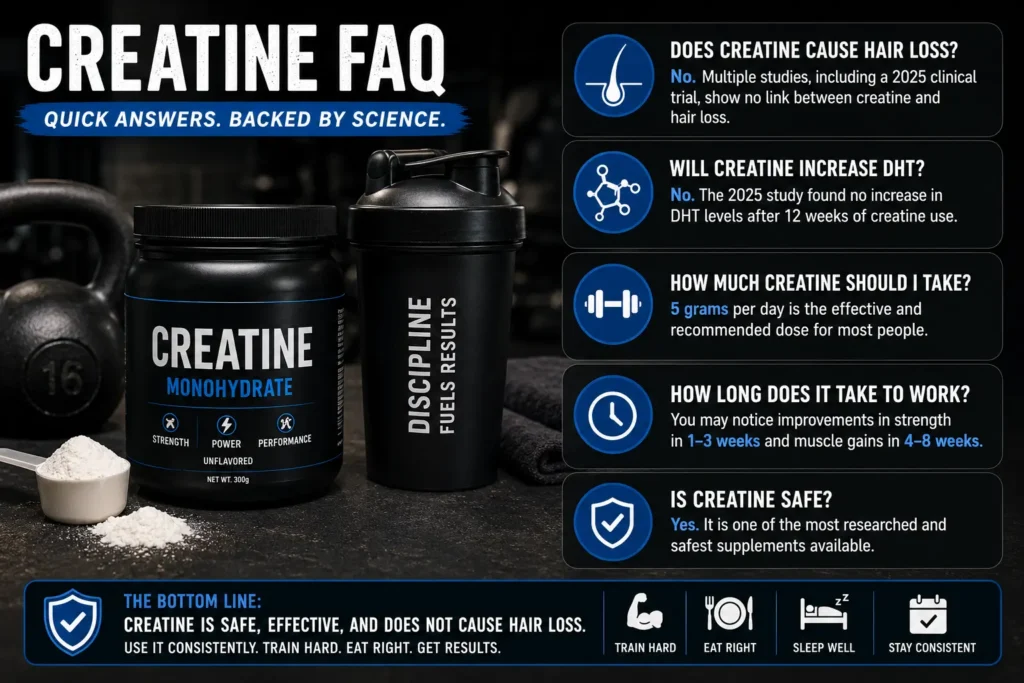
No. There is zero clinical evidence that creatine causes hair loss in healthy men.
A landmark 2025 study that directly looked at hair follicles found no difference in hair density, thickness, or growth between men taking creatine and those taking a placebo. The myth traces back to a single 2009 study that never even measured hair loss—only DHT levels.
In this article, I’ll walk you through where the fear started, what the research actually shows, and whether you should be worried. By the end, you’ll know exactly what to do.
Quick Answer: Does Creatine Cause Hair Loss?
No. Creatine does not cause hair loss.
Key facts you need to know:
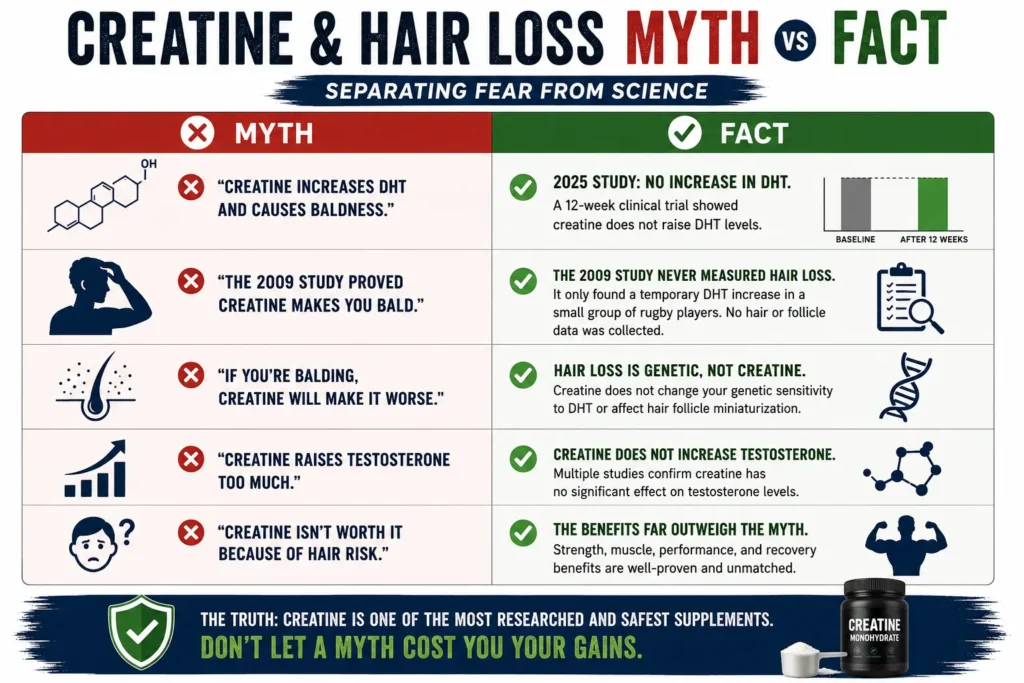
- The myth comes from a single 2009 rugby study that found a temporary DHT increase—but didn’t measure hair loss at all
- A 2025 randomized controlled trial directly measured hair density, follicle count, and thickness after 12 weeks of creatine use. Result: no effect on hair.
- DHT levels in the 2009 study remained within normal clinical limits
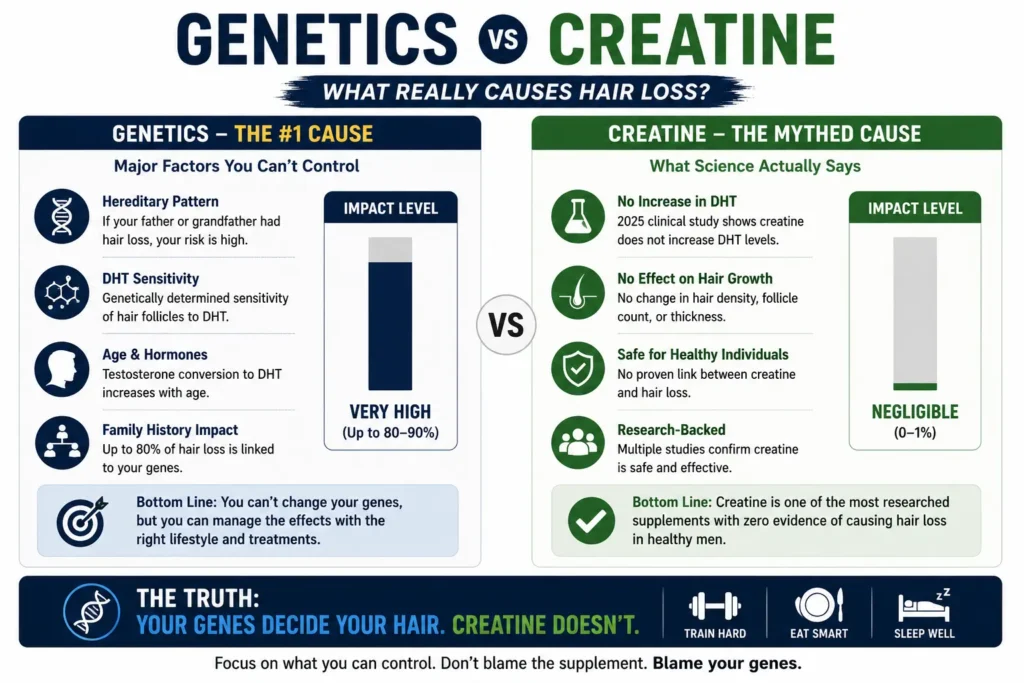
- Male pattern baldness is 99% genetics, not creatine
Bottom line: Creatine is safe for your hair. If you’re losing hair, blame your genes—not your supplement.
Why People Think Creatine Causes Hair Loss (The Origin Story)
Every myth has a starting point. This one dates back to 2009.
A group of researchers in South Africa gave 20 college rugby players a hefty dose of creatine—an aggressive loading phase of 25 grams per day for 7 days, followed by 5 grams daily for 14 days.
After three weeks, they measured the players’ hormone levels. The finding? DHT levels increased by 56% after the loading phase and remained 40% above baseline after maintenance. The DHT-to-testosterone ratio also went up by 36%.
Sounds scary, right?
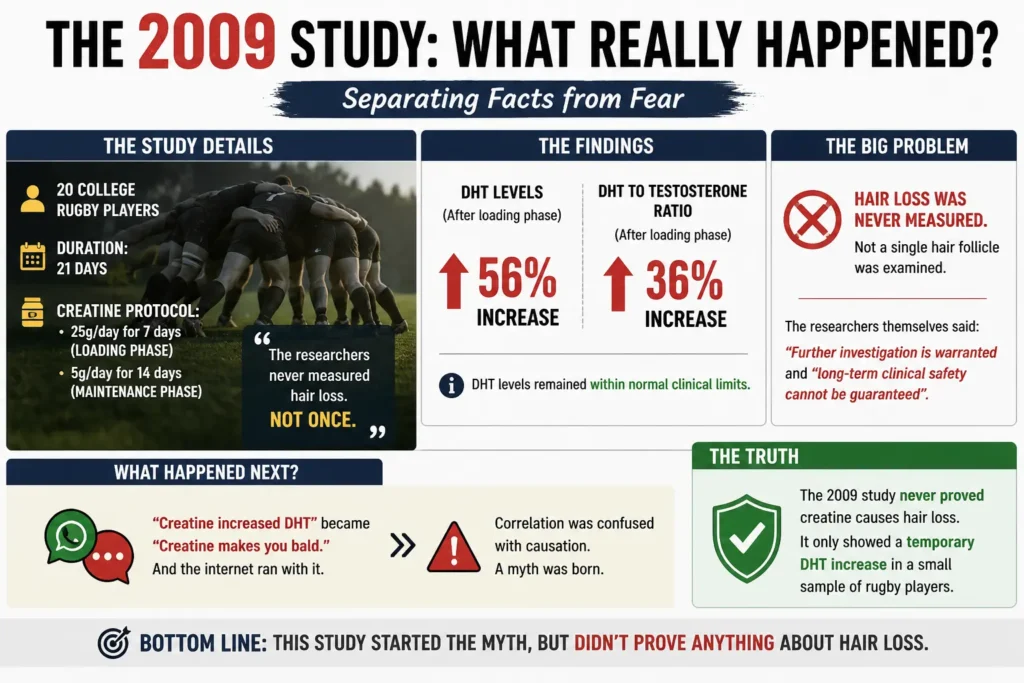
Here’s the problem: The study never measured hair loss. Not once. Not a single hair follicle was examined. The researchers themselves said: “Further investigation is warranted” and “long-term clinical safety cannot be guaranteed”.
But the internet doesn’t do nuance. “Creatine increased DHT” became “Creatine makes you bald.” And that message spread faster than a Delhi rumour in a WhatsApp group.
What Actually Is DHT? (And Why It Matters for Hair)
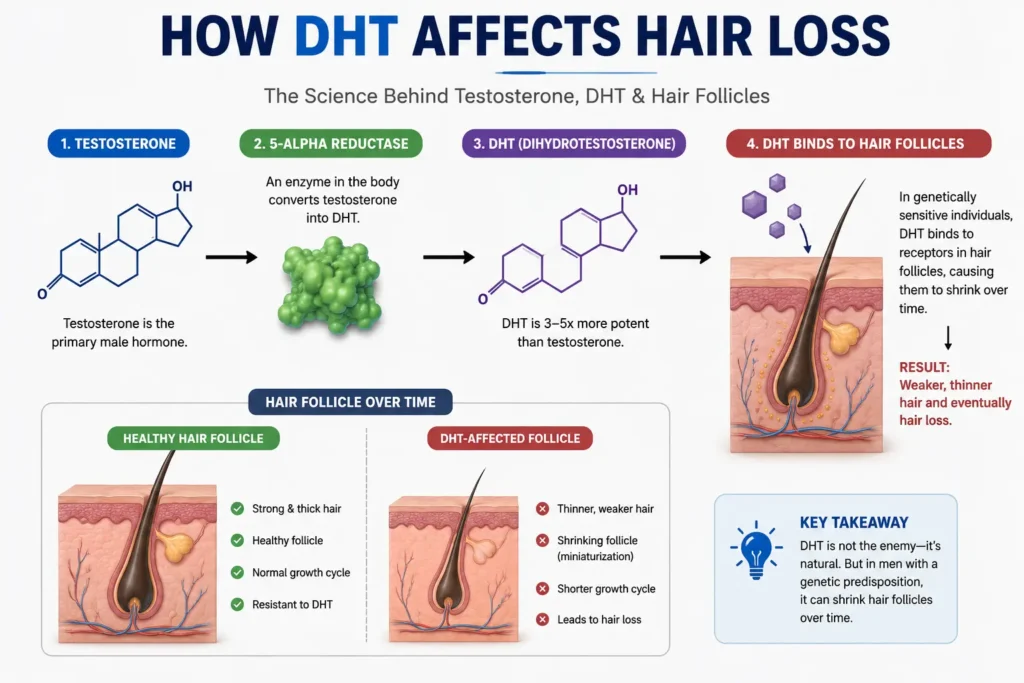
DHT (dihydrotestosterone) is a byproduct of testosterone. An enzyme called 5-alpha reductase converts about 5-10% of your testosterone into DHT.
Here’s the thing about DHT:
- DHT is three to five times more potent than testosterone
- It’s responsible for male characteristics—body hair, deep voice, muscle growth
- But in men with a genetic predisposition, DHT can attach to hair follicles and shrink them over time
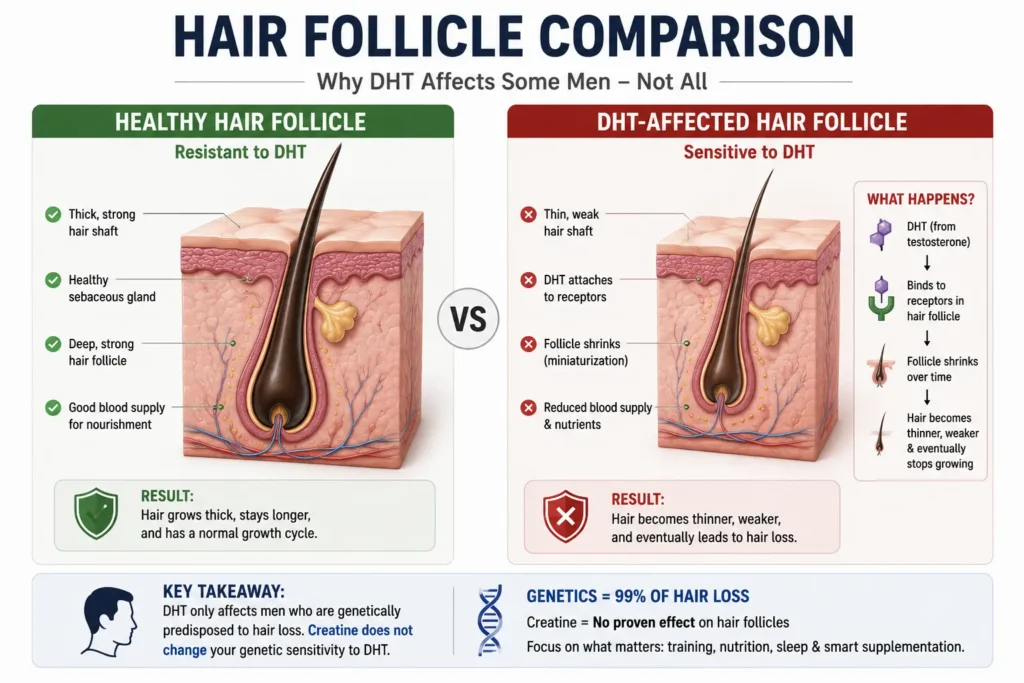
This is the critical part: Not every man’s hair follicles are sensitive to DHT. Male pattern baldness is caused by your genes. If your father and grandfather have full heads of hair, you’re probably safe. If they’re bald, you might follow the same path—regardless of creatine.
DHT only accelerates hair loss that was already going to happen. It doesn’t create baldness out of thin air.
The 2025 Study That Changes Everything
For 15 years, the creatine–hair loss debate was based entirely on that single 2009 rugby study. No one had actually looked at hair follicles.
Until 2025.
The Study Details
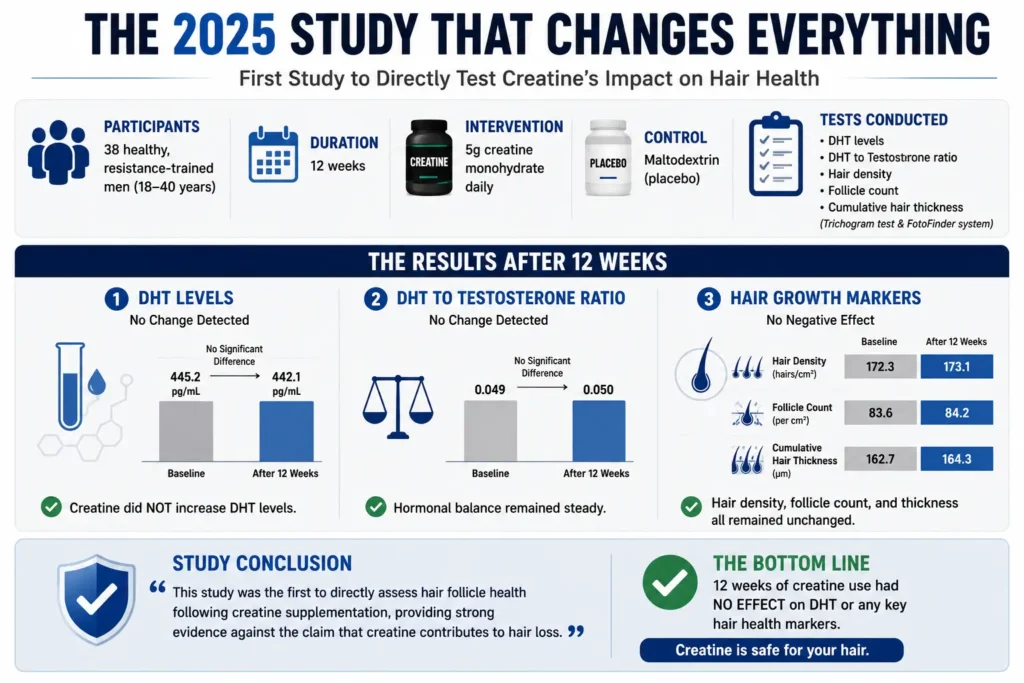
Researchers recruited 38 healthy, resistance-trained men between 18 and 40 years old. One group took 5 grams of creatine monohydrate daily for 12 weeks. Another group took a placebo of maltodextrin.
The researchers measured:
- Serum DHT levels
- DHT-to-testosterone ratio
- Hair density, follicle count, and cumulative hair thickness (using the Trichogram test and FotoFinder system)
The Results
After 12 weeks, here’s what they found:
- No change in DHT levels – Despite the 2009 concerns, creatine did not increase DHT
- No change in DHT-to-testosterone ratio – The hormonal balance remained steady
- No effect on hair growth markers – Hair density, follicle count, and thickness all stayed the same
The study’s conclusion is direct:
“This study was the first to directly assess hair follicle health following creatine supplementation, providing strong evidence against the claim that creatine contributes to hair loss.”
Myth vs Fact: Creatine and Hair Loss
Who Should Be Cautious About Hair Loss?
Let me be honest with you.
If you’re already losing your hair—receding temples, thinning crown, that classic MPB pattern—creatine won’t magically stop it. But it also won’t accelerate it beyond what your genes have already programmed.
The 2025 study included men with no hair loss at baseline. For men who are already balding, there’s no direct evidence. But given that creatine had zero effect on hair follicles in healthy men, it’s extremely unlikely to suddenly cause shedding.
Who should actually worry about hair loss?
| Factor | Level of Concern |
|---|---|
| Family history of baldness | High (this is the real cause, not creatine) |
| High baseline DHT | Moderate (but creatine doesn’t increase it in recent studies) |
| Using anabolic steroids | Very high (steroids affect hormones directly—creatine doesn’t) |
| Thyroid disorders | Moderate (separate medical issue) |
| Taking creatine | Negligible |
Creatine Benefits vs the (Non-Existent) Hair Risk
Let’s put this in perspective.
Creatine is one of the most researched supplements in history. Over 1,000 studies confirm its benefits:
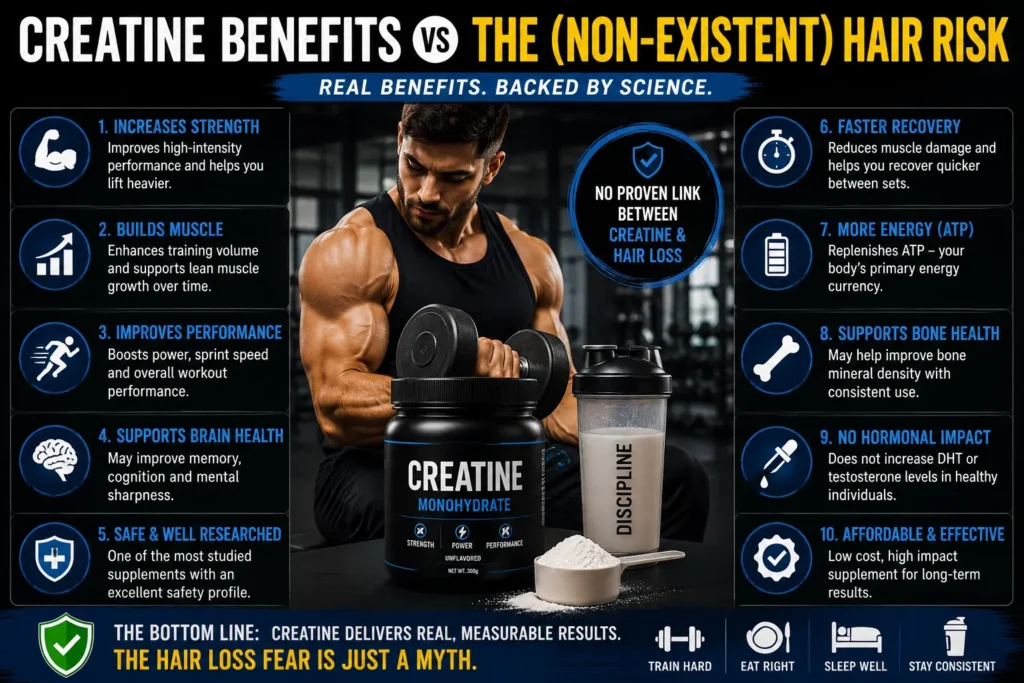
- Increases strength by 5-15%
- Accelerates muscle growth
- Improves high-intensity exercise performance
- Supports cognitive function (especially in vegetarians, who have lower baseline creatine stores)
And the “hair risk”? Based on a single small study that didn’t even look at hair, blown completely out of proportion.
If you’re in a calorie deficit or trying to lose weight, preserving muscle is hard enough. Why would you avoid a safe, effective supplement that helps you train harder and recover faster?
Read the best protein sources for muscle gain and fat loss in India to understand how creatine fits into a complete muscle-building plan.
Should You Stop Taking Creatine?
Direct answer: If your only reason for avoiding creatine is fear of hair loss—keep taking it.
Here’s my honest advice:
Keep taking creatine if:
- You have no family history of MPB
- You’ve been taking it for months with no visible thinning
- Your primary goal is muscle gain, strength, or performance
Consider stopping if:
- You have aggressive MPB and are extremely anxious about any theoretical risk (though no evidence supports this)
- You experience other side effects (bloating, digestive issues—these are real and happen to some people)
- Your doctor advises against it for unrelated medical reasons
Don’t stop because of:
- A WhatsApp forward you saw
- A 2009 study that didn’t even measure hair
- Gym bro “science” your trainer heard from his cousin
If you’re vegetarian or vegan, you might actually benefit more from creatine than meat-eaters, because your baseline levels are lower. Read best vegetarian protein sources in India for more on plant-based nutrition.
Final Verdict: The Bottom Line on Creatine and Hair Loss
Let me summarise this as clearly as I can.
Does creatine cause hair loss?
No. The scientific consensus across multiple studies—including the most recent 2025 RCT that actually measured hair health—shows that creatine has no effect on hair density, follicle count, or hormonal markers linked to balding.
The myth grew from a 2009 study that:
- Only looked at DHT
- Had a very short duration (3 weeks)
- Used an aggressive loading protocol that most people don’t follow
- Never measured hair loss at all
The 2025 study directly looked at hair follicles in 38 men over 12 weeks. Result? No difference between creatine and placebo.
If you’re worried about hair loss, look at your family history. That’s the real culprit—not your supplement.
*”Creatine does NOT cause hair loss. This 2025 study should finally put the myth to bed. Creatine is one of the most well-researched, effective, and safe supplements out there for building muscle, improving strength, and even enhancing cognitive performance.”* – Dr. Jim Stoppani
Frequently Asked Questions (Long-Tail)
1. Does creatine increase DHT enough to cause hair loss?
According to the 2025 study—no. The study found “no change in DHT levels” after 12 weeks of daily creatine use. The 2009 DHT increase was temporary and remained within normal clinical limits. And again: higher DHT doesn’t automatically mean hair loss. Genetics matter far more.
2. Can creatine make you bald if you’re already losing hair?
Hair loss is primarily driven by genetics, not creatine. If you’re already balding, it’s because your hair follicles are sensitive to androgens. There’s no evidence that creatine speeds up this process. Blame your grandfather, not your supplement.
3. Is creatine safe for long-term use?
Yes. Creatine is one of the most studied supplements in history. A 2025 systemic review confirmed it is a “safe and effective intervention for improving certain aspects of sport, exercise performance, and health across the lifespan.” Hundreds of studies have found no long-term safety issues.
4. What are the real side effects of creatine?
The actual side effects—much more common than any hair concerns—include:
- Mild bloating or water retention (temporary, usually during loading phase)
- Digestive discomfort (if you take too much at once)
- Cramping in rare cases (usually due to inadequate hydration)
Most people experience none of these with standard 3-5g daily dosing.
5. Which protein powder works best with creatine?
If you’re taking creatine for muscle growth, pairing it with a high-quality protein powder makes sense. Read whey vs plant protein: which is better? to choose the right protein for your goals.
6. Should I cycle creatine or take it continuously?
You don’t need to cycle creatine. The most efficient protocol is a daily maintenance dose of 3-5 grams, taken consistently. A loading phase (20g/day for 5-7 days) can saturate muscles faster, but it’s not necessary and not recommended if you’re concerned about DHT (though the DHT increase in the 2009 study happened during a heavy loading phase).
Ready to Build Muscle Without the Fear?
You now know the truth. Creatine is safe. You don’t need to avoid one of the most effective supplements because of a myth based on outdated, incomplete research.
But creatine isn’t magic. The real results come from consistent training and proper nutrition.
If you want to take your fitness journey to the next level, here are two guides to start with:
👉 Best Protein Sources for Muscle Gain and Fat Loss in India – The complete food-first guide to building muscle.
👉 10 Best Workouts for Home – No gym? No problem. Build muscle anywhere.
👉 Can Yeast Protein Replace Whey? – A deep dive into the new protein on the block.
Drop a comment below: Did you believe the creatine-hair loss myth? Were you avoiding creatine because of it? Share your experience—it might help someone else make an informed decision.
And if this article helped you separate fact from fear, share it with a friend who’s still scared of going bald from their pre-workout. Let them know the truth.
Creatine lo. Gains lo. Balding se daro nahi. (Take creatine. Get gains. Don’t fear balding.) 🌟
Disclaimer: This information is for educational purposes only. Always consult a qualified healthcare provider before starting any new supplement, especially if you have pre-existing medical conditions.