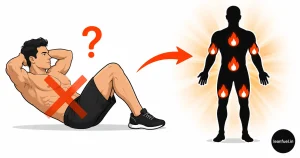
Skipping rope burns roughly 10 to 16 calories per minute, which is significantly more than walking or moderate cycling. For weight loss, it works extremely well — but only if you use it correctly and pair it with a calorie deficit. Most people in India pick up a rope, jump for five minutes, get tired, and quit. That is not a workout problem. That is a planning problem. This article covers exactly how to use skipping rope for real fat loss, what mistakes to avoid, and whether it actually fits into an Indian lifestyle with limited time, space, and budget.

The Short Answer
- Yes, skipping rope is very effective for weight loss because it burns calories faster than jogging or brisk walking while also improving cardiovascular fitness.
- A 70 kg person burns approximately 350 to 450 calories in 30 minutes of moderate skipping — that is enough to create a meaningful deficit without diet changes.
- Skipping rope does not spot-reduce belly fat. No exercise does. Fat loss happens everywhere, and skipping helps create the calorie deficit needed for that.
- For Indians specifically, skipping rope works well because it requires no gym membership, no expensive equipment, and can be done in a small balcony or terrace.
- The biggest reason skipping fails for weight loss is inconsistency — doing it twice a week for ten minutes will not move the needle. Four to five sessions of 20–30 minutes is where results actually appear.
Why Most Indians Give Up on Skipping Too Soon
You have probably seen someone in your colony jumping rope for a week and then stopping. That is not laziness. It is poor execution. Most beginners start too fast, jump too high, and use the wrong rope. Their calves burn after two minutes. Their shins ache. They assume skipping is just not for them.
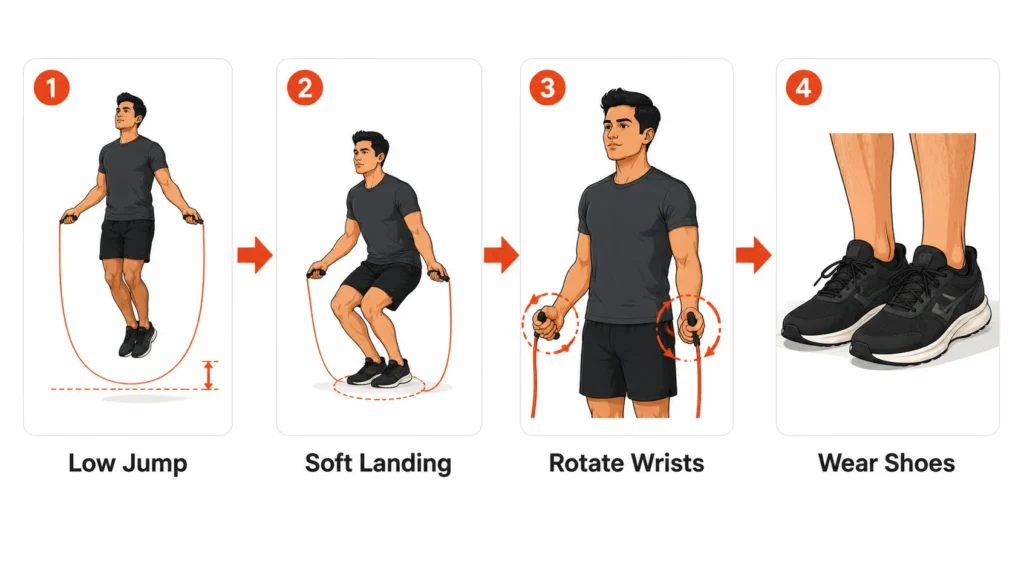
The truth is different. Skipping is a skill, not just a workout. Your body needs two to three weeks to adapt to the impact, coordination, and rhythm. Once that adaptation happens, skipping becomes as natural as walking. Indian conditions add two specific challenges: heat and hard floors. Jumping on bare tiles or concrete in 35°C weather increases joint stress and fatigue. A simple mat or wearing cushioned shoes fixes both problems. Most people never make these small adjustments, so they quit before the real benefits start.
How Skipping Actually Burns Fat — The Numbers
Your body burns calories constantly. Exercise increases that burn. Skipping rope is classified as a vigorous-intensity activity, meaning it burns more than 6 METs (metabolic equivalents). For comparison, walking at 4 km per hour burns about 3 METs. Running at 8 km per hour burns about 8 METs. Skipping at a moderate pace of 80–100 jumps per minute sits between 10 and 12 METs.
Here is what that means in real calories for an average Indian body weight:
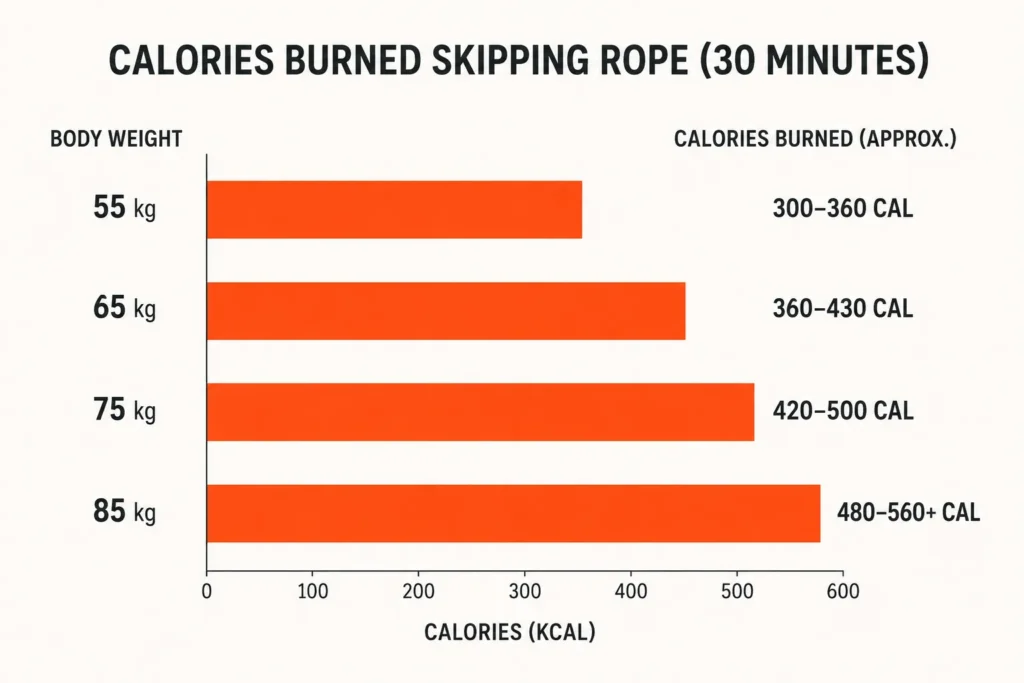
| Body Weight | 10 Minutes Skipping | 20 Minutes Skipping | 30 Minutes Skipping |
|---|---|---|---|
| 55 kg | 90–110 calories | 180–220 calories | 270–330 calories |
| 65 kg | 110–135 calories | 220–270 calories | 330–405 calories |
| 75 kg | 130–160 calories | 260–320 calories | 390–480 calories |
| 85 kg | 150–185 calories | 300–370 calories | 450–555 calories |
These numbers assume continuous skipping with brief pauses. The actual burn depends on intensity, rest periods, and your fitness level. But even the lowest estimate — 90 calories in ten minutes — is impressive for a zero-equipment activity.
One 30-minute skipping session burns roughly the same as two whole rotis or one plate of vegetable pulao. That means skipping can offset small dietary indulgences without forcing extreme restriction. But here is the catch: skipping does not work if you eat back those calories. A samosa (roughly 150–200 calories) wipes out fifteen minutes of skipping. A 500 ml sweet lassi (roughly 250–300 calories) wipes out an entire 30-minute session. Skipping creates the deficit. Your food choices protect it.
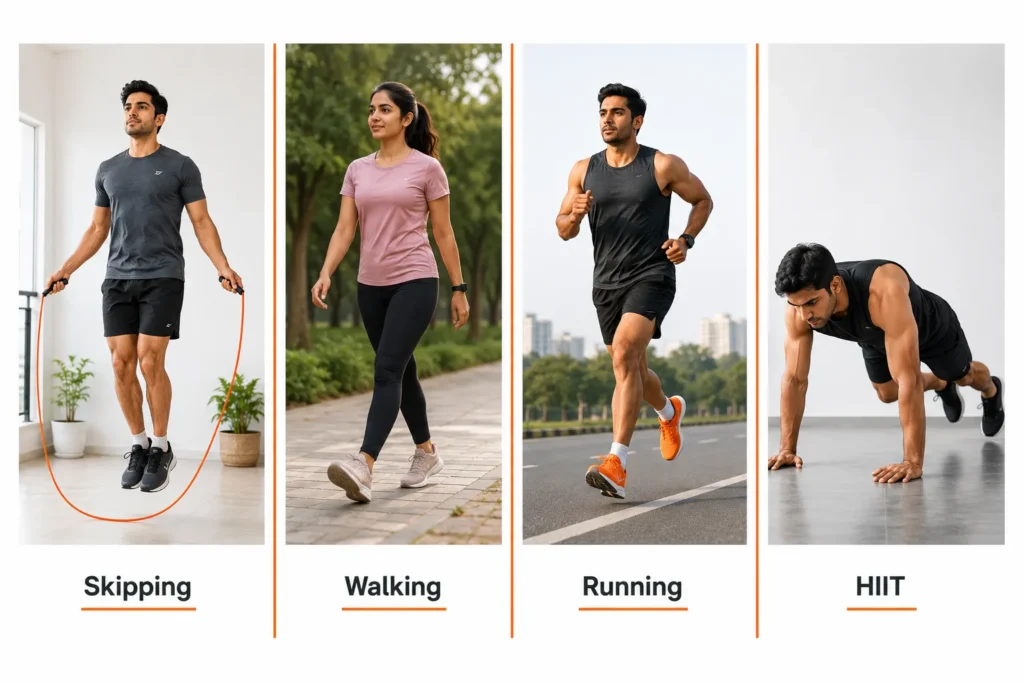
Skipping vs Walking vs Running vs HIIT — What Actually Works for Indians
Walking: The most sustainable but slowest
Walking 10,000 steps burns roughly 300–400 calories for an average person. That takes over 90 minutes. Skipping burns the same calories in 20–25 minutes. For Indians with long commutes and family responsibilities, time efficiency matters. Walking is excellent for recovery days or for people with joint issues. But for pure fat loss speed, skipping wins on time alone.
Running: Higher impact, harder to sustain
Running at 8 km per hour burns roughly 10–12 calories per minute — almost identical to skipping. But running requires space, good shoes, and consistent weather. In Indian cities, finding a safe 5 km running route is genuinely difficult. Pollution, traffic, stray dogs, and uneven footpaths make running a hassle. Skipping happens in your own home. That consistency advantage is massive.
HIIT (High-Intensity Interval Training): Similar benefits, different structure
Skipping naturally works as HIIT — 30 seconds fast, 15 seconds rest, repeated. That pattern raises your heart rate fast and keeps it elevated even after you stop (excess post-exercise oxygen consumption, or EPOC). A 15-minute skipping HIIT session burns nearly as many total calories as 30 minutes of steady skipping, plus additional fat burning for the next hour. Most Indians can fit 15 minutes into their morning routine far more easily than 45 minutes at a gym.
Verdict: Skipping rope is the most time-efficient cardio option for most Indians, provided you have basic coordination and no existing knee or ankle injuries.
| Activity | Calories per 30 min (70 kg person) | Equipment Cost (India) | Space Needed | Joint Impact | Best For |
|---|---|---|---|---|---|
| Skipping Rope | 350–480 | ₹150–500 for rope, ₹0 for mat (optional) | 6×6 ft area | Moderate (with shoes) | Time-crunched fat loss |
| Brisk Walking | 120–160 | ₹0 | Any open area | Low | Beginners, recovery days |
| Jogging (8 km/h) | 280–350 | ₹800–2000 for shoes | 500m+ clear path | High (knees, shins) | Outdoor lovers |
| Cycling (moderate) | 240–300 | ₹5000+ for basic cycle | Road space | Low | Cross-training |
| Running on spot | 200–260 | ₹0 | 4×4 ft area | Moderate | Absolute beginners |
| Burpees (HIIT style) | 400–500 | ₹0 | 4×4 ft area | High (wrists, shoulders) | Advanced fat loss |
How Skipping Rope Changes Your Body Beyond Calories
When you jump rope, your body adapts in four specific ways that directly support weight loss.
First, your heart rate climbs quickly into the fat-burning zone (roughly 65–80 percent of your maximum heart rate). That zone is where your body pulls more energy from fat stores rather than carbohydrates. Skipping gets you there faster than walking or slow jogging.
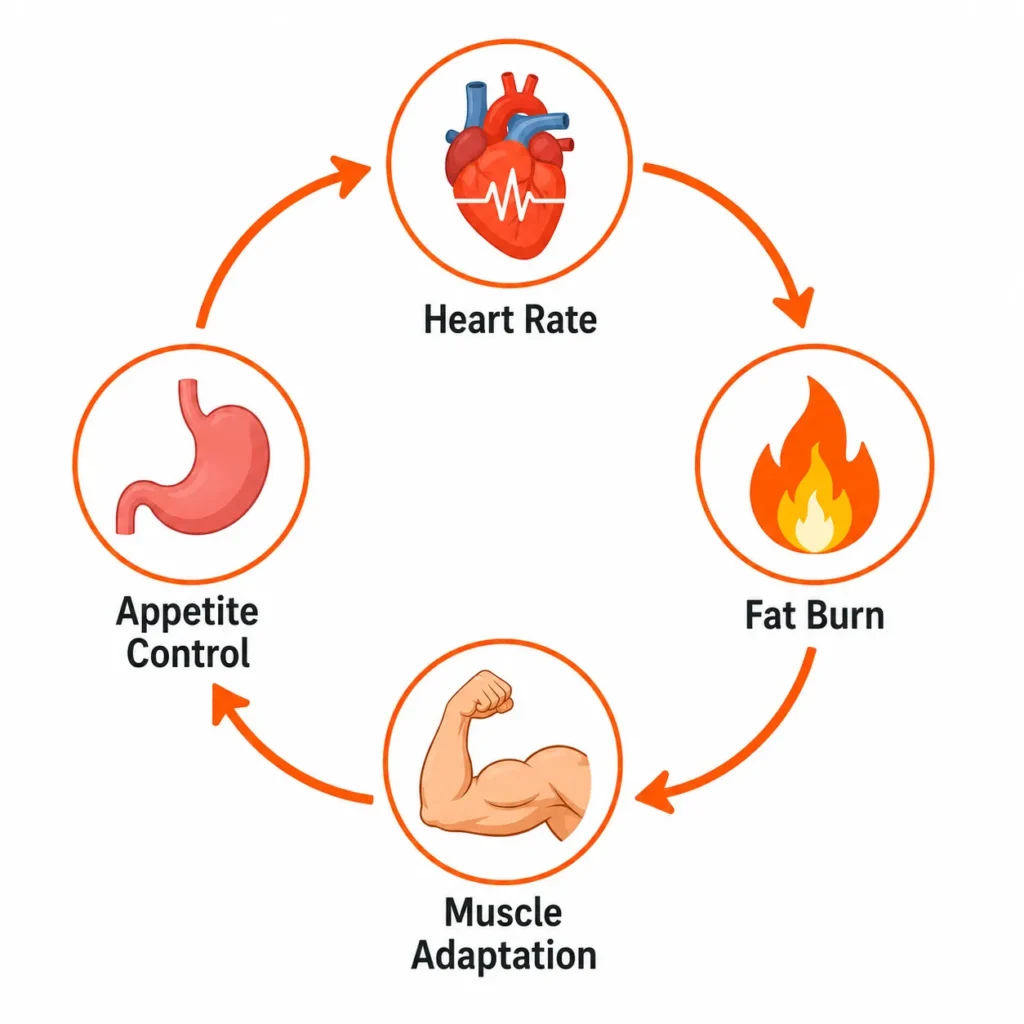
Second, skipping improves your anaerobic capacity. That means your muscles learn to work harder without oxygen for short bursts. Over weeks, this raises your resting metabolic rate. A higher resting metabolism means you burn more calories while sleeping, working, or watching TV. Studies consistently show that people who train with intervals burn more total daily calories than steady-state cardio alone — even when exercise time is the same.
Third, skipping strengthens your calves, shins, feet, and core. Stronger lower legs improve running form and reduce injury risk. A stable core helps you maintain posture during all other exercises. This is not direct fat loss, but it enables you to train harder and more consistently.
Fourth, skipping produces a hormonal response that suppresses appetite for some people. High-intensity work raises peptide YY and GLP-1 (the same hormones targeted by weight loss drugs like Ozempic, though to a much lesser degree). Many people find they are less hungry for an hour after skipping. That is a behavioral advantage you will not get from walking.
Practical timing recommendation: Skip in the morning on an empty stomach or two hours after a meal. Morning sessions burn stored glycogen and shift your body toward fat oxidation for the next few hours. Evening sessions are fine but should not be within 90 minutes of sleeping — the adrenaline can disrupt sleep quality.
What the Research Says
Research consistently shows that skipping rope produces significant improvements in body composition. A 2019 meta-analysis found that six to twelve weeks of regular rope skipping reduced body fat percentage by an average of 3 to 5 percent in previously inactive adults. Another study comparing skipping to jogging found nearly identical calorie burn, but skipping produced better improvements in coordination and bone density.
The World Health Organization recommends at least 150 minutes of moderate or 75 minutes of vigorous activity per week for general health. Skipping qualifies as vigorous activity, so 15 minutes per day, five days per week meets the WHO target. Meeting that target is associated with reduced risk of heart disease, diabetes, and obesity — all highly relevant for Indian populations with rising metabolic syndrome rates.
A realistic reality check: controlled studies show averages. Real life shows variance. Some people lose 2 kg of fat in six weeks of skipping. Others lose nothing because their diet cancels out the deficit. The research does not lie, but it also does not account for the extra chapati, the office biscuit tray, or the weekend biryani. Skipping is a tool, not a magic bullet.
Side Effects and What to Watch Out For
Skipping rope is safe for most healthy adults, but it has real downsides.
Shin splints and calf soreness are the most common complaints, especially in the first two weeks. This happens when you jump too high or land too hard. The fix: jump only one to two centimeters off the ground. Your rope should barely clear your feet. If your knees are bending excessively, you are jumping too high.
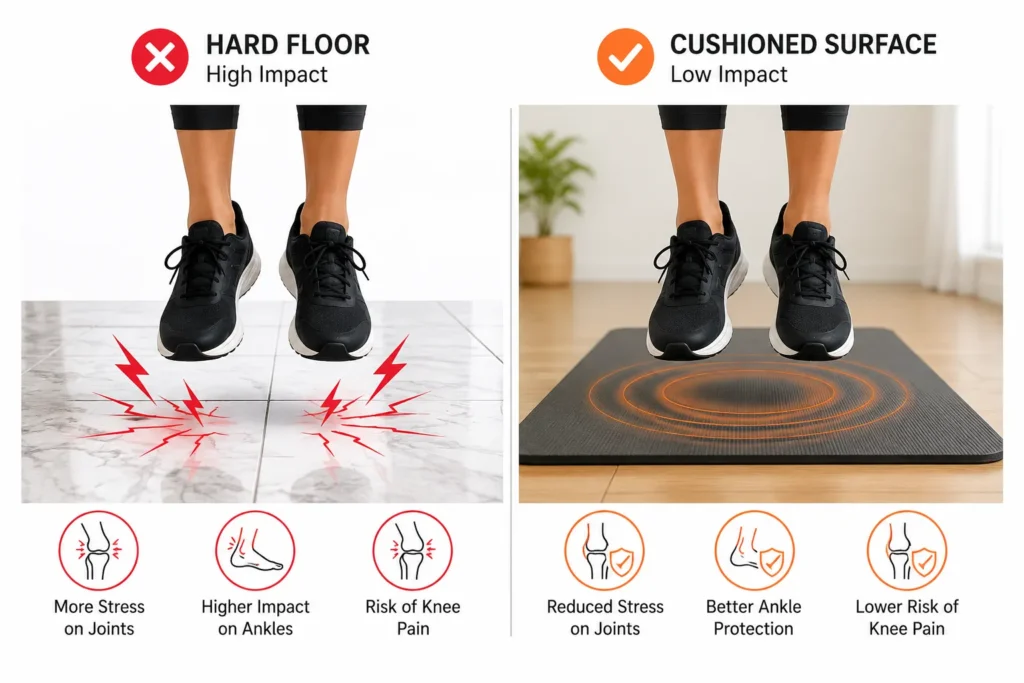
Knee and ankle stress increases on hard surfaces. Indian homes often have marble, tile, or concrete floors. Jumping on these without cushioning transmits shock directly to your joints. Solution: use a yoga mat, an old carpet, or buy a skipping mat for ₹300–500. Better yet, wear cushioned sports shoes, not bare feet or sandals.
Who should avoid or modify skipping: People with existing knee arthritis, severe patellofemoral pain, Achilles tendinitis, or acute ankle sprains should not start with skipping. Pregnant women in second or third trimester should avoid due to balance and pelvic floor pressure. Anyone with uncontrolled high blood pressure should consult a doctor before high-intensity work.
For Indian readers specifically: Heat exhaustion is a real concern if you skip in a non-AC room during summer. Keep a fan on, drink water before and after, and skip during cooler morning or late evening hours. Also, cheap plastic ropes from local markets break within days. Spend ₹300–600 on a PVC or beaded rope from Decathlon or Amazon. The steel cable ropes with plastic coating last years.
Who Should Actually Use Skipping Rope for Weight Loss?
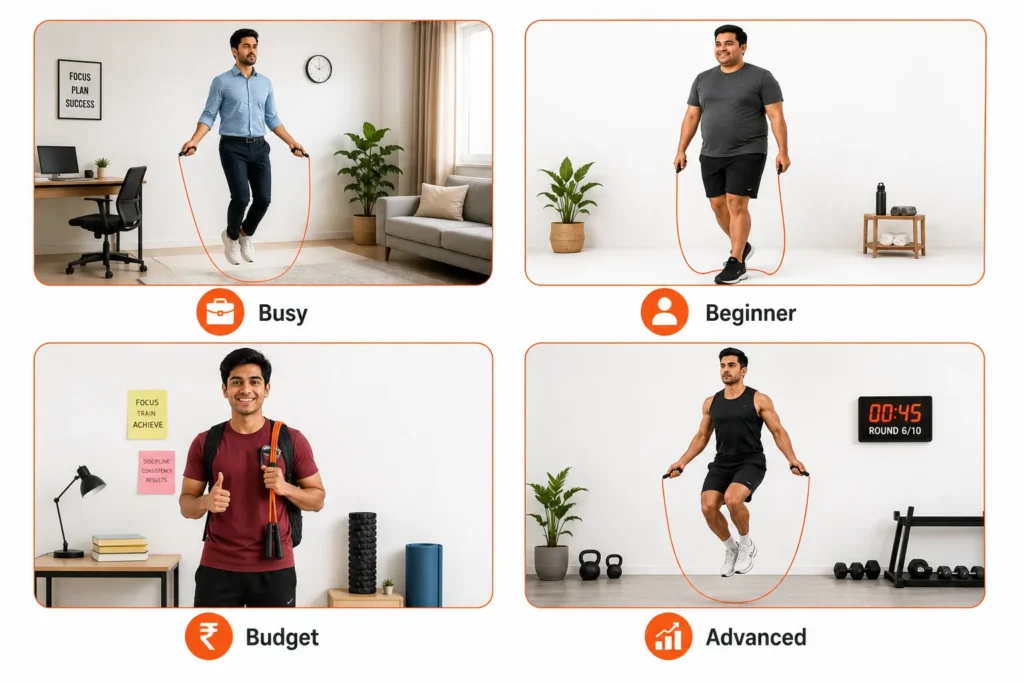
If your goal is pure fat loss and you have less than 30 minutes daily
Skipping is your best home option. Do 20 minutes of interval skipping: 40 seconds fast, 20 seconds rest, repeat for 20 minutes. That burns roughly 300 calories and raises your metabolism for hours. Combine this with a protein-rich breakfast and you have a powerful fat loss protocol.
If you are a complete beginner who gets winded in 30 seconds
Start with walking in place for 1 minute, skip for 20 seconds, repeat. Do this for 10 minutes total. Add 10 seconds to the skipping portion every week. After four weeks, you will be skipping for one minute continuously. Do not compare yourself to Instagram reels. Those people have been jumping for years.
If you are on a tight budget (₹500 or less for equipment)
Buy a basic PVC jump rope from a local sports store for ₹150–250. Use shoes you already own. Skip on a carpet or mat you already have. That is literally all you need. No gym membership, no trainer fees, no supplements. For a full weight loss plan that works with an Indian kitchen and budget, read our budget Indian diet plan for weight loss under ₹200/day.
If you already have knee pain or obesity (BMI over 32)
Do not start with skipping. The impact is too high. Start with stationary walking or recumbent cycling. Once you lose 5–10 kg and strengthen your legs, you can reintroduce skipping slowly. Your joints will thank you.
If you want to build a complete home workout routine
Skipping works perfectly as a warm-up (5 minutes) or as a finisher (10 minutes after strength training). For a full routine without a gym, check our 10 best workout for home guide.
The Bottom Line

Skipping rope absolutely works for weight loss. It burns calories faster than almost any other home exercise, costs practically nothing, and fits into small Indian apartments. But it is not magic. A 30-minute session burns off roughly two samosas. If you skip for half an hour and then eat three samosas, you are going backwards.
The people who succeed with skipping treat it as a non-negotiable habit, not a punishment. They skip four or five days per week. They track their time and intensity. They eat reasonably — not perfectly, but reasonably. And they give their bodies three weeks to adapt before judging results.
If you want to lose weight without spending hours walking or paying for a gym, skipping rope is your answer. Get a rope. Start with five minutes. Add time slowly. Eat one less roti or chapati daily. Come back in three months and see what changed. That is the plan. That is the truth. And it works.
For a deeper dive into building a full fat loss system beyond just cardio, read our 3 pillars of a sustainable fat loss plan. And if you prefer walking over skipping but want real results, how to lose fat by walking covers exactly what works.
People Also Ask
How many minutes of skipping should I do daily for weight loss?
For noticeable fat loss, aim for 20 to 30 minutes of skipping most days. That is the sweet spot where calorie burn is meaningful but recovery is manageable. Beginners should start with 10 minutes and add 2 minutes every week. Going from zero to 30 minutes overnight will cause shin splints and frustration.
Is skipping better than running for belly fat loss?
No exercise targets belly fat specifically. Fat loss happens systemically. However, skipping burns as many calories as running in half the time, and time efficiency is often the deciding factor for consistency. If you actually do skipping four times a week but would only run once, skipping wins for you.
Can I skip rope if I have flat feet?
Yes, but you need good shoes with arch support. Skipping barefoot on flat feet increases risk of plantar fasciitis. Buy basic sports shoes with cushioned insoles. Also, land softer and jump lower than normal. If pain persists, switch to a lower-impact activity like stationary cycling.
Does skipping increase height?
No. Skipping rope does not increase height in adults. Height is determined by genetics and nutrition during growth years. The myth comes from the fact that skipping improves posture, which can make you look taller. Children who skip get the same bone density benefits as any weight-bearing exercise, but their height will follow their genetic pattern.
What is the right skipping rope length for an average Indian height?
Stand on the middle of the rope. Pull the handles up. The handles should reach your armpits. For someone 5’5″ to 5’8″ (165–173 cm), an 8 to 9 foot rope works. For 5’9″ to 6′ (175–183 cm), a 9 to 10 foot rope. Most adjustable ropes sold in India cover all heights. A rope that is too long makes you trip. Too short forces you to hunch.
Why do my calves hurt so much after skipping for two minutes?
Because you are jumping too high and landing on your toes with stiff ankles. Proper skipping uses a tiny hop — just enough for the rope to pass. Land softly, roll from toe to midfoot, and keep knees slightly bent. Stretch your calves after every session. The pain fades after two weeks of consistent practice.
Can skipping rope damage my knees permanently?
Not if you do it correctly. Permanent knee damage comes from repeated high impact on hard surfaces without recovery or from existing joint problems. Skipping on a mat with cushioned shoes, keeping jumps low, and taking rest days between sessions is safe for healthy knees. If you hear crunching or feel sharp pain, stop and see a physiotherapist.