Introduction: The Protein Powder Confusion
Walk into any supplement store in Delhi or Mumbai. You’ll see shelves stacked with whey tubs. Right next to them, plant protein options are creeping in—soy, pea, even yeast.
Ask the shopkeeper which one is best. You’ll get a different answer depending on what makes him the most profit.
Ask your gym trainer. He’ll probably say whey.
Ask your vegan friend. Plant protein, obviously.
So who’s right?
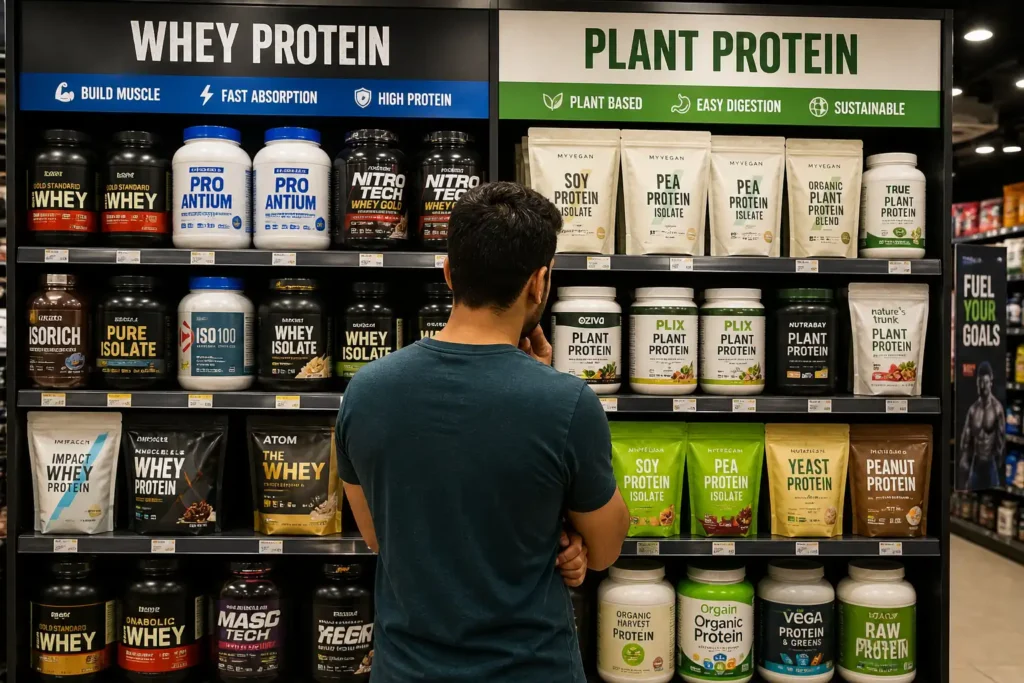
Here’s my direct answer: Whey is still the gold standard for muscle growth. But plant protein—specifically soy and yeast—comes surprisingly close. And for some people, plant protein is actually the better choice.
The “whey vs plant protein which is better” debate isn’t about good versus bad. It’s about matching the protein to your body, your budget, and your goals.
In this guide, I’ll break down five protein types: whey, soy, pea, yeast, and peanut. No supplement company bias. Just the science, plus practical advice for regular Indians who don’t want to waste money.
Quick Answer: Whey vs Plant Protein
Whey protein is better for rapid muscle growth (higher leucine, faster absorption). But high-quality plant proteins like soy and yeast are excellent alternatives—especially if you’re lactose intolerant, vegan, or want a protein with fiber.
Ranking by goal:
| Goal | Best Protein | Why |
|---|---|---|
| Maximum muscle growth | Whey | Highest leucine, fastest absorption |
| Fat loss (satiety) | Soy or pea | Fiber keeps you fuller |
| Vegan / plant-based | Soy or yeast | Complete amino profile |
| Digestive issues | Plant protein (any) | No lactose, no bloating |
| Budget | Soy or peanut (in food form) | Cheaper per gram of protein |
| Taste & mixability | Whey | Creamy, neutral taste |
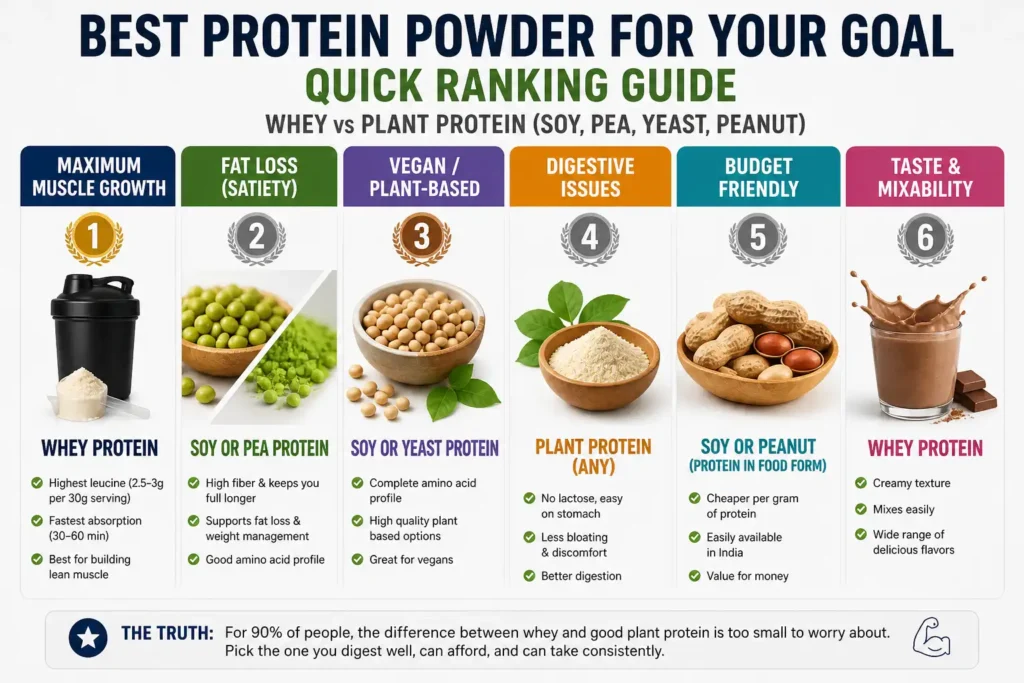
The truth: For 90% of people, the difference between whey and good plant protein is too small to worry about. Pick the one you digest well and can afford consistently.
What Is Whey vs Plant Protein? (Simple Explanation)
Whey Protein
Whey is the liquid part of milk that separates during cheese making. It’s then filtered, dried, and turned into powder.
Types of whey:
- Concentrate (WPC): 70-80% protein, some lactose and fat. Cheap. Good enough for most.
- Isolate (WPI): 90%+ protein, very little lactose. More expensive. Better for fat loss or lactose sensitivity.
- Hydrolysate (WPH): Pre-digested. Fastest absorption. Expensive. You probably don’t need it.
Plant Protein
Plant proteins are extracted from various sources:
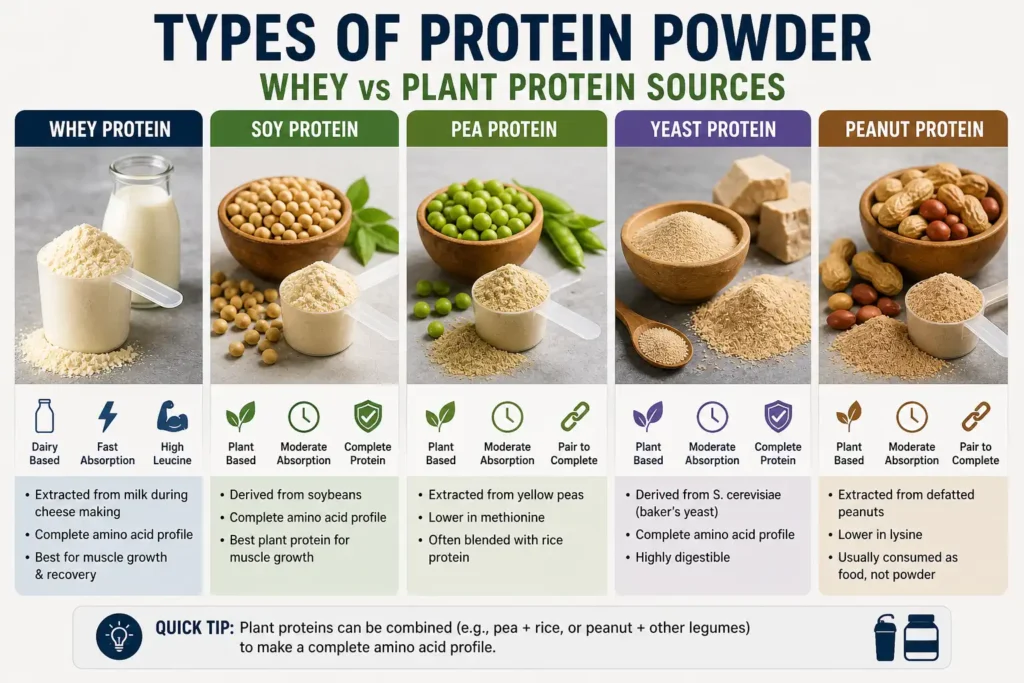
- Soy protein isolate: From soybeans. Complete amino profile. Very close to whey.
- Pea protein isolate: From yellow peas. Slightly lower in methionine (an essential amino acid). Usually blended with rice protein to fix this.
- Yeast protein: From S. cerevisiae (baker’s yeast). Complete profile. Newer but promising.
- Peanut protein: From defatted peanuts. Incomplete on its own. Usually used as a food, not a powder.
Protein Quality Comparison (The Critical Section)
This is where most “whey vs plant protein” articles get vague. Let’s get specific.
The Metrics That Matter
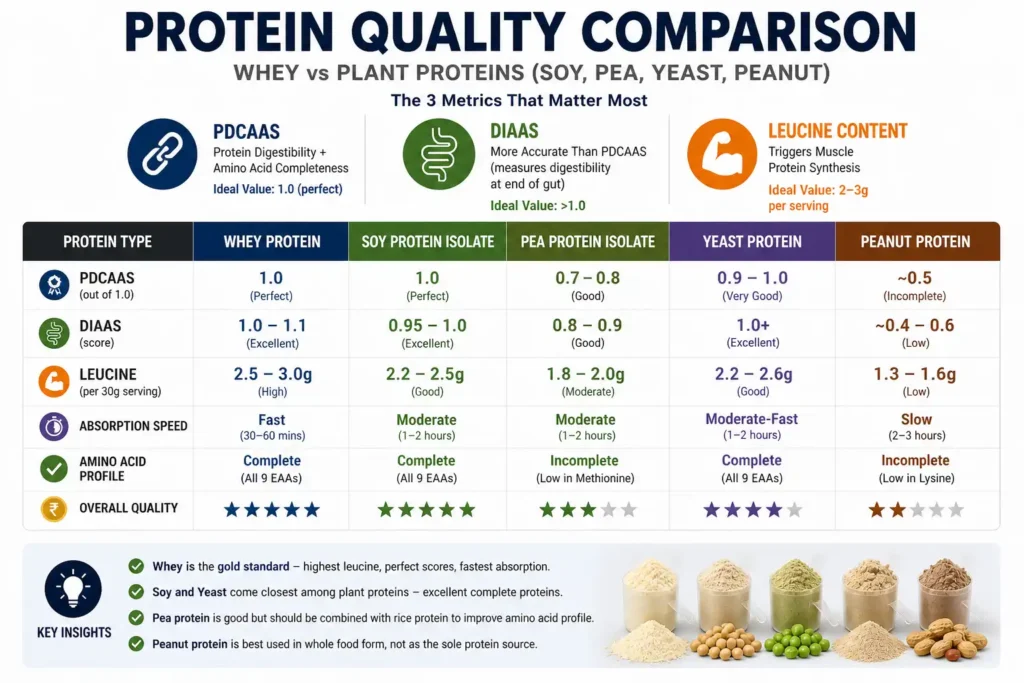
| Metric | What It Measures | Ideal Value |
|---|---|---|
| PDCAAS | Protein digestibility + amino acid completeness | 1.0 (perfect) |
| DIAAS | More accurate than PDCAAS (measures digestibility at end of gut) | >1.0 is excellent |
| Leucine content per serving | Triggers muscle protein synthesis | Minimum 2-3g per meal |
Whey Protein
| Property | Value |
|---|---|
| PDCAAS | 1.0 (perfect) |
| DIAAS | ~1.0-1.1 (excellent) |
| Leucine per 30g (typical scoop) | ~2.5-3.0g |
| Absorption speed | Fast (30-60 minutes) |
Whey is the gold standard. High leucine, perfect digestibility, rapid absorption. It triggers muscle protein synthesis faster than any plant protein.
But here’s the catch: Whey comes from milk. If you’re lactose intolerant (common in India), you’ll bloat. Also, some people get acne from whey.
Soy Protein Isolate
| Property | Value |
|---|---|
| PDCAAS | 1.0 (perfect) |
| DIAAS | ~0.95-1.0 (excellent, slightly below whey) |
| Leucine per 30g | ~2.2-2.5g |
| Absorption speed | Moderate (1-2 hours) |
Soy is the best plant protein for muscle growth. It’s the only plant protein with a PDCAAS of 1.0. Leucine content is slightly lower than whey, but still sufficient to trigger muscle growth for most people.
A 2020 meta-analysis comparing soy and whey found that whey led to slightly greater muscle growth—but the difference was small. For untrained individuals, it was almost identical.
One more thing: The “soy lowers testosterone” myth is dead. A 2021 meta-analysis of 41 clinical studies found no effect of soy on male hormones. Read the full debunking in do soya chunks cause man boobs.
Pea Protein Isolate
| Property | Value |
|---|---|
| PDCAAS | 0.7-0.8 (incomplete alone) |
| DIAAS | ~0.8-0.9 |
| Leucine per 30g | ~1.8-2.0g (lower) |
| Absorption speed | Moderate |
Pea protein is decent, but not great by itself. It’s low in methionine—one of the essential amino acids. That’s why most good pea protein blends mix it with rice protein (which is high in methionine) to fix the profile.
On its own, pea protein probably won’t maximize muscle growth. But in a blend? Works fine.
The upside: Pea protein is hypoallergenic. Almost no one has issues digesting it.
Yeast Protein (from S. cerevisiae)
| Property | Value |
|---|---|
| PDCAAS | 0.95-1.0 (almost perfect) |
| DIAAS | ~0.9-1.0 |
| Leucine per 30g | ~2.0-2.4g |
| Absorption speed | Moderate |
Yeast protein is the new contender. It’s naturally complete—no blending needed. A 2024 systematic review found that yeast protein effectively stimulates muscle protein synthesis similar to animal proteins.
It’s also lactose-free, gluten-free, and soy-free. Downsides? The taste is nutty/earthy (not as neutral as whey), and it’s more expensive than soy.
For a detailed breakdown, read can yeast protein replace whey protein.
Peanut Protein
| Property | Value |
|---|---|
| PDCAAS | ~0.6-0.7 (incomplete) |
| Leucine per 30g | ~1.5g (low) |
Peanut protein is not a good standalone protein powder. It’s low in lysine (another essential amino acid). You’ll rarely find pure “peanut protein isolate” sold for muscle growth.
That said, peanut powder (defatted peanut flour) is a great addition to smoothies for flavor and extra protein. Just don’t rely on it as your primary source.
Complete Comparison Table
| Protein | PDCAAS | Leucine/30g | Absorption | Best For | Cost (₹ per kg) |
|---|---|---|---|---|---|
| Whey | 1.0 | ~2.5-3.0g | Fast | Max muscle growth | ₹2,000-4,000 |
| Soy | 1.0 | ~2.2-2.5g | Moderate | Plant-based muscle | ₹1,500-3,000 |
| Yeast | 0.95-1.0 | ~2.0-2.4g | Moderate | Hypoallergenic | ₹2,500-4,000 |
| Pea (alone) | 0.7-0.8 | ~1.8-2.0g | Moderate | Budget blends | ₹1,500-2,500 |
| Pea+rice blend | ~1.0 | ~2.0-2.2g | Moderate | Vegan muscle | ₹2,000-3,500 |
| Peanut | ~0.6 | ~1.5g | Slow | Food, not powder | ₹800-1,500 (as food) |
Absorption & Bioavailability
Faster absorption isn’t always better.
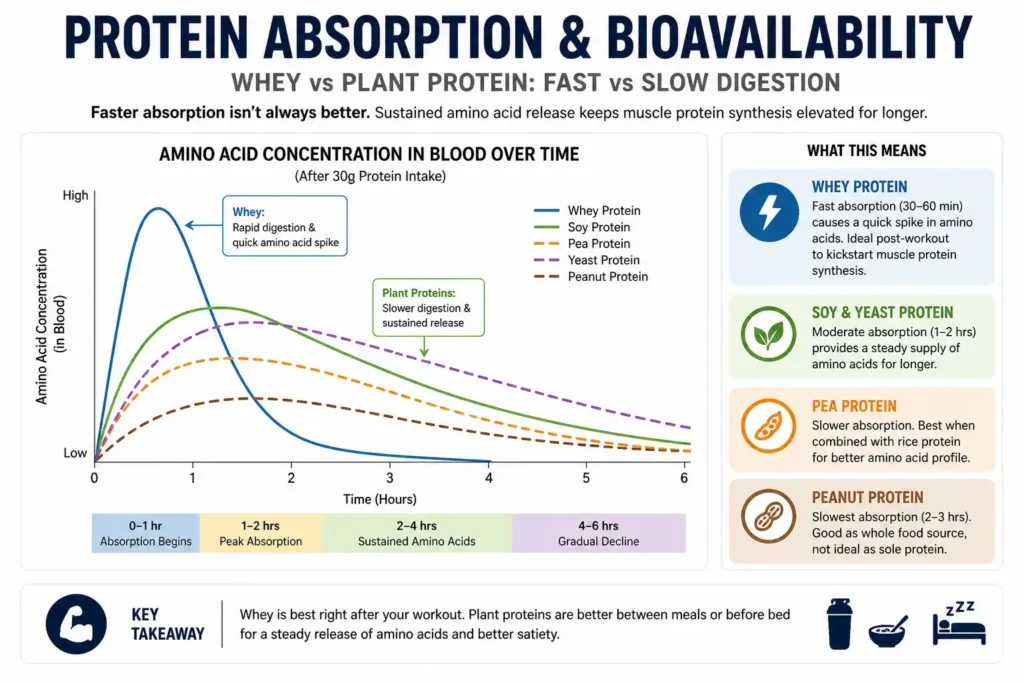
Whey spikes amino acids in your blood within 30-60 minutes. Great post-workout for rapid recovery.
Plant proteins (soy, pea, yeast) absorb more slowly—over 1-3 hours. That means a more sustained release of amino acids. Some research suggests this might actually be better for muscle building over the long term, because the signal to build muscle lasts longer.
But honestly? The difference is small. Total daily protein matters more than absorption speed.
Muscle Growth & Results: What the Research Says
Here’s what the clinical evidence actually shows.
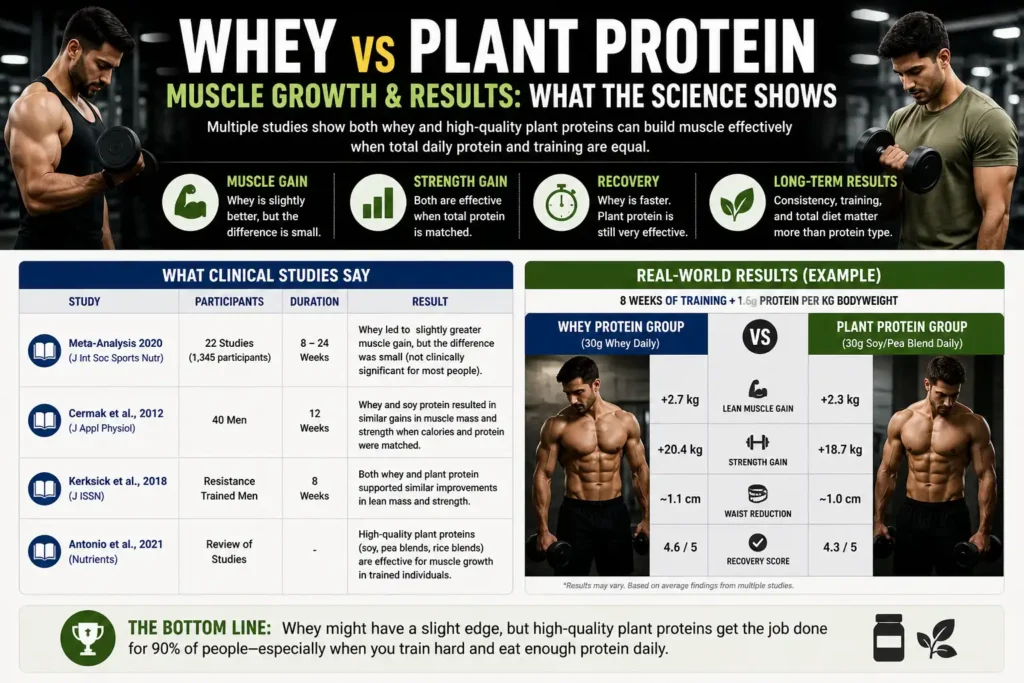
Whey vs Soy: A 2019 meta-analysis in Sports Medicine compared whey and soy for muscle growth. Whey led to slightly greater lean mass gains—about 5-10% more over 12 weeks. Significant for athletes. Probably irrelevant for regular gym-goers.
Whey vs Pea: A 2015 study directly compared whey and pea protein in men doing resistance training. Both groups gained similar muscle mass. The pea protein group actually lost more body fat.
Whey vs Yeast: Too early for long-term studies, but the systematic review shows yeast triggers muscle protein synthesis effectively.
The bottom line: Whey is still the king for maximum muscle growth. But good plant proteins (soy, yeast, pea+rice blends) get you 90-95% of the way there. For most people, that’s more than enough.
If you want to understand how protein fits into a complete muscle-building plan, read the best protein sources for muscle gain and fat loss in India.
Digestibility & Side Effects
This is where the choice gets personal.
| Protein | Common Side Effects | Who Should Avoid |
|---|---|---|
| Whey | Bloating, gas, acne (in some) | Lactose intolerant, dairy allergy |
| Soy | Mild gas (rare) | Soy allergy (uncommon) |
| Pea | Almost none | Anyone? Very rare allergies |
| Yeast | Mild gas (high fiber) | Yeast allergy (rare) |
| Peanut | Possible allergen | Peanut allergy (serious) |
My observation: In India, lactose intolerance is common—much more than people admit. If whey makes you bloated, switch to a plant protein for two weeks. You’ll know quickly.
Which Protein Should You Choose? (Decision Guide)
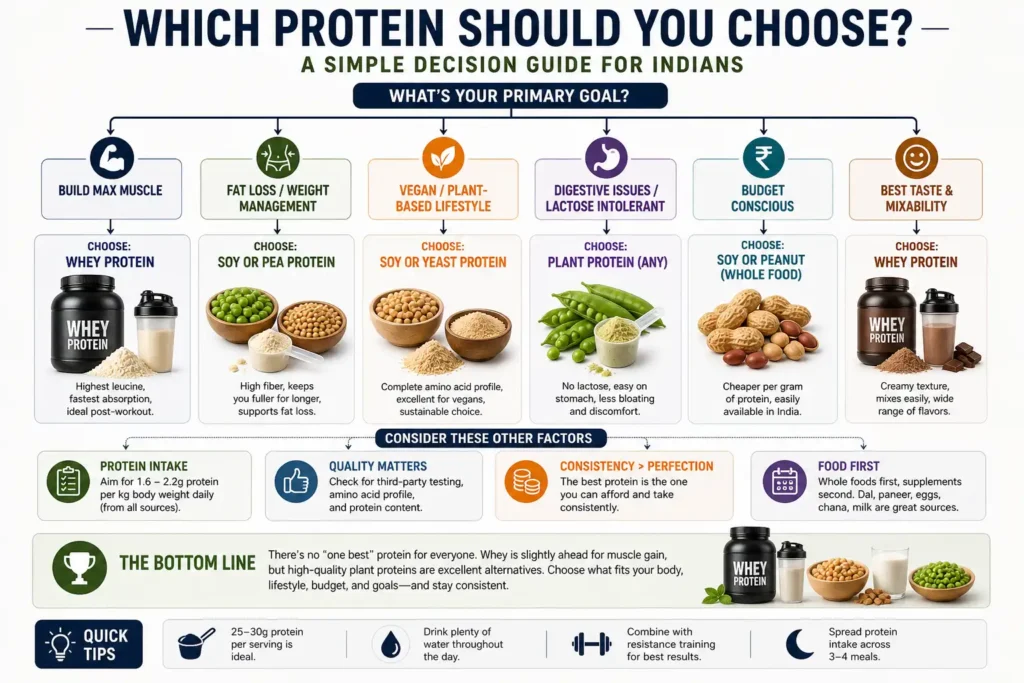
For Maximum Muscle Growth → Whey
If your only goal is to build muscle as fast as possible, and you tolerate dairy well, buy whey. It’s the most researched, the most leucine-dense, and absorbs fastest post-workout.
For Fat Loss → Soy or Pea Protein
Plant proteins have fiber. Whey has none. Fiber keeps you full. Plus, plant proteins are slightly lower in calories per serving. If you’re in a calorie deficit, that helps.
Check out the best fat burner supplement guide for other tools to support fat loss.
For Vegans / Plant-Based → Soy or Yeast
Avoid pea protein alone. Get a pea+rice blend or straight soy isolate. Yeast protein is also excellent if budget allows.
For Digestive Issues → Pea or Soy
Whey bothers your stomach? Try pea protein. It’s the most hypoallergenic option. Soy is a close second.
For Budget → Food First, Then Supplement
Honestly? The cheapest protein isn’t a powder at all. Soya chunks give you 52g protein per 100g for ₹150-200 per kg. That’s roughly ₹15 for 30g protein—far cheaper than any powder.
Use protein powder for convenience. Use whole foods for the bulk of your intake.
If you’re vegetarian, read the best vegetarian protein sources in India guide.
For Taste & Mixability → Whey
Let’s be honest. Whey tastes better. It’s creamier. It mixes with water without clumping. Plant proteins can be gritty or earthy. If taste is a dealbreaker, whey wins.
Quick Decision Flowchart
Ask yourself:
- Can I digest dairy without bloating?
- Yes → Consider whey
- No → Go plant-based
- What’s my primary goal?
- Max muscle growth → Whey (if tolerated) or soy
- Fat loss → Plant protein (fiber helps)
- Vegan → Soy or yeast
- What’s my budget?
- Low → Whole foods (soya chunks, eggs, paneer)
- Medium → Soy isolate
- High → Whey or yeast
- Do I care about taste?
- Yes → Whey
- Neutral → Plant
Final Verdict: Whey vs Plant Protein – Which Is Better?
There’s no single winner. But there’s a clear answer for each person.
Whey is better if: You tolerate dairy, want maximum muscle growth, and prefer better taste.
Plant protein (soy/yeast) is better if: You’re lactose intolerant, vegan, want fiber for fat loss, or have acne triggered by dairy.
What about the “whey vs plant protein which is better” debate for most people?
For 80% of you reading this: The difference is too small to matter. Pick the one you can afford, digest well, and will actually take consistently.
The worst protein powder is the one sitting in your cupboard because you hate the taste or it makes you bloat.
Frequently Asked Questions
1. Is plant protein as good as whey for muscle growth?
Close, but not equal. Whey has higher leucine content. But good plant proteins (soy, yeast, pea+rice blends) get you 90-95% of the results. Most people won’t notice the difference.
2. Which plant protein is most like whey?
Soy protein isolate has a PDCAAS of 1.0 (same as whey) and the closest amino acid profile. Yeast protein is also very close.
3. Can I mix whey and plant protein?
Yes. Many people do. Whey post-workout (fast absorption). Plant protein before bed (slower release). Or just pick one. Mixing isn’t necessary.
4. Is pea protein alone good enough?
Not really. Pea protein is low in methionine. Most good pea proteins are blended with rice protein to fix this. Check the label. If it says “pea protein isolate” alone, skip it. If it’s “pea and rice protein blend,” that’s fine.
5. Which protein is best for fat loss?
Soy or pea protein. Both have fiber (whey has none). Fiber increases satiety. In a calorie deficit, every bit of fullness helps.
For a complete fat loss plan, read the budget Indian diet plan for weight loss under ₹200/day.
6. Is whey protein safe for long-term use?
Yes. Decades of research show no harm in healthy individuals. The only caveat: If you have kidney disease, consult a doctor first. For healthy people, high protein intake is safe.
7. Can I build muscle without any protein powder?
Absolutely. Protein powder is convenience, not a necessity. Whole foods like soya chunks, eggs, chicken, paneer, and lentils can easily hit your daily target. Read the best protein sources guide for exactly how.
Ready to Choose Your Protein?
You now know:
- How whey and plant proteins compare on quality
- Which one suits your specific goal
- What to look for on the label
Here’s your action step: If you’re currently using a protein powder, check the label. Is it a complete protein? Does it have at least 2g of leucine per serving? If not, consider switching.
If you’re buying your first protein, start with a small pack. Test digestion. Test taste. Then commit to a larger size.
Drop a comment below: Have you tried both whey and plant protein? Which one worked better for you? Or ask a question—I read every comment.
And if this guide helped you cut through the marketing noise, share it with a friend who’s confused about which protein to buy.
Protein powder is a tool, not a magic potion. Pick the right tool for your body.
Related Articles
👉 Best Protein Sources for Muscle Gain and Fat Loss in India (Complete Guide) – Food-first protein guide.
👉 Can Yeast Protein Replace Whey Protein? – Deep dive on the new contender.
👉 Best Vegetarian Protein Sources in India – If you’re skipping meat.
👉 Do Soya Chunks Cause Man Boobs? – Busting the soy myth once and for all.
Disclaimer: This information is for educational purposes only. Consult a healthcare provider before starting any new supplement, especially if you have kidney disease, allergies, or other medical conditions.