
Eggs do not cause body heat in any medically meaningful sense — and no scientific evidence supports the idea that eating eggs raises your core body temperature or harms you in summer. This belief is deeply rooted in Indian household culture, passed down across generations as practical wisdom, but the mechanism people describe simply does not exist the way they think it does.
That said, there is a real biological phenomenon being confused here. Protein does produce slightly more heat during digestion than carbohydrates or fat do. Eggs are high in protein. So technically, your body does work a little harder to digest them. But this is true of all protein-rich foods — dal, paneer, chicken, whey — and the effect is so minor that it has no practical relevance to how hot you feel in May. The real reason you feel uncomfortable after eggs in summer is almost certainly not the eggs.
What Actually Happens When You Eat Eggs
- Eggs do not raise core body temperature. The idea of “heating foods” comes from Ayurvedic and folk medicine frameworks, not from modern physiology or nutrition science.
- All protein causes a small rise in metabolic heat during digestion. This process, called diet-induced thermogenesis (DIT), accounts for roughly 20 to 30% of the calories from protein — but it does not translate into feeling hot.
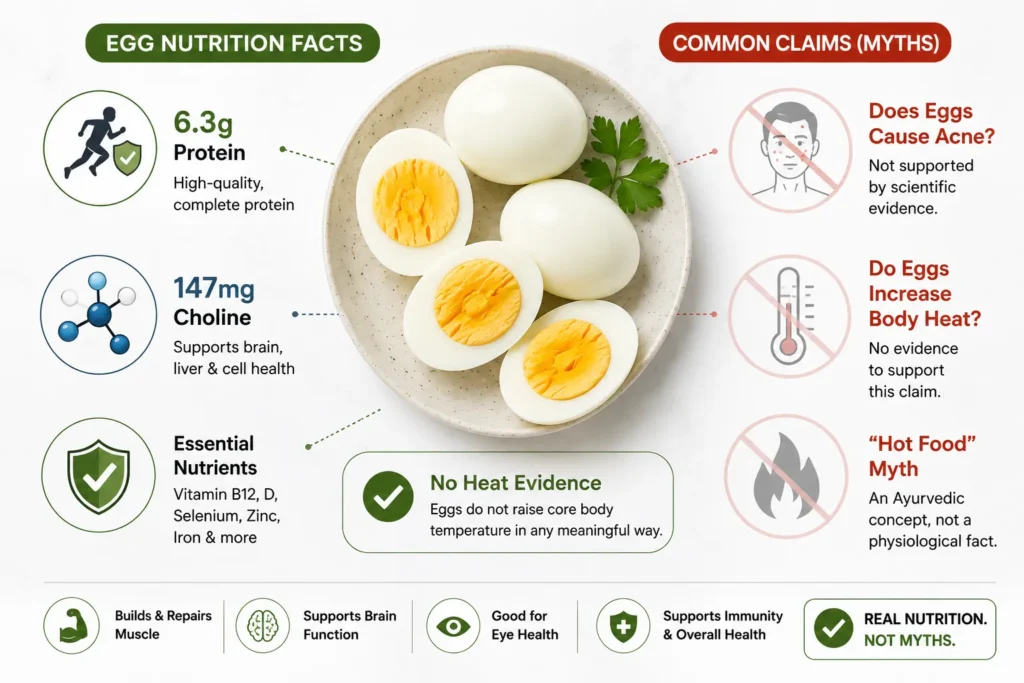
- One large egg contains 6.3g of complete protein, around 72 calories, and 147mg of choline — making it one of the most nutritionally efficient foods per rupee available in India.
- Eating up to one egg per day is not associated with increased cardiovascular disease risk in healthy adults, per a 2020 BMJ study tracking over 215,000 participants for up to 32 years.
- Eggs do not cause pimples in most people. No strong scientific evidence links egg consumption to acne in the general population. Individual food sensitivities are a separate matter.
Why Indians Believe Eggs Are a “Hot Food”
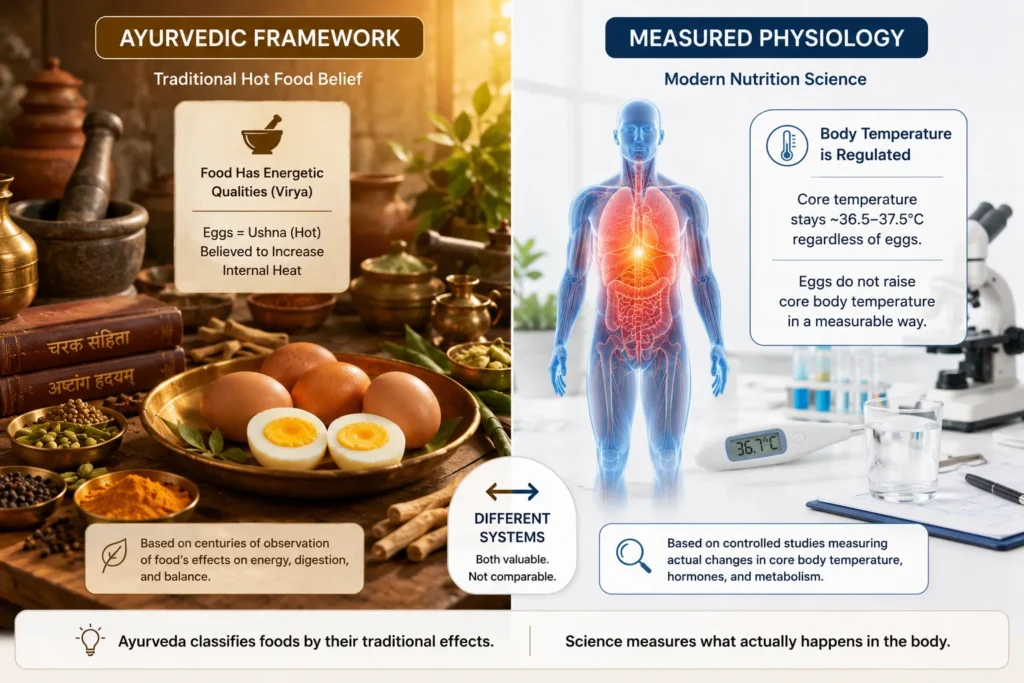
The “hot and cold foods” framework has been part of Indian household thinking for centuries. It comes primarily from Ayurveda, which classifies foods by their effect on the body’s internal balance rather than their measurable temperature or caloric content. Foods deemed “ushna” (hot in nature) are thought to increase internal heat, trigger inflammation, cause skin problems, or aggravate conditions like acne and nosebleeds.
Eggs landed in the “hot foods” category for reasons that made intuitive sense at the time. They are animal-origin, nutrient-dense, and eaten mostly in their cooked form. In Ayurvedic logic, these properties pointed to a heating quality.
The problem is that the Ayurvedic concept of food temperature and the modern physiological concept of body temperature are describing completely different things. One is a theoretical framework about bodily balance. The other is a measurable biological fact. Conflating the two is where the confusion starts.
In Indian households specifically, the egg-heat belief gets reinforced by a very common pattern: someone eats eggs in summer, feels warm or develops a pimple shortly afterward, and connects the two. The connection feels real. But summer heat, sweating, dehydration, increased sebum production from humidity, and changes in sleep or digestion would all produce the same effects independently.
The belief also travels selectively. North Indians tend to be more concerned about eggs in summer, while South Indians and Northeast Indians eat eggs year-round without these concerns and do not report notably worse outcomes. That regional inconsistency is itself a clue.
Does Eating Eggs Actually Increase Body Heat?
Eggs do not increase core body temperature in any clinically measured way. Core body temperature in healthy adults stays within a narrow range of 36.1 to 37.2 degrees Celsius regardless of what you eat, and food does not push it outside that range in healthy people.
What Diet-Induced Thermogenesis Actually Means
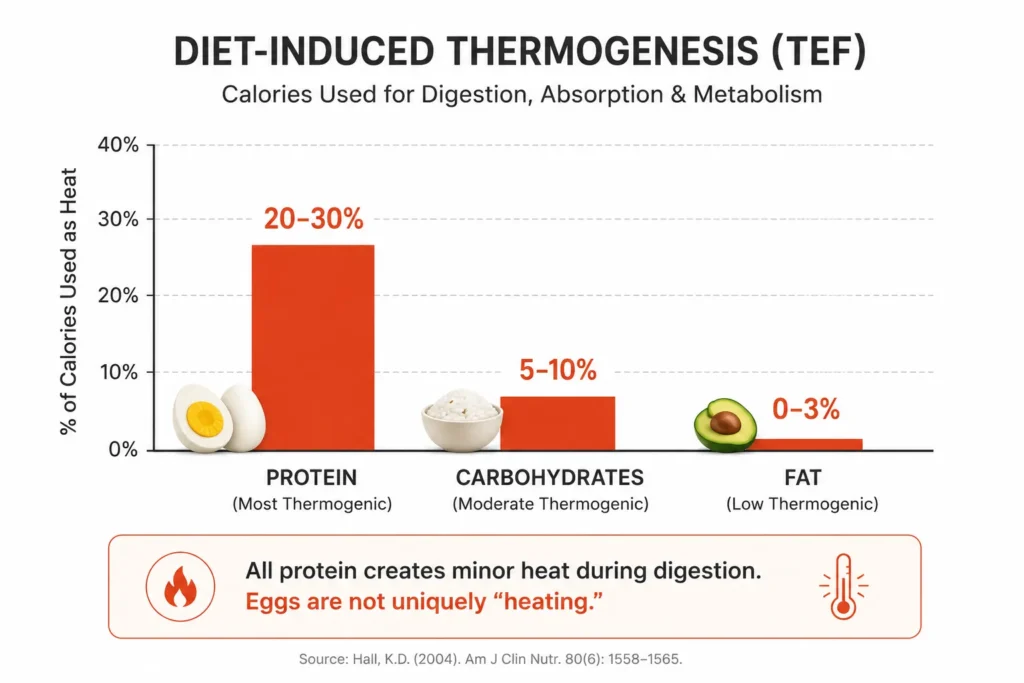
Diet-induced thermogenesis (DIT) is the energy your body uses to digest, absorb, and metabolize food. It is often called the thermic effect of food. All food produces some DIT. The breakdown by macronutrient is well-established: protein produces the highest DIT at roughly 20 to 30% of its caloric content, carbohydrates produce 5 to 10%, and fats produce 0 to 3%.
A 2004 review published in Nutrition and Metabolism found that protein-rich meals consistently produce greater thermogenic responses than fat or carbohydrate meals. A large egg contains 6.3g of protein. At a DIT of roughly 25% for protein, digesting the protein in one egg burns approximately 4 to 5 extra calories as heat. That is not enough to make you feel warmer. It is certainly not enough to cause pimples, nosebleeds, or any of the other effects attributed to “hot foods.”
The one-sentence verdict: The heat produced by digesting eggs is real but physiologically trivial — and it is the same for all protein-rich foods, not specific to eggs.
Do Eggs Cause Pimples and Skin Problems?
Eggs do not cause acne or pimples in most people. The American Academy of Dermatology does not list eggs as an acne trigger. Their guidelines point to high-glycemic foods and dairy as the dietary factors with the strongest evidence for acne causation.
A 2022 systematic review examining diet and acne found strong evidence linking dairy products and high-sugar foods to breakouts, but eggs were not identified as a significant dietary factor for the general population. A separate 2023 study found that eggs were the most common food allergen among acne patients with confirmed food sensitivities — but this means egg allergies can contribute to inflammation in a specific subgroup, not that eggs universally cause pimples.
If you eat eggs and notice consistent breakouts, an elimination trial is reasonable. Remove eggs for 3 to 4 weeks and observe. But do not assume causation without testing it personally.
The one-sentence verdict: Eggs do not cause acne for most people; the link exists only for those with a genuine egg sensitivity or allergy.
Is Egg a Hot Food for the Body in Summer?
Eggs are not biologically “hotter” in summer than in any other season. The discomfort many people associate with eating eggs in summer is explained by other factors: higher ambient temperature, dehydration, reduced water intake relative to sweat loss, or heavier cooking methods like bhurji with extra oil and spices.
A plain boiled egg eaten in summer is nutritionally identical to a plain boiled egg eaten in winter. The preparation method and overall meal composition matter far more than the egg itself. A heavily spiced anda masala in 42-degree heat in Delhi will make you feel warm. The masala, oil, and heat are the reasons. Not the egg.
Egg Nutrition Facts vs Common Claims
| Nutrient / Claim | Actual Value Per Large Egg | What It Means | Verdict |
|---|---|---|---|
| Protein | 6.3g (all 9 essential amino acids) | Complete protein, high DIAAS score | Excellent for muscle and satiety |
| Calories | 72 kcal | Low caloric density | Good for fat loss diets |
| Choline | 147mg (27% Daily Value) | Brain function, liver health | One of the best dietary sources |
| Cholesterol | 186mg | No significant CVD risk at 1 egg/day in healthy adults | Safe for most people |
| “Body Heat” | Not measurable / not supported | No clinical evidence for this claim | Myth |
| Causes Acne | No strong evidence for general population | May affect those with egg allergy | Not a universal concern |
| Safe in Summer | Yes | No seasonal restriction supported by science | Eat year-round |
How Your Body Actually Processes Eggs
The body processes eggs efficiently and completely within 3 to 4 hours of consumption. Eggs have one of the highest protein bioavailability scores of any whole food — cooked whole eggs score approximately 91% on protein digestibility measures, meaning your body absorbs and uses most of what you eat.
When you eat an egg, stomach acid and digestive enzymes break down the proteins into individual amino acids. These are absorbed through the small intestine and enter the bloodstream within 1 to 2 hours. They are then used for muscle protein synthesis (MPS), the process by which the body builds and repairs muscle tissue, or for producing enzymes, hormones, and structural proteins.
The yolk delivers the fat-soluble nutrients — vitamin D, vitamin A, choline, and lutein. Lutein is a carotenoid (a natural plant pigment found in egg yolks from hens fed a carotenoid-rich diet) that accumulates in the retina and is associated with eye health.
PDCAAS (Protein Digestibility Corrected Amino Acid Score) and DIAAS (Digestible Indispensable Amino Acid Score) are the two main systems used to rank protein quality. Cooked eggs score close to 1.0 on PDCAAS and above 1.0 on DIAAS for several essential amino acids, which places them among the highest-quality protein sources available.
Timing note: Eggs eaten at breakfast consistently show better satiety than carbohydrate-heavy breakfasts. Research on meal timing and satiety suggests that front-loading protein — eating it earlier in the day — reduces total daily calorie intake more reliably than eating the same protein later. A two-egg breakfast is a practical, low-cost strategy for controlling hunger through the morning.
What the Research Actually Says
The largest and most rigorous study on eggs and health outcomes to date is a 2020 analysis published in the BMJ, led by researchers from Harvard T.H. Chan School of Public Health. The study analyzed health data from 173,563 women and 90,214 men tracked for up to 32 years. The finding was unambiguous: eating up to one egg per day was not associated with an increased risk of cardiovascular disease.
An updated meta-analysis included in the same paper, covering 1,720,108 participants across prospective cohort studies, confirmed this: moderate egg consumption showed no association with increased CVD, coronary heart disease, or stroke risk.
On the specific question of eggs and body heat, there is no peer-reviewed study that has found eggs raise core body temperature in healthy adults. The entire “hot food” framework has not been subjected to rigorous clinical testing because there is no measurable physiological mechanism to test.
“Eating up to one egg per day is not associated with an increased risk of cardiovascular disease.” — Drouin-Chartier et al., BMJ, 2020.
The honest reality check: millions of people in India avoid eggs in summer based on a belief system that predates modern nutrition science by centuries. Most of them also change multiple behaviors in summer — they eat differently, sleep less well, sweat more, and are more dehydrated. Attributing any discomfort specifically to eggs, without controlling for these other factors, is not valid reasoning.
Who Genuinely Needs to Be Careful With Eggs
Most people have no reason to restrict eggs. There are specific situations where caution makes sense, and they are worth stating clearly.
People with confirmed egg allergies should avoid eggs entirely. Egg allergy is one of the most common food allergies, particularly in children. Symptoms include skin rash, hives, digestive upset, or in severe cases, anaphylaxis. This is a real immune response, not a “body heat” effect.
People with diabetes should be mindful of egg consumption in the context of their overall diet. Some studies in diabetic populations have shown a modest association between high egg intake and cardiovascular risk, though the evidence is mixed. Discussing egg consumption with a doctor is reasonable for anyone managing Type 2 diabetes.
People with familial hypercholesterolemia (a genetic condition that causes very high LDL cholesterol from birth) may need to moderate dietary cholesterol intake. For everyone else, the research consistently shows that dietary cholesterol from eggs has a minimal effect on blood cholesterol levels in healthy adults.
People who fry eggs in excessive oil are eating more calories and saturated fat than they may realize. The egg is not the problem in that scenario. The preparation is. A boiled or poached egg is nutritionally superior to a fried one purely from a calorie-and-fat standpoint.
For vegetarians trying to meet protein targets, eggs are one of the best complete protein sources available. If you are exploring other vegetarian options, the best vegetarian protein sources in India guide covers practical alternatives beyond paneer and dal.
How to Know If Eggs Are Actually Right for Your Situation

If Your Goal Is Muscle Gain
Eat 2 to 3 whole eggs daily without concern. The complete amino acid profile, high DIAAS score, and leucine content — leucine is the key amino acid that triggers muscle protein synthesis — make eggs one of the most efficient and affordable muscle-building foods available in India at roughly Rs 6 to 10 per egg. Pair them with carbohydrates post-workout for optimal glycogen replenishment alongside muscle repair.
If Your Goal Is Fat Loss
Eggs are ideal for fat loss diets. At 72 calories per egg with 6.3g of protein, they offer one of the best protein-to-calorie ratios of any whole food. The satiety effect of protein is real and well-documented — a two-egg breakfast consistently produces lower total daily calorie intake compared to carbohydrate-only breakfasts of equivalent calories. For a complete picture of protein-rich foods for fat loss, the high protein foods for fat loss guide is worth reading alongside this.
If You Are Worried About Eating Eggs in Summer
Eat them. There is no scientific reason to avoid eggs in summer specifically. Keep your preparation simple — boiled, poached, or lightly scrambled with minimal oil. Stay hydrated separately. If you feel warm after eating a heavily spiced egg dish in hot weather, the spices and ambient heat are the more likely explanation.
If You Are Vegetarian But Eat Eggs (Eggetarian)
You are in a strong nutritional position. Eggs give you complete protein, vitamin B12, vitamin D, and choline — nutrients that pure vegetarians often struggle to get from food alone. A vitamin B12 deficiency is one of the most common nutrient gaps among Indians who avoid meat, and eggs are one of the practical solutions.
If You Have Acne and Are Wondering Whether Eggs Are the Cause
Test it properly. Remove eggs entirely from your diet for 3 to 4 weeks. Keep everything else the same. If your skin improves meaningfully, you may have a sensitivity. If it does not, eggs are probably not the issue — and other factors like dairy, high-glycemic foods, or stress are more likely culprits.
If You Are a Complete Beginner to Nutrition
Start with 1 to 2 eggs per day as part of a balanced diet. Do not overcomplicate this. Eggs are affordable, complete, and easy to cook. They are one of the most practical nutrition upgrades available to the average Indian who is not eating enough protein — which, based on dietary surveys, is most people.
The Bottom Line
Eggs do not cause body heat. They do not raise your core temperature, they do not cause pimples in most people, and there is no scientific reason to avoid them in summer. The belief comes from a food classification system that predates modern nutrition science, and it has been reinforced by coincidence and selective memory rather than evidence.
One egg per day is supported as safe by the largest long-term studies available, covering more than a million participants. Two eggs per day is entirely reasonable for most healthy adults. The only groups with genuine reasons for caution are people with confirmed egg allergies, those with familial hypercholesterolemia, and people with diabetes who should discuss intake with a doctor.
Stop letting a pre-scientific belief system take one of the cheapest, most complete protein sources off your plate. If your grandmother says eggs will heat your blood in summer, she is not wrong to care about your health. She is just working from a different framework than the one nutrition science uses.
People Also Ask
Do eggs cause body heat in summer?
No. Eggs do not raise core body temperature in any measurable way. The “hot food” classification comes from Ayurvedic tradition, which uses a different framework than modern physiology. All protein-rich foods produce a small amount of metabolic heat during digestion through a process called diet-induced thermogenesis, but the effect is minor and not specific to eggs. There is no clinical evidence that eggs make you feel hotter or cause heat-related symptoms in summer.
Why do Indians say eggs cause body heat?
The belief comes from Ayurveda’s ushna-sheeta (hot-cold) food classification system, which categorizes foods by their theoretical effect on the body’s internal balance rather than their measured temperature. Eggs were traditionally classified as “hot” or “ushna” foods. This framework has been passed down through generations and is reinforced by coincidental associations — someone eats eggs, feels warm or gets a pimple, and attributes it to the egg. Modern nutrition science does not recognize food-based body heat as a real physiological mechanism.
Can I eat eggs in summer every day?
Yes. There is no nutritional or physiological reason to restrict eggs during summer. A 2020 BMJ study covering over 1.7 million participants found that eating up to one egg per day is not associated with increased cardiovascular disease risk. The discomfort some people feel after eating eggs in summer is more plausibly explained by heavy spicing, cooking oil, dehydration, or ambient heat than by the egg itself. Boiled or poached eggs are the lightest preparation choice for warm weather.
Does eating eggs cause pimples and heat boils?
Eggs do not cause pimples in most people. The American Academy of Dermatology does not list eggs as an acne trigger. High-glycemic foods and dairy have far stronger evidence linking them to acne than eggs do. A 2022 systematic review found no strong link between egg consumption and acne in the general population. If you have a confirmed egg allergy or sensitivity, your skin may react to eggs specifically — but this is an immune response, not a “heat” effect.
How many eggs per day is safe?
For most healthy adults, 1 to 2 eggs per day is consistently supported as safe by large-scale research. The 2020 Harvard-led BMJ study found no CVD risk increase at up to one egg per day. Some research suggests up to six eggs per week shows a neutral or even slightly protective effect on cardiovascular health. People with Type 2 diabetes, familial hypercholesterolemia, or confirmed egg allergy should discuss intake with their doctor. For everyone else, daily egg consumption is nutritionally well-supported.
Are eggs in summer good or bad for the body?
Eggs in summer are nutritionally good. The season does not change the egg’s protein content, amino acid profile, choline content, or bioavailability. What changes in summer is your hydration, sweat rate, and ambient temperature — none of which are caused by eggs. If you feel heavy or warm after eating eggs in summer, the more likely causes are cooking method (heavy oil, spices), eating in heat without drinking enough water, or simply the weather itself.
Is egg a good protein source for Indians specifically?
Eggs are one of the best protein sources available to Indians at any budget. At roughly Rs 6 to 10 per egg and 6.3g of complete protein per egg, the protein-to-cost ratio is difficult to match. They contain all nine essential amino acids, score near the top of protein quality scales (PDCAAS and DIAAS), and provide vitamin B12 — a nutrient that many Indians, especially vegetarians, are deficient in. The cultural hesitation around eggs because of body heat concerns has no nutritional justification for healthy people.
Sources and References
- Drouin-Chartier, J.P., Chen, S., Li, Y., et al. (2020). Egg Consumption and Risk of Cardiovascular Disease: Three Large Prospective US Cohort Studies, Systematic Review, and Updated Meta-Analysis. BMJ, 368, m513. https://www.bmj.com/content/368/bmj.m513
- Westerterp, K.R. (2004). Diet Induced Thermogenesis. Nutrition and Metabolism, 1, 5. https://www.ncbi.nlm.nih.gov/pmc/articles/PMC524030/
- USDA FoodData Central. Egg, whole, raw, fresh — choline 146.9mg per large egg. https://www.nal.usda.gov/sites/default/files/page-files/choline.pdf
- Noll Health. (2025). Do Eggs Cause Acne? What Research Shows. Summary of 2022 systematic review and 2023 allergy study. https://www.nollahealth.com/learning/do-eggs-cause-acne