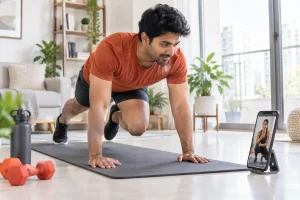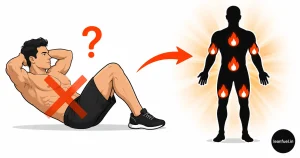
How to Start Workout at Home: Science-Backed Guide for Beginners
Learning how to start workout at home doesn’t have to be overwhelming. Discover evidence-based strategies for building a sustainable home fitness routine.
Introduction: The Living Room Revolution
You have seen them. The perfectly lit Instagram reels. The person in matching activewear flowing seamlessly from yoga poses to push-ups, never sweating, never looking confused, never bumping into the coffee table.
That is not reality.
Reality looks like you, in old shorts, staring at your phone screen, wondering: “Is my form even right? Am I wasting my time? Should I just join a gym instead?”
Here is what the research says: exercising at home is an accessible alternative to the gym . But it presents unique challenges—low adherence, poor exercise quality, and difficulty reaching your goals .
The good news? Thousands of people have figured out how to start workout at home successfully. And the science of what works—and what doesn’t—is clearer than ever.
Let me show you the path that actually works, backed by peer-reviewed research, not influencer hype.
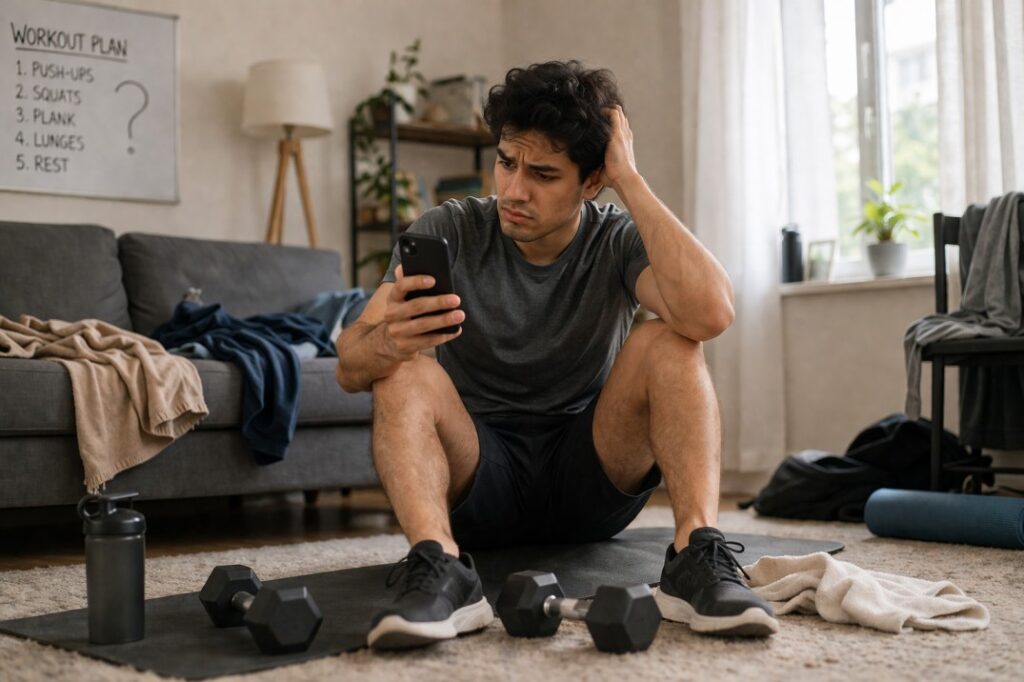
Part 1: Why Most Home Workouts Fail (And How Yours Won’t)
The Adherence Problem
Here is the uncomfortable truth. A study of 300 adults with prescribed home exercise programs found that only 48.8% fully adhered to their routines. Another 27.6% partially adhered, and 23.6% did not adhere at all .
Almost a quarter of people never even really started.
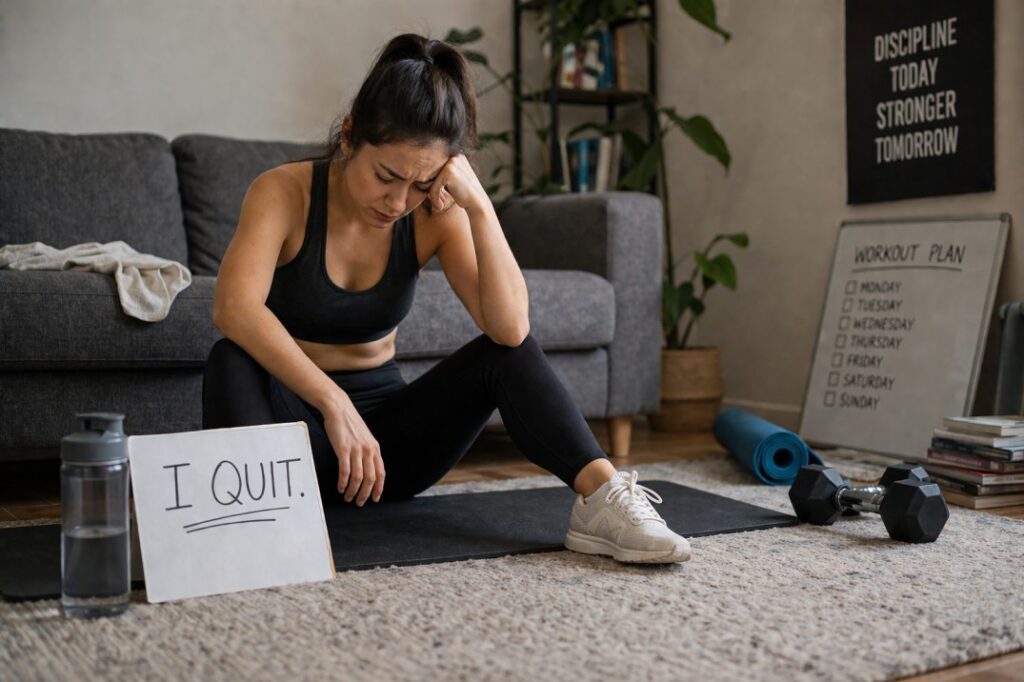
What separates the 48.8% from the rest? The same study identified two critical factors:
Factor 1: Age – Older adults showed higher adherence rates. The researchers hypothesized that this relates to recognizing the tangible consequences of inactivity .
Factor 2: Perceived Sufficiency of Instructions – This was the big one. Participants who felt they received “sufficient instructions” were significantly more likely to stick with their programs .
Here is what this means for you: clarity kills procrastination. If your home workout plan is vague (“I’ll exercise more”), you will fail. If it is specific (“Monday, Wednesday, Friday at 7 AM, I will do these six exercises”), you have a fighting chance.
The Motivation Myth
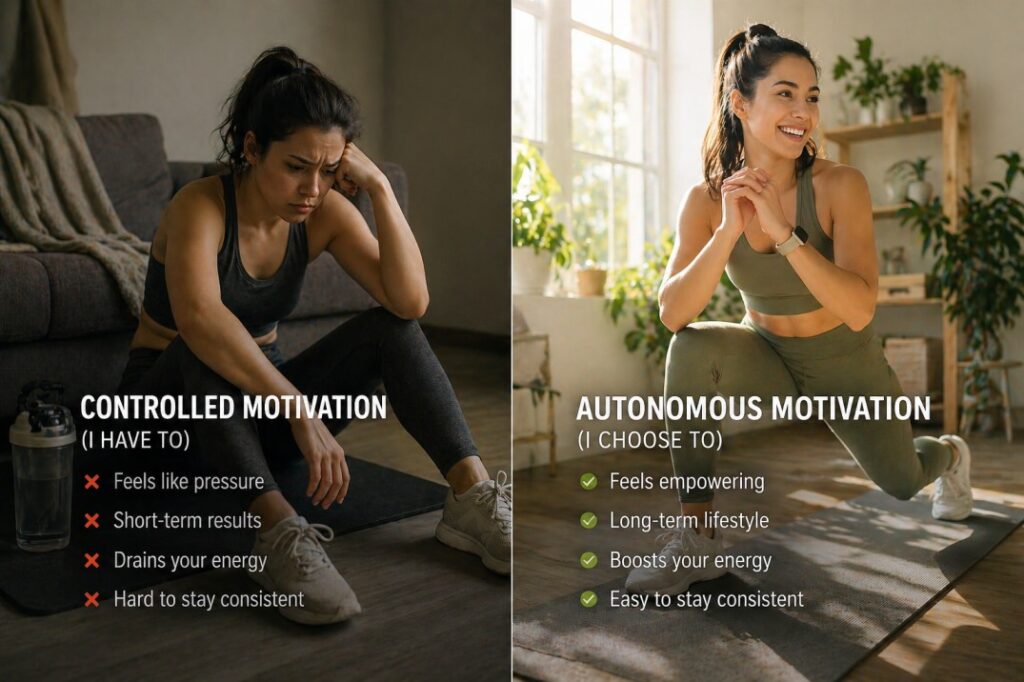
We tend to think motivation is something you have or don’t have. But research on physical activity motivation tells a different story. Autonomous motivation—exercising because you genuinely value its benefits, not because you feel pressured—is independently associated with higher physical activity levels .
The implication is profound. You cannot hate your way into consistency. If your internal dialogue is “I should exercise because I’m lazy and out of shape,” that is controlled motivation. It burns out fast.
If your internal dialogue is “I choose to exercise because I value how it makes me feel and what it does for my long-term health,” that is autonomous motivation. It lasts.
Part 2: Before You Start One Exercise
The Environmental Setup
Research on home-based video exercise programs has identified a crucial factor: session duration directly impacts adherence .
The data: sessions shorter than 20 minutes had the highest attendance rates. Sessions longer than 60 minutes decreased attendance rates by nearly 25% .
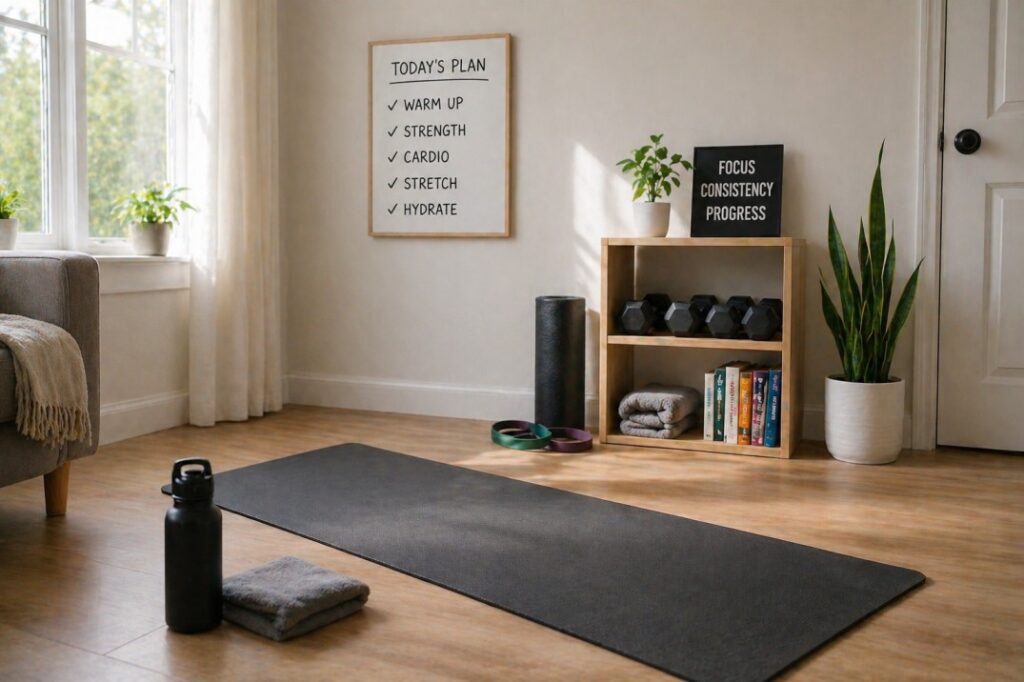
When learning how to start workout at home, start short. Fifteen to twenty minutes. That is it. You can always add more later. You cannot subtract time from a workout that is already discouragingly long.
The Technology Question
Does using an app help? The evidence says yes—with caveats.
A 2025 study on HRV-based training using a smartphone app found that sedentary adults using an app completed an average of 23.3 sessions over 11 weeks, with significant improvements in fitness metrics . The app users showed improvements comparable to those guided by a personal trainer in several areas.
However, a systematic review of home-based video exercise found that the absence of live contact with a coach decreased attendance rates compared to online sessions with real-time interaction .
Practical takeaway: Apps and videos are better than nothing. Live virtual coaching (even via Zoom) is better than pre-recorded videos. But the most important variable is simply showing up.
Part 3: The Workout Structure That Science Recommends
The ACSM Guidelines
The American College of Sports Medicine (ACSM) , the world’s leading authority on exercise science, has published comprehensive guidelines for resistance training progression .
For beginners learning how to start workout at home, their recommendations are remarkably clear:
| Training Variable | Novice Recommendation |
|---|---|
| Load/Weight | 8-12 repetition maximum (RM) |
| Exercise Types | Both concentric AND eccentric actions; single-joint AND multiple-joint exercises |
| Exercise Order | Large muscle groups first, then small; multiple-joint before single-joint |
| Frequency | 2-3 days per week |
| Rest Between Sets | 1-2 minutes for hypertrophy focus |
| Contraction Velocity | Moderate (1-2 seconds up, 1-2 seconds down) |
| Progression | Add 2-10% load when you can perform 1-2 extra reps beyond target |
What “8-12 RM” Means for Home Workouts
Repetition maximum (RM) means the heaviest weight you can lift for a given number of repetitions. For home workouts without dumbbells, you use body weight as resistance.
Here is how to apply the 8-12 RM principle without equipment:
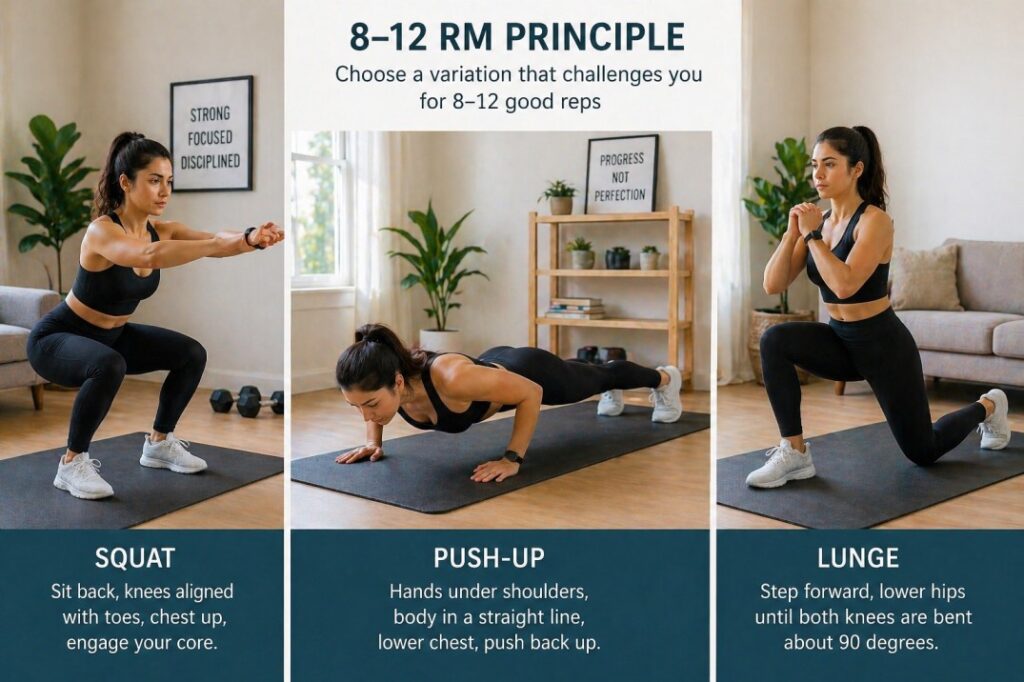
- Squats: If you can do more than 12 bodyweight squats easily, you need to make them harder (pulse squats, jump squats, single-leg squats)
- Push-ups: If you cannot do 8 standard push-ups, do them on your knees or against a wall
- Lunges: 8-12 per leg should be challenging. If not, add a pause or a jump
The principle is the same regardless of equipment: choose a version of each exercise that makes 8-12 repetitions feel difficult but achievable.
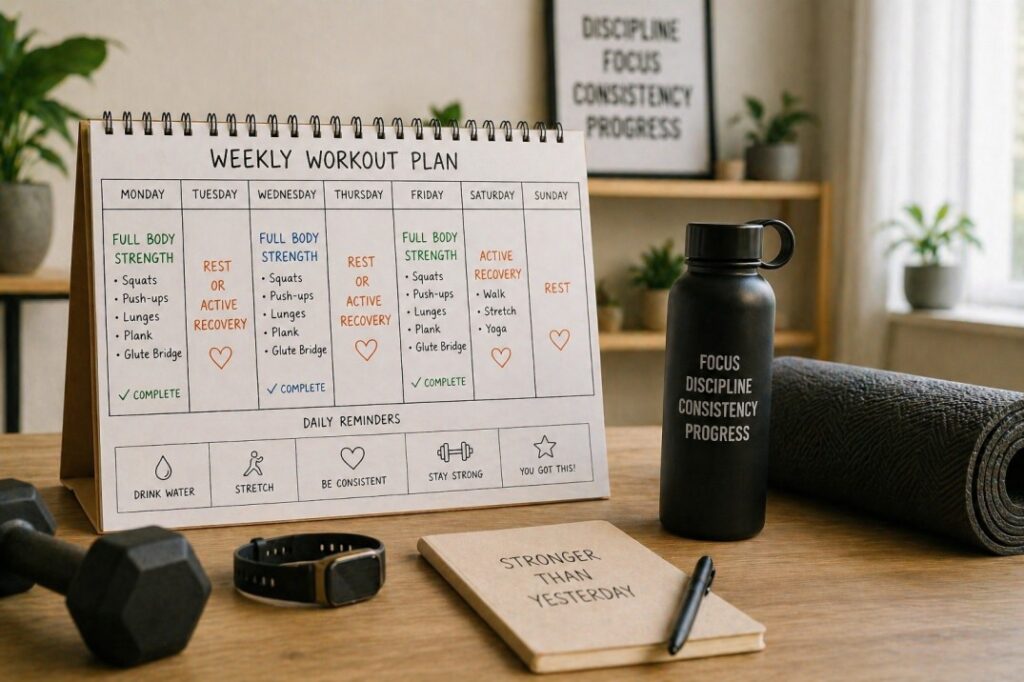
The Weekly Template
Based on ACSM frequency recommendations of 2-3 days per week for novices , here is a sample weekly structure:
Monday (Full Body)
- Bodyweight squats: 3 sets of 8-12 reps
- Push-ups (or incline push-ups): 3 sets of 8-12 reps
- Reverse lunges: 3 sets of 8-12 per leg
- Plank: 3 sets of 20-30 seconds
Wednesday (Full Body)
- Glute bridges: 3 sets of 12-15 reps
- Triceps dips (using a chair): 3 sets of 8-12 reps
- Walking lunges: 3 sets of 10-12 per leg
- Bird-dog: 3 sets of 10-12 per side
Friday (Full Body)
- Repeat Monday OR swap in different exercises targeting the same muscle groups
Part 4: The Progression Strategy
When to Add Difficulty
The ACSM recommends: add 2-10% load when you can perform the current workload for one to two repetitions over the desired number .
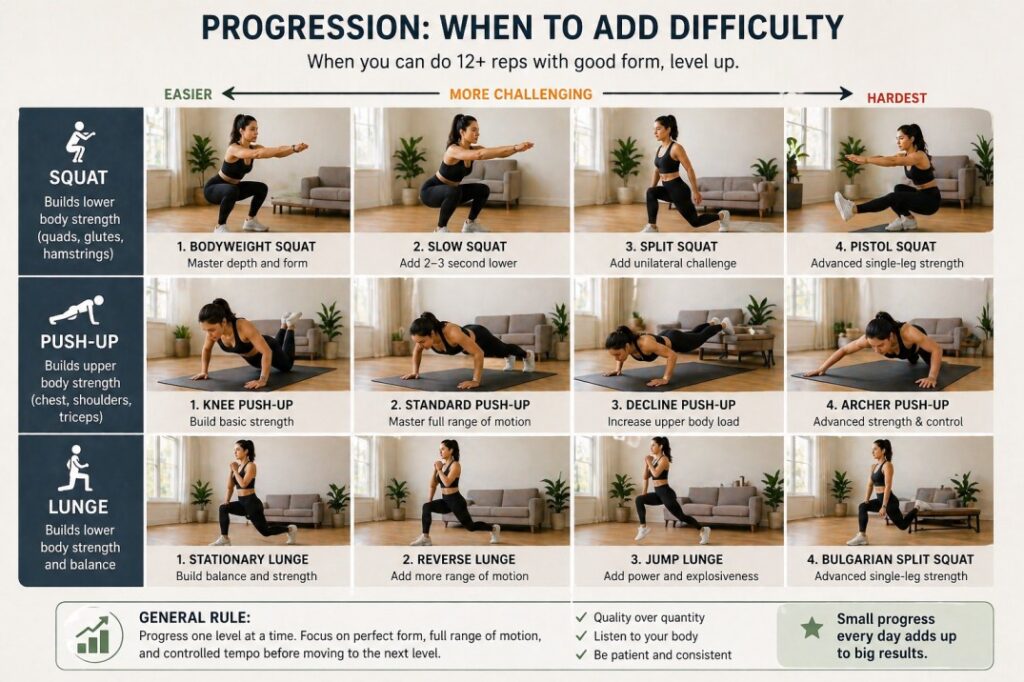
For bodyweight exercises, “adding load” means:
- Increase repetitions (if at 8, try 10)
- Decrease rest time between sets
- Add a pause at the hardest part of the movement
- Progress to a harder variation (e.g., knee push-ups → standard push-ups → decline push-ups)
The Long Game
A 12-week home-based strength-balance training study found that 75% of participants completed the full program . The key success factors identified were:
- Personalized training plans tailored to individual capabilities
- Social motivation strategies (accountability to others)
- Technology assistance (apps that track and remind)
The researchers concluded that “social motivation strategies proved more effective than individual strategies” for behavior change .
Practical application: Find an accountability partner. It could be a friend who also works out at home and sends a “done” text each day. It could be sharing your workout log in a group chat. The social element creates a sense of obligation that pure self-discipline cannot sustain.
Part 5: Overcoming the Inevitable Barriers
The “I Don’t Have Time” Barrier
A qualitative study of exercise adherence identified a recurring theme: participants described prioritizing exercise ahead of family responsibilities as a distinct challenge .
The solution is not to neglect family. The solution is strategic timing.
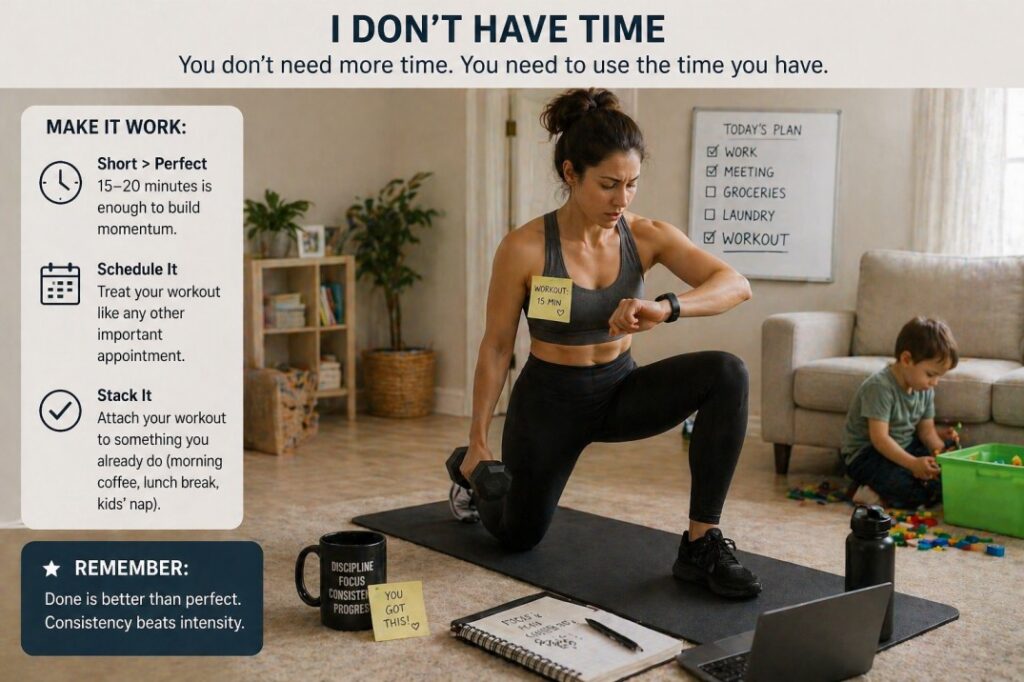
The same study found that participants who successfully maintained long-term adherence had established “a safe space for oneself” within their daily schedules . They protected their workout time the way they protected a doctor’s appointment.
The 10-Minute Rule: On days when you genuinely cannot find 20-30 minutes, do 10 minutes. Ten minutes of movement is infinitely better than zero minutes. And most of the time, once you start, you will find yourself continuing past the 10-minute mark.
The “I Lost Motivation” Barrier
Motivation is a fluid concept. Research on older adults at risk of falling found that “the level of motivation constantly influenced exercise adherence” and that motivation “changed due to interactions with individual factors and environmental factors” .
Translation: Motivation is not a switch that stays on or off. It fluctuates.
The successful exercisers do not wait for motivation to strike. They have systems. They have schedules. They have accountability. They have made their workout as automatic as brushing their teeth.
The “My Form Is Probably Wrong” Barrier
Remember the study that found “perceived sufficiency of instructions” was a key predictor of adherence? This is where that science meets your anxiety.
Do this:
- Film yourself doing each exercise
- Compare your form to a trusted source (YouTube channels from certified professionals)
- Focus on the basics first: neutral spine, controlled movement, full range of motion
- Consider one session with a virtual personal trainer to check your form
Poor form increases injury risk. But obsessing over perfect form is also a form of procrastination.
Key Insights Summary
Part 6: Your 30-Day Home Workout Launch Plan
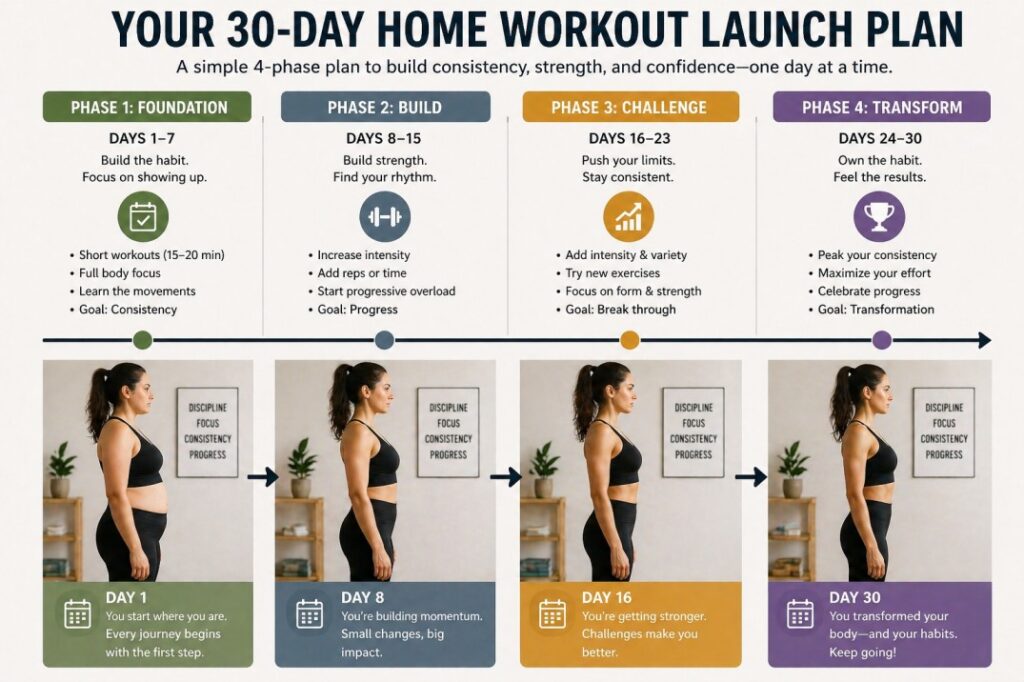
Week 1: The Habit, Not the Heroics
- Goal: Complete 3 workouts of <20 minutes
- Focus: Showing up at the scheduled time, regardless of intensity
- Success metric: Did you do it? Not how hard you pushed.
Week 2: Quality Introduction
- Goal: 3 workouts, 20-25 minutes each
- Focus: Proper form on fundamental movements (squat, push-up, lunge, plank)
- Success metric: You can explain and demonstrate correct form
Week 3: Intensity Building
- Goal: 3 workouts, 25-30 minutes
- Focus: Reaching that 8-12 RM zone where the last 2 reps are challenging
- Success metric: You are breathing hard during sets
Week 4: System Lock-In
- Goal: 3-4 workouts, 30 minutes each
- Focus: Automaticity—you no longer debate whether to work out
- Success metric: You feel slightly off on rest days
Conclusion: The Only Home Workout Guide You Will Ever Need
Here is what I want you to take away.
Learning how to start workout at home is not about finding the perfect program. It is not about buying the right equipment. It is not about having the body of an influencer.
It is about adherence. Show up. Do the work—even a little. Do it again two days later.
The research could not be clearer. The people who succeed are not the strongest or the most gifted. They are the ones who build systems, who perceive their instructions as sufficient, who start short, and who stay consistent.
Your living room is enough. Your body is enough. Your imperfect, sometimes-skipped, sometimes-shortened workout is infinitely better than the perfect workout you never do.
Now go start.
Related Articles You Should Read
[The Science of Walking for Weight Loss: Why It Beats Running] (https://leanfuel.in/the-science-of-walking-for-weight-loss-why-it-beats-running/) – Low-intensity exercise pairs perfectly with home strength training for a complete fitness routine.
[High Protein Foods for Fat Loss: A Simple Beginner’s Guide That Actually Works] (https://leanfuel.in/high-protein-foods-for-fat-loss-a-simple-beginners-guide-that-actually-works/) – Nutrition and exercise work together. Learn how to fuel your home workouts effectively.
[How to Lose Weight in 30 Days: The Realistic, Science-Backed Plan That Works] (https://leanfuel.in/lose-weight-in-30-days/) – A comprehensive 30-day protocol that includes the home workout strategies outlined here.
Express Your Views
What is the single biggest barrier keeping you from starting your home workout today? Is it time? Is it not knowing what to do? Is it fear of bad form?
Drop it in the comments. I will personally respond with a specific strategy drawn from the research to help you overcome it.
And if this guide helped you, share it with someone who has been saying “I really should start exercising” for the past six months. They just needed permission to start small.