Ghee is not inherently bad for heart health, but eating large amounts of it every day in an already high-calorie diet is a real cardiovascular risk – and the research makes this distinction clearly. For most healthy Indians consuming one to two teaspoons of ghee daily as part of a balanced diet, the evidence does not support the idea that pure desi ghee is a major heart disease driver. What it does support is that the quantity, your overall diet, and what you are comparing ghee against all matter enormously.
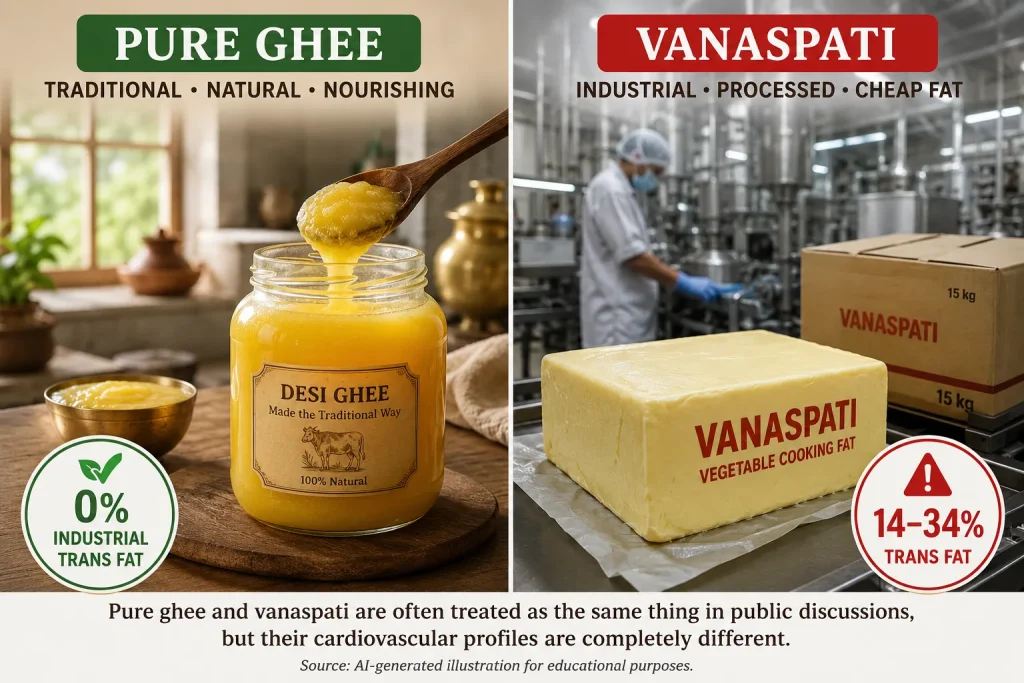
The ghee-and-heart-disease story in India is genuinely complicated. Pure ghee and vanaspati – the hydrogenated vegetable shortening sold as “Dalda” for decades – have been confused in the same conversation for generations. They are not the same food. Vanaspati contains 14 to 34% industrial trans fatty acids; pure ghee contains none. Conflating the two has distorted how Indians think about ghee and heart health for the last fifty years.
The question of whether ghee is bad for heart health deserves an honest, evidence-based answer — not an Ayurvedic endorsement and not a reflexive fat-phobic warning. Both exist in abundance. Neither is the complete picture.
The Honest Take on Ghee and Your Heart
- Pure desi ghee is not the same cardiovascular risk as vanaspati (Dalda). Vanaspati contains 14 to 34% industrial trans fats; pure ghee contains zero industrial trans fats and is not hydrogenated.
- Ghee is approximately 62% saturated fat by total fat content, which does raise LDL cholesterol in dose-dependent amounts — this is a real concern at high intake levels.
- One to two teaspoons (5 to 10g) per day is the range most nutrition researchers consider safe for healthy adults within a balanced diet; beyond two tablespoons daily, LDL and non-HDL cholesterol increases become measurable.
- Ghee contains butyric acid (3 to 4% of total fat), a short-chain fatty acid with documented anti-inflammatory effects on the gut lining and emerging evidence for cardiovascular benefit through gut-heart axis mechanisms.
- The most important heart health variable is your total diet pattern, not whether you use ghee for tadka — replacing refined carbohydrates and seed oils with moderate ghee in a vegetable-rich diet is likely neutral to mildly beneficial for most Indians.
Why Indians Have the Wrong Mental Model of Ghee and Heart Disease
The confusion starts in the 1950s. India needed a cheap substitute for ghee, and vanaspati — made by partially hydrogenating vegetable oils — filled that gap. Brands like Dalda became household staples, especially in lower-income families who could not afford pure ghee. The two products look similar, taste somewhat similar, and were often sold side by side.
When cardiovascular disease rates climbed in India through the 1970s and 1980s, researchers and doctors lumped both fats under the “ghee problem” label. Studies on Indian populations with high cardiovascular risk often did not distinguish between pure ghee consumers and vanaspati consumers. The resulting warnings were applied to both equally, even though their biochemistry is entirely different.
Vanaspati contains industrial trans fatty acids (iTFA) at 14 to 34%, produced during the partial hydrogenation process. As noted in a 2014 review in the Pakistan Journal of Medical Sciences, iTFAs increase LDL cholesterol, lower HDL cholesterol, and have been consistently associated with increased cardiovascular disease risk in multiple meta-analyses. This is not a debated finding. It is settled science.
Pure ghee, made by clarifying butter from milk, undergoes no hydrogenation. It has no industrial trans fats. Treating them as equivalent in any heart health discussion is a category error.
The other layer of confusion is the fat-phobia era of the 1990s and 2000s, when all saturated fat was treated as uniformly dangerous. That consensus has since been revised significantly — not because saturated fat is now considered healthy, but because the picture is more nuanced than a single villainous macronutrient.
Does Ghee Actually Raise Cholesterol?
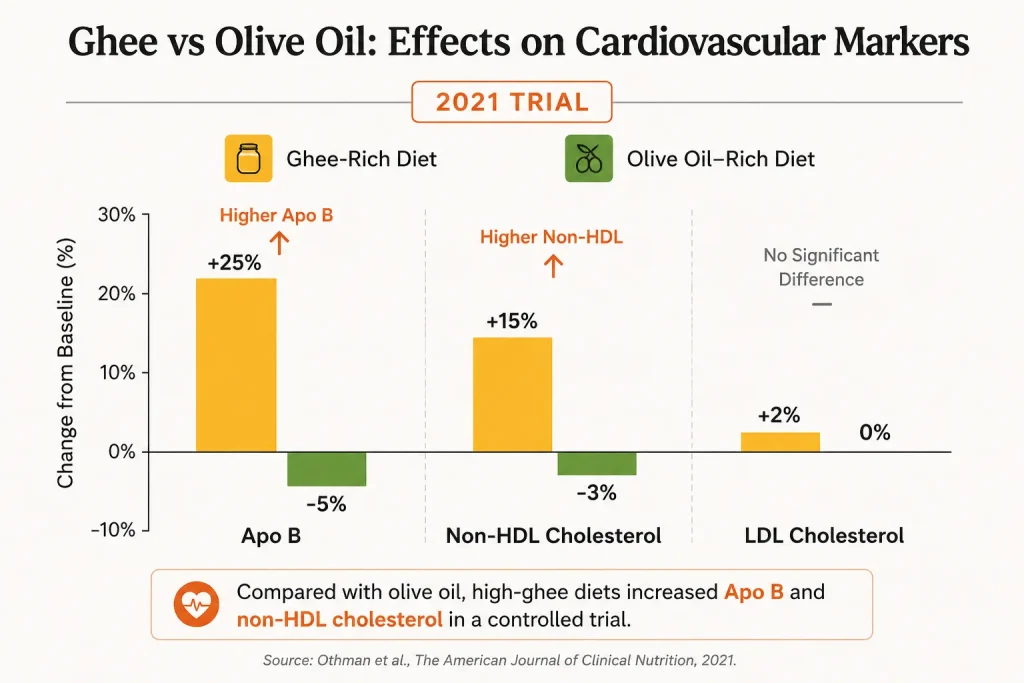
Ghee does raise LDL cholesterol at high intake volumes — this is supported by direct clinical evidence, and it is not a myth. A 2021 randomised crossover trial published in the British Journal of Nutrition, comparing ghee-rich versus olive oil-rich diets in healthy adults, found that the ghee diet significantly increased plasma apolipoprotein B (Apo B) and non-HDL cholesterol compared to olive oil. LDL cholesterol showed a directional increase that did not reach statistical significance. The study concluded that replacing saturated fat-dominant fats like ghee with unsaturated fats like olive oil reduces CVD risk markers.
This is real data and it matters. Anyone who tells you ghee has no effect on LDL is not reading the evidence honestly.
But the effect is dose-dependent and context-dependent. The same study used ghee as the primary cooking fat across an entire diet — a substantially higher intake than the one to two teaspoons most Indian households actually use. Research on Indian populations in south India, where traditional ghee consumption has historically been higher, has also found associations between moderate ghee use and elevated HDL levels, suggesting the lipid picture is not uniformly negative at typical consumption volumes.
The one-sentence verdict: Ghee raises LDL at high intake — especially when it replaces unsaturated fats — but at typical Indian household quantities of one to two teaspoons daily, the cardiovascular effect is modest and context-dependent.
What About Ghee’s Saturated Fat Profile Specifically?
Not all saturated fats behave identically in the body, and ghee’s saturated fat composition is worth understanding rather than dismissing. Ghee is approximately 62% saturated fat by total fat, with palmitic acid as the dominant saturated fatty acid, followed by stearic acid and myristic acid.
Stearic acid, one of ghee’s major saturated fats, is metabolised differently from palmitic acid. Research consistently shows that stearic acid has a neutral effect on LDL cholesterol — it does not raise LDL the way palmitic and myristic acid do. This partially explains why ghee’s LDL-raising effect at moderate doses is less pronounced than a simple “62% saturated fat” headline implies.
Ghee also contains approximately 28% monounsaturated fat, primarily oleic acid — the same fat found in olive oil — and around 4% polyunsaturated fat. It is not simply a block of saturated fat. The fatty acid profile is more varied than most people realise.
The one-sentence verdict: Ghee’s saturated fat is real and relevant, but its specific fatty acid composition — including stearic acid and oleic acid content — makes it nutritionally more complex than the raw saturated fat percentage suggests.
Does Ghee’s Butyric Acid Content Offer Any Heart Benefit?
Ghee contains butyric acid (butyrate) at approximately 3 to 4% of total fat by weight — one of the few dietary sources of preformed butyrate available to the gut. Butyrate is a short-chain fatty acid that serves as the primary energy source for colonocytes (the cells lining the colon) and has well-documented anti-inflammatory effects in the gut.
A 2022 review in ScienceDirect confirmed that butyrate strengthens the gut barrier by enhancing tight junctions and the mucus layer, and reduces inflammatory signalling by inhibiting histone deacetylase (HDAC) — an enzyme that regulates inflammatory gene expression. A 2024 review in PMC specifically explored butyrate’s role in cardiovascular diseases, finding that butyrate can influence cardiovascular health through modulation of G protein-coupled receptors and anti-inflammatory pathways.
This is genuinely interesting science. But the honest caveat is that the butyrate in one or two teaspoons of ghee is a small dose compared to the amounts used in clinical studies. The gut-heart benefit of dietary butyrate from ghee is plausible and mechanistically supported — it is not proven in large human trials specifically.
The one-sentence verdict: Butyrate in ghee has real anti-inflammatory and gut-barrier effects; the cardiovascular benefit through the gut-heart axis is mechanistically plausible but not yet proven at typical dietary doses.
Is Ghee Bad for Heart Health Compared to Other Cooking Fats?
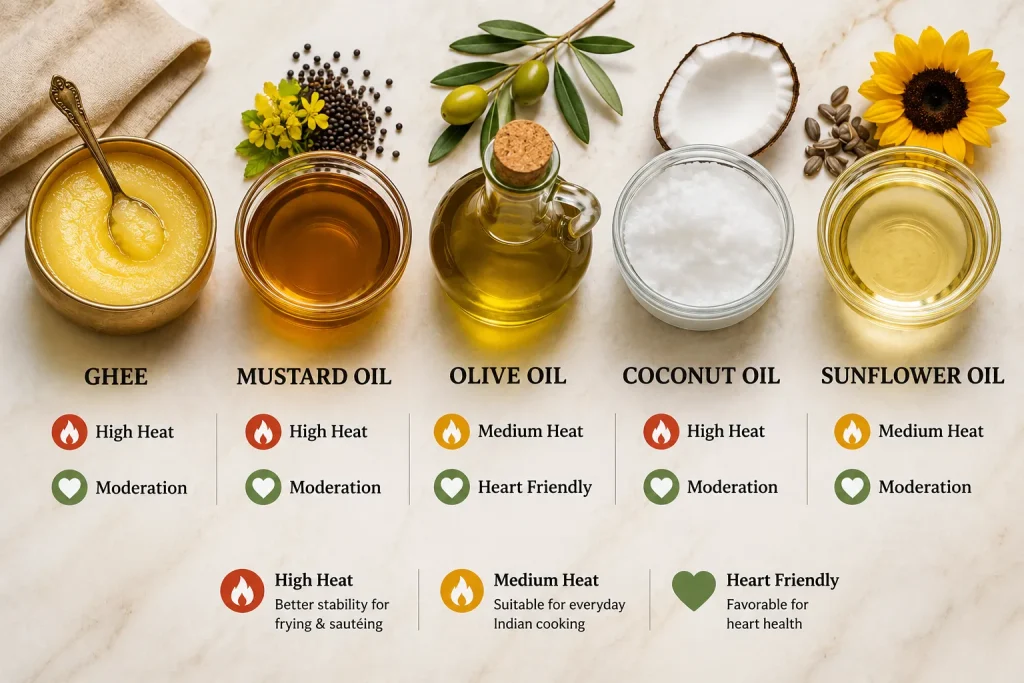
Compared to vanaspati (Dalda): ghee is significantly better for cardiovascular health. Compared to extra virgin olive oil or mustard oil: ghee is likely worse as a primary cooking fat for heart health, based on the LDL and non-HDL effects in the British Journal of Nutrition trial. Compared to refined seed oils: the picture is more nuanced, because many refined seed oils have high omega-6 content and poor oxidative stability at high temperatures, while ghee’s smoke point of approximately 250 degrees Celsius means far fewer harmful oxidation products are formed during Indian high-heat cooking like tadka and deep frying.
This last point is underappreciated. Oxidised lipids — fats that break down under high heat and produce harmful compounds including cholesterol oxidation products — are a genuine cardiovascular concern. Ghee’s stability at high heat means it produces fewer of these compounds than most refined vegetable oils when used for Indian cooking methods that routinely exceed 180 to 200 degrees Celsius.
The one-sentence verdict: Ghee is better than vanaspati, broadly comparable to butter, worse than olive oil as a primary fat, and better than most refined seed oils for high-heat Indian cooking.
Ghee vs Common Indian Cooking Fats: What the Data Shows
| Fat | Saturated Fat % | Smoke Point | Trans Fats | LDL Effect at Moderate Use | Heart Health Verdict |
|---|---|---|---|---|---|
| Pure Desi Ghee | 62% | 250°C | None (natural) | Mild increase at high doses | Use in moderation |
| Vanaspati (Dalda) | 40-50% | 200°C | 14 to 34% iTFA | Significant increase | Avoid |
| Extra Virgin Olive Oil | 14% | 190 to 215°C | None | Neutral to decrease | Prefer for cold use |
| Mustard Oil | 12% | 250°C | None | Neutral to mild decrease | Good for cooking |
| Refined Sunflower Oil | 11% | 227°C | None (but unstable at heat) | Neutral at low use | Avoid for high heat |
| Coconut Oil | 82% | 177 to 232°C | None | Increases LDL and HDL | Use sparingly |
| Butter | 63% | 177°C | Trace natural | Similar to ghee | Similar to ghee |
How Your Body Processes Ghee
Ghee is absorbed as fat in the small intestine and metabolised primarily by the liver, with short-chain and medium-chain fatty acids entering the portal circulation more rapidly than long-chain saturated fats. This metabolic pathway difference is one reason butyric acid and other short-chain fats in ghee behave differently from the long-chain saturated fats that dominate most other animal fats.
When you eat ghee, digestive lipases break down the triglycerides into fatty acids and monoglycerides in the small intestine. These are absorbed through the intestinal wall and packaged into chylomicrons — lipoprotein particles that carry fat through the lymphatic system into the bloodstream. The liver then processes these chylomicron remnants and produces LDL and HDL particles.
LDL (low-density lipoprotein) is the cholesterol-carrying particle associated with arterial plaque buildup when levels are elevated. HDL (high-density lipoprotein) performs reverse cholesterol transport, carrying cholesterol away from arteries back to the liver for excretion. The ratio between LDL and HDL is a more meaningful heart health marker than total cholesterol alone.
Ghee’s saturated fatty acids, particularly palmitic and myristic acid, upregulate LDL receptor activity in a way that increases circulating LDL — this is the established mechanism by which saturated fat raises LDL cholesterol. The effect is real. It is also dose-dependent, meaning small amounts produce a smaller effect than large amounts.
Timing note: Using ghee for cooking rather than adding it raw on top of cooked food at the table does not materially change its metabolic profile. What matters more is total daily quantity and the rest of your dietary pattern — specifically whether you are replacing ghee with refined carbohydrates or with unsaturated fats, since the former does not improve cardiovascular risk markers and the latter does.
What the Research Actually Says
The most directly relevant clinical study is the 2021 British Journal of Nutrition randomised crossover trial, which compared ghee-rich versus olive oil-rich diets in healthy adults. Ghee increased Apo B and non-HDL cholesterol compared to olive oil, though LDL differences did not reach statistical significance. This study used ghee as the primary cooking fat — a higher intake than typical.
An earlier review of existing Indian studies, summarised in a 2025 journal paper on ghee and lipid profiles, found mixed results across different Indian populations. One south Indian study found increased HDL with ghee consumption. A north Indian prospective study of 80 vegetarian subjects consuming 9g of ghee per day for six months found significant increases in LDL, triglycerides, and total cholesterol in 39 of those subjects. A cross-sectional study of 301 north Indian vegetarians found ghee significantly elevated total cholesterol and LDL in both men and women.
A PubMed-indexed review on ghee and serum lipid levels found that the literature does not support harmful effects of moderate ghee consumption in the general population, and that a rural Indian study showed a lower prevalence of coronary heart disease in men who consumed higher amounts of ghee — though this is observational and confounded by other dietary factors.
“The data available in the literature do not support a conclusion of harmful effects of the moderate consumption of ghee in the general population.” — PubMed review on ghee and serum lipid levels, Ayurveda journal.
The honest reality check: most Indians who have heart disease are not eating one teaspoon of pure ghee daily. They are eating an overall diet high in refined grains, sugar, salt, and often vanaspati in packaged food and street food — with ghee receiving the blame because it is visible and culturally conspicuous.
What Nobody Mentions in the Standard Ghee-and-Heart-Disease Discussion
Most articles on ghee and heart health miss the thing that actually matters most for a typical Indian reader.
The vanaspati-in-disguise problem is real. A significant proportion of commercially sold “desi ghee” in India is adulterated with vanaspati or other hydrogenated fats. The FSSAI has documented this repeatedly. Cheap mithai, street food, and even some branded ghee products contain partial hydrogenation products. If your “ghee” is coming from an unverified source, you may be eating vanaspati cardiovascular risk while believing you are eating a traditional food.
People with existing heart disease, high LDL, or familial hypercholesterolaemia should treat ghee as a restricted fat, not a health food. Cardiovascular risk is cumulative and these individuals have less margin for saturated fat. A cardiologist’s guidance applies here, not a nutrition article.
The Indian diet’s real cardiovascular problem is excess refined carbohydrates, low vegetable intake, high sodium, physical inactivity, and stress — not primarily the teaspoon of ghee in the dal. Fixating on ghee while eating white rice three times a day with pickle and papad is misplacing attention.
For anyone wanting to understand heart health more broadly, exercises for heart health that improve cardio naturally and 10 best fruits for heart health you should eat daily cover the lifestyle and dietary factors that move the needle more than cooking fat choices.
How to Know If Ghee Is Right for Your Situation
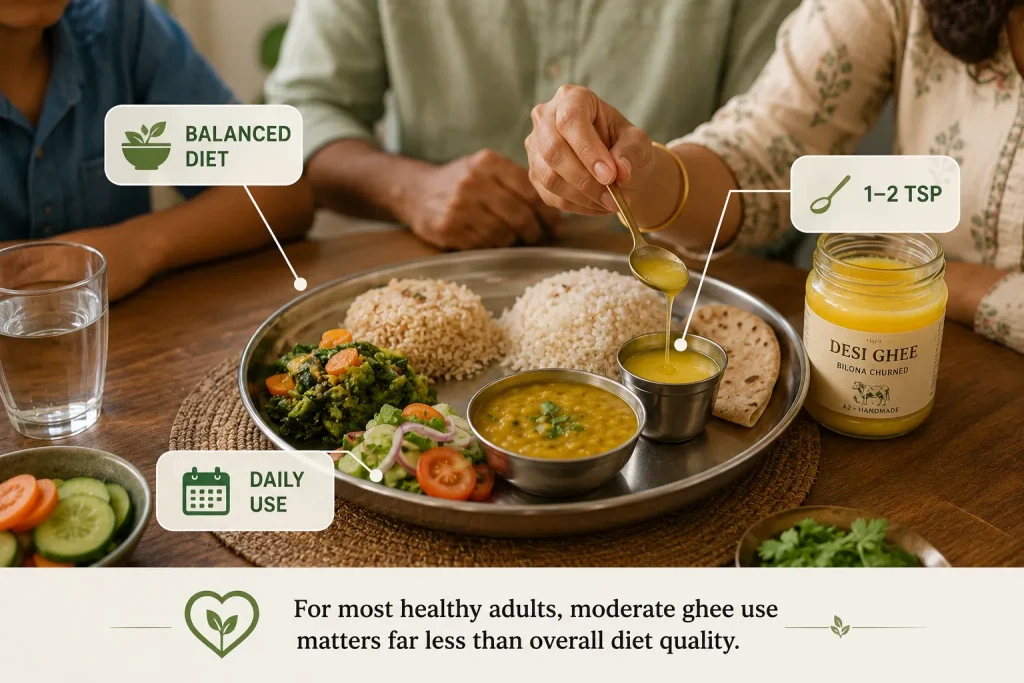
If You Are a Healthy Adult With Normal Cholesterol
One to two teaspoons of pure ghee daily is supported as safe by the available evidence. Use it for high-heat Indian cooking — tadka, tempering, shallow frying — where its smoke point of 250 degrees Celsius outperforms most alternatives. Buy from verified sources and check for FSSAI certification to avoid adulterated products. This is not a food to be afraid of in moderation.
If You Have High LDL or Existing Cardiovascular Disease
Treat ghee as a restricted fat. The dose-dependent LDL-raising effect of ghee’s saturated fat is real, and someone with already elevated LDL has less room for that effect. This does not mean complete elimination — it means discussing your total saturated fat budget with your cardiologist and fitting ghee into that budget, rather than using it freely.
If You Are Vegetarian and Ghee Is Your Primary Cooking Fat
You are likely eating more ghee than you realise, particularly if it is used across multiple meals. Track your daily intake for one week. If you are consistently above two tablespoons per day, the LDL effect becomes a real consideration. Substituting some ghee use with cold-pressed mustard oil or olive oil — particularly for lower-heat cooking — is a practical way to reduce saturated fat load without eliminating ghee entirely.
If You Are Trying to Lose Weight
Ghee is calorie-dense at approximately 120 calories per tablespoon (14g). It does not cause weight gain in any special way beyond being a high-calorie fat — but it is easy to underestimate how much you are using when cooking. For fat loss, the issue is not ghee’s effect on heart health — it is calorie control. Measure rather than pour.
If You Are Concerned About Cholesterol but Eat Ghee for Cultural or Religious Reasons
This is a real tension for a large number of Indians. The practical answer is not to eliminate ghee but to limit it to one teaspoon per day, ensure it is pure and verified, and look at the rest of your diet for larger cardiovascular risk factors. Replacing refined white rice and maida with whole grains, increasing vegetable intake, and reducing sodium will do more for your lipid profile than eliminating ghee entirely. For a complete picture of heart-supportive eating, 10 best fruits for heart health you should eat daily is worth reading alongside this.
The Bottom Line
Pure desi ghee is not bad for heart health at one to two teaspoons daily for most healthy adults. At higher doses — particularly when it replaces unsaturated fats as the primary cooking medium — it does raise LDL and non-HDL cholesterol, and the clinical evidence for this is solid. The safe answer is not “ghee is a superfood” and it is not “ghee causes heart disease.” The safe answer is dose, quality, and dietary context.
The more important conversation for Indian heart health is about vanaspati, refined carbohydrates, salt, and physical inactivity — not the teaspoon of pure ghee in the dal. Pure ghee and vanaspati are not the same food, and treating them as equivalent has muddied this debate for decades.
Use ghee. Use it in measured amounts. Buy it from verified sources. And spend at least as much energy thinking about your vegetables, your whole grains, and your step count as you do about your cooking fat.
People Also Ask
Is ghee bad for heart health?
Ghee is not inherently bad for heart health at moderate consumption of one to two teaspoons daily for healthy adults. At higher intakes, ghee’s 62% saturated fat content raises LDL and non-HDL cholesterol, which are cardiovascular risk markers. The 2021 British Journal of Nutrition trial confirmed this LDL-raising effect compared to olive oil. However, pure desi ghee contains no industrial trans fats and is far less harmful than vanaspati (Dalda), which contains 14 to 34% industrial trans fatty acids directly linked to CVD.
How much ghee per day is safe for the heart?
One to two teaspoons (5 to 10 grams) of pure ghee per day is widely considered safe for healthy adults with normal cholesterol levels. Beyond two tablespoons (approximately 28 grams) per day, measurable increases in LDL and non-HDL cholesterol have been observed in clinical studies. People with existing cardiovascular disease, high LDL cholesterol, or familial hypercholesterolaemia should consult their cardiologist before deciding on a safe daily amount.
Is desi ghee better than butter for heart health?
Desi ghee and butter have very similar saturated fat profiles — ghee at approximately 62% and butter at approximately 63% saturated fat. The main practical difference for heart health is ghee’s higher smoke point of 250 degrees Celsius versus butter’s 177 degrees Celsius, meaning ghee produces fewer harmful oxidation products during high-heat Indian cooking. For cardiovascular effects at rest, both fats behave similarly. Ghee has a slight edge for Indian cooking methods, not for any unique heart-protective compound.
Is vanaspati (Dalda) worse than ghee for the heart?
Yes, significantly worse. Vanaspati contains 14 to 34% industrial trans fatty acids produced during partial hydrogenation, which both raise LDL cholesterol and lower HDL cholesterol simultaneously — a combination that increases cardiovascular risk more than saturated fat alone. Pure ghee contains zero industrial trans fats. A 2014 review in the Pakistan Journal of Medical Sciences confirmed that iTFA consumption is associated with increased cardiovascular disease risk across multiple studies. These two fats should never be treated as equivalent.
Does ghee raise cholesterol in Indians?
Yes, ghee can raise total cholesterol and LDL cholesterol in Indians, particularly at higher intake volumes. Indian studies have shown mixed results: one south Indian study found increased HDL with moderate ghee consumption; a north Indian prospective study found significant LDL, triglyceride, and total cholesterol increases in nearly half of 80 subjects consuming 9 grams of ghee daily for six months. The effect depends on individual metabolic response, total dietary pattern, and how much ghee is consumed per day.
Can ghee be part of a heart-healthy Indian diet?
Yes, in limited amounts. One teaspoon of pure, verified ghee daily as part of a diet rich in vegetables, whole grains, pulses, and fruits is compatible with heart health for most people. The Indian diet’s main cardiovascular risks are excess refined carbohydrates, high sodium intake, low vegetable consumption, and physical inactivity — not primarily moderate ghee use. Using ghee for high-heat cooking where it is stable, while choosing olive oil or mustard oil for other purposes, is a practical balanced approach.
Why do cardiologists tell Indians to avoid ghee?
Most cardiologists advise limiting ghee because of its high saturated fat content, which has a dose-dependent LDL-raising effect, and because many Indian patients with cardiovascular disease have historically consumed ghee in large amounts as part of a high-calorie diet. The advice reflects caution about saturated fat intake in the context of patients who already have high LDL or established heart disease. It is not universally applicable to healthy adults consuming ghee in small amounts. The confusion between pure ghee and vanaspati has also led some older clinical advice to be more restrictive than the current evidence requires.
Sources and References
- Effects of Diets Rich in Ghee or Olive Oil on Cardiometabolic Risk Factors in Healthy Adults: A Randomised Trial — British Journal of Nutrition, 2021. Primary source for ghee’s effect on Apo B, non-HDL cholesterol, and LDL compared to olive oil.
- The Effect of Ghee on Serum Lipid Levels and Microsomal Lipid Peroxidation — PubMed indexed review. Source for the conclusion that moderate ghee consumption does not show harmful effects in the general population, and for the rural India coronary heart disease observation.
- Trans Fatty Acids: A Risk Factor for Cardiovascular Disease — Pakistan Journal of Medical Sciences, 2014. Source for vanaspati trans fat content (14.2 to 34.3% iTFA) and CVD risk association.
- Impact of Ghee Consumption on Human Lipid Profile — IJFMR, 2025. Source for the north Indian prospective study (9g/day, 6 months, 80 subjects) and cross-sectional data on LDL and total cholesterol in Indian vegetarians.
- Butyrate’s Role in Human Health and Clinical Application to Treat Gastrointestinal Disease — ScienceDirect, 2022. Source for butyrate’s gut barrier strengthening and HDAC-inhibition anti-inflammatory mechanisms.
- Recent Advancements of Butyric Acid in Cardiovascular Diseases — PMC, 2024. Source for butyrate’s cardiovascular mechanisms including GPCR modulation and anti-inflammatory pathways.