
Why Are Indians Shorter Than Chinese? The Truth About Height Disparity
Discover the real reason behind the average height India vs China gap. Research shows nutrition, not genetics, explains why Chinese men have grown 8cm taller.
Introduction: The Statistic That Demands an Explanation
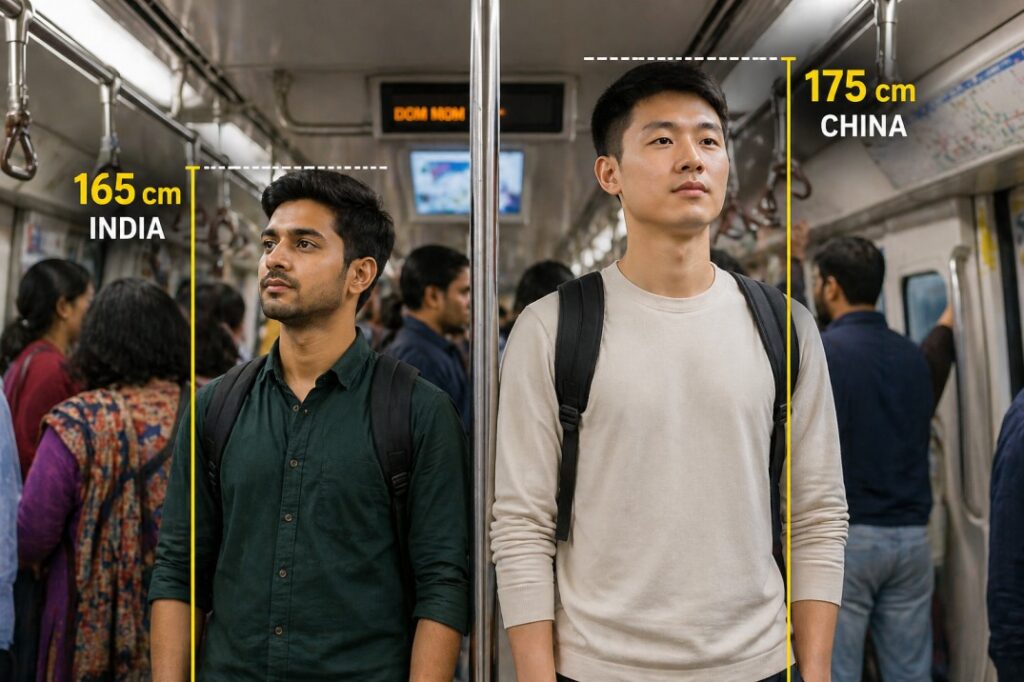
On a crowded Delhi metro, a young man stands at 5’5″ (165 cm). He glances at a Chinese tourist passing by, who is visibly taller—perhaps 5’9″ (175 cm). Neither thinks much of it. But when you zoom out to the national level, the pattern becomes impossible to ignore.
China’s 19-year-old males now average 175.7 cm (5’9″). India’s average? 166 cm (5’5″) . That is nearly a 10 cm (4 inch) gap.
But here is what makes this statistic genuinely shocking: in 1985, the two countries were nearly identical in average height. Over just three decades, China shot up while India barely moved.
The question of average height India vs China isn’t just about centimeters. It is about what those centimeters reveal about two nations’ diverging paths in public health, nutrition, and human development.
And the real reason? It has almost nothing to do with genetics.
The Numbers That Started Everything
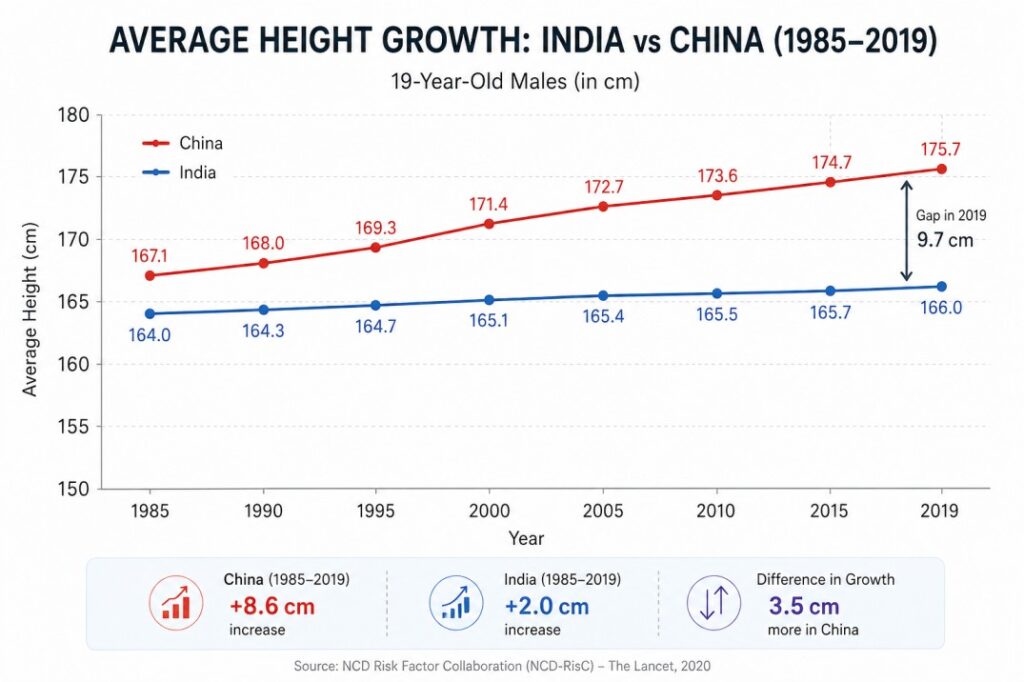
According to a landmark 2020 study published in The Lancet, between 1985 and 2019, “China saw the largest male height increase of any country examined” . Chinese men gained over 8 cm in that period. Indian men? Less than 3 cm.
The study quantified the gap bluntly: “Gains in mean height at age 19 years in China were larger than in India by 3.5 cm for boys and 2.3 cm for girls” .
Another critical finding: China moved from being shorter than India in the 1980s to significantly taller. This crossover tells us something vital—height can change rapidly when conditions improve. If genetics were destiny, populations wouldn’t shift this much this fast.
The Genetic Myth: Why DNA Isn’t the Answer
Let me dismantle the most common assumption immediately.
“Yes, but aren’t South Asians genetically shorter than East Asians?”
The evidence says no.
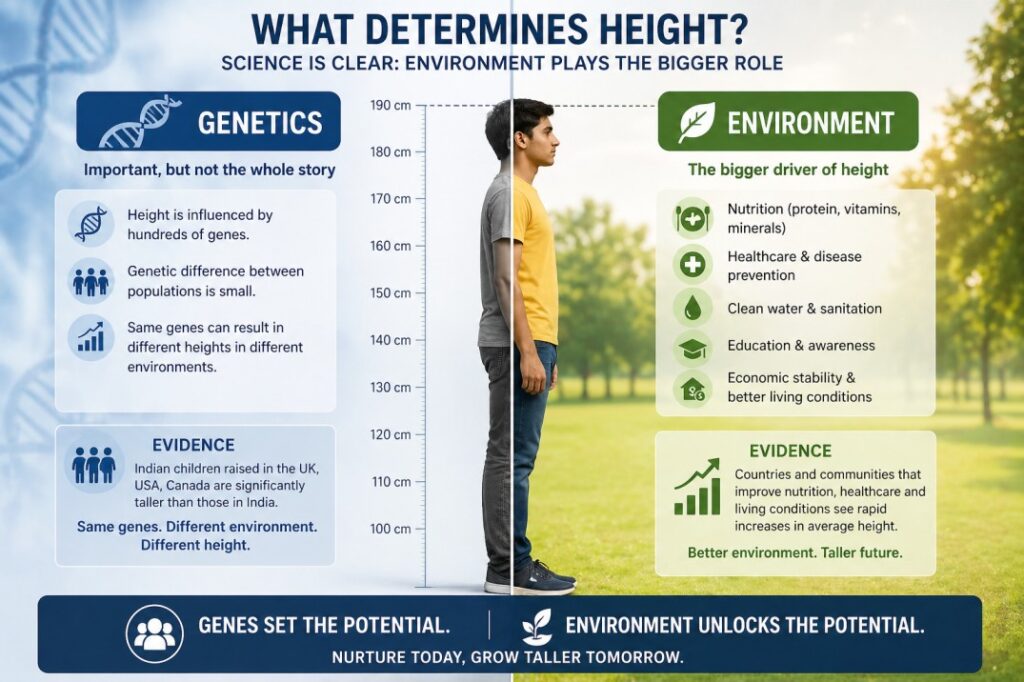
First, the GIANT 2022 height GWAS study analyzed genetic associations for height in 77,890 individuals of South Asian ancestry . While specific genetic variants do influence height, these variants are distributed across populations. The polygenic scores for height between South and East Asians show significant overlap—meaning there is no “short gene” unique to Indians .
Second, and more convincingly: the rapid growth of Indian diaspora populations abroad. Studies consistently show that Indian children raised in the UK, Canada, or the US are significantly taller than their counterparts in India, often approaching or matching local averages. The same genetic pool, dramatically different outcomes.
As one Indian researcher put it to The Indian Express, genetics cannot explain a change that happened in “just two to three generations” . Evolution doesn’t work that fast.
If you want to understand the average height India vs China gap, stop looking at DNA and start looking at dinner plates.
The True Driver: The Nutrition Gap
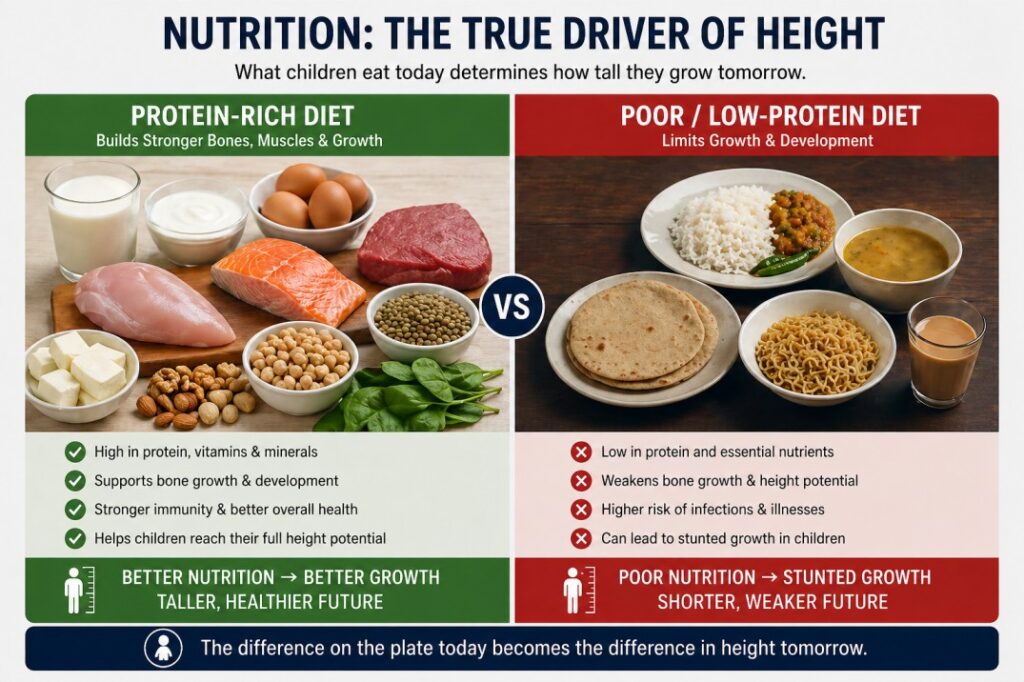
Protein: The Building Block of Height
Dr. Jagadish Hiremath, a public health intellectual, summarizes the disparity succinctly: “The remarkable height increase among Chinese men can be attributed to a combination of factors, including significant improvements in nutrition, healthcare, and economic growth” .
Here is where the rubber meets the road. A 2018 study of 4,747 Indian children aged 3-18 years found something alarming: mean daily energy and protein intakes were significantly lower than recommended dietary allowances for children above age 6 .
More specifically, the study documented a 55% reduction in micronutrient intakes among older children. When researchers ran regression analyses, they found that height-for-age Z-scores (HAZ) were positively associated with protein density—meaning children who ate more protein were taller, even when controlling for parental height .
The Chinese comparison is stark. Data from the China Health and Nutrition Survey (1991-2015) shows that protein intake as a percentage of total calories increased across successive birth cohorts, while carbohydrate intake declined . Chinese families moved from “filling up on rice” to “eating more meat, eggs, and milk.”
This is not a minor difference. This is the difference between a body that has the raw materials to grow and one that doesn’t.
The “30% of Indian Children” Problem
Consider this statistic: over 30% of Indian children remain malnourished according to multiple public health surveys .
The 2024 ICMR-National Institute of Nutrition study of 4,726 children under five in Haryana found that the prevalence of stunting was 34%, underweight 27.5%, and wasting 11% . These are not abstract numbers. Each percentage represents millions of children whose growth potential has been permanently capped.
The same study identified the key risk factors: illiterate mothers, landless households, no access to electricity, low birth weight, and no antenatal care during pregnancy .
Compare this to China’s trajectory. The 2024 Scientific Reports longitudinal study tracking 8,542 Chinese children from 1991-2015 documented that family dietary structure and environmental sanitation significantly accounted for regional height disparities . As household income rose and education levels climbed, children grew taller. By the 2000-2009 cohort, the average height Z-score had moved from negative to positive .
The Urbanization Factor: Cities Make You Taller
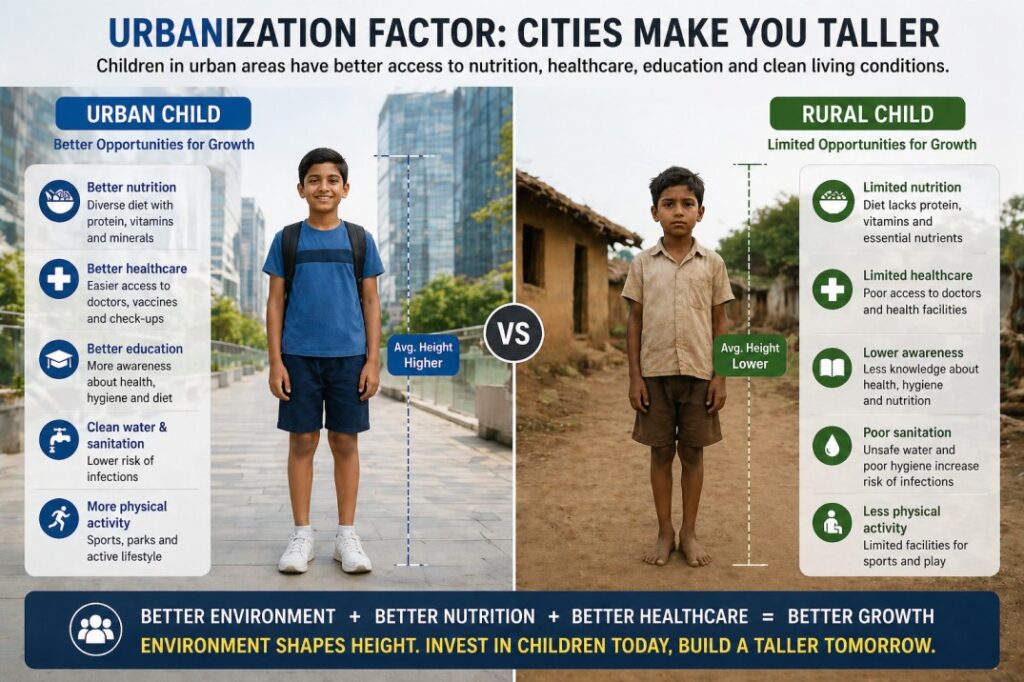
One of the most compelling findings from the Chinese research is the urban-rural height gap.
In the 1990-1999 cohort, the mean height gap between urban and rural Chinese boys at age 13 was 4.07 cm. Urban children also experienced their growth spurt on average 1.4 years earlier than rural children—a difference attributed to better nutrition and hygiene conditions .
Here is the key insight: China closed much of that gap over time. By the 2000-2009 cohort, regional disparities in height were reduced by half after adjusting for family socioeconomic factors . The Chinese government’s investments in poverty reduction, public health infrastructure, and education literally grew the population taller.
India’s urbanization story is different. As Dr. Hiremath notes, “While India has seen economic growth, challenges such as malnutrition, inequitable healthcare access, and poverty remain barriers” . Urbanization in India has not brought the same health improvements because urban slums often replicate rural conditions—poor sanitation, overcrowding, and limited healthcare access.
A study of Indian adolescents put a precise number on it: inactivity was negatively associated with height Z-scores (β = -0.0001, P = 0.049) . Sedentary urban lifestyles, without the compensating factor of better nutrition, don’t produce taller children.

What This Means: The Policy and Personal Takeaways
The National Level
The height gap between India and China is not a verdict on “genetic potential.” It is a verdict on public health priorities.
China invested heavily in:
- Public health infrastructure (sanitation scores improved across cohorts)
- Poverty reduction (median household income rose from 1,254 yuan to 5,100 yuan)
- Education (parental high education rates climbed from 49% to 78%)
India, despite economic growth, has seen slower improvements in these same metrics. The result shows up in national average heights.
The Individual Level
If you are a parent concerned about your child’s growth, the research offers actionable insights:
- Protein density matters. Ensure children get adequate protein at every meal—eggs, dairy, pulses, and if affordable, meat or fish.
- Reduce inactivity. The same 2018 study found physical activity positively correlated with muscle mass and height .
- Antenatal care for mothers is one of the strongest predictors of child height .
- Sanitation matters. Lack of sanitary latrine facilities was associated with significantly higher odds of stunting .
The Verdict: What the Height Gap Really Means
When we examine the average height India vs China gap, the data points in one direction. Genetics did not change in 30 years. Diets, healthcare systems, and sanitation did.
China made a national investment in human growth—quite literally. India has made progress, but the pace has been slower, particularly for the most vulnerable populations.
The good news? This gap is not permanent. Height is a lagging indicator of public health. If India can address the malnutrition crisis affecting over 30% of its children, improve maternal education, and expand access to clean water and sanitation, the next generation will stand taller.
Not because their DNA changed. But because their circumstances did.

Related Articles You Should Read
Before you go, these articles will help you understand the full picture of nutrition and growth:
High Protein Foods for Fat Loss: A Simple Beginner’s Guide That Actually Works – Learn why protein is the single most important nutrient for growth and body composition, with practical Indian food examples.
How to Lose Weight in 30 Days: The Realistic, Science-Backed Plan That Works – Apply nutrition science to your own body composition goals with this evidence-based 30-day protocol.
Top 5 Supplements for Fat Loss That Actually Work in 2026 – Understand which supplements actually support metabolic health (and which are just marketing).
What’s Next?
What do you think about the height gap? Have you noticed generational differences in your own family—children growing taller than their parents or grandparents?
Share your experience in the comments below. And if you found this analysis valuable, share it with someone who still believes that height is “just genetics.” The truth matters—and it might just change how we think about nutrition policy.







One Response
Really insightful article. I agree that nutrition and early childhood conditions play a much bigger role than genetics. The focus on stunting highlights an important issue that deserves more attention in India.