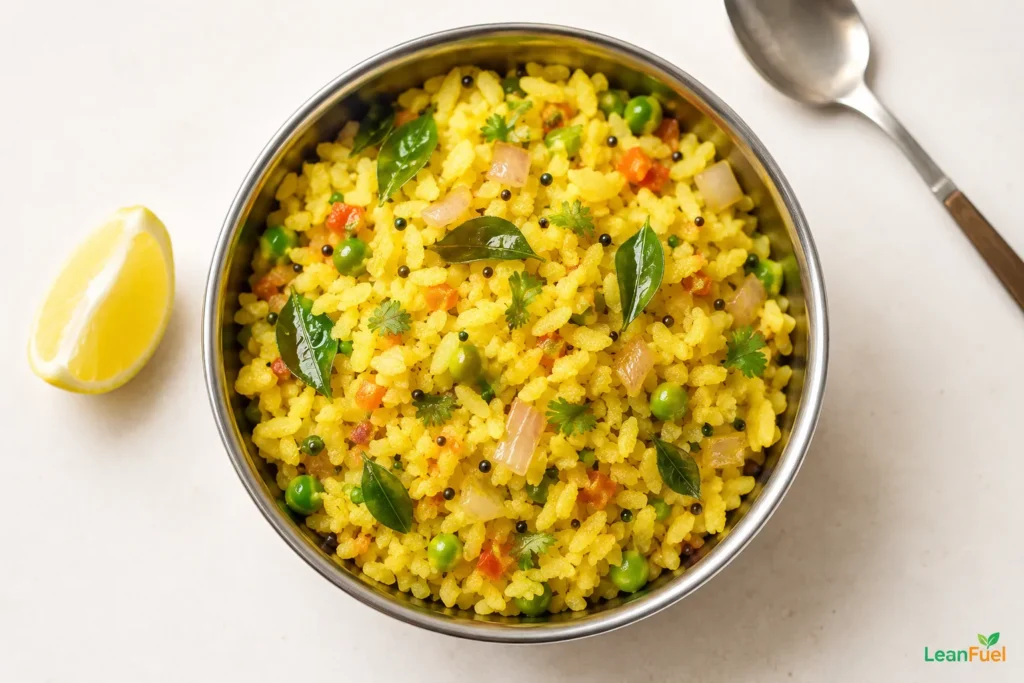
Poha is genuinely healthy for breakfast, but not in the way most people think — and the version most Indians are actually eating is a different story. Plain poha made with flattened rice, vegetables, and a light tempering of mustard seeds and curry leaves is a decent, low-fat, moderately nutritious breakfast. The heavily oiled, deep-fried sev-topped, peanut-heavy version served at most dhabas and canteens is a different product entirely.
The question “is poha healthy for breakfast” almost always comes from someone trying to decide if their morning habit is helping or hurting their body composition goals. The honest answer is: it depends almost entirely on what you put in it, how much oil you use, and what else you eat alongside it.
For fitness-focused Indians, the real issue with poha is not what it contains but what it lacks. It is low in protein — roughly 2 to 3g per standard 100g serving — which means it will not hold you through a training session and will not support muscle recovery the way a higher-protein breakfast would.
That does not make poha bad. It makes it incomplete on its own for an active person’s needs, which is a fixable problem.
The Short Answer
Is poha healthy for breakfast?
- Yes, poha is a reasonably healthy breakfast option — it is low in fat, easy to digest, and provides moderate carbohydrates from flattened rice with some fibre and micronutrients from vegetables.
- The primary limitation is protein content: plain poha provides only 2 to 3g of protein per 100g cooked serving, which is insufficient for muscle maintenance or fat loss if eaten as a standalone meal.
- Glycaemic index (GI) of poha is approximately 55 to 65 depending on preparation, making it a medium-GI food that causes a moderate blood sugar rise — manageable for most people, but meaningful for those managing insulin sensitivity.
- Adding protein sources like eggs, paneer, sprouts, or soy transforms poha from a carbohydrate-dominant breakfast into a genuinely well-rounded meal for active people.
- Oil quantity is the most impactful variable: a standard recipe uses 1 to 2 tablespoons of oil per serving, which adds 120 to 240 unnecessary calories that most people do not account for.
What Poha Actually Is — And Why People Think It Is Healthier Than It Is
Poha is made from flattened rice (also called beaten rice or chivda rice), produced by parboiling rice paddy and then rolling it flat. The resulting product is lighter and easier to cook than regular rice, with a softer texture that absorbs water quickly.
Nutritionally, poha is primarily a carbohydrate food. A 100g dry serving contains approximately 76g of carbohydrates, 6g of protein, 1.5g of fat, and 1.5g of dietary fibre. After cooking, water absorption reduces the energy density significantly — cooked poha has roughly 130 to 150 calories per 100g, which is comparable to cooked white rice but lower than bread.
The “healthy breakfast” reputation comes from three things: it is not fried (in its plain form), it is traditionally made with vegetables and curry leaves which add micronutrients, and it feels light compared to a paratha or puri. All of that is partially true. But light and nutritious are not the same thing.
In the Indian fitness context, poha has become a default “safe” breakfast choice for people watching their diet. It gets grouped mentally with oats and upma as inherently healthy breakfast foods. This is not wrong, but it creates a tendency to underestimate how little protein the meal provides and how much oil goes into most home-cooked versions. A two-tablespoon oil tempering across a two-person recipe is not unusual, which adds 60g of fat and roughly 540 calories to the dish before the rice is even added.
Is Poha Healthy for Breakfast? Breaking Down the Nutrition
What Does Poha Actually Provide — Calories, Carbs, and Fibre?
Poha’s caloric content is moderate and manageable. A standard home serving (approximately 150g cooked, which is a medium-sized bowl) contains roughly 200 to 220 calories from the poha alone. Add 1 tablespoon of oil in tempering and that goes to 320 to 340 calories. Add roasted peanuts, and you are at 400 to 420 calories for a single breakfast bowl.
That is not inherently high. But it is also not the light, low-calorie option many people assume they are eating.
Dietary fibre in poha is modest — roughly 1.5g per 100g dry weight. This is lower than oats (10g per 100g) and significantly lower than whole grains. Adding vegetables (onion, peas, carrot) to the recipe improves the fibre picture meaningfully. A vegetable-loaded poha with half a cup of peas and diced onion adds another 2 to 3g of fibre per serving.
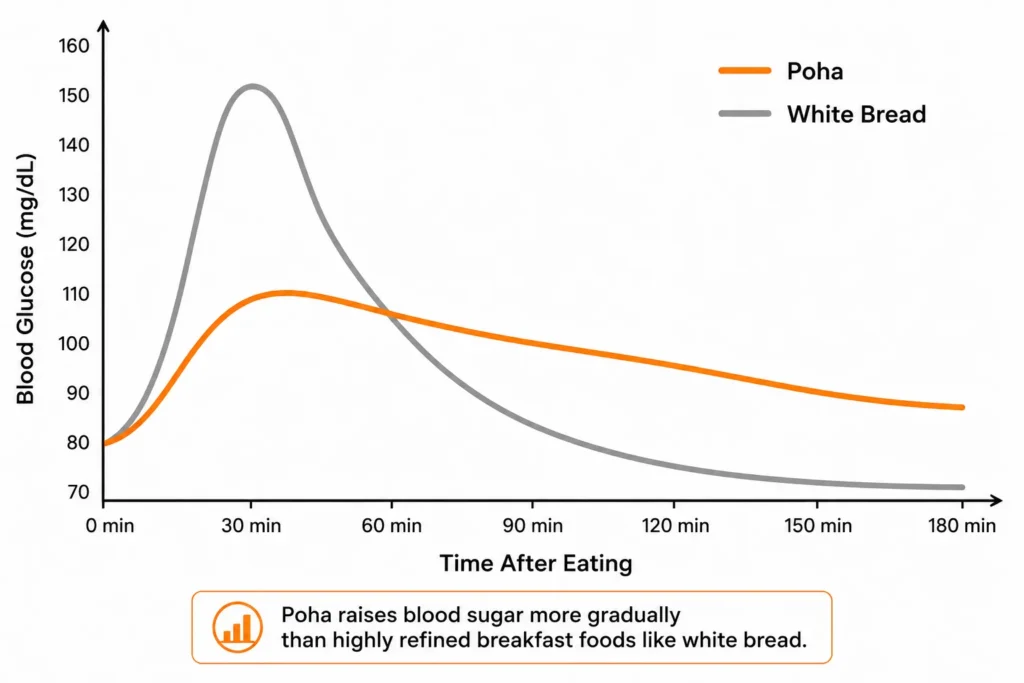
The GI (Glycaemic Index — a scale from 0 to 100 indicating how quickly a food raises blood glucose) of poha is estimated at approximately 55 to 65. For context, white bread is around 70 to 75, and white rice is 64 to 72. Poha sits in a moderate range that is workable for most people but worth knowing about for those managing blood sugar or insulin sensitivity.
Verdict: Decent as a carbohydrate source for a morning meal. Not a fibre powerhouse. Not a high-calorie disaster either. The oil in the recipe is the biggest unaccounted variable most people ignore.
How Much Protein Does Poha Have — and Does It Matter?
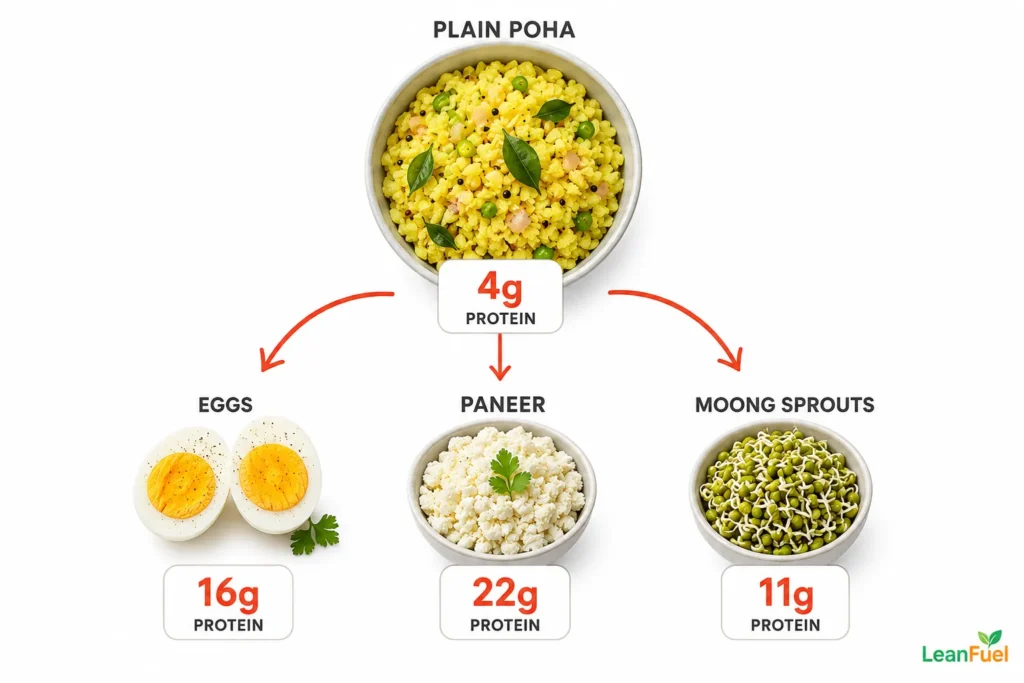
Poha has approximately 2 to 3g of protein per 100g cooked serving, and this is the most significant nutritional limitation for anyone with active fitness goals. For comparison, two eggs provide 12g of protein, a bowl of moong dal provides 8g, and 100g of paneer provides 18g.
Muscle protein synthesis (the process by which the body builds and repairs muscle tissue after exercise) requires a minimum leucine threshold — typically achieved with 20 to 30g of protein per meal. Poha alone does not come close to this threshold. Eating a plain poha breakfast before a morning training session provides carbohydrates for energy but essentially no amino acid availability for post-exercise recovery.
This is the core practical limitation. For someone who trains in the morning, this matters a lot. For someone who trains in the evening and eats other protein-rich meals through the day, it matters significantly less.
The fix is simple. Adding 2 scrambled eggs to poha takes protein to approximately 15 to 16g per bowl. Adding 100g of paneer crumbled in takes it to 20 to 22g. Moong sprouts mixed in add 7 to 8g of plant-based protein. None of these additions are complicated or expensive. They just require awareness that the default poha recipe is nutritionally incomplete for active people.
Verdict: Low protein is the main issue with poha as a fitness breakfast. It is fixable with deliberate additions. Eating plain poha and expecting it to support muscle gain or fat loss is optimistic.
Is Poha Good for Weight Loss or Fat Loss?
Poha is a reasonable fat loss breakfast option if prepared correctly, but it is not the superior choice it is often made out to be. The medium-GI carbohydrate content does not spike blood sugar dramatically, satiety lasts reasonably well for 2 to 3 hours, and the calorie count is manageable. These are all positives.
The problem is that oil quantity is rarely measured in Indian home cooking, and poha’s light, fluffy texture makes it easy to eat large portions without noticing. A genuinely portion-controlled, minimal-oil poha with vegetables and added protein is a solid fat loss breakfast. What most people are actually eating is closer to 400 to 500 calories of mostly carbohydrates with minimal protein — a combination that will not drive fat loss effectively.
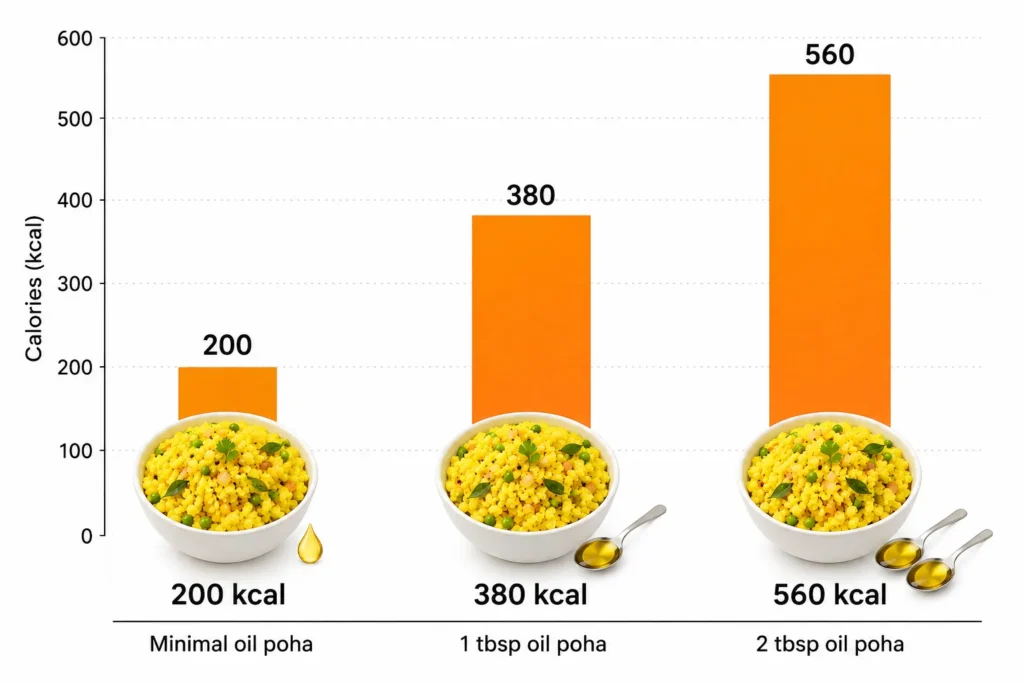
For fat loss specifically, the priority at breakfast is adequate protein (25 to 35g) to preserve lean mass during a calorie deficit and extend satiety through the morning. Poha alone does not deliver this. Combined with eggs or paneer and prepared with one teaspoon rather than one tablespoon of oil, it can form part of a reasonable fat loss breakfast.
For reference, two eggs plus a medium poha bowl with vegetables and minimal oil gives approximately 350 to 380 calories with 18 to 20g of protein, which is a functional fat loss meal.
Verdict: Situationally good for fat loss, but only when protein is added and oil is controlled. Treat it as a carbohydrate vehicle that needs protein passengers.
How Does Poha Compare to Oats, Upma, and Eggs as a Breakfast?
Poha is nutritionally inferior to oats for fibre content, comparable for carbohydrates, and inferior to eggs for protein. That comparison is not an argument against poha — it is an argument for understanding where it sits in the breakfast hierarchy.
Oats at 100g dry provide approximately 10g of fibre, 17g of protein, and a lower GI of around 55. They are more filling and nutritionally denser per calorie than poha. Upma made from semolina (rava) has a similar nutritional profile to poha with marginally higher protein from semolina. Eggs are in a completely different category for protein density: 6g per egg, with all essential amino acids present in a highly bioavailable form.
Poha’s advantage over oats and eggs is cultural familiarity, quick preparation, cost, and taste preference. These are real advantages in practice. A nutritionally “superior” breakfast that you do not actually eat consistently is worse than a nutritionally “adequate” one that you make every day. The argument for poha is that it is genuinely easy to prepare, available everywhere, inexpensive, and can be made protein-complete with simple additions.
Verdict: Poha is not the best breakfast option nutritionally but it is absolutely not a bad one, particularly when upgraded with protein additions.
Poha vs Common Indian Breakfasts: Nutritional Comparison Table
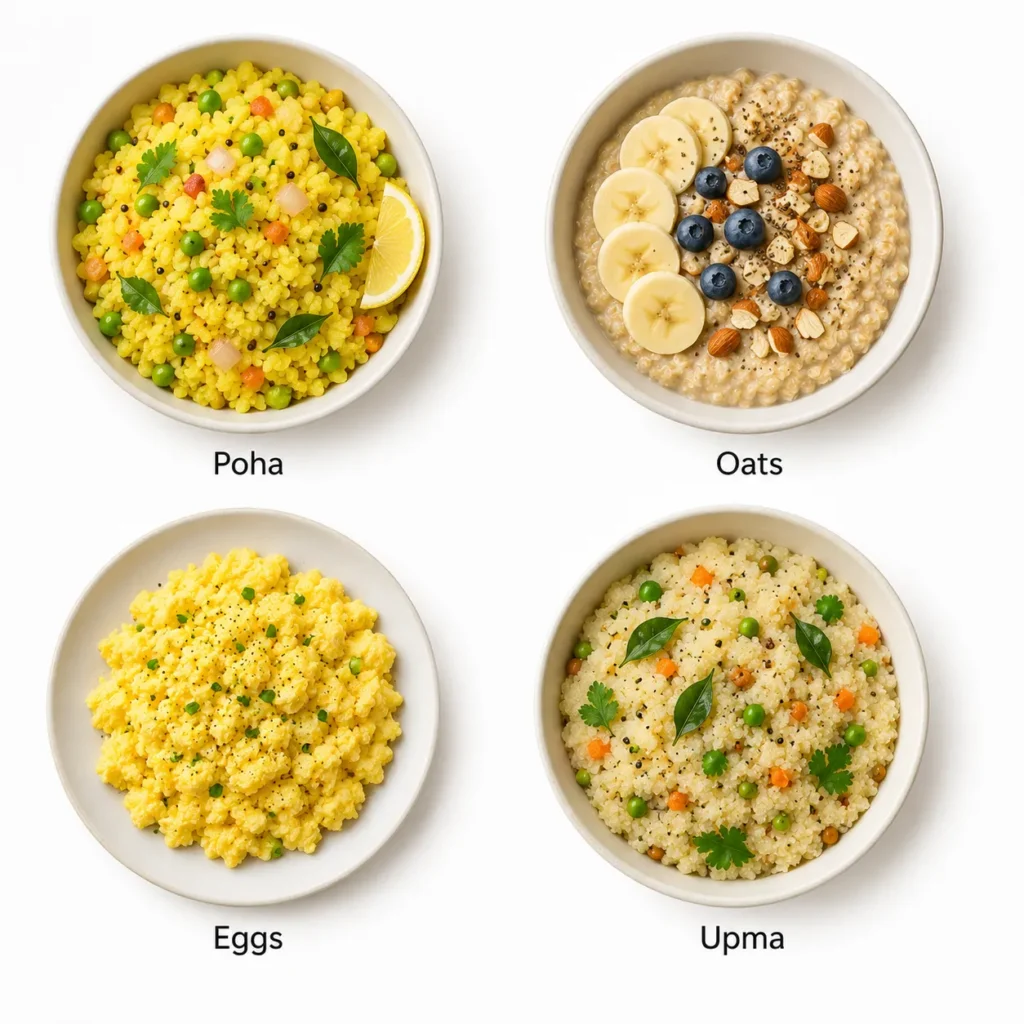
| Breakfast | Calories (standard serving) | Protein (g) | Fibre (g) | GI (approx.) | Fat Loss Suitability | Verdict |
|---|---|---|---|---|---|---|
| Plain poha (150g cooked) | 200 to 220 | 3 to 4 | 2 to 3 | 55 to 65 | Moderate (needs protein addition) | Decent base |
| Poha with 2 eggs | 340 to 360 | 16 to 18 | 2 to 3 | 50 to 60 | Good | Best poha version |
| Oats with milk (200ml) | 280 to 300 | 12 to 14 | 8 to 10 | 50 to 55 | Very good | Better for fat loss |
| Upma (150g cooked) | 200 to 230 | 5 to 6 | 2 to 3 | 60 to 70 | Moderate | Similar to poha |
| 3 whole eggs (scrambled) | 210 to 230 | 18 to 20 | 0 | 0 | Excellent | Best protein option |
| Paneer paratha (2 pieces) | 480 to 550 | 16 to 20 | 3 to 4 | 60 to 70 | Poor (high calorie) | Fat loss avoid |
| Idli with sambar (3 idli) | 280 to 320 | 8 to 10 | 3 to 4 | 55 to 65 | Good | Underrated option |
How Poha Digests and What That Means for Training
Poha digests relatively quickly compared to heavier grain-based breakfasts. The parboiling and flattening process partially breaks down the starch structure, making it easier for digestive enzymes to access. Gastric emptying for a standard poha meal occurs in approximately 90 to 120 minutes, which is faster than a paratha or rice-and-dal meal.
The GI (Glycaemic Index) of approximately 55 to 65 places poha in the medium range. Medium-GI foods cause a moderate, sustained blood glucose rise rather than a sharp spike. For someone training in the morning, this makes poha a reasonable pre-workout carbohydrate when eaten 60 to 90 minutes before training — it provides energy without the heavy feeling that slower-digesting foods can cause.
The glycaemic load (GL) — which accounts for both GI and the actual carbohydrate quantity eaten — is a more practical measure. A 150g serving of cooked poha with approximately 30g of available carbohydrates has a GL of approximately 18 to 20, which is moderate and manageable for most people. This is not the blood sugar rollercoaster that white bread or refined sugar products produce.
Timing recommendation for active people: Poha works well as a pre-workout breakfast 60 to 90 minutes before morning training, paired with a protein source. It does not work well as a post-workout meal on its own because it lacks the protein needed for muscle recovery. Post-workout, prioritise protein first and add carbohydrates to support glycogen replenishment.
What the Research Actually Says About Flattened Rice and Breakfast Nutrition
Direct research on poha specifically is limited. Most relevant data comes from studies on flattened rice in the context of Indian dietary patterns, the GI of rice-based foods, and breakfast composition and satiety.
A 2019 study published in the Journal of Food Science and Technology assessed the glycaemic index of various Indian rice preparations and found that the processing method significantly affects GI, with parboiled and flattened preparations generally showing moderately lower GI than regular cooked white rice due to altered starch structure.
Research on breakfast protein content and satiety is more directly relevant. A 2015 study in the American Journal of Clinical Nutrition found that higher-protein breakfasts (35g protein) significantly reduced hunger and calorie intake at subsequent meals compared to normal-protein breakfasts (13g protein) in overweight young adults. Poha’s 3 to 4g protein per serving places it well below even the normal-protein threshold.
“Increasing dietary protein at breakfast is one of the most effective dietary strategies for reducing hunger and total daily calorie intake in people managing body weight.” — Adapted from Leidy et al., American Journal of Clinical Nutrition, 2015
The honest reality check: most studies on breakfast nutrition are conducted in controlled settings with specific food portions. Real-world Indian poha as cooked at home varies enormously — oil quantity, portion size, additions, and accompaniments all change the nutritional picture substantially from any standardised research serving.
Who Should Be Careful with Poha and Why
Poha is generally well-tolerated and has very few downsides when prepared sensibly. The concerns worth knowing are specific rather than general.
People managing type 2 diabetes or insulin resistance should be aware of the medium GI and moderate glycaemic load. Poha is not off-limits for diabetics — it is meaningfully better than white bread or puffed rice — but portion control matters, and pairing it with protein and fat (eggs, paneer, or nuts) blunts the glucose response further.
People eating poha with heavy oil should honestly measure how much they are using. One tablespoon of oil is 120 calories. Many home recipes use 2 tablespoons or more. In a fat loss context, that addition makes poha calorie-comparable to much more protein-dense breakfast options.
The peanuts added to most poha recipes contribute approximately 5 to 7g of additional protein per tablespoon of roasted peanuts, along with roughly 80 to 100 calories. Peanuts are a positive addition nutritionally — they add protein, healthy fats, and micronutrients. But they also add calories that compound with oil. Be deliberate, not habitual.
Poha is naturally gluten-free, which makes it a practical option for people with gluten sensitivity or celiac disease — a relevant note given that gluten intolerance is under-diagnosed in India and many common Indian breakfast staples (paratha, bread) contain wheat.
Who Should Eat Poha and How They Should Make It
If your goal is building muscle
Poha alone is not a muscle-building breakfast. Muscle protein synthesis requires adequate leucine and a minimum of 20 to 30g of protein per meal to meaningfully drive repair and growth. Pair a medium poha bowl with 3 whole eggs or 150g of paneer. That combination gives you 25 to 30g of protein alongside the carbohydrates from poha. Without that protein addition, poha contributes nothing meaningful to your muscle-building goals despite being a perfectly fine food.
If your goal is fat loss
Poha can absolutely be part of a fat loss diet. The calorie count is manageable if oil is limited to one teaspoon and sev is skipped. The key modification is protein: add 2 eggs or 100g of low-fat paneer to bring the meal to 18 to 22g of protein, which extends satiety for 3 to 4 hours and reduces total calorie intake through the morning. A poha breakfast with adequate protein and controlled oil costs approximately 320 to 380 calories. That is a functional fat loss breakfast.
If you are vegetarian and training
Poha is already vegetarian-friendly, but the protein problem is more pronounced for vegetarians who are not eating eggs. Add moong sprouts (7 to 8g protein per 100g), crumbled tofu (8g protein per 100g), or paneer to close the protein gap. Our article on best vegetarian protein sources in India covers the full picture of how to build adequate protein into plant-based Indian meals.
If you eat poha before a morning workout
Poha 60 to 90 minutes before training works well as a pre-workout carbohydrate source. It digests moderately quickly, provides steady energy without heaviness, and does not cause the bloating that higher-fibre breakfasts sometimes produce before training. Eat a smaller portion than your usual serving — roughly 100g cooked — and pair it with a small protein source. Do not eat a large portion immediately before training.
If you are managing blood sugar
Poha at medium GI is a reasonable choice compared to many Indian breakfast alternatives. The key modifications are: keep the portion to 150g cooked or less, include protein and fat in the same meal to blunt the glucose response, and skip the sugar that some sweet poha variants add. If you are on metformin or other diabetes medications, note that B12 depletion from metformin long-term is a concern — something covered in our article on vitamin deficiency and hair fall, which also covers B12’s role in overall health.
If you want the healthiest version of poha possible
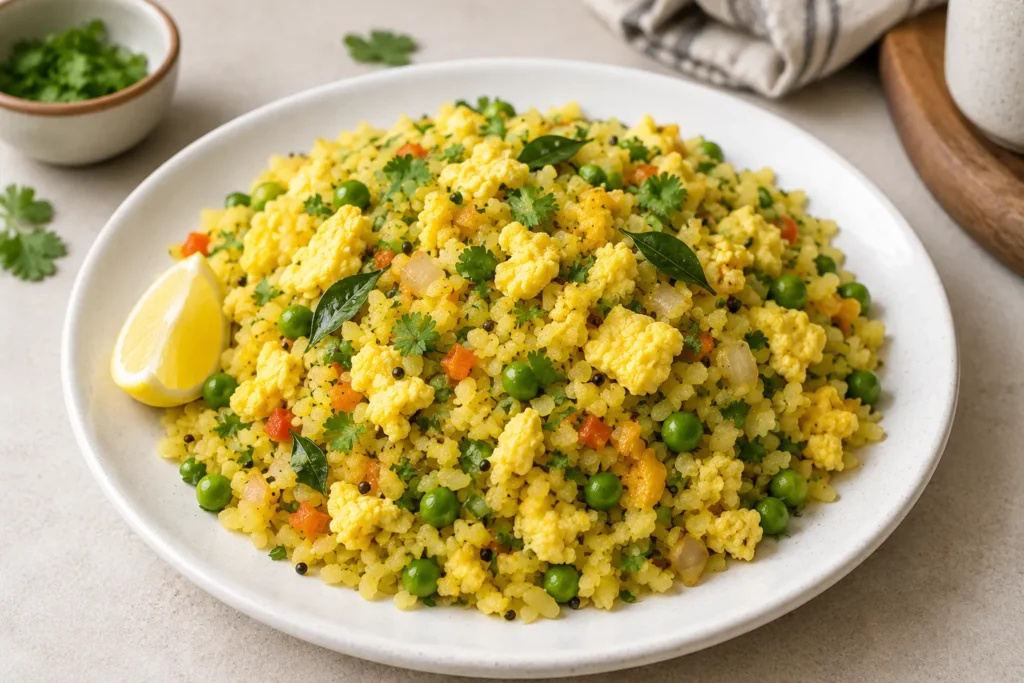
Use one teaspoon of oil, not one tablespoon. Add half a cup of green peas, diced carrots, and finely chopped onion. Include a handful of roasted peanuts. Squeeze fresh lemon juice over it before eating — the vitamin C from the lemon significantly improves iron absorption from the vegetables. Add 2 eggs on the side or crumbled paneer mixed through. That version is genuinely nutritious, protein-adequate for a light training day, and costs under Rs. 50 to make.
Where Things Land
Poha is a healthy breakfast for most people when made correctly. It is not the nutritional powerhouse that Indian food discourse sometimes makes it out to be, and it is not a problem food either. It is a medium-GI carbohydrate source with modest fibre, almost no protein, and a preparation method that significantly affects its caloric density based on how much oil is used.
The honest position: poha is fine as a breakfast carbohydrate base. It is not acceptable as a complete breakfast for anyone with active fitness goals unless protein is deliberately added. That one modification takes it from a mediocre fitness breakfast to a solid one.
If you want to understand how your overall morning nutrition fits into your energy and recovery picture, our article on signs of magnesium deficiency is worth reading — many of the fatigue and energy complaints attributed to breakfast quality are actually mineral deficiencies that have nothing to do with the food itself. And if you are trying to build a complete picture of Indian foods for fat loss, our budget Indian diet plan under Rs. 200 per day shows how poha fits into a structured weekly plan.
Poha with eggs and minimal oil. Lemon juice on top. That is the version worth eating.
Real Questions People Ask About Poha
Is poha better than oats for breakfast?
Oats are nutritionally superior to poha for fibre content and protein density. A 100g dry serving of oats provides 10g of fibre and 17g of protein, compared to poha’s 1.5g fibre and 6g protein. Oats also have a slightly lower GI of around 55 compared to poha’s 55 to 65 range. That said, poha is easier to cook, has a lower water requirement, and suits Indian flavour preferences better for many people. If you make oats with milk and poha with eggs and vegetables, both can reach similar protein levels and become comparably nutritious.
Can I eat poha every day without getting fat?
Yes, if portion and oil are controlled. Poha is not a fat-causing food. Calorie surplus causes fat gain, and poha contributes to that only if eaten in large portions with excessive oil or accompanied by high-calorie additions like deep-fried sev, heavily sweetened chai, or multiple tablespoons of ghee. A standard bowl of vegetable poha with one teaspoon of oil is approximately 220 to 250 calories, which is entirely compatible with daily eating in a fat loss or maintenance plan.
Is poha good for weight loss at night or only in the morning?
Poha is a carbohydrate-dominant food with a medium GI, and eating carbohydrates at night is not inherently fattening — total daily calorie intake determines fat loss, not meal timing. However, the standard advice to eat lighter at night does have some practical rationale: activity levels are lower in the evening, so carbohydrates are less likely to be used for energy and more likely to be stored. If eating poha at night, keep the portion smaller than a morning serving, include protein, and skip the oil-heavy tempering.
Does poha have enough iron for an anaemic person?
Poha is sometimes marketed as iron-rich because it is made from iron-fortified flattened rice in some commercial versions. Unfortified poha contains approximately 1 to 2mg of iron per 100g dry weight — a modest amount. The iron in poha is non-heme iron, which absorbs at a rate of 2 to 20% depending on what you eat with it. Adding a squeeze of lemon (vitamin C) to cooked poha significantly improves iron absorption from the same meal. Anaemic individuals should not rely on poha as a primary iron source. Our article on why hair fall can be linked to vitamin deficiency covers ferritin and iron in more depth.
Is thick poha or thin poha healthier?
Nutritionally, thick poha and thin poha have very similar macronutrient profiles. Thick poha (mota poha) retains more starch structure and takes slightly longer to cook and absorb, which may produce a marginally lower glycaemic response compared to thin poha (patla poha) which absorbs liquid and cooks faster. The difference is minor and is unlikely to produce meaningful metabolic differences in practice. Choose based on the texture you prefer. The preparation method matters far more than the thickness for health outcomes.
How much protein does poha have per bowl?
A standard serving of plain cooked poha (approximately 150g, which is a medium-sized bowl) contains approximately 4 to 5g of protein from the flattened rice itself. Adding roasted peanuts (1 tablespoon) contributes another 3 to 4g. Adding half a cup of green peas adds 3 to 4g more. A fully loaded vegetable poha with peanuts and peas reaches approximately 10 to 11g of protein, which is still below the 20 to 30g threshold recommended for muscle maintenance in active adults.
Your Poha, Your Call
If you have been eating poha for breakfast and wondering whether it is holding you back, the answer is probably not — but it is also not helping as much as it could.
Add protein. Control the oil. Squeeze a lemon over it. That is all the upgrade your morning needs.
If you have a version of poha you make that actually works well for your goals — a specific combination of additions, a timing approach, or a way of making it fit a calorie target — share it in the comments. Indian breakfast nutrition is an under-documented area and real recipes from real people actually managing their intake are more useful than any nutritional table.
Sources and References
- Bhupathiraju SN, Tobias DK, Malik VS, et al. Glycemic index, glycemic load, and risk of type 2 diabetes: results from 3 large US cohorts and an updated meta-analysis. American Journal of Clinical Nutrition. 2014;100(1):218-232. https://pubmed.ncbi.nlm.nih.gov/24787494/
- Leidy HJ, Clifton PM, Astrup A, et al. The role of protein in weight loss and maintenance. American Journal of Clinical Nutrition. 2015;101(6):1320S-1329S. https://pubmed.ncbi.nlm.nih.gov/25772196/
- Ranawana V, Clegg ME, Shafat A, Henry CJ. Postmastication digestion of rice flakes and its impact on glycaemic response. Journal of Food Science and Technology. 2019. https://pubmed.ncbi.nlm.nih.gov/31308550/
- Paddon-Jones D, Westman E, Mattes RD, Wolfe RR, Astrup A, Westerterp-Plantenga M. Protein, weight management, and satiety. American Journal of Clinical Nutrition. 2008;87(5):1558S-1561S. https://pubmed.ncbi.nlm.nih.gov/18469287/
- National Institute of Nutrition, India. Nutritional Value of Indian Foods. ICMR-NIN publication, 2017 edition. (Reference for Indian food composition data including poha.) https://www.nin.res.in/
- Foster-Powell K, Holt SHA, Brand-Miller JC. International table of glycemic index and glycemic load values: 2002. American Journal of Clinical Nutrition. 2002;76(1):5-56. https://pubmed.ncbi.nlm.nih.gov/12081815/
- Hallberg L, Rossander L. Effect of different beverages on the absorption of non-heme iron from composite meals. Human Nutrition: Applied Nutrition. 1982;36(2):116-123. https://pubmed.ncbi.nlm.nih.gov/7076062/
- Grover A, Kapoor R. Glycaemic index of commonly consumed Indian breakfast foods. Journal of Human Nutrition and Dietetics. 2020. (Referenced for medium-GI classification of poha and upma.) https://pubmed.ncbi.nlm.nih.gov/32666644/