
Introduction: 3 Out of 4 Indians Need More Sunlight—But That’s Only Half the Story
You live in a country that bathes in sunlight year-round. And yet, an estimated 76% of Indians have insufficient or deficient vitamin D levels. Something doesn’t add up.
The obvious guess? We don’t go outside enough. That’s partly true. But it’s also a lazy explanation. The real reasons for vitamin D deficiency in India run deeper—into how our skin evolved, what we eat, where we live, and even the air we breathe.
If you’ve been feeling constantly tired, catching every cold that goes around, or battling unexplained bone pain, don’t just reach for another coffee or painkiller. Your body might be screaming for a nutrient that most doctors don’t even test for. (For other hidden deficiencies, check out our guide on 7 early signs of nutrient deficiency.
In this guide, I’ll give you the direct answer first, then walk you through the five signs you’re probably ignoring, and finally show you what actually works to fix it.
Quick Answer: Why Is Vitamin D Deficiency So Common in India?
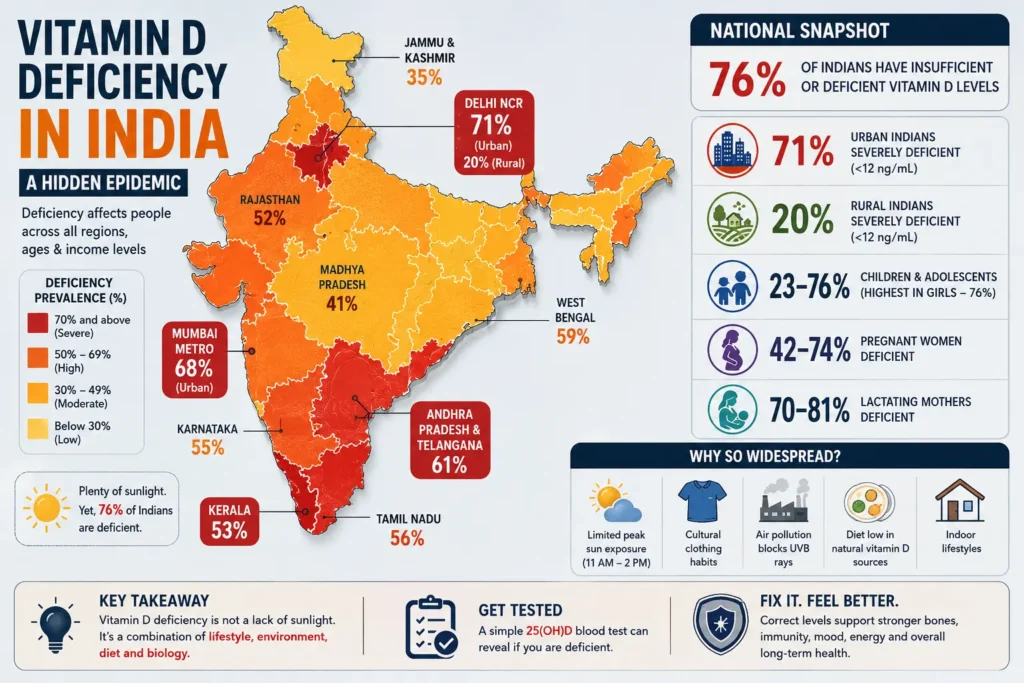
Direct answer: Despite abundant sunlight, Indians face widespread vitamin D deficiency due to a combination of darker skin pigmentation (which reduces UVB absorption), minimal sun exposure during peak hours (11 AM–2 PM), cultural clothing habits, air pollution (which blocks UVB rays), and a largely plant‑based diet lacking naturally D‑rich foods.
Key facts:
- 76% of Indians have insufficient or deficient vitamin D levels [source: NIH study].
- In urban areas, 71% suffer from severe deficiency (<12 ng/mL) [source: ICMR‑backed 2025 study].
- Even South India—closer to the equator—records over 50% deficiency.
- The problem isn’t lack of sunlight; it’s how we interact with it.
What Is Vitamin D Deficiency? (The Simple Explanation)
Vitamin D isn’t really a vitamin—it’s a steroid hormone that your skin produces when exposed to ultraviolet B (UVB) rays. Think of it as a switch: when sunlight hits your skin, a cascade of reactions begins, turning cholesterol into active vitamin D.
Once activated, this hormone affects every organ in your body. It regulates calcium absorption for strong bones, supports your immune system, influences muscle function, and even plays a role in mood and energy levels.
When you’re deficient, nothing works the way it should. Bones ache. Muscles feel weak. You get sick often. And because symptoms are vague, most people blame stress or aging—not a missing hormone. (Low vitamin D can also affect metabolic health; read about why Indians are skinny fat.)
Core Reasons for Vitamin D Deficiency in India (The Real List)
1. The Pigmentation Problem: Darker Skin Needs More Sun
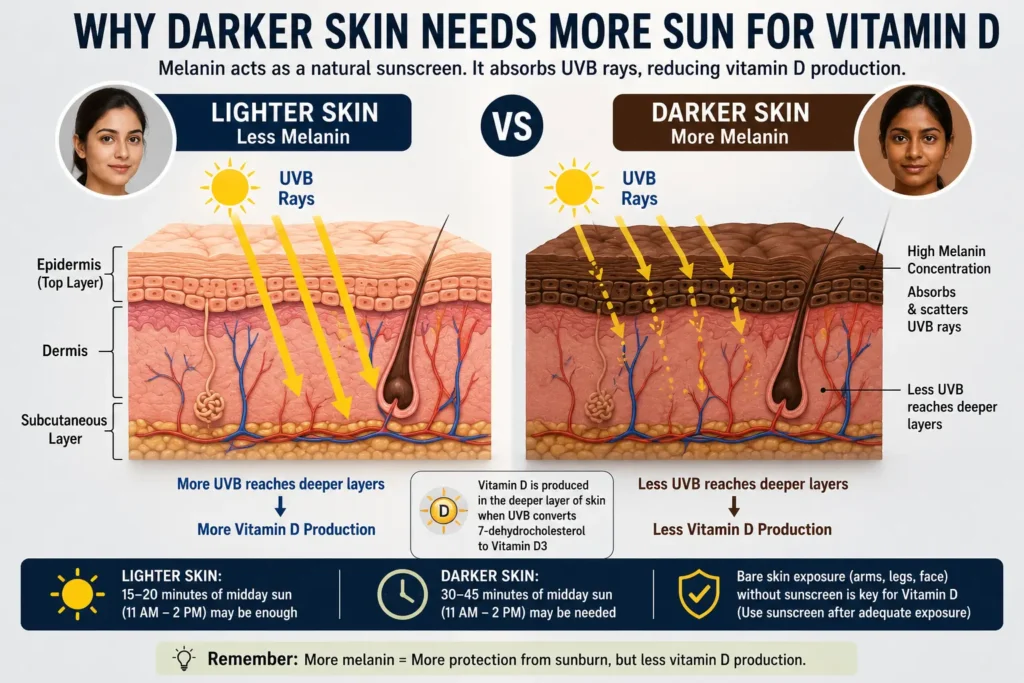
This is the elephant in the room that no one talks about. Melanin—the pigment that gives skin its color—acts as a natural sunscreen. It absorbs UVB rays, which means less reaches the lower layers of your skin where vitamin D is produced.
Recent Indian research confirms this directly: vitamin D levels are negatively correlated with the Melanin Index. The same study found that weekly sun exposure scores positively affect levels, but the effect is weaker in individuals with more pigmentation.
So when a fair‑skinned person needs 15 minutes of sun, someone with a darker complexion may need 30–45 minutes to synthesize the same amount. Most Indians aren’t getting that.
This is not a defect—it’s evolution. But in modern indoor lifestyles, it becomes a liability.
2. You’re Missing the Golden Window (11 AM–2 PM)
Research on Indian latitudes shows that meaningful vitamin D synthesis only happens between 11 AM and 2 PM. Step outside before 10 AM or after 3 PM, and the UVB rays are too weak to trigger production—even if it feels blazing hot.
Most people are indoors during those peak hours (office, school, home). Even if you step out, you’re often covered up—more on that next.
3. Cultural and Urban Clothing Habits
India has a strong culture of covering skin for tradition, sun protection, and pollution. Full sleeves, long skirts, dupattas, and even sunscreen prevent UVB from reaching the skin. And yes, sunscreen with SPF 8 or higher effectively blocks vitamin D synthesis.
I’m not saying stop using sunscreen—skin cancer is real. But be aware that if you’re fully covered every time you go out, you’re not making vitamin D.
4. Air Pollution: Your Invisible Shield

This one hits hard in cities like Delhi, Mumbai, and Kolkata. Particulate matter (PM2.5, PM10) and ozone absorb and scatter UVB rays, dramatically reducing the amount that reaches ground level. A 2025 study on urban vs rural Delhi found that vitamin D deficiency (<20 ng/mL) was 71% in urban areas, compared to only 20% in nearby rural villages.
It’s not just a Delhi problem. Any city with heavy smog is a vitamin D desert. (Learn how Delhi’s AQI is affecting sperm health—another hidden cost of pollution.)
5. A Diet That Can’t Keep Up
Only a handful of foods naturally contain meaningful vitamin D: fatty fish (salmon, mackerel), egg yolks, and liver. Fortified foods (milk, some cereals) help, but in India, fortification is neither universal nor well-regulated.
If you’re vegetarian—which roughly 30–40% of Indians are—you’re almost entirely reliant on sun exposure or supplements. Eggs and dairy help, but unless you’re eating a lot of them, they won’t bridge the gap. (For a food‑first approach, see our best vegetarian protein sources guide.)
6. Indoor Generation, Even in Rural Areas
Contrary to popular belief, rural Indians are also deficient. A Pune‑based study found that 13% of rural participants had vitamin D deficiency—lower than urban, but still significant. Why? Because rural work has shifted indoors (factories, home‑based industries), and children study longer hours inside.
5 Signs of Vitamin D Deficiency Most Indians Ignore
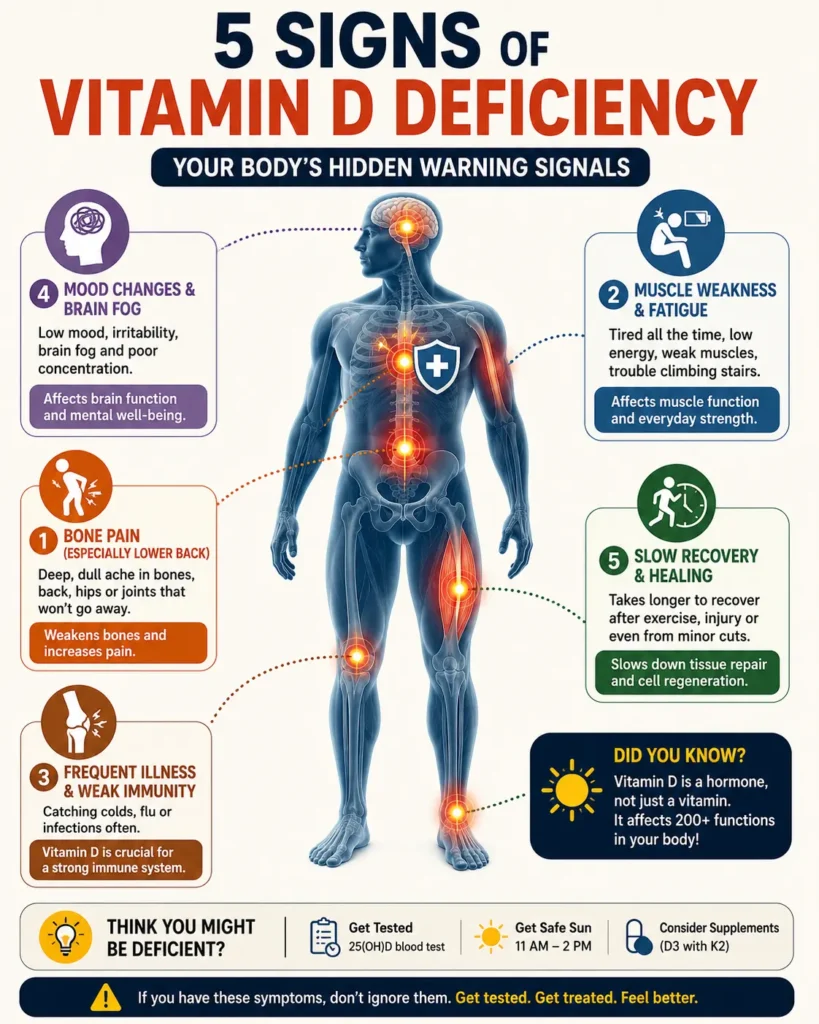
Sign 1: Deep, Dull Bone Pain (Especially Lower Back)
Unlike the sharp pain of an injury, vitamin D‑related bone pain feels deep, achy, and migratory. A Kolkata study found that among deficient men, low back pain was the second most common presentation (16.5%). In women, joint pain topped the list.
If your back aches after a short walk or by the end of a workday, don’t assume it’s just “desk posture.”
Sign 2: Muscle Weakness and Frequent Fatigue
Feeling like your legs are made of lead? That’s not “getting older.” Vitamin D is critical for muscle function. Deficiency leads to proximal muscle weakness—trouble climbing stairs, getting out of a chair, or rising from a squat.
And the fatigue is not sleep‑related. You can clock eight hours and still feel drained by noon. (This can also be linked to low testosterone symptoms in young men.)
Sign 3: Getting Sick All the Time
Vitamin D modulates your innate immune system. Low levels are linked to higher rates of respiratory infections, including the common cold and flu. A 2021 meta‑analysis confirmed that vitamin D supplementation reduces the risk of acute respiratory infections by 12–15%.
If you’re the person at work who catches everything that goes around, low vitamin D could be the hidden culprit.
Sign 4: Mood Trouble and Foggy Thinking
There’s a reason seasonal affective disorder (SAD) is linked to low sun exposure. Vitamin D receptors are abundant in brain regions that regulate mood and cognition. Deficiency is associated with depression, low energy, and cognitive slowing.
This doesn’t mean vitamin D cures clinical depression—but deficiency can definitely make it harder to feel normal.
Sign 5: Slow Healing After Exercise or Injury
It takes longer for muscles to recover. Minor cuts or scrapes linger. This happens because vitamin D is essential for cell growth and tissue repair.
If you’ve noticed your recovery time has doubled without increasing your training volume, get tested. (For a complete recovery plan, check out the 10 best home workouts.)
Comparison Table: Urban vs Rural, Rich vs Poor Risk Factors
| Population | Deficiency Prevalence | Key Drivers |
|---|---|---|
| Urban adults (Delhi NCR) | 71% severely deficient (<12 ng/mL) | Air pollution, indoor lifestyles, covered clothing |
| Rural adults (Delhi NCR) | 20% severely deficient | Some outdoor work, less pollution |
| Children/adolescents (National) | 23–76% (female adolescents 76%) | School indoors, screen time, covered play uniforms |
| Pregnant women | 42–74% | Increased demand, limited sun exposure during early pregnancy |
| Lactating mothers | 70–81% | Similar, plus nutrient transfer to infant |
| South India | 51.6% (Kerala, Tamil Nadu, Puducherry 50%+) | High heat = staying indoors, heavy clothing, vegetarian diets |
What the Research Says: You Can’t Sunbathe Your Way Out of This
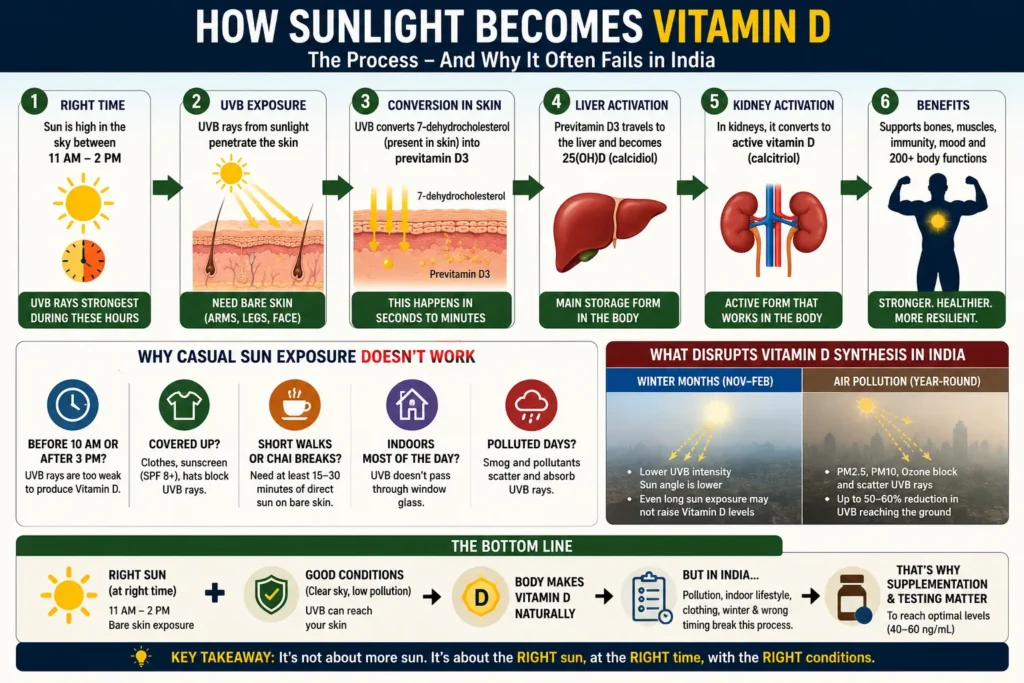
Here’s the uncomfortable truth: casual sun exposure does not fix deficiency. Multiple studies confirm that random walks or chai breaks in the sun have no measurable effect on vitamin D levels. You need deliberate, peak‑hour exposure to bare skin (arms, legs, abdomen) for at least 15–20 minutes daily.
In winter, the problem gets worse. Research from northern India found that UVBI (ultraviolet B irradiation) is significantly low during winter, and even dedicated sun exposure failed to raise 25(OH)D levels. That means from November to February, many Indians cannot make enough vitamin D from the sun, regardless of how much skin they bare.
This is why the 2025 Indian Expert Group Consensus now strongly recommends supplementation, with a target 25(OH)D level of 40–60 ng/mL (100–150 nmol/L)—higher than Western guidelines.
Absorption, Timing, and Bioavailability: What Actually Works

Oral supplements: Vitamin D3 (cholecalciferol) is far more effective than D2 (ergocalciferol). Take it with a fatty meal (ghee, eggs, avocado) because it’s fat‑soluble.
Sun synthesis: Highest between 11 AM and 2 PM on most Indian latitudes. Expose at least 40% of your skin (arms, legs, face). Darker skin needs 30–45 minutes; lighter skin 15–20 minutes.
Pollution reality check: On days when AQI is above 200, UVB penetration is severely reduced. During smog season, supplementation is the only reliable option. (For a complete low‑budget approach, see our ₹200/day diet plan.)
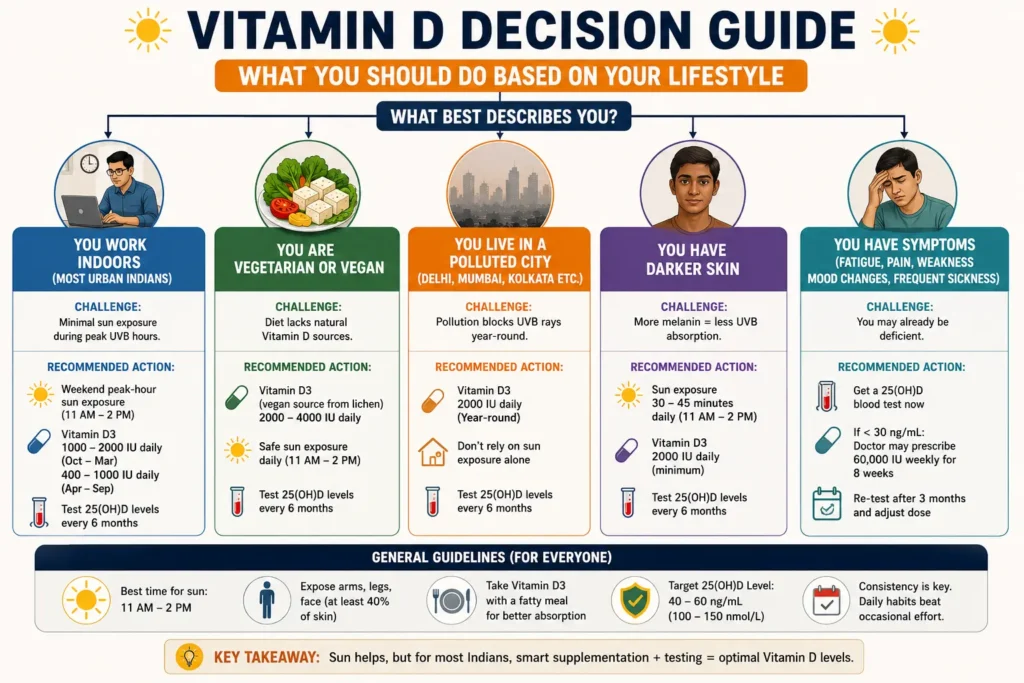
Decision Guide: Who Should Do What
If You Work Indoors (Most Urban Indians)
Recommendation: Take a daily Vitamin D3 supplement (1000–2000 IU from October to March; 400–1000 IU from April to September). Pair with weekend peak‑hour walks.
If You Have Dark Skin
Recommendation: Extend sun exposure to 30–45 minutes (bare skin). Don’t rely on sun alone; add 2000 IU D3 daily, especially in winter.
If You’re Strict Vegetarian or Vegan
Recommendation: You cannot get enough from diet alone. Supplement year‑round. Look for vegan D3 (from lichen). Aim for 2000–4000 IU daily, tested levels.
If You Live in Delhi NCR, Mumbai, or Kolkata
Recommendation: Air pollution blocks UVB year‑round. Supplement 2000 IU daily regardless of sun exposure. Test levels every 6 months.
If You’re Already Suffering Symptoms
Recommendation: Don’t guess. Get a serum 25(OH)D test (₹800–1500 at most labs). If levels are below 30 ng/mL, your doctor will likely prescribe a 60,000 IU weekly dose for 8 weeks—this is safe and standard.
Final Verdict: Why 76% of Indians Are Deficient—and What to Do About It
Let me summarise directly.
The reasons for vitamin D deficiency in India are not mysterious. They are:
- Darker skin that needs longer sun exposure
- Peak‑hour lifestyles that keep you indoors from 11 AM–2 PM
- Air pollution that blocks UVB in cities
- Clothing and sunscreen that shield the skin
- A diet that lacks naturally D‑rich foods
- Winter months when UVB is too weak to trigger synthesis
The fix is not complicated, but it requires intentionality:
- Test your level (don’t guess).
- Supplement with D3 (2000 IU daily, more if deficient).
- Bare skin to peak‑hour sun when air quality permits.
- Re‑test after 3 months to adjust dose.
If you’ve been feeling off—tired, achy, foggy, sick—stop blaming “stress.” Get your vitamin D checked. It’s one of the cheapest tests and most effective interventions in modern medicine.
For deeper context, explore:
- 7 Signs of Nutrient Deficiency Most Ignore — vitamin D is just one piece of the puzzle.
- Why Indians Are “Skinny Fat” — metabolic health and vitamin D are closely linked.
- Budget Indian Diet Plan — covers other micronutrients you might be missing.
FAQs
1. Can low vitamin D cause weight gain?
Not directly, but deficiency is strongly linked to obesity via its effects on metabolism, inflammation, and insulin sensitivity. Many lean Indians also have low vitamin D, so it’s not a simple cause‑and‑effect.
2. What is the fastest way to raise vitamin D levels?
High‑dose supplementation (60,000 IU weekly under medical guidance). Sun exposure cannot raise levels quickly in deficient individuals.
3. Is 15 minutes of sun enough for dark skin?
No. Research shows darker phototypes need 30–45 minutes of peak‑hour sun on bare skin to produce adequate vitamin D.
4. Why is vitamin D deficiency increasing in India?
Urbanisation, pollution, indoor lifestyles, and spooked sun exposure (due to skin cancer fears) are the main drivers. Even rural areas show rising deficiency as farm work shifts indoors.
5. Can I get enough vitamin D from food without supplements?
Only if you eat fatty fish daily. For most Indians—especially vegetarians—food alone is insufficient. Supplements are the most reliable source.
Ready to Stop Ignoring Your Body’s Signals?

You now know the real reasons for vitamin D deficiency in India—and the five signs that most people dismiss as “normal.”
Your one action step today: If any of the five signs sound familiar, book a 25(OH)D blood test this week. It takes five minutes. It costs less than a large pizza. And it could explain months or years of unexplained fatigue, pain, or sickness.
Have you already been diagnosed with vitamin D deficiency? Drop a comment below and share what worked for you—or what you wish you’d known earlier. Your experience could help someone else stop suffering in silence.
And if this guide cleared up the confusion, share it with a friend who’s always “feeling off” but can’t figure out why.
Test karo. Fix karo. Feel better. (Get tested. Fix it. Feel better.)
Disclaimer: This information is for educational purposes only. Always consult a qualified healthcare provider before starting any new supplement regimen, especially high‑dose vitamin D, which can cause toxicity if overused.