
The best time to take protein powder is within 1 to 2 hours after your workout — but that single answer misses most of what actually matters. Timing is real. It is just not the main event. The total protein you eat in a day matters far more than when you take it, but once that is locked in, timing gives you a measurable edge.
Most people in Indian gyms obsess over the 30-minute post-workout window like it is a closing deadline. It is not. Research has pushed that window considerably wider. What actually destroys results is not missing a 30-minute slot. It is eating 70 grams of protein daily when your body needs 140.
Get the total right. Then use timing to sharpen what you have already built.
The Short Answer
- Post-workout is the highest-priority window — consume 25 to 40 grams of whey protein within 1 to 2 hours after resistance training when muscle protein synthesis is at its peak.
- Pre-workout protein matters only if you train fasted or have not eaten in 3 or more hours before your session.
- Morning protein is underused by Indian gym-goers — a typical Indian breakfast delivers 5 to 12 grams of protein, which is far below what supports muscle recovery and satiety.
- Bedtime casein (a slow-digesting milk protein) sustains amino acid release across 5 to 7 hours of sleep and is worth considering in a dedicated muscle gain phase.
- Total daily intake drives results — aim for 1.6 to 2.2 grams of protein per kilogram of body weight, and use timing to optimise what consistent intake has already set in motion.
Why Does Protein Timing Even Matter?
Your muscles do not grow during the workout. They grow after it — during recovery, when your body uses dietary amino acids to repair micro-tears in muscle fibers and build them back denser and stronger. Protein timing is about making sure those amino acids are available in your bloodstream when the repair process is running hardest.
After a resistance training session, muscle protein synthesis (MPS) — the biological process of building new muscle tissue — stays elevated for 24 to 48 hours. The first 2 to 3 hours post-workout are when MPS is highest. That is the window where dietary protein has the strongest anabolic effect.
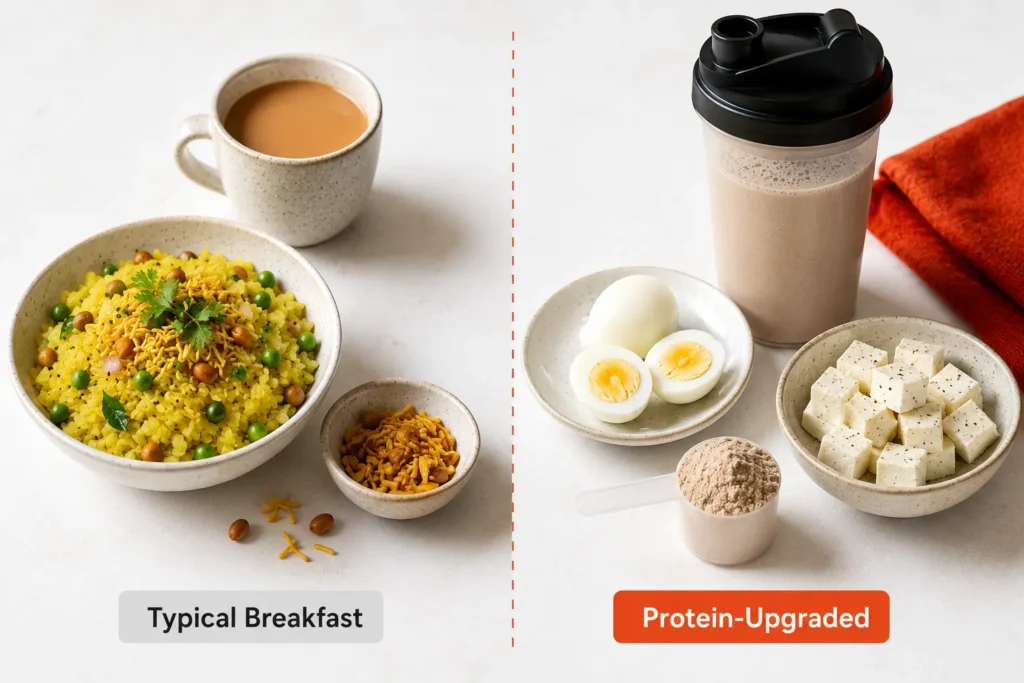
For Indian gym-goers, there is a specific gap worth understanding. A typical Indian breakfast — chai, poha, idli with sambar, or paratha without a protein side — delivers somewhere between 5 and 12 grams of protein. If you train at 6 or 7 AM after that kind of breakfast, you are working out in a near-fasted state. The post-workout window matters more for you than for someone who had three eggs and paneer before leaving the house.
The Indian diet is not bad for protein — it is inconsistent. Dal, paneer, eggs, curd, and chicken are all solid sources. The problem is distribution. Heavy protein at dinner and almost none before noon is common, and it leaves the morning and training window underserved.
When to Take Protein Powder: Each Window Explained
Post-Workout: The Window That Actually Earns Its Name
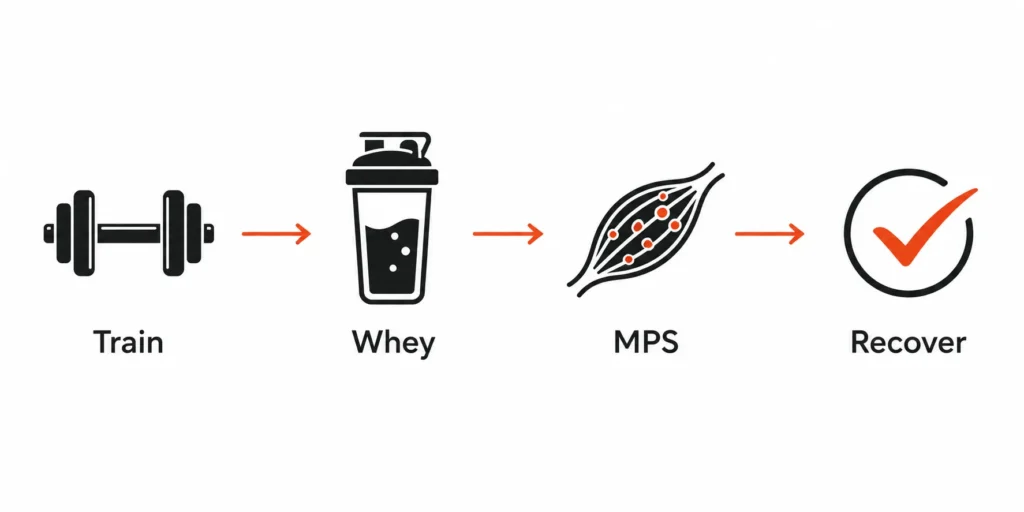
Post-workout is the best time to take protein powder for the majority of people, and this is where the evidence is strongest. After resistance training, muscle protein breakdown rises alongside MPS. Consuming fast-digesting protein immediately drives MPS significantly higher than training without post-workout nutrition.
The “anabolic window” idea is not wrong — it is just less dramatic than supplement marketing suggests. A 2013 meta-analysis in the Journal of the International Society of Sports Nutrition found the window extends to roughly 4 to 6 hours around training when pre-workout nutrition is accounted for. If you ate a protein-containing meal 1 to 2 hours before training, the post-workout window is more relaxed. If you trained fasted, it tightens.
Practical rule: drink your shake within 60 to 90 minutes after your session. Miss that and it becomes 2 hours? You have lost nothing meaningful. What matters is not being in a protein-deficit state for the entire 48-hour recovery period.
Whey works best here because of its absorption speed. It raises blood amino acid levels within 60 to 90 minutes of consumption — fast enough to serve the post-workout window without waiting.
Verdict: Top priority. Make this the one timing you do not skip.
Pre-Workout: Only Essential If You Are Training Fasted
Pre-workout protein is the best time to take protein powder specifically if you exercise first thing in the morning without eating. Training in a completely fasted state — 8 or more hours since your last meal — increases muscle protein breakdown during the session itself. A small protein dose before training blunts that effect meaningfully.
20 to 25 grams of whey 30 to 60 minutes before your session is enough. You do not need a full meal, and you do not need a complex formula. Half a scoop in water is sufficient to reduce fasted-state catabolism without giving you a heavy stomach mid-set.
If you have eaten a proper meal within 2 to 3 hours of training, pre-workout protein adds very little additional benefit. The amino acids from that meal are still circulating.
A myth common in Indian gym culture: many people take pre-workout stimulants and creatine before training but skip protein entirely, assuming the performance boost covers everything. Stimulants improve output. Protein handles the muscle. They do different jobs.
Verdict: Situational. Only necessary if training fasted or 3 or more hours past your last meal.
Morning Protein: The Most Overlooked Window for Indians
Morning is one of the best times to take protein powder for anyone eating a typical Indian breakfast, and it is consistently under-prioritised. After 7 to 9 hours of sleep, your body has been in a mild catabolic state — muscle protein breakdown runs steadily overnight without a dietary source to counteract it. Your first meal stops that drift. What that meal contains determines how fast you stop it.
Poha delivers roughly 3 to 5 grams of protein per standard serving. Idli is 2 to 3 grams per piece. A plate of dosa rarely clears 10 grams even with sambar. Adding one scoop of protein powder to a morning smoothie, mixed into milk, or taken alongside breakfast can push that number to 30 to 35 grams — enough to reverse the overnight protein deficit and set a positive tone for the day.
On rest days especially, morning protein is more valuable than most people realise. MPS remains elevated for up to 48 hours post-training, and feeding amino acids during recovery days supports that process even without a workout trigger.
If you only have budget for one scoop per day and you do not train in the morning, morning protein is worth comparing directly against a post-workout shake. For someone whose post-workout meal is already protein-rich but whose breakfast is almost protein-free, morning may actually win.
Verdict: High value for Indians with low-protein breakfasts. Significantly underused.
Bedtime Casein: Useful, But Not for Everyone
Bedtime protein is where casein earns its reputation, and it is a different animal from whey. Casein is a slow-digesting milk protein that forms a gel in the stomach and releases amino acids steadily over 5 to 7 hours. During sleep, MPS continues at a lower rate than post-workout, and a sustained amino acid supply from casein supports overnight recovery in a way that whey simply cannot — whey absorbs too fast and the amino acid spike fades within 2 hours.
A 2012 study published in Medicine and Science in Sports and Exercise found that 40 grams of casein consumed before sleep increased overnight muscle protein synthesis and improved net protein balance compared to a placebo in resistance-trained men. The effect was real and measurable.
The practical reality: casein is less available and more expensive than whey in India. Outside major cities, finding a reliable casein product at a reasonable price is genuinely difficult. For someone on a budget, this is the timing window to deprioritise first. Post-workout and morning shakes return more per rupee for most people.
Casein before bed matters most for dedicated bodybuilders in an active muscle gain phase, people with very high daily protein targets, and those doing two-a-day training. For someone training 3 to 4 times a week for general fitness and body composition, it is a refinement, not a foundation.
Verdict: Valuable for serious muscle gain phases. Optional and budget-dependent for most.
Between Meals: When the Gap Gets Too Long
Between-meal protein is the best time to take protein powder when your meals are spaced more than 4 to 5 hours apart. Research suggests that distributing protein across 3 to 5 meals of 20 to 40 grams each — rather than eating the same total in 1 to 2 large meals — maximises the number of times per day MPS is fully stimulated.
In practice, this matters most for people with demanding schedules, long gaps between meals, or athletes trying to hit very high protein targets above 180 grams daily.
For the average Indian college student or office-goer eating 3 structured meals a day, a between-meal shake is the least essential timing window. If total daily protein is already being hit through food and one strategically timed shake, adding a fourth shake between meals is unlikely to shift the needle noticeably.
Verdict: Situational. Most useful for athletes or people with unavoidably long meal gaps.
Protein Timing Comparison Table

| Timing Window | Best Protein Type | Optimal Dose | Timing Precision | Best For | Verdict |
|---|---|---|---|---|---|
| Post-workout | Whey isolate or concentrate | 25–40g | Within 1–2 hours after training | Everyone who trains with resistance | Top priority |
| Pre-workout (fasted) | Whey concentrate | 20–25g | 30–60 min before training | Morning fasted trainers | Situational |
| Morning | Whey or plant-based blend | 25–35g | With or after breakfast | Indians with low-protein breakfasts | High value |
| Bedtime | Casein | 30–40g | 30 min before sleep | Dedicated muscle gain phase | Optional/budget-dependent |
| Between meals | Whey or blend | 20–30g | Flexible | Athletes, two-a-day trainers | Low priority for most |
How Your Body Processes Protein After a Workout
When you consume whey protein, it is broken down into amino acids and absorbed through the small intestine into the bloodstream within 60 to 90 minutes. The resulting spike in plasma amino acids — particularly leucine — is what triggers muscle protein synthesis to accelerate.
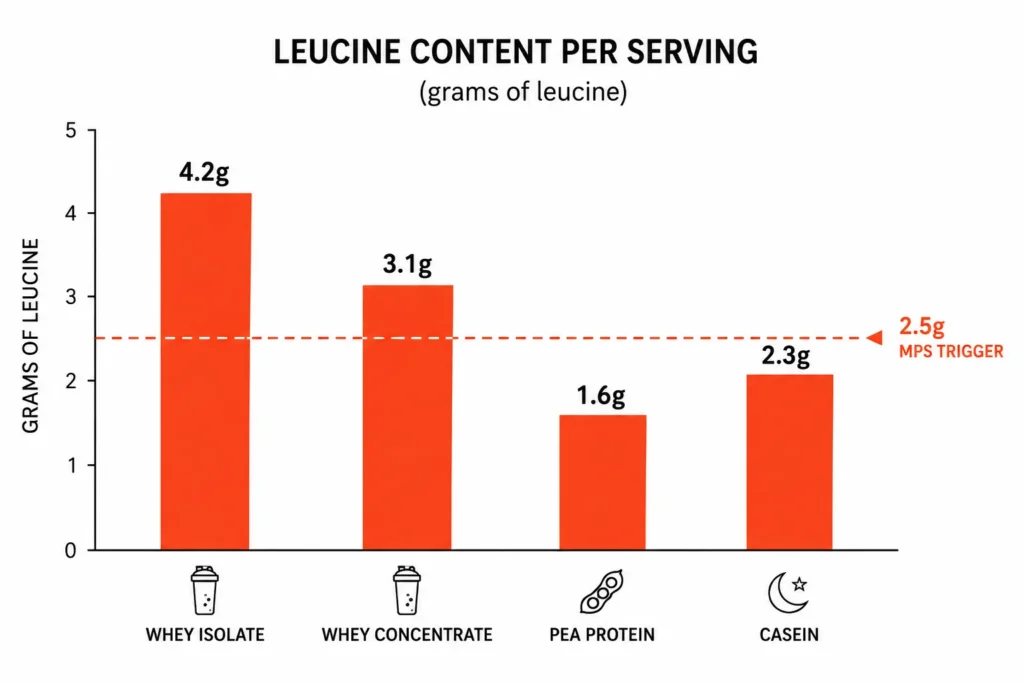
Leucine acts as a molecular signal for MPS. Research suggests a leucine threshold of approximately 2 to 3 grams per serving is needed to maximally stimulate MPS. A standard 25 to 30 gram scoop of quality whey protein delivers roughly 2.5 to 3 grams of leucine, which is why that dose appears consistently across research outcomes.
Two scoring systems are used to assess protein quality. PDCAAS (Protein Digestibility Corrected Amino Acid Score) measures how well a protein provides all essential amino acids relative to human needs, on a scale of 0 to 1. DIAAS (Digestible Indispensable Amino Acid Score) is a newer, more precise version that accounts for absorption at the small intestine level specifically. Whey protein scores near 1.0 on PDCAAS and above 1.0 on DIAAS — meaning it exceeds the minimum amino acid requirements for MPS stimulation. Most plant proteins score between 0.5 and 0.9, which is why plant-protein users sometimes need 5 to 10 grams more per serving to reach the same MPS response.
One practical note: taking protein with a high-fat meal slows gastric emptying and delays how quickly amino acids reach the bloodstream. This is not a problem if you are flexible about timing windows, but it is worth knowing if you are deliberately trying to optimise the post-workout spike. Post-workout, water or low-fat milk is preferable to a heavy meal as a delivery vehicle.
What the Research Says
The science on protein timing has shifted considerably over the past 15 years, mostly in the direction of relaxing the urgency around exact windows.
The early “anabolic window” model — consume protein within 30 minutes or your session is wasted — was derived largely from fasted-state research and applied too broadly to all training conditions. A comprehensive meta-analysis by Aragon and Schoenfeld published in the Journal of the International Society of Sports Nutrition found that when total daily protein intake was controlled across groups, the timing advantage was real but modest, and the effective window around training was considerably wider than 30 minutes.
Research in this area consistently shows that hitting 1.6 to 2.2 grams of protein per kilogram of body weight daily is the stronger predictor of muscle gain than any specific timing protocol. A 2018 systematic review and meta-analysis by Morton and colleagues in the British Journal of Sports Medicine, covering 49 studies and over 1,800 participants, found that protein supplementation significantly increased muscle mass gains from resistance training, but the effects plateaued at approximately 1.62 grams per kilogram per day in most populations.
The honest reality check: study participants follow protocols precisely. Real people do not. In controlled research, a 60-minute post-workout window is tested under clean conditions. In the real world, people finish training, commute home, shower, cook, and eat 90 minutes later — and still build muscle consistently over months. The research ceiling and the practical ceiling are not the same thing. Timing matters meaningfully once your diet is dialled in. If you are eating 80 grams of protein daily when you need 140, fixing that gap will do more for your results than any timing optimisation.
If you are still building your food-first protein foundation, the article on best protein sources for muscle gain and fat loss in India covers what actually works in Indian kitchens and on Indian budgets.
Side Effects and What to Watch Out For
Protein powder is safe for healthy adults at recommended doses. That does not mean there are no considerations worth knowing.
Digestive discomfort is the most common complaint, and it is more common among Indians than generic supplement advice acknowledges. Approximately 60 to 70 percent of South Asian adults have some degree of lactose intolerance. Whey concentrate contains residual lactose — enough to trigger bloating, gas, or loose stools in sensitive individuals. Switching to whey isolate, which undergoes additional filtration that removes most lactose, typically resolves this. Plant-based proteins are the cleanest option for those who react even to isolate.
Kidney concerns come up frequently, often with real fear attached. For people with healthy kidneys, high protein intake at 1.6 to 2.2 grams per kilogram of body weight does not cause damage. The kidneys handle the increased load without structural harm. This concern is valid only for people with pre-existing kidney disease or a strong family history of renal problems — in those cases, a doctor’s guidance before significantly increasing protein is the right step.
Budget and availability are practical realities in India that most generic supplement guides ignore. Casein is expensive, inconsistently stocked outside metros, and often sold in large tub sizes that require significant upfront spend. If one scoop of whey daily is what your budget allows, that one scoop timed well at post-workout or morning delivers more than two poorly timed scoops of anything.
Excess intake is a money problem more than a health problem at these doses. Protein above 2.2 grams per kilogram daily does not add more muscle — it adds more calories and more cost.
Who Should Actually Use This?

If Your Goal Is Muscle Gain
Post-workout protein is the foundation. Take 25 to 40 grams of whey within 90 minutes of your resistance training session on every training day. If budget allows and you are serious about adding mass, add 30 to 40 grams of casein 30 minutes before bed on training days. Hit 1.8 to 2.2 grams of protein per kilogram of body weight daily, spread across at least 3 meals. The timing layers on top of total intake — it does not replace it.
If Your Goal Is Fat Loss
Morning and pre-workout timing matter most here. High protein intake during a calorie deficit preserves lean muscle while fat is lost — that is the main job. A morning shake pulls your first-meal protein up, keeps hunger in check through the late morning, and makes it easier to stay in a deficit through lunch. Post-workout protein still matters, but the calorie accounting around it becomes more deliberate.
For a practical guide on how protein fits into a full fat loss approach, the article on high protein foods for fat loss is the right follow-on read.
If You Follow a Vegetarian or Vegan Diet
Distribute protein across 3 to 4 windows per day rather than relying on one large post-workout dose. Plant proteins have lower leucine content per gram and slightly lower DIAAS scores than whey, meaning you may need to consume 30 to 35 grams per serving rather than 25 to 30 to hit the same MPS trigger. A pea-rice blend delivers the best essential amino acid coverage among plant options. Morning and post-workout are the two priority windows to protect.
If You Are on a Tight Budget
One scoop per day, timed at post-workout on training days and with breakfast on rest days. Do not try to optimise multiple timing windows when budget limits you to one serving. The primary driver of results is consistent total protein intake across the day — food-first, supplements to fill the gap. If whole food sources can cover your post-workout window on a given day, let them. Save the scoop for the window where food cannot.
If You Have Digestive Sensitivity
Switch to whey isolate or a plant-based protein first. If post-workout shakes taken immediately after training cause discomfort, try spacing the shake 30 to 45 minutes after your session when digestion is settling. A smaller 15 to 20 gram dose taken twice — once post-workout, once before bed or in the morning — delivers the same total amino acid load with less gastric demand per sitting.
The Bottom Line
The best time to take protein powder for maximum results is post-workout for most people, morning for anyone eating a typical low-protein Indian breakfast, and bedtime casein for those actively trying to build mass. That order of priority holds for the majority of people training in Indian gyms today.
None of it matters much if total daily protein is falling short. Timing is the refinement. Adequate intake is the foundation. Build the foundation before you optimise the refinement.
If you are just starting out, one scoop of whey post-workout on training days is genuinely enough to move the needle — no need for a four-window protocol on day one. Add complexity only when the basics are running consistently.
Consistency across months beats perfect timing on any given day.
People Also Ask
What is the best time to take protein powder for muscle gain?
Post-workout is the best time to take protein powder for muscle gain. Consuming 25 to 40 grams of fast-digesting whey protein within 1 to 2 hours after resistance training aligns with the peak of muscle protein synthesis. Bedtime casein adds a secondary benefit by sustaining amino acid availability across 5 to 7 hours of sleep. Of the two, post-workout is the higher priority for most people.
Is it okay to take protein powder in the morning on rest days?
Yes, morning protein on rest days is a genuinely useful strategy, especially for Indians eating low-protein breakfasts. Muscle protein synthesis remains elevated for up to 48 hours after training, meaning recovery is still active on rest days. A 20 to 30 gram morning shake feeds that process and brings the first meal of the day up to a protein level that food alone rarely achieves in a typical Indian breakfast.
Does protein powder work if you take it before a workout instead of after?
Pre-workout protein works, but only meaningfully if you are training in a fasted state or more than 3 hours after your last meal. If you have eaten a protein-containing meal within 2 hours of training, taking protein before adds very little extra benefit. Post-workout remains the more important window because MPS accelerates most sharply after the training stimulus, not before it.
Is whey protein bad for lactose-intolerant people? What should Indians use instead?
Whey concentrate contains residual lactose that can cause bloating, gas, or loose stools — a real concern given that around 60 to 70 percent of South Asians have some degree of lactose intolerance. Whey isolate undergoes additional processing that removes most of the lactose and is better tolerated by most sensitive individuals. For those who react even to isolate, a plant-based protein using pea, rice, or soy is the cleanest alternative.
Can you take protein powder twice a day safely?
Yes, two servings per day is safe and practical for people who cannot hit their daily protein target through food alone. The most effective pairing is post-workout plus morning, or post-workout plus bedtime casein. For most people training 3 to 5 days per week, two well-timed servings cover the meaningful windows without unnecessary cost. More than two servings daily adds minimal measurable benefit unless total daily targets require it.
Does timing of protein matter more than the total amount you eat?
No. Total daily protein intake matters significantly more than timing. Research consistently shows that 1.6 to 2.2 grams per kilogram of body weight daily is the primary driver of muscle gain and preservation. Timing optimises outcomes once intake is adequate — but increasing total intake from 80 grams to 140 grams will produce far greater results than perfecting a timing protocol while staying at 80 grams.
Is taking protein powder at night actually good for recovery?
Taking casein protein 30 minutes before sleep supports overnight muscle recovery by releasing amino acids steadily across 5 to 7 hours. A 2012 study in Medicine and Science in Sports and Exercise found that 40 grams of casein before sleep increased overnight muscle protein synthesis compared to a placebo. Whey before bed absorbs too quickly to sustain this effect. Casein is the right choice for bedtime; whey is better reserved for post-workout or morning.
Sources and References
Aragon, A.A., & Schoenfeld, B.J. (2013). Nutrient timing revisited: Is there a post-exercise anabolic window? Journal of the International Society of Sports Nutrition, 10(1), 5. https://www.ncbi.nlm.nih.gov/pmc/articles/PMC3577439/
Res, P.T., Groen, B., Pennings, B., Beelen, M., Wallis, G.A., Gijsen, A.P., Senden, J.M.G., & Van Loon, L.J.C. (2012). Protein ingestion before sleep improves postexercise overnight recovery. Medicine and Science in Sports and Exercise, 44(8), 1560–1569. https://pubmed.ncbi.nlm.nih.gov/22330017/
Morton, R.W., Murphy, K.T., McKellar, S.R., Schoenfeld, B.J., Henselmans, M., Helms, E., Aragon, A.A., Devries, M.C., Banfield, L., Krieger, J.W., & Phillips, S.M. (2018). A systematic review, meta-analysis, and meta-regression of the effect of protein supplementation on resistance training-induced gains in muscle mass and strength in healthy adults. British Journal of Sports Medicine, 52(6), 376–384. https://pubmed.ncbi.nlm.nih.gov/28698222/