
Whey protein does not damage kidneys in healthy people – this is one of the most well-studied questions in sports nutrition, and the evidence is consistent. The fear comes from a real mechanism that is being applied to the wrong population, and that misapplication has scared a lot of people away from a supplement that is genuinely safe for the vast majority of gym-goers.
The concern exists for a reason. People with existing chronic kidney disease (CKD) do need to manage protein intake carefully. But that clinical reality got stretched – somewhere between medical textbooks and WhatsApp forwards – into a blanket warning that applies to everyone. It does not. And the research is clear enough that this is worth settling properly.
What You Need to Know
- Whey protein does not cause kidney damage in people with healthy kidneys. Multiple long-term studies have found no negative effect on kidney function at intakes up to 2.2g of protein per kg of bodyweight per day.
- The restriction applies to people who already have kidney disease, not people who are healthy and trying to build muscle.
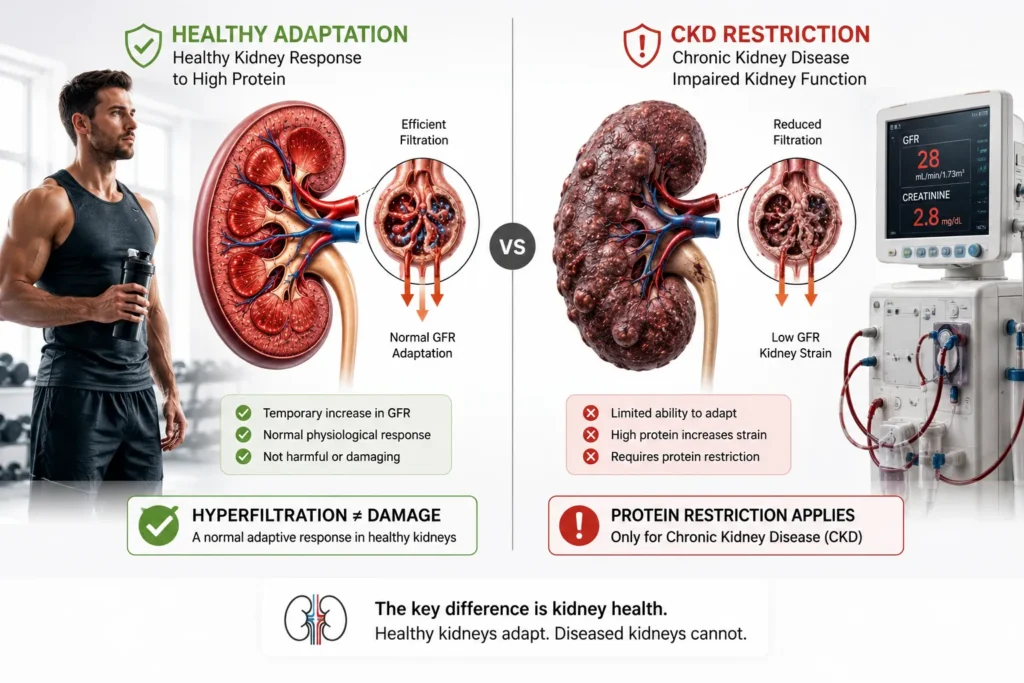
- Your kidneys can handle high protein intake. Healthy kidneys adapt to higher protein loads through a normal process called hyperfiltration — this is adaptation, not damage.
- Most Indian gym-goers consume far less protein than the amounts studied in clinical trials. The fear is disproportionate to the actual intake.
- If you have diabetes, a family history of kidney disease, or have never had a basic kidney function test, get one — not because whey is dangerous, but because undiagnosed kidney conditions are genuinely common in India.
Why Most People Get This Wrong From the Start
The logic behind the concern sounds reasonable on the surface. Protein metabolism produces nitrogenous waste – primarily urea – that the kidneys must filter and excrete. Higher protein intake means more filtering. More filtering means more work. More work over time means wear and tear. Right?
Not quite. That reasoning applies to kidneys that are already compromised. Healthy kidneys have enormous reserve capacity. When protein intake increases, the kidneys respond by increasing their filtration rate – a well-documented adaptive response called glomerular hyperfiltration. This is not a sign of stress or injury. It is normal physiology. The same logic that says “more filtering equals damage” would suggest that exercise damages the heart because it beats faster during a run.
The myth has been kept alive partly by legitimate medical caution. Nephrologists do restrict protein in patients with CKD because damaged kidneys cannot adapt the same way. That clinical guidance got generalized – incorrectly – to the entire population.
In India, the myth has a specific texture. Indian parents and extended family members who associate kidney problems with protein supplements often reference someone they know whose doctor told them to avoid protein – and that person almost certainly had a pre-existing condition. The advice was correct for them. It is not universally correct.
The supplement industry has not helped either. Cheap, adulterated protein powders sold in local markets have occasionally caused problems – but those are issues of contamination and heavy metals, not protein itself. The whey is not the problem in those cases.
Does Whey Protein Actually Damage Kidneys?
No – in people with normal kidney function, whey protein does not cause kidney damage. This has been examined directly in multiple controlled studies, and the findings are consistent across populations and timeframes.
The One-Year Study That Settled Most of This
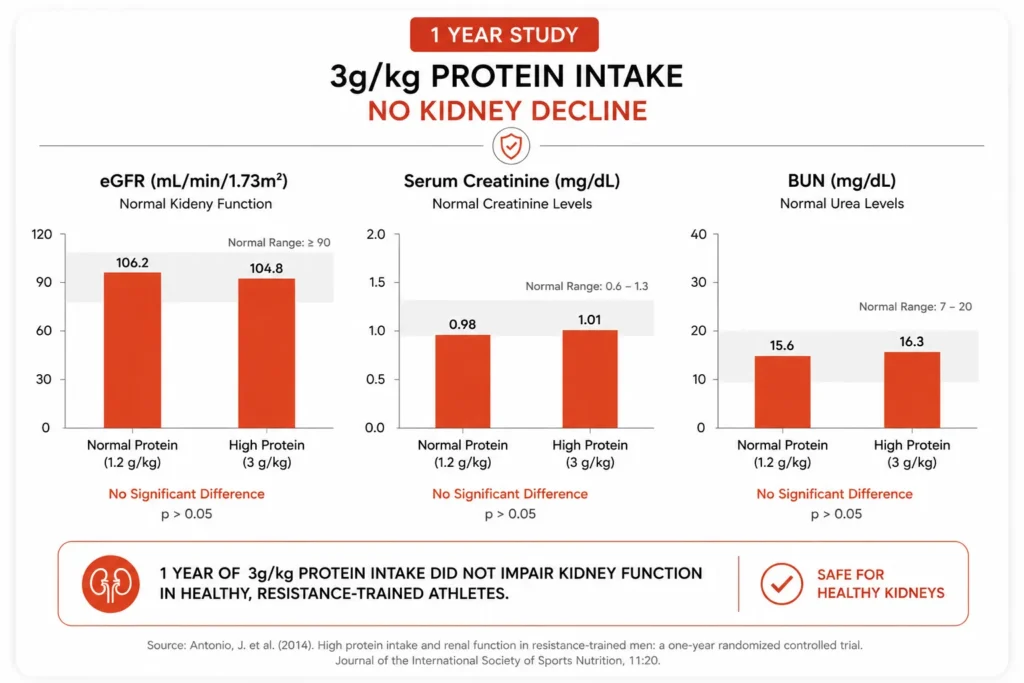
A 2016 study by Antonio et al. published in the Journal of Nutrition and Metabolism examined healthy resistance-trained men consuming more than 3g of protein per kg of bodyweight per day – well above typical supplement use – for one year. No adverse changes were found in kidney function markers including serum creatinine, blood urea nitrogen (BUN), or estimated glomerular filtration rate (eGFR). The eGFR is the standard clinical measure of how well the kidneys filter blood, measured in mL/min/1.73m2. A normal eGFR is above 60. The high-protein group maintained normal values throughout.
The Athletes Study That Came Before It
A 2000 study by Poortmans and Dellalieux published in the International Journal of Sport Nutrition and Exercise Metabolism examined athletes consuming between 1.26g and 2.8g of protein per kg of bodyweight per day. Kidney function – measured through creatinine clearance in 24-hour urine output, which is a more precise measure than spot eGFR – remained within normal clinical ranges across the entire intake spectrum in healthy individuals.
What Both Studies Say Together
The research consistently shows a distinction that matters enormously: high protein intake increases kidney workload in the short term, but does not cause structural damage or long-term decline in people with healthy kidneys. The kidneys adapt. That is what they are designed to do.
How Much Protein Can Healthy Kidneys Actually Handle?
Healthy kidneys can safely process protein intakes up to at least 2.2g per kg of bodyweight per day without functional decline. The Antonio et al. study above examined intakes exceeding 3g/kg with no adverse kidney outcomes in healthy individuals.
To put that in practical terms: a 70kg Indian man eating 154g of protein per day – roughly two scoops of whey plus regular food – is well within the range that research considers safe for healthy kidneys.
The threshold that triggers genuine concern is not a protein intake number. It is a baseline kidney function number. If your eGFR is below 60 mL/min/1.73m2 – indicating Stage 3 chronic kidney disease or worse — protein restriction is medically appropriate and your doctor will tell you so. If your eGFR is normal and you have no underlying conditions, the protein volume most supplement users consume is not a risk.
One honest caveat: most research on high protein intake and kidneys has been conducted on adults under 50 in controlled settings. Very long-term data spanning 20 to 30 years of high intake is limited. What is available does not show harm, but saying the question is 100% closed forever would overstate the evidence. For practical purposes and realistic supplement use, the safety case is solid.
Can Too Much Whey Protein Cause Kidney Stones?
Whey protein does not directly cause kidney stones in most people, but very high animal protein intake can modestly increase the risk for those already predisposed. This distinction is important and frequently missed.
Kidney stones are primarily composed of calcium oxalate – about 80% of cases – or uric acid. High animal protein intake can increase urinary excretion of calcium and uric acid, and reduce urinary pH, all of which can slightly favor stone formation. However, the effect size is modest and depends heavily on individual predisposition, hydration status, and total dietary oxalate intake.
The most important protective factor against kidney stones is hydration. Drinking enough water to keep urine dilute significantly reduces stone risk regardless of protein intake. Most people who develop stones while consuming high protein are chronically underhydrated, not simply eating too much protein.
If you have a personal or family history of kidney stones, this is worth discussing with a doctor before significantly increasing protein intake. For everyone else, staying well-hydrated while using whey protein is sufficient precaution.
How Your Kidneys Actually Process Protein
The kidneys filter metabolic waste from protein breakdown – primarily urea, uric acid, and creatinine – but the process of doing so at higher volumes does not injure healthy kidney tissue.
When you consume protein, the body breaks it down into amino acids. These are used for muscle protein synthesis (MPS) – the process by which muscle tissue is built and repaired – and other structural functions. Amino acids that are not used are broken down further; the nitrogen component is converted to urea by the liver and transported to the kidneys for excretion.
Glomerular filtration rate (GFR) – the speed at which the kidneys filter blood – increases with protein intake. This adaptation is mediated partly by increased blood flow to the kidneys and partly by structural changes within the nephrons (the individual filtering units inside each kidney). In healthy kidneys, this upregulation is temporary and proportional. It does not accelerate nephron loss or cause scarring.
PDCAAS (Protein Digestibility Corrected Amino Acid Score) and DIAAS (Digestible Indispensable Amino Acid Score) are two scoring systems used to rate protein quality. PDCAAS scores proteins on a 0 to 1 scale based on digestibility and amino acid completeness. DIAAS is more precise, measuring amino acid absorption in the small intestine specifically. Whey protein scores near the top of both scales – approximately 1.0 on PDCAAS and above 1.0 on DIAAS for several essential amino acids – which means the body uses it efficiently and produces less nitrogenous waste per gram of usable protein compared to lower-quality sources.
Timing note: Distributing protein intake across meals – rather than consuming most of it in one or two large servings – reduces the peak filtration demand on the kidneys at any single time. Spreading 150g of daily protein across four meals is mildly preferable to consuming it all at dinner, though the practical effect on healthy kidneys is small.
What the Research Actually Says
The International Society of Sports Nutrition (ISSN) 2017 Position Stand on Protein and Exercise, published in the Journal of the International Society of Sports Nutrition, reviewed the available evidence and reached a clear conclusion: there is no scientific evidence that a high protein diet causes kidney disease in healthy exercising individuals.
The same position stand noted that protein intakes of 1.4g to 2.0g per kg of bodyweight per day are sufficient for most exercising individuals, and that intakes above this range – while studied – do not present a safety risk in healthy people.
Earlier work by Poortmans and Dellalieux (2000) and the Antonio et al. crossover trial (2016) both pointed in the same direction: protein intake below 2.8g/kg/day did not impair kidney function in well-trained, healthy athletes.
“There is no scientific evidence that a high protein diet causes kidney disease in healthy individuals.” – Jager R et al., International Society of Sports Nutrition Position Stand: Protein and Exercise, JISSN, 2017.
The honest reality check: most people who are afraid of whey damaging their kidneys are consuming one to two scoops per day – roughly 25g to 50g of additional protein – on top of a diet that is typically already low in total protein by global standards. The gap between what they consume and the amounts studied in clinical trials is significant. The fear, in most cases, is disproportionate to the actual intake.
Protein Intake, Kidney Function, and Safety Thresholds
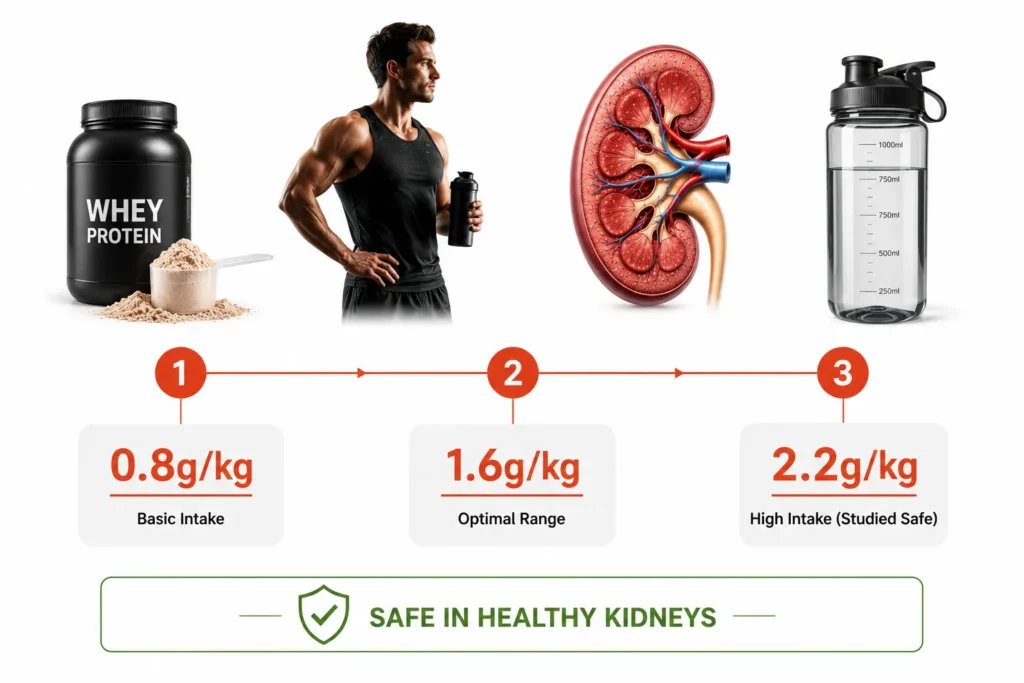
| Daily Protein Intake | Population | Effect on eGFR | Kidney Safety Verdict |
|---|---|---|---|
| 0.8g/kg/day (RDA) | General adult | Baseline | Safe — meets minimum needs |
| 1.6g/kg/day | Active, recreational training | Mild adaptive increase | Safe — well-supported for healthy kidneys |
| 2.2g/kg/day | Regular resistance training | Moderate adaptive increase | Safe in healthy individuals (studied up to 12 months) |
| 2.5 to 3.4g/kg/day | Competitive athletes | Pronounced adaptive increase | Safe in healthy athletes; limited very long-term data |
| Any intake | CKD Stage 3 or worse (eGFR below 60) | Cannot adapt normally | Restrict — follow nephrologist’s guidance |
| Any intake | Diabetic nephropathy | Accelerates decline | Restrict — medical supervision required |
Who Should Actually Be Careful
The people who genuinely need to be cautious about high protein intake and kidney health are a specific, identifiable group – not everyone.
Undiagnosed kidney disease is a genuine concern in India. The SEEK (Screening and Early Evaluation of Kidney Disease) study, published in BMC Nephrology, found that the overall prevalence of CKD in the SEEK-India cohort was 17.2% – with the majority of those cases undetected before the study. A more recent 2025 meta-analysis in Nephrology covering community-based studies from 2011 to 2023 found a pooled CKD prevalence of 13.24% across India, with a rising trend over time.
Type 2 diabetes – itself closely linked to diabetic nephropathy, the leading cause of CKD – affects over 100 million Indians, many of them undiagnosed.

This does not mean whey protein is dangerous for Indians. It means a basic kidney function test – a serum creatinine test and eGFR calculation, available for under Rs 300 at most pathology labs – is worth having before starting high-dose supplementation. Not because whey is a threat, but because undetected CKD is common and worth knowing about.
Who should consult a doctor before increasing protein significantly:
- People with diagnosed diabetes (Type 1 or Type 2)
- People with high blood pressure being managed with medication
- Anyone with a family history of kidney disease
- Anyone who has had kidney stones in the past
- People over 50 who have never had a kidney function test
- Anyone with a known single kidney or structural kidney abnormality
Digestive concerns are more common than kidney concerns for most whey users. India has significant regional variation in lactase persistence – north Indians tolerate dairy better than south Indians on average, but lactose malabsorption is widespread. Whey concentrate contains lactose; whey isolate contains very little. Switching from concentrate to isolate resolves most GI discomfort in lactose-sensitive individuals. For a full comparison of protein types including plant-based alternatives, the whey vs plant protein guide covers the tradeoffs.
Who Should Do What With Whey Protein
If You Are Healthy With No Known Kidney Issues
Whey protein is safe. The research is consistent and the clinical consensus is clear. Use it according to your protein targets – typically 1.6g to 2.2g per kg of bodyweight per day for people training regularly. Get a basic kidney function test if you have never had one and plan to use supplements long-term – not out of fear, but out of basic health literacy.
If You Have Diabetes or Hypertension
Get a kidney function test first. Diabetic nephropathy can be asymptomatic for years. If your eGFR is normal and your doctor clears you, whey protein at moderate intakes is generally fine. If there is any kidney involvement, follow your nephrologist’s guidance on total protein – not just supplement protein.
If You Are a Vegetarian Trying to Hit Protein Targets
Whey is one of the most efficient tools available to you. For a complete picture of plant-based and whole-food options, the best vegetarian protein sources in India guide covers what actually works beyond paneer and dal.
If You Are a Beginner Just Starting Out
Start with one scoop per day. Assess how your digestion responds. If you experience bloating or gas with concentrate, switch to isolate. There is no need to hit aggressive protein targets in week one. Build up over four to six weeks as your training load increases.
If You Are on a Tight Budget
Whey concentrate gives you the same kidney-safety profile as isolate at a lower price. The lactose difference matters only if you are lactose-sensitive. The best protein sources for muscle gain and fat loss in India guide covers value-for-money options across all protein types including whole foods.
If You Have a History of Kidney Stones
Hydration is your primary concern, not protein elimination. Discuss intake levels with a urologist. In most cases, moderate whey protein use with adequate water intake is acceptable even in stone-formers, but individual stone composition and underlying causes vary.
The Bottom Line
Whey protein does not damage healthy kidneys. That sentence is supported by multiple long-term studies, a consistent scientific consensus, and the formal position of major sports nutrition research bodies. The fear is real, but it is based on a clinical restriction that applies to people with pre-existing kidney disease being generalized – incorrectly – to everyone.
If your kidneys are healthy, use whey protein according to your training needs without fear. If you have diabetes, high blood pressure, or a family history of kidney problems, get a basic kidney function test first – not because whey is dangerous, but because knowing your baseline eGFR is genuinely useful health information that most Indians never have.
The one practical thing worth taking from the kidney concern: stay hydrated. Drink enough water. That removes the only real mechanism by which high protein could theoretically cause issues in a predisposed individual.
If you want to see how protein fits into a complete approach to body composition, the best protein sources for muscle gain and fat loss in India guide covers the full picture.
People Also Ask
Does whey protein damage kidneys in healthy people?
No. Research consistently shows that whey protein does not damage kidneys in people with normal kidney function. Multiple studies tracking athletes consuming 2.2g to 2.8g of protein per kg of bodyweight per day for up to 12 months found no adverse changes in kidney markers such as eGFR, serum creatinine, or BUN. The restriction on protein intake applies specifically to people with existing chronic kidney disease, not to healthy individuals.
How much whey protein is safe per day for kidney health?
In healthy adults, protein intakes up to at least 2.2g per kg of bodyweight per day have been studied without negative kidney outcomes. For a 70kg person, that equals roughly 154g of total daily protein — far more than most supplement users consume. Most Indian gym-goers using one to two scoops of whey daily are well below any range that has shown kidney stress in research.
Can whey protein cause kidney stones?
Whey protein does not directly cause kidney stones in most people. Very high animal protein intake can modestly increase urinary calcium and uric acid — both stone risk factors — but the primary protective factor is hydration. Drinking adequate water keeps urine dilute and significantly reduces stone risk regardless of protein intake. People with a personal or family history of kidney stones should discuss protein targets with a urologist.
Who should not take whey protein because of kidney concerns?
People with diagnosed chronic kidney disease (CKD), diabetic nephropathy, or a single functioning kidney should follow their doctor’s specific protein guidance and not self-prescribe supplement use. People with diabetes, uncontrolled high blood pressure, or a strong family history of kidney disease should get a basic kidney function test (serum creatinine and eGFR) before significantly increasing protein intake. Healthy individuals without these conditions do not need to restrict whey protein for kidney reasons.
Is whey protein safe for long-term use?
Yes, the available evidence supports long-term safety for healthy individuals. Studies of up to 12 months of high protein intake show no kidney function decline. Very long-term data spanning decades is limited, but nothing in the existing research suggests a cumulative harmful effect. The practical caveat: product quality matters. Choose whey from brands that provide third-party testing certificates, as contamination — not protein itself — is the more realistic quality concern in the Indian supplement market.
Does whey protein raise creatinine levels and affect kidney tests?
Whey protein can temporarily raise serum creatinine levels because creatine found in animal protein is metabolized to creatinine, a standard kidney filtration marker. This is a diet-related fluctuation, not a sign of kidney damage. If you are having a kidney function test, inform your doctor about recent high protein intake so results are interpreted correctly. The eGFR remains the more reliable functional measure and is not distorted by diet in the same way.
Is whey protein safe for Indians specifically?
For healthy Indians with no underlying kidney, diabetes, or blood pressure conditions, yes. The SEEK-India study found that 17.2% of a screened Indian cohort had CKD — most of it previously undetected. Type 2 diabetes affects over 100 million Indians, many of them undiagnosed, and is the leading cause of kidney damage. A basic kidney function test is a sensible first step before supplementing heavily — not because whey is risky, but because undetected conditions are genuinely common in India.
Sources and References
- Antonio, J., Ellerbroek, A., Silver, T., Vargas, L., Tamayo, A., Buehn, R., and Peacock, C.A. (2016). A High Protein Diet Has No Harmful Effects: A One-Year Crossover Study in Resistance-Trained Males. Journal of Nutrition and Metabolism, 2016, 9104792. https://www.ncbi.nlm.nih.gov/pmc/articles/PMC5078648/
- Poortmans, J.R. and Dellalieux, O. (2000). Do Regular High Protein Diets Have Potential Health Risks on Kidney Function in Athletes? International Journal of Sport Nutrition and Exercise Metabolism, 10(1), 28-38. https://pubmed.ncbi.nlm.nih.gov/10722779/
- Jager, R., Kerksick, C.M., Campbell, B.I., et al. (2017). International Society of Sports Nutrition Position Stand: Protein and Exercise. Journal of the International Society of Sports Nutrition, 14, 20. https://www.ncbi.nlm.nih.gov/pmc/articles/PMC5477153/
- Singh, A.K., Farag, Y.M., Mittal, B.V., et al. (2013). Epidemiology and Risk Factors of Chronic Kidney Disease in India: Results from the SEEK (Screening and Early Evaluation of Kidney Disease) Study. BMC Nephrology, 14, 114. https://pubmed.ncbi.nlm.nih.gov/23714169/
- Talukdar, R., Ajayan, R., Gupta, S., et al. (2025). Chronic Kidney Disease Prevalence in India: A Systematic Review and Meta-Analysis From Community-Based Representative Evidence Between 2011 to 2023. Nephrology (Carlton), 30(1), e14420. https://pubmed.ncbi.nlm.nih.gov/39763170/