
Women should take 3 to 5 grams of creatine monohydrate per day — the same daily dose that applies to men, adjusted slightly downward based on body weight. Most women do well at 3g daily and see the same muscle creatine saturation as men taking 5g, simply because average female body mass is lower and muscle creatine stores scale accordingly. How much creatine a woman should take does not depend on gender in the way most supplement companies suggest — it depends on body weight, training goals, and whether a loading phase is used.
This distinction matters because a lot of women either skip creatine entirely due to myths about bloating and bulking up, or take doses designed for a 90kg male lifter when 3g would have done the same job more comfortably. Both are avoidable mistakes.
For Indian women specifically, the case for creatine is stronger than most people realise. Vegetarian diets provide essentially zero dietary creatine — no meat, no fish, no direct creatine intake from food. This means baseline muscle creatine stores are measurably lower in vegetarian Indian women than in omnivores, and the improvement from supplementation is proportionally larger.
The standard advice on how much creatine a woman should take has not changed in years, but the context behind it has gotten richer.
The Short Answer
How much creatine should a woman take daily?
- 3 to 5g of creatine monohydrate per day is the evidence-backed dose for women — most women see full muscle saturation at the lower end of this range based on typical body weight.
- Loading is not required — skipping the loading phase and taking 3g daily reaches the same saturation in 3 to 4 weeks with significantly less bloating risk.
- Timing matters less than consistency — post-workout with a carbohydrate-containing meal is optimal, but taking it at any consistent time daily produces equivalent long-term results.
- Vegetarian Indian women benefit most — dietary creatine from food is zero on a vegetarian diet, meaning supplementation fills a genuine gap rather than simply topping up existing stores.
- Pregnant and breastfeeding women should avoid creatine until more safety data exists for these specific populations.
Why the Creatine Dose for Women Is Not as Different as You Think
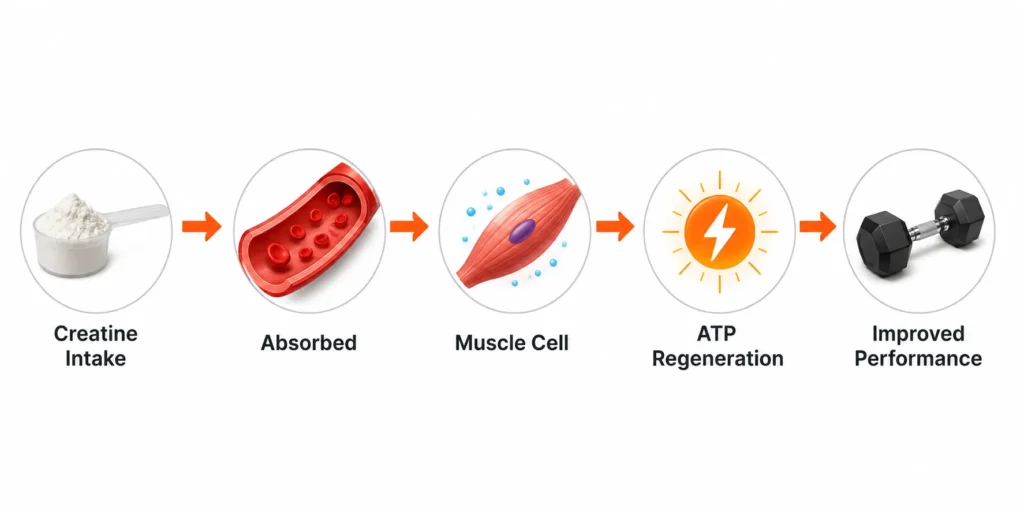
The idea that creatine dosing needs to be completely different for women comes from the supplement industry more than from physiology. The underlying mechanism is identical in male and female bodies. Creatine replenishes phosphocreatine stores in muscle cells, which helps regenerate ATP (adenosine triphosphate — the energy molecule muscle contraction runs on) during high-intensity efforts. This process works the same regardless of sex.
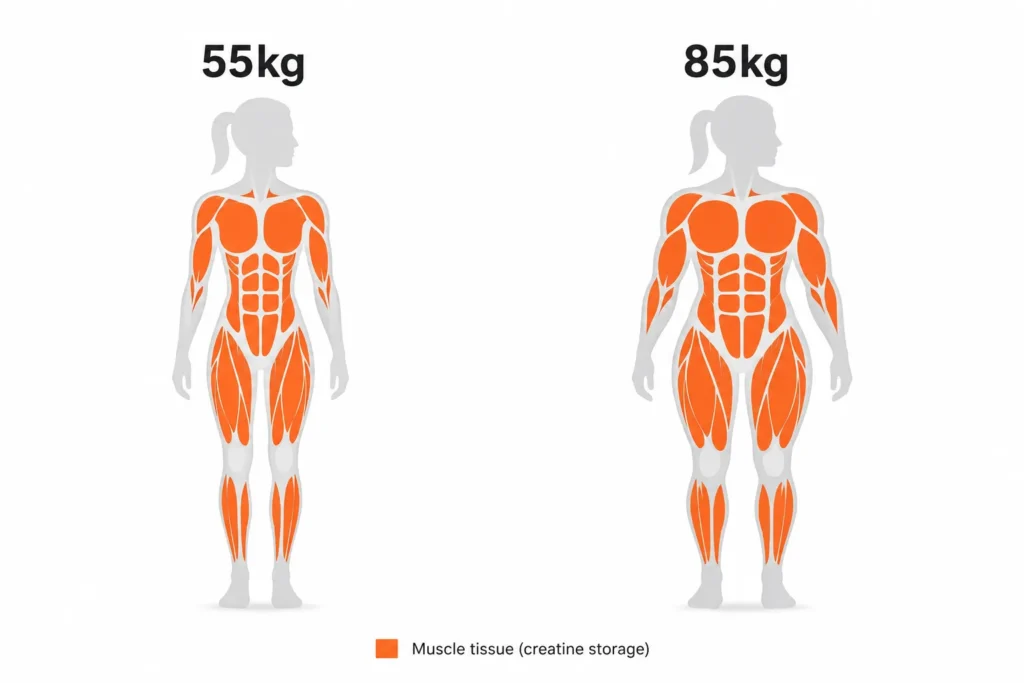
Where body weight genuinely matters is in the scaling. Phosphocreatine stores scale roughly with total muscle mass. A woman weighing 55kg typically has less total muscle mass than a man weighing 85kg, so the absolute amount of creatine required to saturate those stores is lower. At a dose of 3g daily, most women in the 50 to 65kg range reach full saturation over 3 to 4 weeks at maintenance dosing — the same endpoint as a larger person taking 5g.
The myth that women need a special “female creatine” product — and there are several on the Indian market making exactly this claim — is not backed by any meaningful research. Plain creatine monohydrate, the cheapest and most studied form available, works identically. Products marketed to women at a premium price for “gentler” creatine chemistry are selling marketing, not results.
In India, creatine monohydrate from brands like AS-IT-IS Nutrition is available for Rs. 500 to 900 per month. There is no nutritional reason to spend more than that. If you are wondering about the broader safety picture for Indian contexts, our article on Is Creatine Safe for Indians? covers the kidney concern, the climate question, and the vegetarian advantage in full.
How Much Creatine Should a Woman Take: Breaking Down the Options
What Is the Right Daily Dose of Creatine for Women?
The right daily creatine dose for women is 3g for most, and up to 5g for women with higher muscle mass, heavier training loads, or who are above 70kg. This is the dose range used in the research that has specifically studied creatine supplementation in female populations, and it consistently produces full muscle creatine saturation within 3 to 4 weeks.
The 5g figure that appears on most creatine packaging is based on research populations that included predominantly male participants. For a woman at average Indian female body weight of 55 to 60kg, 3g daily is not a reduced dose — it is the proportionally correct dose. Taking 5g daily is not harmful, but the extra 2g does not produce additional benefit once stores are saturated.
A practical way to think about how much creatine a woman should take: use 0.05g to 0.07g per kilogram of body weight per day as a working guideline. At 55kg, that is 2.75 to 3.85g — so 3g is the natural practical dose. At 70kg, 3.5 to 4.9g is the range, making 4g or 5g appropriate.
Verdict: 3g daily is the starting point for most Indian women. Adjust upward toward 5g based on body weight and training volume.
Should Women Load Creatine or Skip It?
Women should skip the loading phase — the evidence does not support it producing meaningfully better outcomes compared to standard daily dosing, and the digestive side effects disproportionately discourage women from continuing.
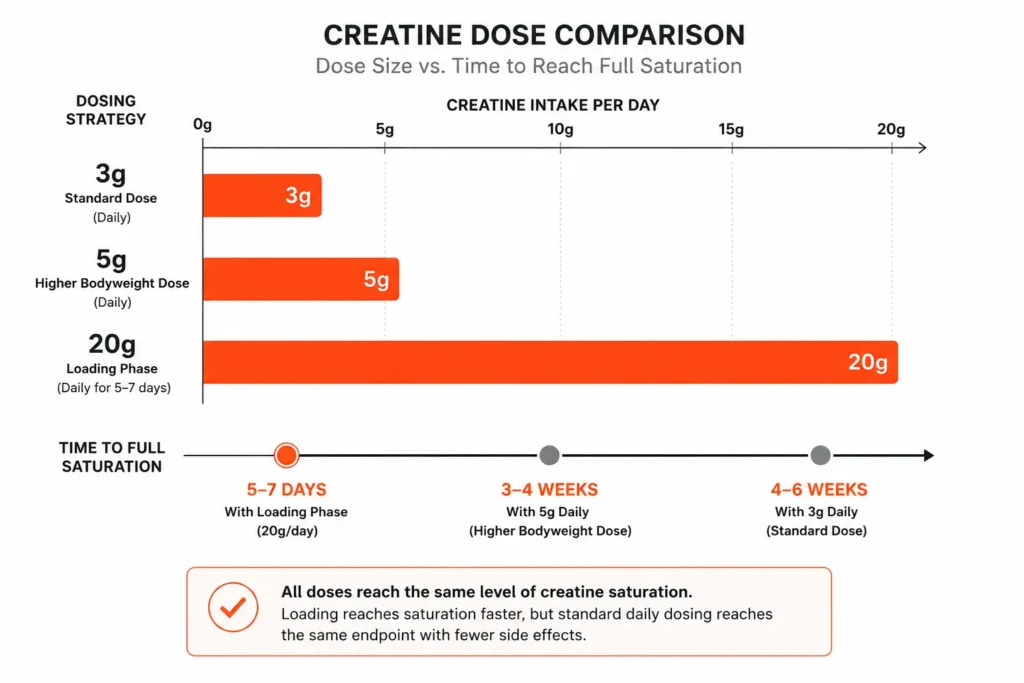
The loading protocol (20g daily for 5 to 7 days, split into 4 doses) was designed to saturate muscle stores in 5 to 7 days rather than 3 to 4 weeks. The end-state is identical. The shortcut is real, but the cost is significant gastrointestinal discomfort — nausea, bloating, loose stools — that affects a higher proportion of women than men in real-world usage.
Women also report the scale weight increase from the first week of loading (approximately 1 to 1.5kg of intramuscular water retention) more negatively than men, particularly during a fat loss phase where scale tracking is common. At 3g daily without loading, this water retention still occurs but builds gradually over 3 to 4 weeks, making it much less noticeable on the scale and much easier to tolerate psychologically.
Verdict: Skip loading. 3g daily without a loading phase is the practical recommendation for most women.
Does Creatine Cause Bloating or Water Retention in Women?
Creatine causes intramuscular water retention, not the subcutaneous (under-skin) water retention that creates a puffy or bloated appearance. This distinction is important and frequently misunderstood in discussions of how much creatine a woman should take.
Intramuscular water is stored inside muscle cells, not beneath the skin. It increases muscle volume and typically makes muscles look fuller and denser — not softer or puffier. The 1 to 1.5kg of weight gain seen in the first few weeks of creatine use is water inside muscles, not fat.
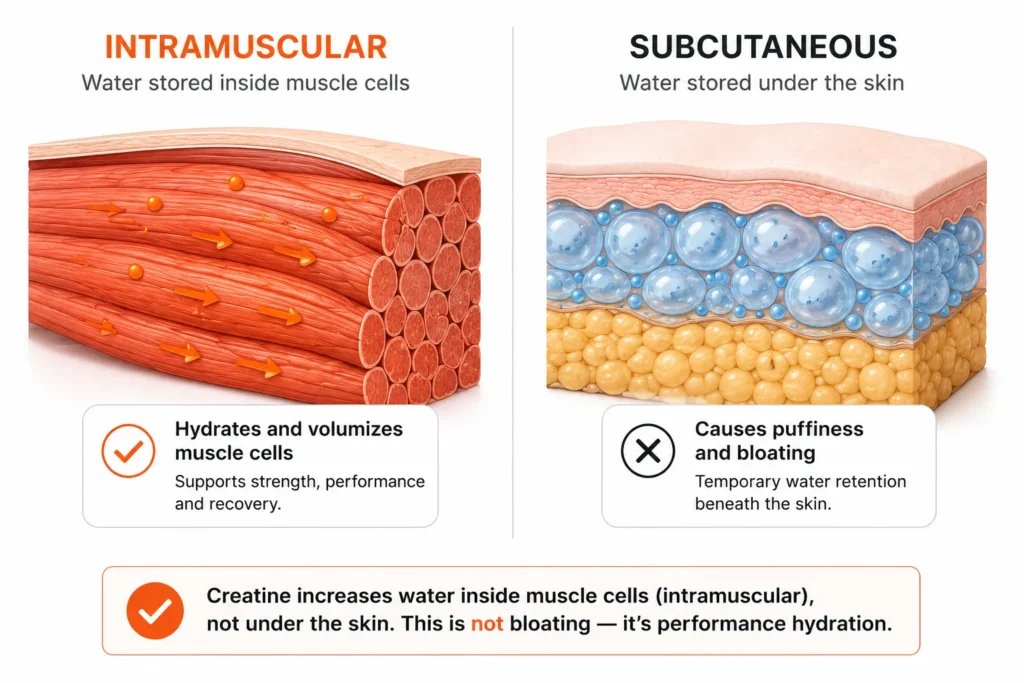
Subcutaneous bloating can occur if a loading dose is taken — 20g daily overwhelms absorption and the unabsorbed creatine draws water into the intestine, producing genuine digestive bloating. At 3g daily, this does not happen for the vast majority of users.
The myth that creatine “makes women look puffy” appears to come from the loading protocol experience, not from standard maintenance dosing. At 3g daily, the intramuscular water retention is effectively invisible and shows up only as slightly better muscle fullness.
Verdict: Bloating from creatine at standard doses is a myth. Scale weight increases 1 to 1.5kg from intramuscular water. Visible puffiness does not occur at 3 to 5g daily.
How Does the Menstrual Cycle Affect Creatine Dosing for Women?
Some emerging research suggests that creatine’s effectiveness may vary across the menstrual cycle, and this is one area where dosing for women genuinely differs from the standard male-centric model. This research is still early, but the mechanistic case is plausible and worth knowing about.
Oestrogen appears to have a direct effect on muscle creatine metabolism. During the luteal phase (the second half of the cycle, after ovulation), intramuscular phosphocreatine levels naturally decline, and creatine supplementation may produce greater relative benefit during this phase by compensating for this natural drop. This has led some researchers to suggest that women might benefit from slightly higher creatine intake during the luteal phase — though the practical guidance that follows from this is not yet well-defined.
The honest position: standard dosing at 3g daily throughout the cycle is the appropriate starting point. If you are a competitive athlete who wants to experiment with phase-specific dosing, that is a reasonable area to explore — but it is not where most women need to focus when first establishing how much creatine to take.
Verdict: Emerging area of research. Standard 3g daily regardless of cycle phase is the practical recommendation for now.
Is Creatine Safe During Pregnancy or Breastfeeding?
Women should not take creatine during pregnancy or while breastfeeding without explicit medical guidance. This is not because research has shown harm — it is because the specific safety research in these populations does not yet exist at a scale sufficient to draw conclusions.
Animal research has actually explored creatine as a potential neuroprotective agent in foetal development, which is interesting but not a basis for recommending supplementation in human pregnancies without clinical guidance. Until more data exists, the appropriate approach is to pause creatine use during pregnancy and the breastfeeding period.
Verdict: Avoid during pregnancy and breastfeeding until medical guidance is available for your specific situation.
Creatine Dosing for Women: Quick Reference
| Scenario | Recommended Daily Dose | Loading Phase? | Best Timing | Notes |
|---|---|---|---|---|
| General fitness, under 60kg | 3g | Skip | Post-workout or with main meal | Most Indian women fall here |
| Active training, 60 to 75kg | 3 to 4g | Skip | Post-workout with carbs | Adjust based on training intensity |
| Strength-focused, above 75kg | 4 to 5g | Optional | Post-workout with carbs | Same as male dosing protocol |
| Vegetarian, any weight | 3 to 5g | Skip | With largest meal | Lower baseline = greater benefit |
| Fat loss phase | 3g | Skip | With post-workout meal | Scale weight increase is water, not fat |
| Pregnancy or breastfeeding | Avoid | N/A | N/A | Consult doctor if considering |
How Creatine Actually Works in a Woman’s Body
Creatine monohydrate has an absorption rate of approximately 99% when taken orally, meaning nearly all of what is swallowed reaches circulation. Absorption happens in the small intestine through a sodium-dependent transporter called CreaT1. Once in circulation, creatine is taken up into muscle cells and stored as phosphocreatine.
The total phosphocreatine capacity of muscle is finite. Once stores are saturated, additional creatine is excreted as creatinine in urine — which is why testing creatinine rises during supplementation without indicating kidney damage. Saturation at 3g daily takes approximately 28 to 30 days. At 5g daily, approximately 21 to 24 days.
Insulin significantly improves creatine uptake into muscle. Taking creatine alongside a carbohydrate-containing meal increases muscle creatine uptake substantially compared to taking it alone. Post-workout timing works well here because the post-exercise insulin response is elevated and carbohydrate intake at this point is common.
For timing: post-workout with your main meal is the practical recommendation. On rest days, take it with any carbohydrate-containing meal at the same time each day. The consistency of daily intake matters more than precise timing.
Women who are also addressing iron deficiency or B12 deficiency — two common nutritional gaps in Indian women that affect energy and exercise performance — will find that creatine and these nutritional corrections work through entirely different mechanisms and do not interfere with each other.
What the Research Actually Says About Creatine in Women
The research base on how much creatine a woman should take has expanded significantly over the past decade as studies began specifically recruiting female participants rather than assuming male data translates directly.
The International Society of Sports Nutrition’s position stand on creatine, reviewed across hundreds of studies, confirms that creatine monohydrate at standard doses is effective and safe in women and supports gains in strength, lean mass, and exercise capacity. The ISSN notes that women in resistance training studies show muscle creatine increases consistent with male participants when dose is adjusted for body weight.
Research published in sports medicine literature has specifically found that resistance-trained women supplementing with creatine show measurably greater strength gains and lean mass improvements compared to placebo over 8 to 12 weeks of training — with the effect being particularly pronounced in vegetarian women whose baseline muscle creatine is lower.
A reality check worth stating: most of the dramatic strength improvements in creatine research involve populations who were either previously sedentary or had significant nutritional gaps. A woman who already eats meat regularly, trains consistently, and has adequate nutrition will see real but more modest improvements from creatine than the headline numbers from some studies suggest. That does not mean it is not worth taking — it means expectations should be realistic.
“Creatine supplementation is one of the most effective nutritional interventions for improving muscular performance in women engaged in resistance training, with a safety profile that is well-established across multiple populations.” — International Society of Sports Nutrition Position Stand, 2017
Side Effects and What Indian Women Should Watch Out For
At 3g daily without a loading phase, side effects from creatine are genuinely uncommon. The most frequently reported issue is gastrointestinal discomfort — nausea or loose stools — and this occurs primarily with higher doses or when creatine is taken on an empty stomach.
Taking creatine with food resolves this for most people within a few days. If discomfort persists, switching from a capsule form to dissolving creatine powder in water before a meal is often more comfortable.
For Indian women who drink significant quantities of chai — 3 to 4 cups daily is not unusual — the tannins in tea do not meaningfully interfere with creatine absorption. This is different from the iron-tannin interaction. Creatine can be taken around chai without any concern.
Weight on the scale will increase by 1 to 1.5kg within the first 2 to 3 weeks. This is intramuscular water, not fat. For anyone running a fat loss phase who tracks scale weight daily, knowing this in advance prevents the unnecessary alarm that causes many women to stop taking creatine before it has had time to work.
Women with diagnosed polycystic kidney disease or chronic kidney disease should not supplement creatine without nephrologist guidance. For everyone else without known kidney conditions, the safety data is consistent and reassuring.
Who Should Use Creatine and at What Dose
If you strength train 3 or more times per week
Take 3g daily if you are under 60kg, or 4 to 5g if you are heavier or training at high volume. Take it post-workout with your protein and carbohydrate meal. Do not load. Give it 6 weeks minimum before assessing your strength numbers. If you are also optimising your protein intake, our guide on Best Protein Sources for Muscle Gain and Fat Loss in India covers how to build a complete nutritional foundation that creatine works on top of.
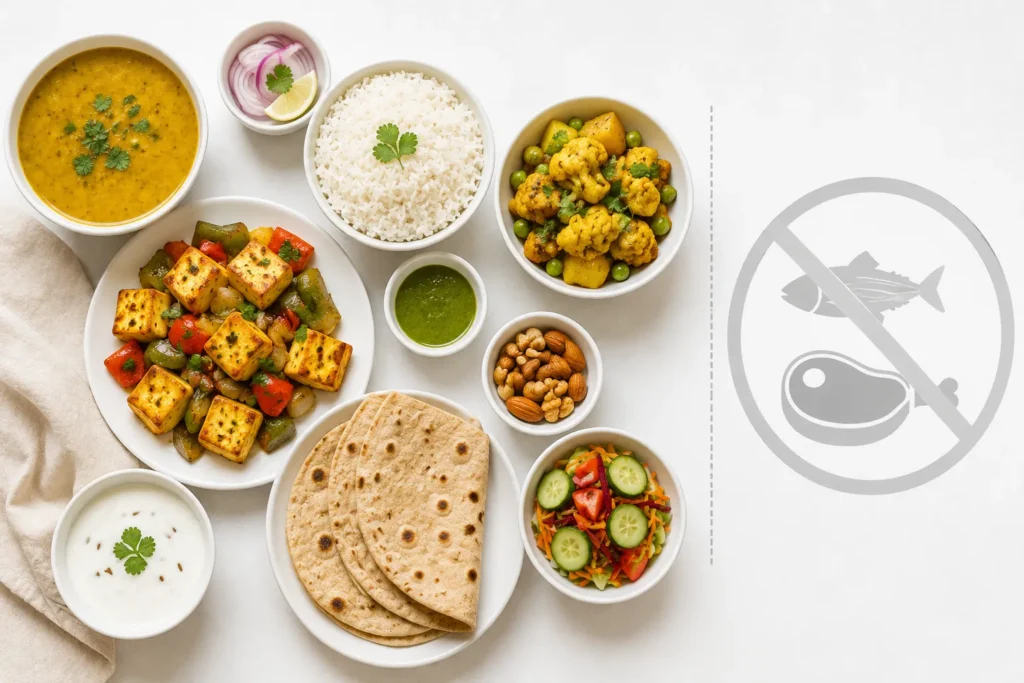
If you are vegetarian or vegan
Creatine is one of the highest-priority supplements for vegetarian Indian women. Your dietary creatine intake from food is essentially zero. The same 3g daily dose applies, but your improvement from supplementation will be larger than for an omnivore because you are filling a genuine baseline gap. Plain creatine monohydrate from a reputable Indian brand is fully vegetarian — it is synthetically produced and contains no animal ingredients.
If you are trying to lose fat and are worried about scale weight
Take creatine at 3g daily and do not panic at the initial scale increase. The weight gain is water inside muscle cells, not fat. More importantly, creatine during a fat loss phase helps preserve lean mass while in a calorie deficit — which is one of the most practically valuable things it does for women specifically. Losing fat while retaining muscle produces better body composition outcomes than losing both together.
If you are a beginner who just started training
Creatine works best when training intensity is high enough to consistently push near the ceiling of phosphocreatine availability. In the first 8 to 12 weeks of training, neuromuscular adaptation is the dominant factor — learning the movement is more limiting than energy availability. Creatine will not hurt beginners, but the benefit is smaller early on. Build the training habit first. Add creatine when you are training consistently at moderate to high intensity.
The Bottom Line
How much creatine a woman should take comes down to one straightforward answer: 3g daily for most Indian women, with no loading phase. This dose is evidence-backed, cost-effective at under Rs. 20 per day from quality Indian brands, and produces real improvements in strength and training capacity over 6 to 12 weeks.
The myths about creatine being unsuitable for women — that it causes bloating, weight gain, or is only for men trying to bulk up — do not reflect how the supplement actually works at standard doses. Those concerns apply to loading protocols and excessive dosing, not to 3g daily.
For vegetarian Indian women especially, creatine addresses a nutritional gap that no amount of plant-based eating can fill. There is no plant food that provides creatine. If you train and you eat vegetarian, this is one of the most straightforward supplementation decisions available.
If you want to understand the broader creatine picture before starting, our Creatine Myths Busted article covers the steroid myth, kidney concern, and hair loss question in full. And for optimising the minerals that work alongside creatine for training performance, our article on Magnesium vs Zinc: Which Mineral Helps You More? covers a combination that many women find complements creatine well.
Three grams. Daily. With food. That is the answer.
People Also Ask
How much creatine should a woman take per day to see results?
A woman should take 3 to 5g of creatine monohydrate daily to see results, with most women at average body weight seeing the same muscle saturation at 3g as larger individuals at 5g. Visible strength and performance improvements typically appear after 4 to 6 weeks of consistent daily intake. Starting at 3g, taken post-workout with a carbohydrate-containing meal, is the practical starting point for most Indian women regardless of training experience.
Will creatine make women bulky or gain weight?
Creatine will not make women bulky. It causes a 1 to 1.5kg increase in scale weight from water stored inside muscle cells, not fat gain and not subcutaneous puffiness. Becoming significantly more muscular requires progressive resistance training over months and years alongside adequate protein and calorie intake — creatine alone does not cause this. Women who use creatine at standard doses while resistance training get stronger and slightly fuller muscles, not a dramatically different body shape.
Should women load creatine or just start with a small dose?
Women should skip the loading phase and start directly at 3g daily. Loading at 20g per day for 5 to 7 days reaches muscle saturation slightly faster but produces significantly more digestive discomfort — nausea, bloating, loose stools — that leads many women to stop taking creatine before it has had time to produce benefits. Reaching saturation at 3g daily takes 3 to 4 weeks instead of 5 to 7 days, which is an entirely acceptable tradeoff for avoiding the loading-phase side effects.
Is creatine safe for Indian women who follow a vegetarian diet?
Creatine is not only safe for vegetarian Indian women — it is particularly beneficial. Creatine monohydrate is synthetically produced and contains no animal ingredients. More importantly, vegetarian diets provide zero dietary creatine because creatine is found exclusively in meat and fish. This means vegetarian Indian women start with measurably lower baseline muscle creatine than meat-eaters, and their response to supplementation — in terms of both muscle creatine increase and performance improvement — is proportionally greater.
Can women take creatine while trying to lose weight?
Yes. Creatine during a fat loss phase helps preserve lean muscle mass while in a calorie deficit, which improves body composition outcomes compared to losing fat and muscle together. The 1 to 1.5kg scale weight increase from intramuscular water can make fat loss tracking confusing if you are not expecting it, but the actual fat loss process is not impaired. For women tracking scale weight closely during a cut, understanding that the initial weight increase is water — not fat — prevents unnecessary course corrections.
Does creatine affect hormones in women?
Creatine does not directly alter oestrogen or progesterone levels. One study found that creatine raises DHT (dihydrotestosterone) levels in male rugby players, but DHT is not a primary female sex hormone and this finding has not been replicated with the same significance in female populations. Some research suggests creatine may interact with oestrogen in ways that affect muscle creatine uptake across the menstrual cycle, but this research is early and does not change the practical dosing recommendation. At 3g daily, creatine does not produce hormonal disruptions in healthy women.
Sources and References
Kreider RB, Kalman DS, Antonio J, et al. (2017). International Society of Sports Nutrition position stand: safety and efficacy of creatine supplementation in exercise, sport, and medicine. Journal of the International Society of Sports Nutrition. https://jissn.biomedcentral.com/articles/10.1186/s12970-017-0173-z
Smith-Ryan AE, Cabre HE, Eckerson JM, Candow DG. (2021). Creatine Supplementation in Women’s Health: A Lifespan Perspective. Nutrients, 13(3), 877. [Search on PubMed: “creatine supplementation women lifespan nutrients 2021”]
Antonio J, Ciccone V. (2013). The effects of pre versus post workout supplementation of creatine monohydrate on body composition and strength. Journal of the International Society of Sports Nutrition, 10:36. https://jissn.biomedcentral.com/articles/10.1186/1550-2783-10-36
Rawson ES, Volek JS. (2003). Effects of creatine supplementation and resistance training on muscle strength and weightlifting performance. Journal of Strength and Conditioning Research. [Search on PubMed: “Rawson Volek creatine resistance training 2003”]